
Every organisation that has attempted a serious transformation in the last three years has the same artefacts. A strategy document. A programme with a name. A set of metrics that are mostly improving. A workforce that has been trained. And somewhere underneath all of it, the quiet knowledge that the way work actually happens on a Tuesday morning is very close to how it happened before any of this started.
This guide is an account of why that happens and what to do instead. It assumes you have read nothing else. It sets out how change actually moves through an organisation, the three things that decide whether it can move at all, the four kinds of work that a change demands in sequence, and thirty-six questions you can use to find out where yours is stuck. The questions are the point. Each one is observable, which means you can answer it this month with things you already have, and each one that you cannot answer names a capacity your organisation is currently living without.
1. People do not change organisations. Events do.
The standard account of change has a leader at the centre of it. Someone with vision decides on a new direction, communicates it persuasively, puts new structures in place, and people begin behaving differently. That story fits on a slide, it flatters everyone involved, and it gets the causation wrong at the first step.
What actually moves an organisation is an event: something that happens which the existing account of the world cannot explain. A competitor does something that was supposed to be impossible. A regulator arrives. A system fails in a way the runbook did not anticipate. A tool appears that makes an expensive thing free. The event does its work by throwing received wisdom into question, and nobody has to be persuaded that something has happened, because they can see it.
Leaders matter enormously, and not in the way the slide suggests. A leader cannot manufacture an event, and the attempt is visible to everybody: an urgency memo asks people to feel something the situation has not given them. What a leader can do is recognise an event when it arrives, hold it open long enough for the organisation to learn from it rather than resolving it early, and take a position on how it resolves. That is a smaller account of leadership than the field usually offers and a much harder one to live up to.
2. The four moves
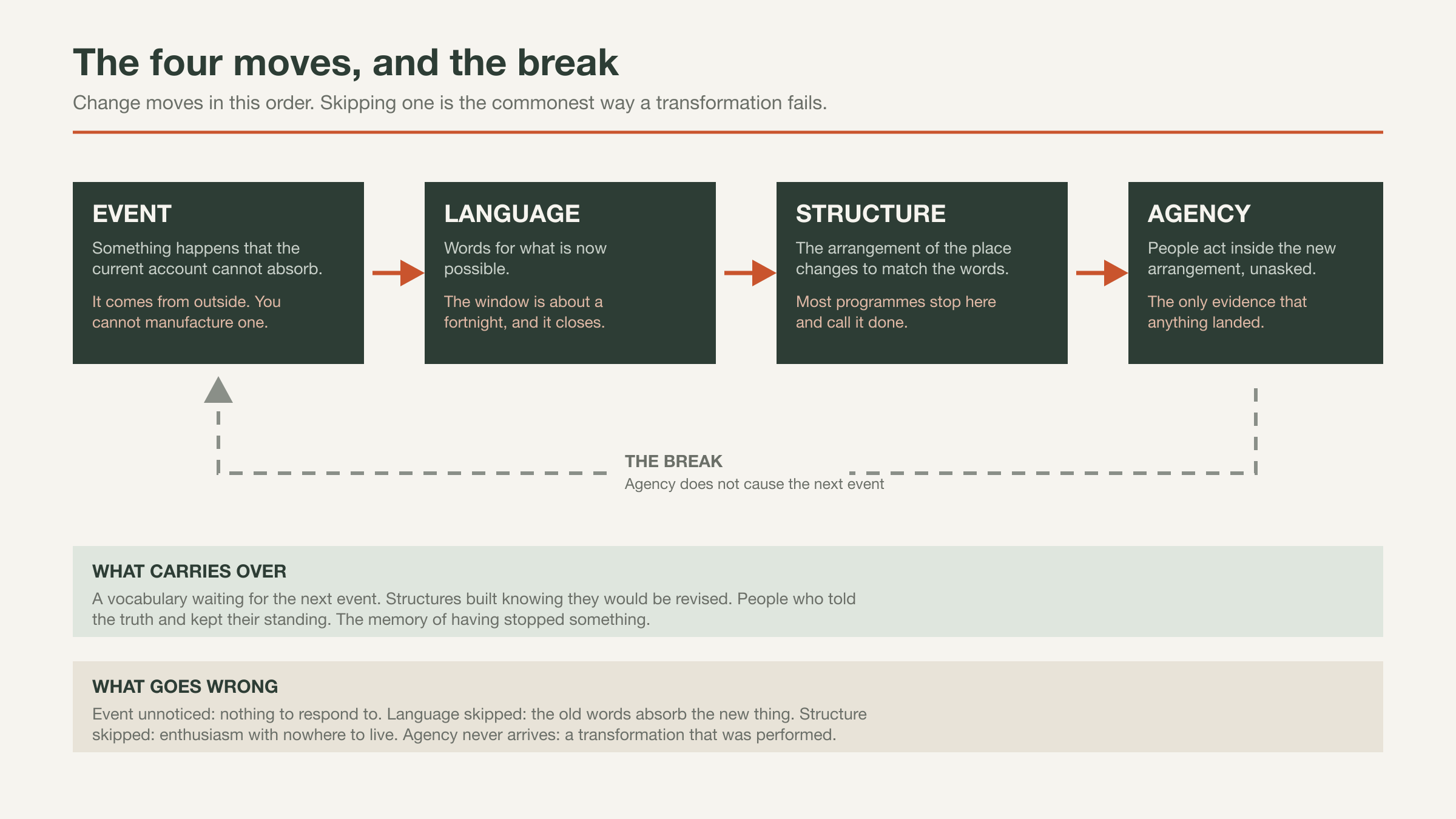
Once an event has occurred, change moves through four kinds of work. They are not stages in a project plan and they do not have clean boundaries, but they happen in this order, and skipping one is the most common way a transformation fails.
Event. Something happens that the current account cannot absorb. The important property of an event is that it is external to the situation: it reveals something the organisation’s existing categories had no way of registering. Most organisations experience several a year and process none of them, because there is no mechanism for noticing that the frame just broke.
Language. After an event, people need words for what is now possible. This is the fastest of the four moves and the most neglected. New vocabulary installs with startling speed in the fortnight after an event has knocked the supports out from under the old account, and whatever the organisation starts calling the thing in that window is what it will believe about it for years. The naming contest is usually won by whoever reaches the all-hands first.
Structure. Words become a world when the arrangement of the place changes to match them: who sits with whom, what gets funded, which meeting exists, what the appraisal form asks. Structure is where most change programmes stop, and stopping there produces the familiar result of a reorganisation that changed the boxes and nothing else, because structure alone does not generate behaviour.
Agency. The change holds when people act inside the new structure on their own initiative, without being asked, because the new way is now the way they work. Agency is the only evidence that any of the previous three actually landed. An organisation with new language, new structures and no new agency has performed a transformation.
3. The break in the loop
The four moves are usually drawn as a cycle, and the drawing is misleading. There is a break in it, and the break is between agency and the next event.
Completing the four moves does not produce the next event. Agency is genuinely the end of that piece of work, and what follows is a settlement in which the new way of working is simply how things are done. The next event arrives from outside, on its own schedule, and no amount of competence at the first three moves will summon it.
What changes is the organisation’s readiness. A group that has been through the four moves once has a vocabulary for what happened, structures that were built knowing they would be revised, and people who have survived the experience. It notices the next event earlier, names it faster, and is less frightened by it. The philosopher Alasdair MacIntyre described the moment when a tradition can no longer explain its own failures in its own terms, and called it an epistemological crisis. That is what an event does to an organisation, and a group that has survived one is measurably better at surviving the next.
4. Three levers: Identity, Information, Interaction
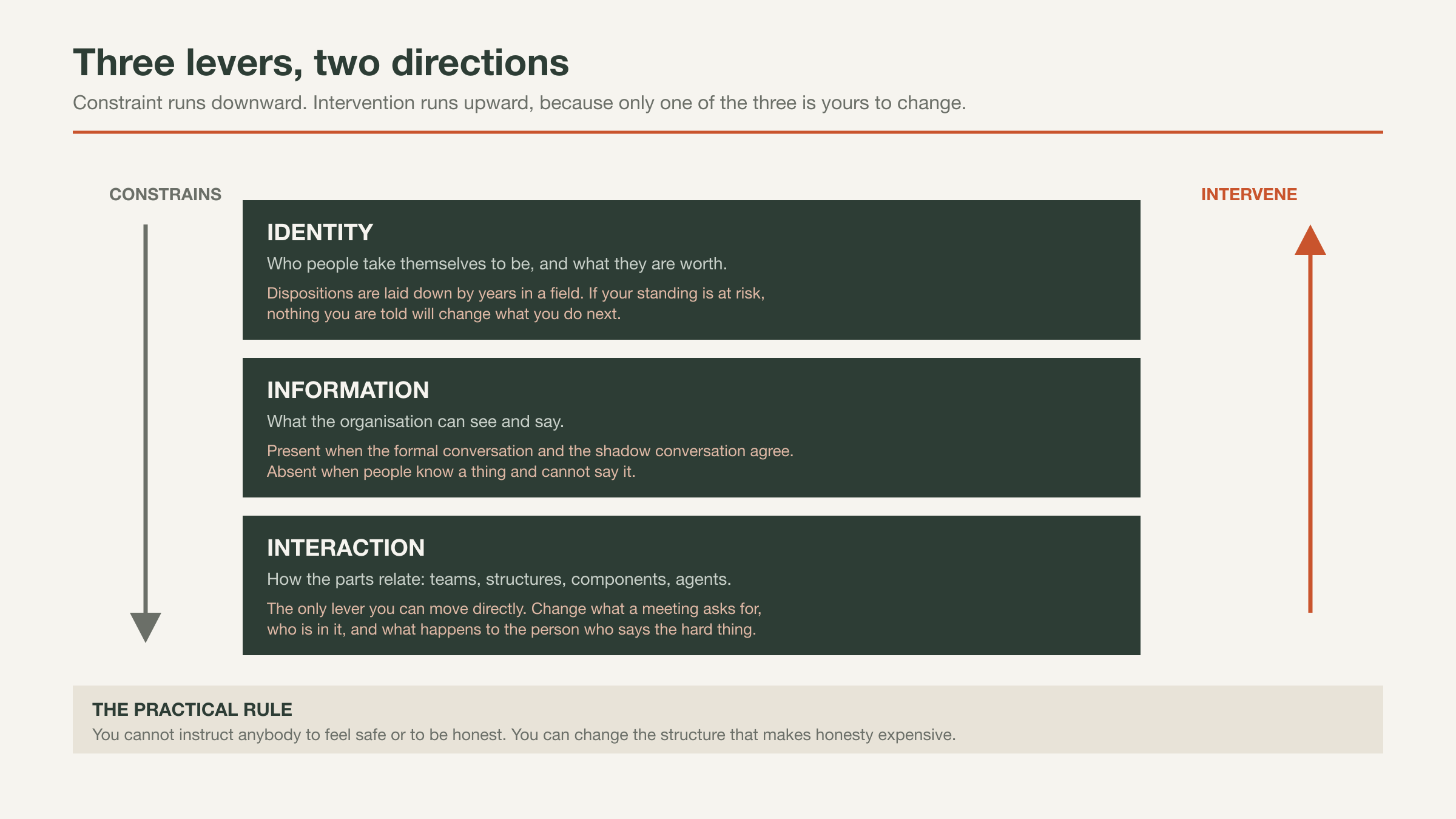
Cutting the other way across the four moves are three questions that decide whether an organisation can do any of this work at all.
Identity is who the organisation and its people take themselves to be, and what they are worth. It is the deepest of the three because it is the least available to argument. The sociologist Bourdieu called the relevant mechanism habitus: the durable dispositions deposited in a person by years of succeeding in a particular field. You do not choose it, and you cannot be lectured out of it. When a change means that a decade of hard-won expertise is now worth less, resistance to the change is not irrationality. It is a rational response to the devaluation of capital.
Information is what the organisation can see and say. It is not a data problem. The question is whether the formal conversation and the shadow conversation say the same thing, and whether the description that reaches the person deciding still resembles the work. The anthropologist Bateson named the failure mode: a double bind, in which contradictory messages arrive at different levels and nobody is permitted to comment on the contradiction. We encourage honest feedback, delivered in a meeting where honest feedback has historically ended careers, is a double bind, and it produces paralysis that looks like compliance.
Interaction is how the parts relate: teams to teams, people to structures, components to components. Illich supplies the test. A convivial institution gives people resources they can use for their own purposes. A manipulative one prescribes the content, controls the sequence, measures the consumption and issues the certificate. The condition is present when the structures serve the people and absent when the people serve the structures.
The three constrain each other in one direction and are changed in the other, and this is the single most useful thing in the framework. Identity constrains Information: if your standing is at risk, you will not say what you know. Information constrains Interaction: if the description is fiction, the structures built on it will reproduce the old patterns. But intervention runs the other way, because Interaction is the only one you can change directly. Change what is rewarded, change which meeting exists, change who is in the room when the decision is made, and Identity and Information move in response. You cannot instruct anyone to feel safe or to be honest. You can change the structure that makes honesty expensive.
5. Four phases, one iteration
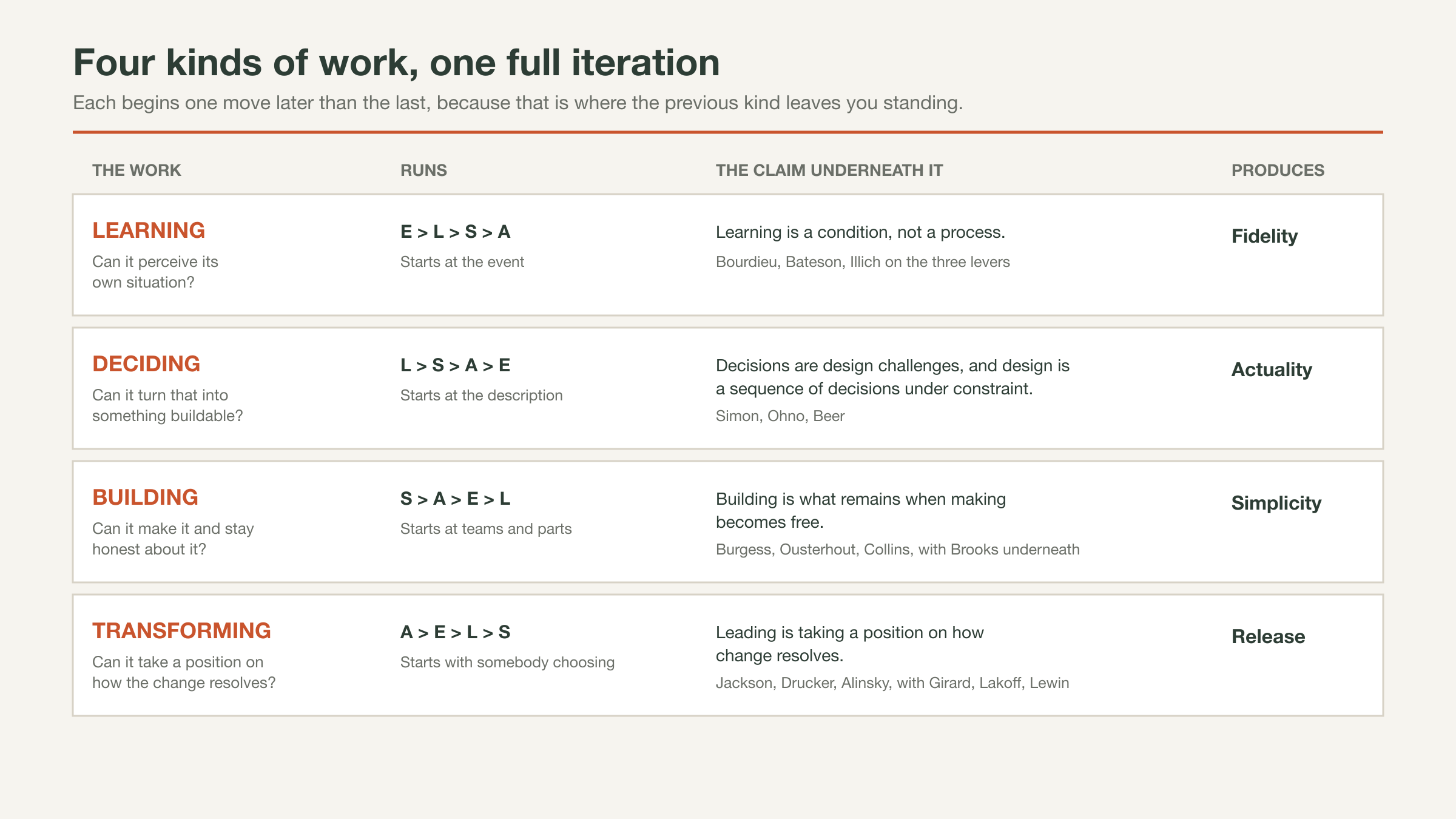
The work of change divides into four kinds, and each one begins at a different point in the four moves. That is not an aesthetic choice. Each kind of work begins where the previous kind leaves the organisation standing.
Learning starts at Event. Something has happened, and the question is whether the organisation can perceive its own situation accurately enough to respond. It runs Event, Language, Structure, Agency.
Deciding starts at Language. Learning leaves an organisation with a description; the question now is whether it can convert that description into a bounded, owned account of what it will make true. It runs Language, Structure, Agency, Event, and the event it ends at is the collision of the decision with reality.
Building starts at Structure. A decision has to be constructed before it can do anything, so this work begins with teams and components and ends with the operational language that comes back off the built thing. It runs Structure, Agency, Event, Language.
Transforming starts at Agency. Nothing compels anyone to act; there is no external shock waiting. It begins with somebody choosing an approach and standing behind it, and runs Agency, Event, Language, Structure.
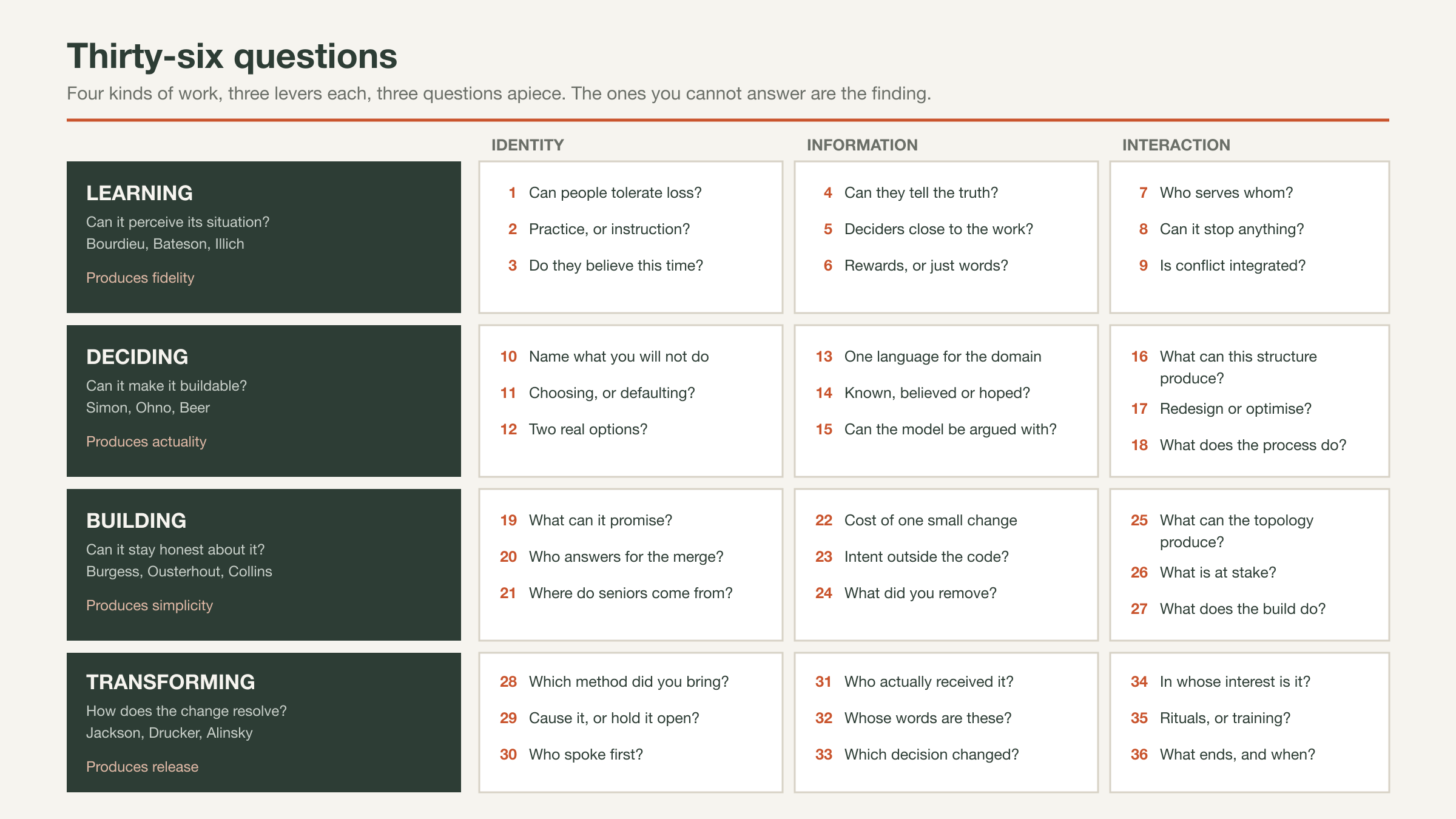
Put the four together and they make one complete iteration of the same four moves at the scale of a whole change. Each has a governing claim, a capacity it produces, and nine diagnostics of its own, three to each lever. Those thirty-six questions are the instrument, and the rest of this guide is a walk through them.
6. Learning: can this organisation perceive its own situation?
The governing claim is that learning is a condition, not a process. Organisations respond to the need to learn by commissioning a programme, and the programme reliably produces people who can describe the new way of working without being able to do it. Learning happens when three conditions are present, and no curriculum creates them. What an organisation gets out of this work is fidelity: an account of its situation that matches the situation.
The three conditions are the three levers in their diagnostic register, and the thinkers who hold them are Bourdieu on Identity, Bateson on Information, and Illich on Interaction.
1. Can people tolerate losing what they have? When you tell a senior professional that the skills they spent a decade perfecting are no longer the main source of value, you are not asking them to learn. You are asking them to accept a loss, and the experience of loss governs the response. Bourdieu’s hysteresis is the lag between a changed field and an unchanged habitus, and Kahneman explains the intensity: losses loom about twice as large as equivalent gains.
2. Is learning happening through practice, or through instruction? Dispositions are reshaped by participation in a changed field, never by a curriculum. Illich adds the sharper point: the training programme teaches a hidden lesson, which is that learning requires a programme, capability is certified by completion, and the change is something being done to you.
3. Do people believe that this time will be different? Change fatigue is not fatigue. It is a disposition laid down by repeated experience that effort produces no result, and it is rational. Bandura gives the only reliable route out, which is mastery experience: a real team solving a real problem the new way, in public.
4. Can people tell the truth about what is happening? Argyris named the mechanism that corrupts organisational information more precisely than anyone: defensive routines, executed so smoothly that the person is unaware of them. Goffman explains why training people in openness fails, because the meeting is a performance in which everyone collaborates to protect everyone’s face.
5. Are decision-makers close to the work? Information degrades with distance, and every layer between the person deciding and the person doing removes signal. Normann puts it at its most uncomfortable: the distant leader is not missing details, but carrying a map that makes the real landscape invisible.
6. Is the organisation changing what it rewards, or just what it says? Examine the last three promotions, the last three performance reviews and where the budget went. Those reveal what the organisation actually believes, whatever the strategy says, and the gap between the two is a double bind made structural.
7. Does the institutional form serve the people, or do the people serve the institution? Illich’s convivial test, applied to the change programme itself. A programme that measures completion rates, certifications and training hours is measuring its own consumption, and the teams quietly solving real problems without it are, in the programme’s own logic, untrained.
8. Can the institution stop doing what no longer works? Every resource spent preserving an activity whose purpose has expired is unavailable for change. Drucker‘s question is the practical form: if we were not already doing this, would we start now?
9. Can the institution integrate conflict, or does it suppress it? Watch what happens when somebody disagrees in a meeting. Suppression takes three forms, hierarchy, process and avoidance, and each loses the divergent signal. Follett named the alternative a century ago: integration, which requires surfacing the desires underneath the positions rather than negotiating between fixed ones.
The failure mode is compounding. If people cannot tolerate the loss, they will not tell the truth. If they will not tell the truth, the structures get built on fiction. If the structures are fiction, the interactions reproduce the old patterns and confirm that the organisation is what it always was.
7. Deciding: can it turn what it sees into something buildable?
The governing claim is that decisions are design challenges, and design is a sequence of decisions under constraint. Most decision post-mortems go looking for the bad choice and rarely find one. What they find is a decision taken without anyone having established two things: whether the organisation knew what it was deciding, and whether it had picked a sound way to decide it. The capacity this work produces is actuality: contact with what is actually the case rather than what is reported.
Simon holds Identity here, Ohno holds Information, and Beer holds Interaction.
10. Name what you will not do. A decision is an act of exclusion. If you cannot say which options you are closing, you have not decided; you have added a commitment alongside all the others and called it a choice. Rumelt‘s bad strategy is the diagnostic in negative form, being the list of good things that excludes nothing.
11. Tell choosing from defaulting. Most of what an organisation appears to decide, it inherits. Ask when a decision was last consciously taken, and whether the method being used was chosen for this decision or simply supplied by habit. If neither has an answer, you are not deciding. You are maintaining.
12. Hold competing designs without closing too early. Require at least two structurally different options, and make each name the method by which it would be decided. Boyd located the advantage with whoever can hold a situation open longer, not with whoever commits first.
13. Use one language for the domain. Where the domain expert says one thing, the strategy deck another and the running system encodes a third, the organisation has three models and the translation between them is where meaning leaks. The test is auditory: listen for translation.
14. Separate what you know from what you assume. Mark every claim a decision rests on as known, believed or hoped, then check whether the consequential uncertainty is the kind you can optimise against. Taleb‘s distinction decides the method: thin uncertainty can be optimised, fat-tailed uncertainty can only be survived by capping the downside.
15. Make the model visible enough to be argued with. If no competent colleague can locate the thing to disagree with, the model is not visible and the decision is being taken on faith. Ohno’s standard work is a hypothesis precisely because writing the current method down makes it challengeable.
16. See the decision the structure will allow. Conway‘s law generalised: a structure with no forum where two functions meet cannot produce a decision requiring those functions to agree. Map what decisions the current structure can produce before deliberating, or the deliberation is theatre.
17. Decide whether to redesign the system or optimise within it. Ackoff distinguished solving a problem from dissolving it by redesigning the system that generates it. Lindblom is the honest counterweight, since most organisations cannot redesign at will. Choose deliberately rather than by reflex.
18. Check what the decision process actually produces. Beer’s instrument is the most unforgiving in the framework: the purpose of a system is what it does. A process that reliably produces delay, or diffused accountability, or the protection of the largest existing budget, has those as its purpose whatever its stated aim.
The failure mode has three shapes and they compound. The decision was already made, by a premise nobody has revisited. The description never arrived, so the thing being decided was never precisely named. And the structure had already chosen, because it could only produce one kind of answer.
8. Building: can it make the thing and stay honest about what it made?
The governing claim is that building is what remains when making becomes free. Generation has collapsed the cost of one step in the work, the step where a person types the thing out, and left every other step where it was. What remains is judgement, verification, coordination and restraint, which is to say everything that was ever essential about the job. The capacity this work produces is simplicity, in the engineer’s sense rather than the aesthetic one: a system that can still be understood and still be changed.
Burgess holds Identity here, Ousterhout holds Information, and Collins holds Interaction. Underneath all three sits Fred Brooks, whose distinction between essential and accidental complexity sorts what has changed from what has not.
19. Ask what the builder can promise. An agent can promise code that compiles and satisfies the tests it was given. It cannot promise those were the right tests or that the feature was worth having, because the information those promises depend on sits outside its control. Write the two lists, and make sure a named person holds everything on the second.
20. Ask who can answer for code nobody wrote. Authorship used to carry accountability without anyone arranging it. Take the last ten merges and ask, for each, whether a named person could describe what it does and what it would break without reopening it. The count of no answers is the size of the unowned surface you are running in production.
21. Ask where the next senior engineer comes from. Sennett‘s claim is that skill is made in the doing, and the work now being automated first is precisely the work seniors were made of. Name three tasks your juniors learned on three years ago and find out who or what does them now.
22. Count what you must know to change one thing. Take a small recent change and ask what the engineer had to hold in their head to make it safely. That number is the real cost of the change and no dashboard reports it. Parnas gave the constructive form in 1972: a module earns its boundary by hiding a decision likely to change.
23. Find the intent somewhere other than the code. When generation was expensive the code was the artefact worth keeping. That economics has inverted, and the statement of what was wanted, and what must never happen, is now the durable thing and the only thing an agent can be held against.
24. Count what you removed. Ohno put overproduction first among the wastes because it hides the others and feels like productivity. Count deletions and retired interfaces alongside additions. A quarter with no removals is a quarter in which the team’s capacity to carry anything fell.
25. Ask what your topology is able to produce. Skelton and Pais turned Conway’s observation into a sizing rule: size the software to the team, and when the software outgrows what the team can hold, split the software. Free generation broke that rule quietly, and adding reviewers treats the symptom.
26. Ask what is at stake when the team is together. Collins showed that groups are made in repeated encounters with shared attention and a real outcome. A stand-up reporting status has nothing at stake and produces nothing. Find the moment in the week where the team is on one thing and the outcome is uncertain, and protect it.
27. Ask what your build system actually produces. Beer’s instrument again, aimed at the pipeline. A pipeline that reliably produces green tests over unread code has that as its purpose. Compare what the process claims about the last ten changes with what it demonstrably did.
The failure mode is that the constraint moved and almost nothing moved with it. Developers report being far faster and delivery numbers barely shift, because the expensive step is now reading rather than writing, and no part of the organisation is arranged for that.
9. Transforming: can it take a position on how the change resolves?
The governing claim is that leading is taking a position on how change resolves. By this point a build has changed what is possible, and nothing about that compels anybody to act. Where nobody takes a position, the question resolves by default, and the default is restoration: the new capability gets fitted into the old shape, and the shape wins, because the shape is what everybody is paid by. The capacity this work produces is release, which is the ability to let the change carry on without you.
Michael Jackson holds Identity in this work, Drucker holds Information, and Saul Alinsky holds Interaction. Two other thinkers sit at specific points: René Girard at the event, and George Lakoff in the window where language is still open. Kurt Lewin supplies the account of how a new arrangement settles.
28. Name the method you brought with you. Jackson’s critical systems thinking begins from the premise that every method carries assumptions about the situation it faces and none is neutral. You do not observe the organisation and then select an approach. You arrive holding one, and it has already decided what you can notice.
29. Separate what you can cause from what you can only make survivable. Kotter taught a generation to begin by creating urgency, and manufactured urgency is what organisations reach for when no event has occurred. Heifetz‘s craft is holding the disequilibrium at a heat people can survive without resolving it early.
30. Leave the silence. A leader hears a problem and answers it within a couple of seconds, and every time that happens the problem travels back up. Whoever speaks first owns it. Wait, visibly, and ask what they think should happen.
31. Check who received it. Drucker’s sharpest claim about communication is that it is an act of the recipient. Ask three people at different distances to say what the change is and what it means for their work, and treat the variance between the three accounts as your actual communication.
32. Listen for the vocabulary nobody issued. After a real event, new words install from below. Their presence is the strongest evidence that something has landed, and their absence is the strongest evidence that nothing has, whatever the engagement scores say. Lakoff explains the mechanism and the shortness of the window.
33. Ask which decision each rising number changed. Take every metric that improved last quarter and name the decision made differently because of it. Where a number moved and no decision changed, it is not a measure, it is a mirror.
34. Write the sentence in which this is in their interest. Alinsky had no authority at all and therefore could not confuse compliance with movement. For each group whose behaviour must change, write one sentence, in their words, in which the change makes their working life better. Where it genuinely does not, say so and negotiate rather than dressing a loss as an opportunity.
35. Look for the rituals, not the training. Everyone has already done the training. List what recurs weekly or fortnightly with a real outcome attached, and ask whether the change appears in any of it. If it lives only in all-hands slides and a quarterly offsite, it will not survive a busy month.
36. Name what the change ends. A transformation that only adds is an initiative. Which report, which committee, which product, which promise stops, and on what date? Most organisations cannot answer, and the inability is the finding.
The failure mode here is the cheapest resolution available to any group in crisis. Girard described what happens when the distinctions a group lives by collapse: the tension has to go somewhere, and the oldest answer is to find somebody to carry it. The organisation feels better immediately, nothing has been learned, and the same crisis returns on schedule. Refusing that resolution, at the moment the organisation most wants it, is the hardest thing on this list.
10. Four questions that recur at every scale
Read the thirty-six together and four of them turn up again and again, worded differently and asking the same thing. These four are the ones I would keep if the rest had to go, and their recurrence is the strongest evidence that this describes one thing rather than four.
Can you stop anything? It appears as the institution that cannot abandon an expired activity, as the choice between optimising within a system and redesigning it, as the quarter with no deletions, and as the change that only adds. An organisation that cannot subtract has no capacity for change, only capacity for accumulation, and everything else on this list is downstream of that.
Does the process produce what it claims? Beer’s instrument turns up on the decision process, on the build pipeline and on the measurement system, and it gives the same unwelcome answer each time. It refuses to let an organisation describe itself by its intentions.
Can people say the true thing? It appears as defensive routines, as the split language of a domain, as the review nobody performed, and as the message that was uttered and not received. Every one of those is the same failure at a different altitude.
Who is answerable? It appears as the decision nobody owns, the merged change nobody read, the promise an agent cannot make, and the crisis resolved by finding somebody to blame. Accountability does not survive being implied; it has to be placed on a named person, deliberately, and re-placed every time the work changes shape.
11. How to use this
Do not attempt all thirty-six. The instrument works by subtraction, and the useful move is to find the nine that match the work you are actually doing.
Find your position first. If your organisation is arguing about what is happening, you are in the Learning questions. If it broadly agrees on what is happening and cannot convert that into a bounded commitment, you are in the Deciding questions. If it has committed and is now producing something, you are in Building. If it has produced something and the question is whether anything will change as a result, you are in Transforming. Every organisation I have worked with of any size is in more than one at once, on different problems, which is fine as long as nobody pretends the whole enterprise sits at a single point.
Then answer the nine honestly in one sitting, with the people who would know. The answers are secondary. The pattern of what cannot be answered is the finding, and in my experience it shows itself inside the first twenty minutes. Every unanswerable question is a capacity the organisation does not have, and it will keep producing the same failure under every future change until it is closed.
Then act on exactly one, and act on it through Interaction. The lever discipline says Identity constrains Information constrains Interaction, and that intervention runs the other way, so the practical instruction is to change a structure rather than to exhort a person. If the finding is that nobody tells the truth about delivery, do not run a psychological safety workshop. Change what the weekly review asks for, change who is in the room, and change what happens to the first person who says the difficult thing. The disposition follows the field.
And expect the first attempt to produce an argument. Lewin’s account of why change fails is the most useful diagnostic tool in this whole guide: any current behaviour is held at its level by driving forces and restraining forces in a rough balance, so adding a new driver raises the tension and produces a snap back the week attention moves elsewhere, while removing a single restraint moves the level and holds it. The argument that follows the removal tells you where the next restraint is.
12. Fidelity, actuality, simplicity, release
Each kind of work produces a capacity, and the four capacities make an arc worth naming, because it is the difference between an organisation that has run a programme and one that has changed.
Fidelity is an account of the situation that matches the situation. Actuality is contact with what is the case rather than what is reported, which is why the discipline of going to see is the oldest instrument in the collection. Simplicity is a system that can still be held in a person’s head and still be changed. Release is the willingness to let the change carry on without you, to be revised by people who were not there when it was made.
Release is the hardest of the four, which is why it comes last. It requires having built something that no longer needs the person who held it open, and being glad about that rather than diminished by it. Most leaders can do the first three. The fourth is where careers and identities are actually at stake, which puts it, appropriately, back at the Identity lever where the whole thing started.
13. What this framework is not
It is not a maturity model. There is no score, no level, and nothing to certify. The value sits in the questions an organisation cannot answer, and a scoring scheme would immediately convert those into a number that somebody would be measured on, at which point the instrument would start producing reassurance and stop producing information.
It is not a sequence of stages to be completed. The four kinds of work recur constantly, at different scales, on different problems, simultaneously. A team can be in Building on one system while the enterprise around it is still in Learning about what happened last year.
It is not a programme. I have watched good diagnostic work turn into a programme with a team and a name, and at that moment Illich’s diagnosis applies to it exactly as it applies to everything else: it will begin measuring its own consumption, it will make its own continuation the condition of the work, and it will teach people that they cannot examine their own organisation without it.
And it is not defensive. Reading the thirty-six as a list of things that go wrong misses the argument. They are conditions for a capacity, and the capacity compounds.
14. The flywheel
An organisation that comes through one full iteration has not merely survived a disruption. It has expanded what it is able to notice.
The mechanism is plain enough. It now has a vocabulary for what happened, so the next event has words waiting for it. It has structures that were built in the knowledge that they would be revised, so the next change does not require demolition. It has people who have been through it and did not lose their standing by telling the truth, which is the only thing that makes the truth cheaper next time. And it has, somewhere, the memory of having stopped something, which is the capacity every other capacity depends on.
That is why completed change is generative rather than merely defensive. Each iteration enlarges the range of events an organisation can perceive and act on, and a larger range means more events, which means more change available to it. The opposite is not stability. An organisation that consumes an event without learning from it has a smaller range afterwards than before, because it has spent credibility and energy and bought nothing, and the process repeats until the range is small enough that the next event arrives as a crisis nobody saw.
People do not change organisations. Events do. What a leader does is decide what the organisation makes of the ones that arrive.
I write about the industry and its approach in general. None of the opinions or examples in my articles necessarily relate to present or past employers. I draw on conversations with many practitioners and all views are my own.