
Your governance framework has an approval process. It has a risk register. It has a board that meets monthly. Every project is assessed, scored, reviewed, and either approved or rejected. The process is thorough, well-documented, and entirely satisfying to the compliance function.
Nobody can tell you who is actually accountable for whether it produces value.
This is the accountability problem. Not the absence of governance, but the presence of governance structures that absorb accountability rather than assigning it. When something goes wrong with something, the response is not “I am accountable” but “the process was followed.” When a strategy fails to produce results, the response is not “I own this failure” but “the roadmap was approved by the steering committee.” The governance apparatus does not clarify who is responsible. It ensures that nobody is. This is a common trope in many organisations.
Five authors from military backgrounds have spent the last two decades writing about a version of this problem that the military has been solving, imperfectly but persistently, for two hundred years. They come from different services, different decades, and different operational contexts. They arrive at essentially the same architecture. And that architecture has something practical to say about how organisations achieve the clarity required to act decisively under conditions of uncertainty (and complexity), which is exactly the condition that most transformations create.
I grew up in apartheid era South Africa. It was heavily policed and visibly militarised. I was an activist with NUSAS and the End Conscription Campaign, so I have a different, rather more cautious, approach to military (or militarised) leadership than many others, even though my cousin was a Major in the British Army. Even so, the lessons that we can derive from structures designed to ensure performance in very high risk situations are very real. Military metaphors have obvious limitations in enterprise contexts though. The authors themselves acknowledge this, with varying degrees of rigour. The adversarial framing does not transfer to every business situation. Military command authority has legal force that civilian management does not. Military organisations invest far more in selection and training than most enterprises, which means the trust that enables mission command is warranted by an investment most businesses have not made. I am glad I don’t have to do 20 pull ups before being employed! The apparent moral clarity of military operations (”defeat the enemy”) is less ambiguous than the typical enterprise transformation objective. These limitations are real, and this article addresses them directly. But the core insight transfers still: accountability and autonomy are not opposites. They are preconditions for each other. And without both, there is no clarity.
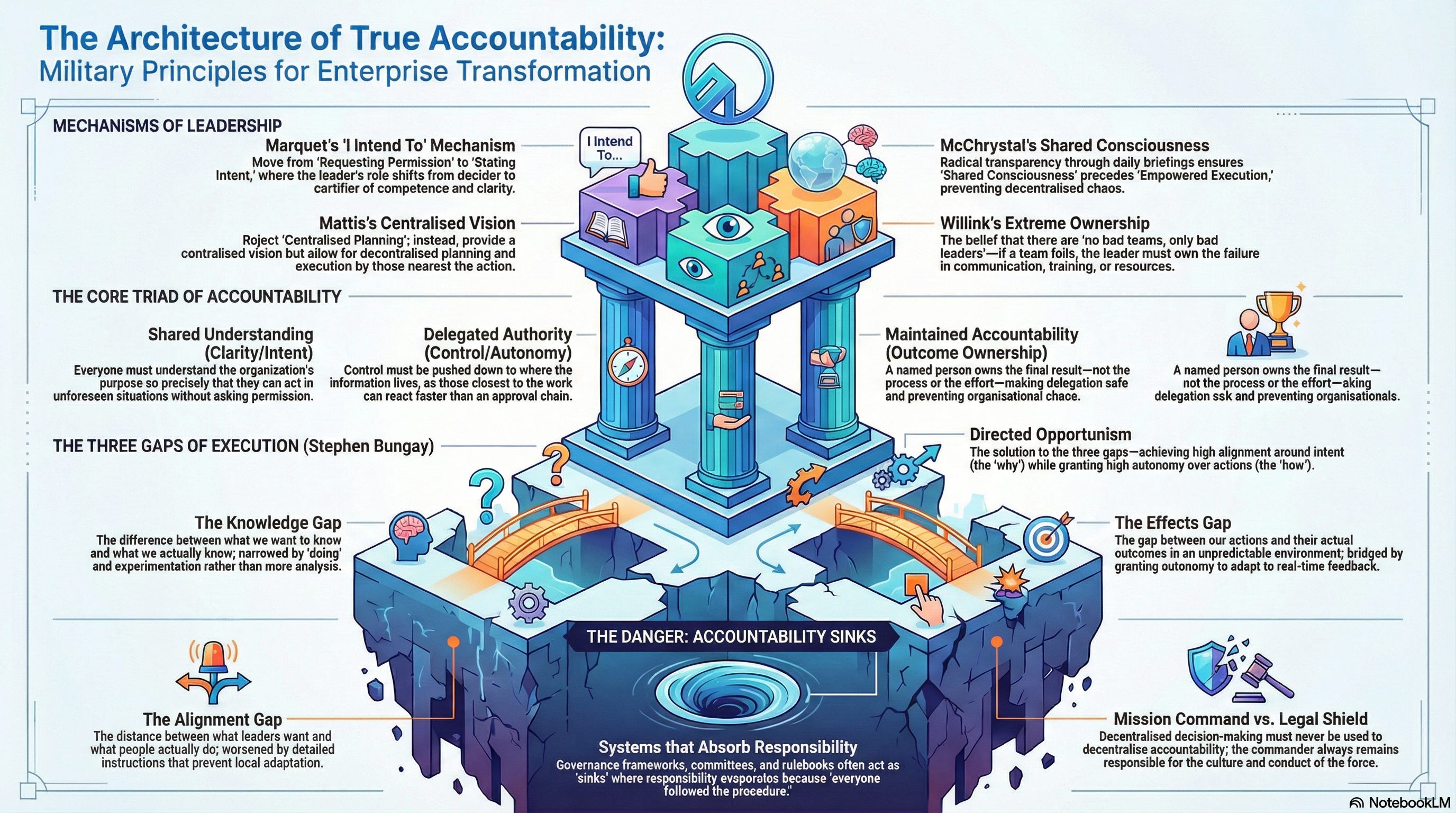
1. The Convergence: Five Authors, One Architecture
The five authors I will discuss, are David Marquet (Turn the Ship Around!, 2013), Stanley McChrystal (Team of Teams, 2015), Jocko Willink and Leif Babin (Extreme Ownership, 2015; The Dichotomy of Leadership, 2018), Stephen Bungay (The Art of Action, 2011), and Jim Mattis (Call Sign Chaos, 2019). Their backgrounds span the US Navy submarine force, US Joint Special Operations Command, US Navy SEALs, British military history and management consulting, and the US Marine Corps. They write in different registers: Marquet is analytical, McChrystal is systemic, Willink is motivational, Bungay is scholarly, Mattis is reflective. They disagree about important things.
What they agree on is an architecture. Expressed in slightly different vocabularies, each author describes three elements that must be present simultaneously for an organisation to achieve clarity of purpose and coherent action.
Shared understanding. Marquet calls it clarity. McChrystal calls it shared consciousness. Bungay calls it alignment around intent. Mattis calls it centralised vision. Boyd, whose work undergirds all five, calls it Einheit: a shared outlook born of common experience and mutual trust. The principle is the same: before you can delegate authority, everyone must understand what the organisation is trying to achieve and why. Not in the abstract language of a strategy slide, but with enough precision that any person, confronted with an unforeseen situation, can determine what action would serve the purpose without asking for permission.
Delegated authority. Marquet calls it control pushed down to where the information lives. McChrystal calls it empowered execution. Willink calls it decentralised command. Bungay calls it autonomy around actions. Mattis calls it decentralised planning and execution. The principle: the people closest to the work must have the authority to decide how to achieve the intent, because they have information that the leader cannot possess and the situation will change faster than the approval chain can process.
Maintained accountability. This is where the five authors are most distinctive and where their contribution to the clarity problem is most direct. Accountability is not surveillance. It is not approval chains, dashboards, or compliance checks. It is the structural condition in which a named person owns the outcome: not the process, not the inputs, not the effort, but the result. And that ownership is what makes the first two elements safe. Shared understanding without accountability produces a well-informed organisation that still cannot act. Delegated authority without accountability produces chaos. Accountability without shared understanding and delegated authority produces micromanagement. All three must act together.
This architecture is old. It traces to the Prussian military reforms of the early nineteenth century, through Moltke the Elder’s Auftragstaktik (mission-type tactics), through Boyd’s organic design principles, to its contemporary expression in these five authors.
2. Bungay’s Three Gaps: Why Instinctive Reactions Destroy Clarity
Bungay provides a rigorous diagnosis. Drawing on two centuries of military history and seventeen years at the Boston Consulting Group, he identifies three gaps that prevent organisations from turning strategy into results.
The knowledge gap is the difference between what we would like to know and what we actually know. In an AI transformation, the knowledge gap is enormous: nobody knows with certainty which AI applications will create value, which roles will change, or how the technology will evolve. The instinctive reaction to this gap is to demand more information, more analysis, more readiness assessments, more maturity models. Bungay’s insight is that this reaction widens the gap rather than closing it. More analysis consumes time and creates false precision. The relevant knowledge only emerges from doing. Weick made the same argument about sensemaking: you cannot know what you think until you see what you say. Bungay adds the organisational mechanism by which this insight is systematically suppressed.
The alignment gap is the difference between what we want people to do and what they actually do. Communication is inherently lossy; what is intended by the sender is not what is understood by the receiver. The instinctive reaction is to provide more detailed instructions, more controls, more oversight. Bungay shows that this widens the alignment gap by removing the subordinate’s ability to adapt to local conditions. The more precisely you specify the actions, the less able people are to respond to situations the specification did not anticipate.
The effects gap is the difference between what we expect our actions to achieve and what they actually achieve. The environment is unpredictable; actions produce unintended consequences; other actors respond in unexpected ways. The instinctive reaction is to tighten control, increase reporting, and demand compliance. Bungay shows that this widens the effects gap by preventing the adaptation that would close it.
The critical insight is that the instinctive reaction to each gap, more detail, more control, more reporting, makes all three gaps worse simultaneously. The organisation caught in this cycle produces increasingly elaborate plans that are increasingly disconnected from reality.
Bungay’s resolution is what he calls directed opportunism: high alignment and high autonomy at the same time. This is not a compromise between centralised control and decentralised chaos. It is a different architecture entirely, one in which alignment is achieved around intent (what to achieve and why) and autonomy is granted around actions (what to do and how). Mintzberg would recognise this as emergent strategy given a mechanism. Stacey would recognise it as skilled participation in ongoing processes. Peters would recognise it as “simultaneous loose-tight properties” given structural expression.
The practical mechanism is the briefing and backbriefing cascade. Leadership communicates intent downward, adding specificity at each level to the tasks implied by the higher intent. Subordinates explain their understanding of the intent and their planned actions upward. This two-way exchange catches misalignment before execution begins. It is enacted sensemaking: the subordinate articulates their understanding, and the leader can see whether it is adequate before action begins.

Argyris would note that this process makes the theory-in-use visible and testable, which is precisely what defensive routines prevent. Bungay’s backbriefing is a structural mechanism for surfacing the undiscussable.
For AI transformation, the application is obvious. Leadership communicates AI intent: “We want to use AI to reduce the time from specification to working prototype by 50%.” Teams backbrief how they intend to achieve this in their specific context. Leadership corrects misunderstanding before execution begins. The strategy emerges from the pattern of successful experiments conducted by empowered people operating within a shared understanding of what they are trying to achieve. This is also Drucker’s Management by Objectives done properly: objectives cascade downward; understanding cascades upward; the result is alignment without micromanagement.
3. Marquet’s Three Pillars: Why Clarity Cannot Exist Without Competence and Control
Marquet provides a diagnostic. His experience commanding the USS Santa Fe, the worst-performing submarine in the US Navy fleet, taught him that the leader-follower model is designed to produce compliance, not thinking. The catalytic moment came during a drill when Marquet ordered “ahead two-thirds” and the officer on deck repeated the order, even though no such setting existed on that class of submarine. The entire crew had been trained to comply, not to think. The officer repeated an impossible order because “you told me to.”
Marquet’s response was to invert the authority structure. Instead of the subordinate asking “request permission to submerge the ship” and the leader deciding, the subordinate would state “I intend to submerge the ship” and the leader would assent or redirect. The difference is profound: with permission, the default is stasis absent approval; with intent, the default is action absent a veto. The person with the most knowledge states what they plan to do. The leader’s role shifts from deciding to certifying.
But Marquet discovered that you cannot simply hand control to people who lack the competence to use it or the clarity to direct it. His three pillars, control, competence, and clarity, must rise together.
Control without competence produces chaos: people making decisions they are not equipped to make. Competence without clarity produces misalignment: skilled people working at cross-purposes because they do not understand the organisation’s intent. Clarity without control produces frustration: people who know what needs to be done but lack the authority to do it.
This maps directly to the AI transformation challenge. Many organisations have pushed AI tools to their teams (control) without investing in the knowledge required to use them well (competence) and without articulating what the organisation is trying to achieve through AI (clarity). The result is predictable: people experiment randomly, outcomes vary wildly, and leadership concludes that AI “isn’t ready” or “isn’t delivering enough” or the teams “aren’t mature enough.” Marquet’s diagnosis is that the problem is not the people. It is the model. The leader-follower model, in which leadership decides and teams execute, cannot produce clarity because it structurally prevents the information that would create clarity from reaching the people who need it.
The connection to Heifetz is clear. Heifetz argues that adaptive challenges cannot be solved on behalf of others. The leader who provides the answer to an adaptive challenge is not leading; they are performing leadership while preventing the learning that would produce a genuine answer. Marquet’s “I intend to” mechanism is a structural implementation of Heifetz’s principle: it returns the work to the people with the problem while maintaining the leader’s accountability for the system within which the work is done.
4. McChrystal’s Shared Consciousness: Why Accountability Requires Transparency
McChrystal faced a different version of the problem. In 2003, the Joint Special Operations Command confronted Al Qaeda in Iraq: a loose network of small, independent cells that moved faster than the US military’s hierarchical decision-making could process. Despite vastly superior resources, manpower, and training, the coalition was losing. The wait for McChrystal’s approval was not resulting in better decisions, and the priority needed to be reaching the best possible decision in a time frame that allowed it to be relevant.
McChrystal’s solution was radical transparency. Seven thousand people attended daily Operations and Intelligence briefings for up to two hours. Embedding and liaison programmes built trust across team boundaries. Information sharing reached levels that were “entirely new to both organisations.” The purpose was not to create a well-informed hierarchy. It was to create the shared consciousness that would make empowered execution safe.
The order matters, and this is McChrystal’s distinctive contribution. Shared consciousness must precede empowered execution. Without shared understanding, decentralised action produces chaos. Without decentralised authority, shared understanding produces frustration. Neither suffices alone.

This is Senge’s shared vision given an operational mechanism: not a statement on a slide but a daily practice of radical transparency that ensures everyone understands the whole picture, not just their part.
McChrystal’s accountability model works through transparency, not hierarchy. Everyone sees the consequences of their decisions because information is shared. The general thinks out loud so that thousands can learn the decision-making framework, not just the decision. The accountability is maintained not by an approval chain but by the visibility of outcomes to everyone who participated in creating them.
The shift in leadership metaphor is significant. McChrystal describes moving from “heroic leader” to “humble gardener.” The leader’s job becomes creating and maintaining the ecosystem: ensuring information flows, connecting teams, building trust. Not making every decision. “Eyes on, hands off”: leaders see everything through shared consciousness but resist the urge to control. This is what McChrystal calls the Perry Principle: when leaders can see what is going on, they understandably want to control what is going on. Empowerment tends to be a tool of last resort, used only when the leader runs out of attention, not as a design principle.
For AI transformation, McChrystal’s insight challenges the standard governance model. Most AI governance creates information asymmetry: the governance board knows what is approved, the delivery teams know what is possible, and neither sees the other’s reality. McChrystal would argue that the precondition for empowered AI experimentation is not a better approval process but a better information architecture: one in which everyone can see what is being tried, what is working, what is failing, and why.
5. Willink’s Dichotomy: Why Accountability Is Not What You Think It Is
Willink provides the emotional and dispositional dimension. His principle of extreme ownership is frequently misunderstood as a demand for micromanagement: the leader controls everything and is therefore responsible for everything. The Dichotomy of Leadership, the sequel to Extreme Ownership, exists precisely to correct this misreading.
The core dichotomy is: “hold people accountable, but don’t hold their hands.” Accountability without autonomy produces compliance. Autonomy without accountability produces chaos. The leader must hold both simultaneously, not as a compromise but as a dynamic tension that must be navigated continuously.
Willink’s most memorable demonstration is the experiment with boat crews during SEAL training. When the leader of the best-performing crew was swapped with the leader of the worst-performing crew, performance followed the leader, not the team. “No bad teams, only bad leaders.” This is a radical version of Argyris’s insight that defensive routines are produced by leadership behaviour. The leader’s Model I behaviour creates the team’s dysfunction.
But the deeper principle is diagnostic. When something goes wrong, the leader’s first question should be “what did I fail to do?” not “who failed?” Extreme ownership drives a specific behaviour: instead of blaming subordinates, the leader examines what they failed to communicate, train, resource, or clarify.

This is Dekker’s local rationality principle applied to leadership: if the team made a bad decision, it is because the system (training, information, clarity, resources) made that bad decision rational from their perspective. And the system is the leader’s responsibility.
6. Mattis and the Three Phases: Why Clarity Is a Leadership Maturity Problem
Mattis contributes a developmental insight. He distinguishes three phases of leadership: direct (leading those you can see), executive (leading through others), and strategic (leading institutions). At each phase, the relationship between accountability and clarity changes.
At the direct level, the leader can see the problem, assess the situation, and act. Clarity is achieved through proximity. At the executive level, the leader must achieve clarity through others: communicating intent clearly enough that people the leader has never met can make good decisions. At the strategic level, the leader must create the conditions under which clarity can emerge across an entire institution.
Mattis’s formulation is clear: “centralised vision, decentralised planning and execution.” He deliberately rejects the more common “centralised planning and decentralised execution” as too top-down. The vision is centralised; the planning is not. This means that the people closest to the work plan how to achieve the intent, not merely execute a plan that has been handed to them. This is Taylor’s separation of thinking from doing explicitly rejected by a four-star general who spent forty-four years testing the alternative.
Mattis also provides a principle that connects accountability to learning: rehearsal until improvisation is possible. You prepare thoroughly, train intensively, and rehearse repeatedly, not to follow the plan but to develop the competence that allows you to improvise intelligently when the plan fails. The accountability is for the preparation, not for the prediction.
7. Accountability Sinks: Where Clarity Goes to Die
Dan Davies, drawing on Beer’s cybernetics, provides the concept that connects the military insight to the enterprise reality.
An accountability sink is a system in which decisions are delegated to rule books, standard procedures, or committee structures in a way that makes it impossible to identify who is responsible for outcomes.
Beer anticipated this: the principle of diminishing accountability states that unless conscious steps are taken to prevent it, any organisation will tend to restructure itself so as to reduce the amount of personal responsibility attributable to its actions.
Every rule is a model of the world. When the model is wrong, there is nobody to blame because everyone followed the rules. The surefire sign: “nobody is responsible” when everyone did everything right and yet results were bad. In military contexts, accountability sinks manifest as rules of engagement so detailed that soldiers follow the letter while the spirit is lost.
This is the accountability paradox that all five authors navigate. Too much control stifles initiative, speed, and adaptation. Too little accountability enables moral drift, misconduct, and systemic failure. The resolution is accountability for creating the conditions in which good decisions are made, not for making every decision yourself. The commander is accountable for the system: the training, the culture, the ethical boundaries, the detection mechanisms. Subordinates are accountable for their actions within the delegated authority.
Beer’s concept of algedonic alerts provides the structural mechanism. An algedonic alert is a pain signal that bypasses normal channels: a mechanism for frontline signals of failure to reach senior leadership without being filtered, delayed, or absorbed by intermediate layers. McChrystal’s daily O&I briefings served this function: radical transparency meant that problems could not be hidden within the hierarchy. The After-Action Review is a structured algedonic alert: it forces the system to confront the gap between intended and actual outcomes.
Westrum’s typology maps directly. In a pathological culture, accountability sinks protect the powerful; information about failure is suppressed. In a bureaucratic culture, accountability sinks are the standard operating procedure; the process is always followed and nobody is ever responsible. Only in a generative culture does accountability function as these military authors describe: named individuals own outcomes, information flows to where it is needed, and the system learns from the gap between intention and result.
8. What Transfers and What Does Not
The military-to-enterprise transfer is not automatic. Several conditions that make mission command work in military contexts are absent or weaker in enterprise settings. What does transfer is the architecture itself and the diagnostic it provides. The three questions that emerge from these five authors can be asked of any organisation:
Does everyone who needs to make decisions about AI understand, with enough precision to act without asking permission, what the organisation is trying to achieve and what constitutes an unacceptable outcome? If not, shared understanding is absent, and no amount of delegated authority will produce coherent action.
Do the people closest to the work have the authority to decide how to use AI within the boundaries of the organisation’s intent? If not, delegated authority is absent, and the organisation is running Taylor’s separation of thinking from doing in contemporary language.
When something goes wrong, can you name the person who is accountable for the outcome (not the process, not the committee, not the board)? If not, accountability has been absorbed by a sink, and the organisation cannot learn from failure because there is nobody whose job it is to learn.
9. The Connection to Specification
Deciding of this series argues that AI has changed the means of production of knowledge, and that achieving clarity of purpose now requires the ability to specify intent with enough precision that machines can act on it. The military authors provide a complementary argument about the human and organisational preconditions for that specification to work.
A specification without accountability is a document. A specification with accountability is a commitment. When a named person owns the outcome that the specification describes, the specification becomes more precise (because the accountable person has an incentive to remove ambiguity), more testable (because the accountable person needs to know whether the outcome was achieved), and more honest (because the accountable person cannot hide behind vagueness).
Bungay’s briefing-backbriefing cascade is the specification review process described in military terms. The specification author communicates intent; the implementing team explains their understanding; misalignment is caught before execution.
Marquet’s “I intend to” mechanism is what specification-driven development looks like when accountability is real. The team does not ask “may we implement this specification?” The team states “I intend to implement this specification, and here is how I interpret it.” The leader assents or redirects. The team owns the implementation. The leader owns the system in which the implementation occurs.
McChrystal’s shared consciousness is the information architecture that enables specifications to be coherent across an enterprise. When everyone can see what is being specified, what is being built, and what is working, the specifications become part of a shared understanding rather than isolated documents that drift apart.
Willink’s extreme ownership applied to AI means: if the AI-generated output is wrong, the leader who deployed it owns the failure. Not the AI, not the vendor, not the team who built the prompt. The specification was the leader’s responsibility. The validation was the leader’s responsibility. The decision to deploy was the leader’s responsibility. This is the accountability that governance frameworks must create rather than absorb.
10. Where It Breaks Down: The Honest Assessment
A 2023 study published in Military Psychology applied Deci and Ryan’s Self-Determination Theory to mission command and found that the central aspects of mission command; empowerment, mutual trust, intent, initiative, shared understanding; directly map to satisfaction of the three basic psychological needs: autonomy, competence, and relatedness. Mission command is not merely a management technique. It is a motivational architecture. It works not because it is efficient but because it aligns with fundamental human psychological needs. This explains why directive command, even when faster in the short term, produces disengagement and learned helplessness in the long term.
But the tensions between the five authors reveal genuine unresolved problems.
Willink’s extreme ownership places the leader at the centre of accountability. McChrystal’s humble gardener places the leader at the edge, tending the ecosystem. Both are right in different contexts, but the advice conflicts if you try to apply both simultaneously. Bungay’s directed opportunism provides the resolution: alignment is leadership’s responsibility; autonomy is the team’s responsibility. Both must rise together.
Marquet’s inversion of authority (”I intend to”) distributes ownership to the team. Willink’s “no bad teams, only bad leaders” concentrates it in the leader. The resolution is that these describe different moments in the same process: the leader creates the conditions (Willink), and the team acts within them (Marquet).
All five authors assume relatively clear organisational boundaries, a unified chain of command, and a shared mission. Most enterprise contexts involve matrix structures, competing priorities, and ambiguous authority. Fayol’s warning about dual command is directly relevant: the matrix organisation is a structural accountability sink. When you report to both a functional lead and a delivery lead, the accountability for AI outcomes falls between the two.
The honest assessment is that mission command transfers to enterprise transformation as a diagnostic more reliably than as a prescription. The three questions; shared understanding? delegated authority? named accountability?; reveal precisely where clarity is breaking down. The solutions require the cultural, structural, and habitual changes that Learning of this series described: the seven conditions for organisational learning are the preconditions for the accountability architecture that the military authors prescribe.
Further Reading
Stephen Bungay: The Art of Action: How Leaders Close the Gaps between Plans, Actions and Results - The most rigorous and scholarly of the five. Start here for the diagnostic framework. The three gaps and directed opportunism are immediately applicable to any organisation struggling with the distance between strategy and execution.
David Marquet: Turn the Ship Around! A True Story of Turning Followers into Leaders -The most practical mechanism for shifting from compliance to initiative. The “I intend to” language is something you can implement on Monday morning.
Stanley McChrystal: Team of Teams: New Rules of Engagement for a Complex World - The argument for radical transparency as the precondition for empowered execution. Read it alongside Westrum for the cultural dimension that McChrystal demonstrates but does not theorise.
Jocko Willink and Leif Babin: Extreme Ownership: How U.S. Navy SEALs Lead and Win - The emotional energy and the leadership disposition. Follow with The Dichotomy of Leadership (2018) for the necessary correction: every principle becomes a liability when taken to its extreme.
Jim Mattis and Bing West: Call Sign Chaos: Learning to Lead - The developmental arc from direct to executive to strategic leadership, and the most precise formulation: “centralised vision, decentralised planning and execution.”
John Boyd: Patterns of Conflict - The intellectual foundation beneath all five authors. Available online. Dense and rewarding.
Dan Davies: The Unaccountability Machine: Why Big Systems Make Terrible Decisions - The concept of accountability sinks applied to contemporary institutions.
Placement: Deciding, the second of four phases; Learning, Deciding, Building, Transforming. Command is a Deciding subject because mission command is a claim about how much description a decision needs before it can be handed on. What an organisation gets out of that work is a commitment somebody can act on without asking again. Why Your Organisation Can't Decide is the synthesis, and From Deciding to Building the bridge out.
(An Organisational Prompt is something you can do now....)
Organisational Prompt
Pick a specific initiative in your organisation that has stalled, underperformed, or produced ambiguous results. Not the whole transformation; one concrete initiative.
Ask three questions.
Can the people working on this initiative articulate, without consulting a document, what the organisation is trying to achieve through this initiative and what would constitute an unacceptable outcome?
Did the people closest to the work have the authority to determine how to pursue the initiative, or were they given a plan and told to execute?
When the initiative underperformed, could you name one person who was accountable for the outcome?
Now ask the harder question: if you could implement one change tomorrow, which of the three would you address first?
Disclaimer
I write about the industry and its approach in general. None of the opinions or examples in my articles necessarily relate to present or past employers. I draw on conversations with many practitioners and all views are my own.