
She starts the sentence and you finish it. “I think the reason the pipeline keeps stalling is that we’re not really...” and there is a pause of about a second, and you say “yes, the review queue, we should probably batch them.” She agrees. You both move on. It felt collaborative and it took eleven seconds.
What just happened is that you took the thought off her before she had finished having it. She now knows what you think, which she can work with, and you will never know what she was about to say, which you cannot. Adkins built a career on that particular loss. Her argument is that the most valuable thing a leader can do in a conversation is very often nothing at all. That is a trained skill rather than a personality trait, and almost nobody senior has trained it.
1. Four stances, and the one everyone defaults to
Coaching Agile Teams came out in 2010 and became the standard text for a role that barely existed. Adkins had come from fifteen years of running project teams, and the book is unusually candid about what that did to her. The skills that made her good at the old job, holding the whole picture in her head and orchestrating who spoke to whom, turned out to be liabilities in the new one.
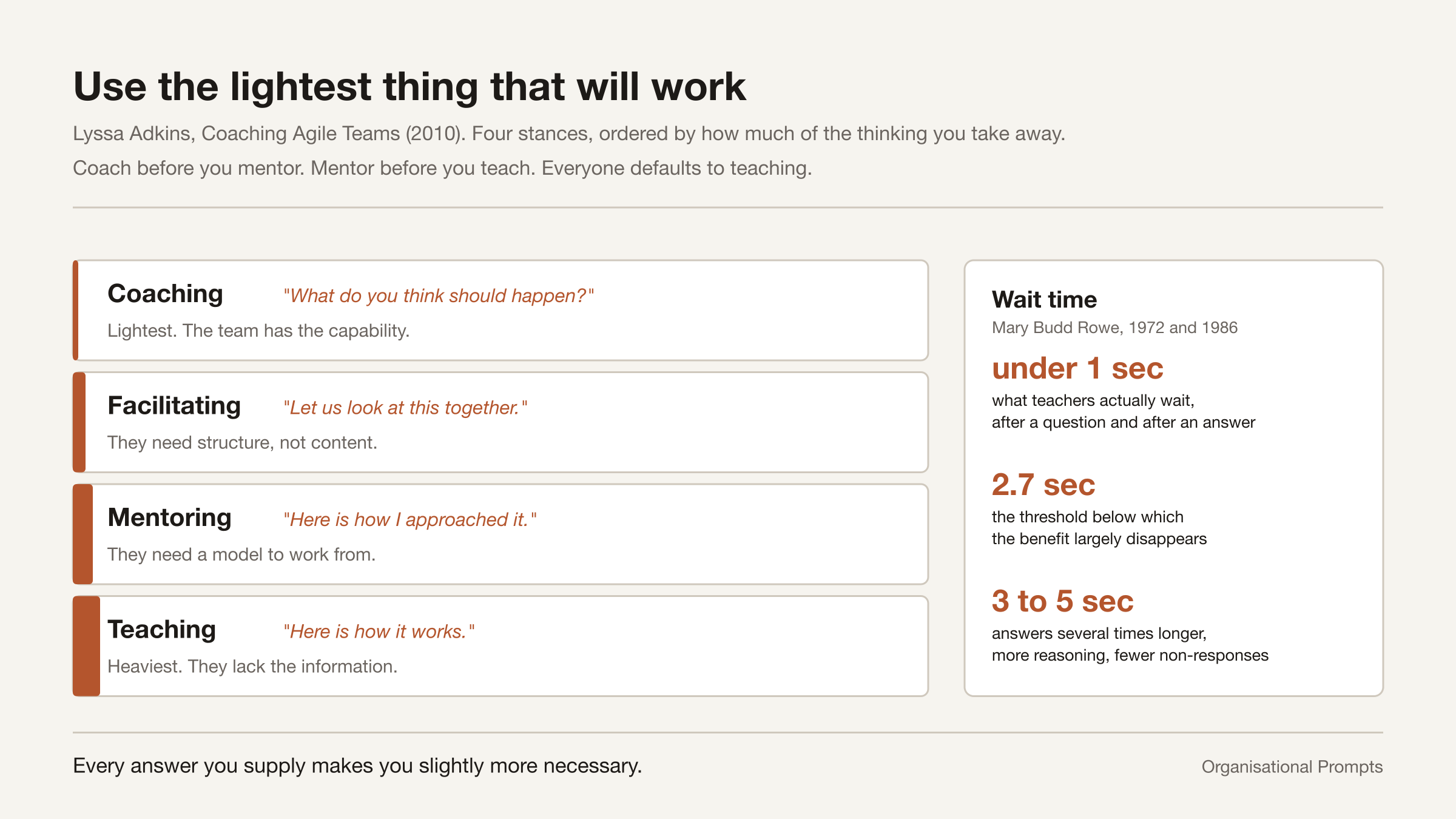
Her framework separates four things that usually get lumped together as “helping”. Teaching transmits information the person does not have. Mentoring offers your own experience as a model, which is a different act and lands differently. Facilitating structures a conversation so that a group can get somewhere it could not have got to alone. Coaching asks a question and then leaves the person to find their own answer, which is the hardest of the four by some distance. All four are legitimate and each suits a different moment.
The discipline is to use the lightest one that will work: coach before you mentor, mentor before you teach. What actually happens in most organisations is that everyone defaults to teaching, because teaching feels useful to the person doing it and comfortable for the person receiving it. It also builds a dependency, quietly, over about eighteen months, until the team cannot make a decision without you in the room and everybody agrees you are indispensable.
2. What one second costs
There is a piece of research from outside this field that gives the whole thing a floor to stand on, and I think it deserves to be better known in business than it is. In the late 1960s Mary Budd Rowe recorded hundreds of classroom lessons and measured the pauses. She found that teachers waited less than a second after asking a question before speaking again, and less than a second after a pupil stopped talking. She named the two gaps wait time one and wait time two, and found the second one mattered more.
When teachers were trained to extend both to three seconds or more, the changes were not marginal. Pupils’ answers got several times longer. They speculated more, offered evidence unprompted, asked more of their own questions, and said “I don’t know” far less often. There is a threshold at roughly 2.7 seconds, below which the benefit largely disappears. The finding has since been replicated from primary schools to universities and into business settings.
Read that back as a description of your last leadership meeting. Roughly a second of silence is what most rooms can bear, and the person with the most authority is usually the one who breaks it. Every time you break it you have taken the answer.
3. Sixty per cent who you are
Adkins’ most demanding claim is that the coaching stance is about sixty per cent who the coach is and forty per cent what the coach does. That sounds like the sort of thing said to fill a chapter. In practice it names something specific, which is that the four seconds are unbearable for reasons that have nothing to do with technique.
Silence in a meeting you are running feels like failure. It reads as your failure to have prepared, or the team’s failure to engage, and the discomfort is yours to hold. So you fill it, and the filling is experienced by everyone as helpfulness. Adkins’ instruction is that you coach yourself first. The instrument is your own tolerance for other people’s struggle, it can be trained, and until it is trained you will keep rescuing teams that were about to work something out.
Heifetz said much the same about a leader’s job being to hold the disequilibrium rather than relieve it. Adkins scales it down to the meeting. Same discipline, three seconds instead of three months, and considerably more chances to practise.
4. Answers are now free, which is the problem
Something has changed since 2010, and it has changed more for this stance than for any other idea here. An engineer with a question no longer has to ask a colleague. The model answers at once, fluently, in whatever format was asked for, without judgement, and often correctly. That is useful. I would not want to take it away from anyone, and I use it myself all day. It also means the market value of being the person with the answer has collapsed, and a leader whose contribution is answers is now competing with something faster, cheaper and more patient.
Two consequences follow, and the second is the more interesting. The first is about you: whatever you were adding by knowing things, add something else. The second is about the room. When answers are free, the expensive thing becomes the collision, the moment two people who see a problem differently have to work it out between them. Teams that route every question to a model stop having those. Nobody decides to stop, and there is simply no longer a reason to turn to the person at the next desk, so the disagreements that used to surface in that moment go unheld instead. Somebody has to protect the collision, and that is a coaching job rather than a technical one. It means noticing when a decision was reached by consensus with a chatbot, and asking the two people who quietly disagree to say so out loud.
5. Coaching yourself out of a job
The agile coaching profession has a failure mode it is honest about, at least in its better literature. The coach becomes permanent. The team gets good, and the coach stays, and stays, and eventually there is a coaching function, and then a centre of excellence, and then a transformation office with a budget line.
Adkins’ test is blunt and I have never seen an organisation apply it. Does the team perform as well without the coach as with? If the answer is no after two years, the coaching failed, however good the retrospectives were.
That test belongs here rather than to agile. Release is what this part of the argument is for: the change no longer needing the person who started it. Applied to the coaching stance it is quite exact. Every time you supply an answer you make yourself slightly more necessary, and necessary is the opposite of the thing you were hired to produce.
You cannot make the event that changes your organisation. What you can do is spend the years beforehand building a group of people who can think without you when it arrives. That work is done four seconds at a time, in ordinary meetings, by not saying the thing you were about to say.
Where this falls: Transforming, the last of four; Learning, Deciding, Building, Transforming. Coaching sits at Agency, the position these articles start from, because agency is grown rather than granted and the growing is mostly a matter of not filling the silence. The Event Is Not Yours to Make sets out the argument.
(An Organisational Prompt is something you can do now....)
Organisational Prompt
Measure your own wait time, then buy four seconds
Pick a meeting this week that you run. Ask one person you trust to sit with a stopwatch and time two things. How long do you wait after asking a question before anyone speaks, and how long after someone finishes before you speak? They should write down the two numbers and nothing else.
Most people are somewhere near one second and are surprised by it. Do not defend the number. It is the same number Rowe found in every classroom she recorded.
Then run one meeting the following week under a single rule, which is that you count. After you ask a question, count silently to four before anything else happens. After someone stops talking, count to four again. Four seconds is much longer than it sounds and the first two attempts will feel like a mistake in front of witnesses.
Write down what came out of the room in the second half of those pauses, because that is the material you have been buying yourself out of for years. If nothing came, you have learned something worth knowing about the meeting.
Further Reading
Coaching Agile Teams (Addison-Wesley, 2010) is the source for all of this, and still the best treatment of the four stances anywhere. Pearson has the front matter and a sample chapter free as a PDF if you want to see the shape of it first.
Mary Budd Rowe, Wait Time: Slowing Down May Be A Way of Speeding Up (Journal of Teacher Education, 1986). Free in full, six pages, and it will change how you run a meeting more reliably than most management books.
Her current work has moved from team coaching to leadership teams and systems coaching, which is a useful corrective if you think of any of this as a delivery-team concern.
I write about the industry and its approach in general. None of the opinions or examples in my articles necessarily relate to present or past employers. I draw on conversations with many practitioners and all views are my own.