
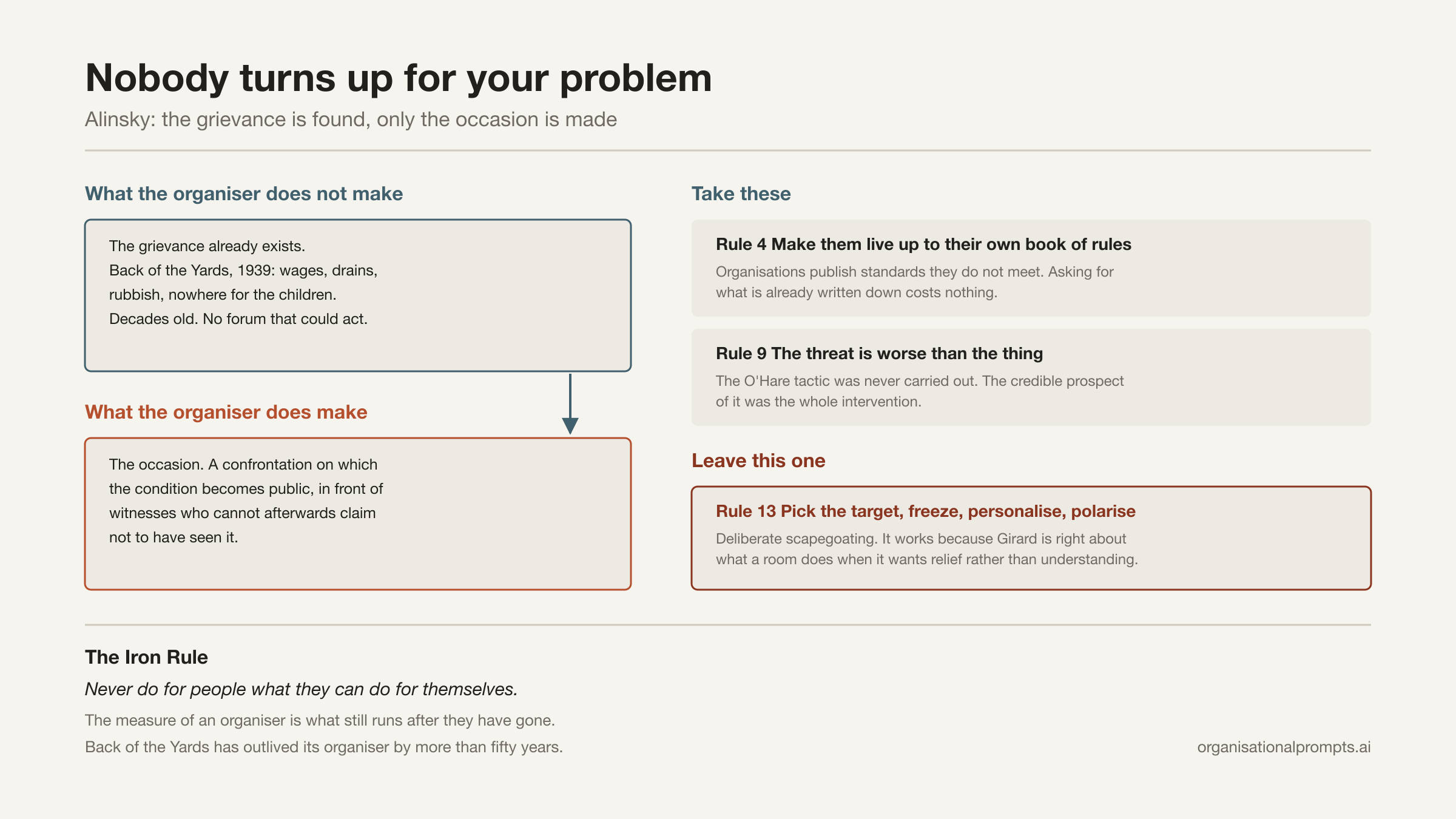
In 1939 Saul Alinsky went to work in the Chicago stockyards district, the neighbourhood Upton Sinclair had written about in The Jungle. He arrived with no programme. He spent months in kitchens and parish halls and union offices asking people what they wanted, and what he found was not what the reformers of the day assumed. People wanted wages, drains, rubbish collection and somewhere for the children to go. The Back of the Yards Neighborhood Council came out of those conversations, and it is still running.
Two things about that council are worth more than the whole shelf of change-management literature. Alinsky did not bring the grievance. The grievance was already there, decades old, and had no forum that could act on it. And he built the council out of 185 organisations that already existed, the parishes and unions and social clubs, rather than founding a new body to compete with them. Most corporate change does the exact opposite on both counts. It arrives with a grievance nobody feels, and a structure nobody asked for.
1. He never brought the problem
Alinsky’s starting position is that people act on their own interests, and that organising which appeals to duty or mission instead will not hold. Readers usually take this as cynicism. The opposite is true, because it takes seriously what people actually want. Self-interest is not selfishness. It runs across the material, the professional, the social and the moral. It includes wanting a say. It does not include your strategy. When a transformation programme asks people to act on the organisation’s interest, it is asking them to run on a fuel they do not carry. They will comply for a while because complying is easier than arguing, and the programme will read the compliance as agreement.
His other founding rule is to start where the world is rather than where you would like it to be. Accepting the world as it is does not weaken the desire to change it. Nowhere else is available.
2. Apathy is a conclusion
The quiet in your organisation is data, and it is probably not data about the people. Alinsky spent his career among people who had every reason to act and did not, and his reading of that was never that they did not care. People who have learned that action produces nothing behave exactly as though they do not care. The behaviour is identical. The cause is opposite. Martin Seligman later gave the mechanism a name and a laboratory, but Alinsky was working with it thirty years earlier as a practical fact about neighbourhoods.
Read your own organisation that way. When you announce something and nothing happens, the silence is a summary of the last three programmes, and I have never known that summary to be wrong. Somebody is doing arithmetic on your track record and arriving at the correct answer.
3. What can be manufactured
One distinction rescues this whole line of thinking from the manufactured-urgency trap. You cannot manufacture a grievance. Alinsky never tried. What the organiser manufactures is the occasion. The occasion is the confrontation on which a long-standing grievance becomes public, in front of witnesses who cannot afterwards claim not to have seen it. The grievance is found. Only the occasion is made. That distinction is the whole of it.
His ninth rule says the threat is usually more terrifying than the thing itself, and the story attached to it is instructive. Word was allowed to circulate that large numbers of people would occupy the washrooms at O’Hare, at length, in a coordinated way. The city imagined it. Passengers, newspapers, the lot. It moved on a commitment it had been sitting on for years. The tactic was never carried out. Nothing was manufactured except the credible prospect of the occasion.
His fourth rule is the one to take into any institution: make the opponent live up to their own book of rules. Organisations publish standards they do not meet. That gap costs nothing to find, and it is the cheapest leverage available to anyone inside, because you are not asking for anything new. You are asking for the thing already written down.
4. The rule that should worry you
Rule thirteen: pick the target, freeze it, personalise it, polarise it. It works, and it works for exactly the reason René Girard says it works, which is that a group under pressure will converge on a single figure with real relief and will experience the convergence as having finally got to the bottom of things. Alinsky is recommending, deliberately and in writing, the mechanism Girard spent a career describing as the thing communities do instead of learning.
He knew what he was doing. Rules for Radicals devotes a full chapter to the ethics of means and ends, and its argument is that judgements about means depend heavily on whether the person judging is a participant or a spectator. That is a serious position and it is not obviously wrong when the participants are people with no other lever at all.
It is wrong inside your own organisation. A leader who applies rule thirteen converts a systemic question into a personnel answer, and the relief in the room is real, which is precisely the problem. Relief was what the room wanted. The information was what it needed. Mary Parker Follett is the standing objection here, and she is probably right at the point where Alinsky is most dangerous: integration rather than domination, on the assumption that shared interests can be found rather than forced. Take the analysis. Leave rule thirteen.
5. The programme with no members
Almost every enterprise has run two AI efforts at once and only counted one. The official one has a charter, a budget, a steering group and a set of adoption targets. The other one happened in a channel nobody chartered, among engineers swapping what worked, and it was driven entirely by self-interest of the sort Alinsky would recognise: less tedium, faster feedback, fewer evenings lost to a migration script. Nobody organised it and it organised anyway. That is what people do when something serves them.
The official programme has all the position power and no members. The unofficial one has all the members and no authority to change anything that matters, which is why the governance forum still takes three weeks and the procurement process still takes four months.
Alinsky’s question for the official programme is short. What does the person you want to move actually want? If the answer is that they want to be part of the transformation, you have no answer, and the programme is running on your fuel rather than theirs. Fuel of that kind tends to run out around the second quarter.
6. The organiser leaves
Alinsky called it the iron rule rather than a preference: never do for people what they can do for themselves. The reasoning is not modesty. Doing the work for people leaves them without the capacity to do it next time, and without ownership of what was won. A victory the group did not win itself is hollow, and it can weaken the organisation rather than build it, because everyone now knows who to wait for. So the organiser finds the people others already listen to, works through them, and goes. Alinsky joined none of the organisations he founded.
The measure of an organiser is what still runs after they have gone. Apply that to your own arrangements and the reading is uncomfortable. The transformation office that has to keep existing is the evidence that the transformation did not take. A capability that needs its programme is not a capability yet; it is a dependency with a budget line. Back of the Yards has outlived its organiser by more than fifty years, which is the number worth being judged against.
Where this falls: Transforming, the last of four; Learning, Deciding, Building, Transforming, at Event. Alinsky's subject is the manufacture of an event: organising is what you do when the disturbance you need has not arrived by itself. The Event Is Not Yours to Make opened this stretch.
(An Organisational Prompt is something you can do now....)
Organisational Prompt
Ask what they want, not what they think
Pick three people at least two levels below you who do the work your programme is about. Ask each one what would make next Tuesday less annoying. Do not ask what they think of the strategy, the tooling or the transformation, because they will tell you what they believe you want to hear and that answer is worth nothing. Write down the three things. Fund one of them this month, visibly, and say whose idea it was.
Further Reading
Alinsky, Rules for Radicals: A Pragmatic Primer for Realistic Radicals (Random House, 1971). The thirteen rules get all the attention; the chapters on the organiser and on the ethics of means and ends are the ones that repay a slow read. A summary of the rules with the O’Hare episode is available.
Alinsky, Reveille for Radicals (University of Chicago Press, 1946). The earlier and warmer book, written out of Back of the Yards rather than about it.
The Industrial Areas Foundation, founded 1940 and still training organisers. Read it for what the method looks like after eighty-five years of practice rather than as Alinsky left it.
Bill Moyers, Who is Saul Alinsky?. A short corrective for anyone who has met the name only as a term of political abuse, with his own account of why he never joined anything.
Disclaimer
I write about the industry and its approach in general. None of the opinions or examples in my articles necessarily relate to present or past employers. I draw on conversations with many practitioners and all views are my own.