
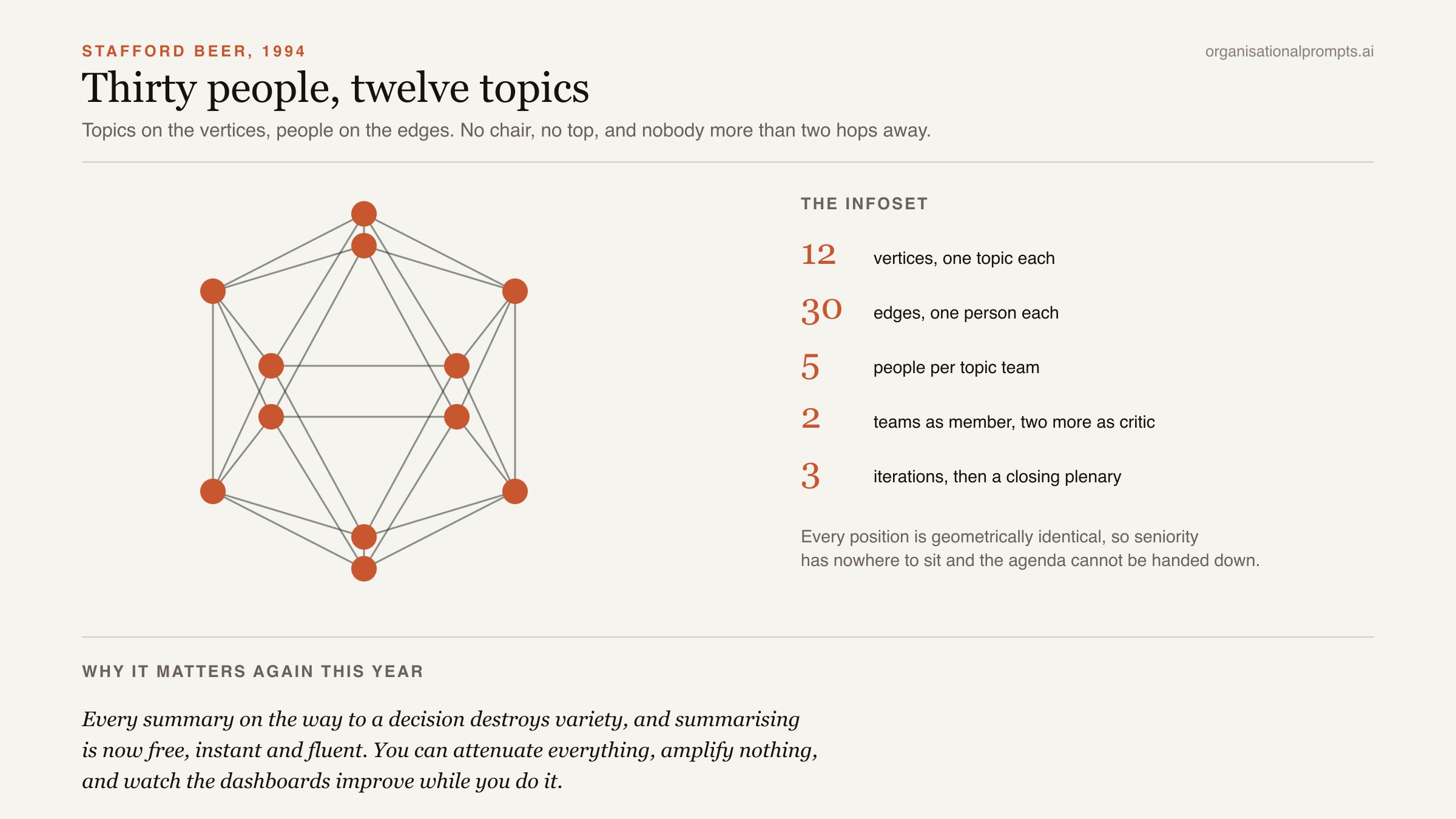
An icosahedron has twelve vertices, thirty edges and twenty faces. In 1994, in his late sixties and at the end of a career spent telling large organisations that their information architecture was killing them, Stafford Beer published a book proposing that you should organise a meeting in that shape.
Put a topic at each vertex. Put a person on each edge. Because every edge touches exactly two vertices, each of the thirty people is now a member of two topic teams, and each team has five people. Give everybody a critic’s role on two further topics. There is no chair, no top and no bottom, and no agenda handed down, because the twelve topics are generated by the thirty people in the first session. Beer called the group an infoset, called the method Team Syntegrity, and thought it was the most important thing he ever built.
Deciding used Beer for the Viable System Model and for the observation that the purpose of a system is what it does. This article takes the part that got left out. Building’s Interaction lever asks how the parts of a system relate, and syntegrity is the only serious attempt anyone has made to design that relating from first principles.
1. The problem it solves
Beer’s whole career rests on one law, borrowed from Ross Ashby and published in 1956. Only variety can absorb variety. A regulator has to be able to produce at least as many distinct responses as the situation can produce distinct states, and where it cannot, the difference does not vanish. It shows up as the situation doing something you had no way of handling.
Hierarchies deal with this by attenuating. Information is summarised at every level on its way up, because the layer above cannot hold what the layer below knows. Attenuation is not an abuse of the structure; it is the structure. And each summary is a decision about what to leave out, made by somebody with an interest in how the result reads.
The Viable System Model answers this with channels and with the audit path, which lets the centre look directly at operations rather than through the reporting line. Syntegrity answers a different question. Suppose you have thirty people who between them know what needs to be known, and no time to pass it through a hierarchy. What shape should the conversation be?
2. The shape, and why it is that shape
The word fuses synergy with Buckminster Fuller’s tensegrity, a structure that holds itself together through distributed tension rather than through a strong centre. That is the design intent stated in the name.
Two properties of the icosahedron are doing the work. The first is that every person sits at most two nodes from every other, so anything said anywhere can reach anybody in two hops without climbing anything. The second is that no position is distinguishable from any other. Rotate the solid and it looks the same, which means the protocol cannot be gamed by seniority, because seniority has nowhere to sit.
The meeting runs three iterations over about three days. In each, a person is a member of one team, a critic of another, and an observer somewhere else, and the roles rotate. Beer’s term for what happens next is reverberation: an idea raised in the green team on the first morning comes back to you on the second afternoon, altered by two teams you were not in. He analysed the propagation mathematically, with eigenvalues, which tells you something about how seriously he meant it. Practitioners who run these report something in the region of ninety per cent of the information ending up genuinely shared across all thirty.
Since 1994 it has been used on the future of the City of London, at Union Bank of Switzerland, by the Colombian Ministry of the Environment, and by an Israeli and Palestinian group discussing West Bank settlements. This is not a thought experiment.
3. What the last two articles would say about it
Collins would notice immediately that syntegrity satisfies all four of his ritual ingredients by construction. Bodily co-presence over three days. A hard boundary, since the infoset is exactly thirty named people. A mutual focus, because each session addresses one statement. And a shared mood, which three days of that intensity guarantees whether or not anyone intended it.
That is probably the honest explanation of why participants describe syntegrations the way they do. Beer built a machine for manufacturing emotional energy and described it in the language of cybernetics, which is the language he had.
Skelton and Pais would notice something else. Syntegrity is the interaction mode chosen deliberately rather than left to drift, at the largest scale anyone has attempted. Their three modes are a vocabulary for pairs of teams. Syntegrity is a protocol for a whole population, making the same argument at a different scale: the shape of the interaction is a design decision rather than a matter of taste.
4. Attenuation just became free
The reason to care about a thirty-year-old protocol is that its central warning just got much cheaper to ignore.
Beer’s warning was always about attenuation. Every point at which information is summarised on its way to a decision is a point at which variety is destroyed, and the destruction is invisible from above, because what arrives looks complete. The report reads well. It reads well because somebody made it read well.
Summarisation is now free, instantaneous and fluent. Every layer of your organisation can attenuate at machine speed, and the output is more polished than the human version was, which makes it harder rather than easier to notice what has gone. An organisation can now attenuate everything and amplify nothing, and the dashboards will look better than they have ever looked.
Lorin Hochstein made the specific version of this argument about incident reports, and his distinction generalises. Using a model to gather the material is fine. Using it to produce the account removes the act in which somebody had to decide what mattered. Beer would put it more bluntly: you have automated the step where variety is lost and left the step where variety is generated to look after itself.
The syntegrity answer is not to ban summarisation, which is impossible and would be stupid. It is to notice what compensates for the losses. A channel with real capacity, in which thirty people hear each other directly, is the only thing that ever has, and such channels are getting rarer while cheap imitations of them get easier to build.
5. Where the argument runs out
Three honest objections, and the third is the serious one.
It is expensive. Thirty people for three days is a real cost, most organisations will do it once, and once is not an operating model. Beer designed an event, not a way of running a company.
It gets strange. The later formalism drifts into chakras, enneagrams and elaborate colour schemes, and this loses him readers who would otherwise take the geometry seriously. Read the structure and skip the mysticism; the structure stands without it.
The evidence is thin, in the way most organisational evidence is thin, and it is worth saying so plainly rather than leaning on the numbers. The ninety per cent figure comes from practitioners rather than from controlled study. And the people reporting how much the experience changed them had just spent three days in a highly charged group, which Collins would tell you affects the reporting.
None of that touches the underlying claim, which is the one to carry away. The shape of your conversations determines what your organisation can know, and almost nobody designs that shape on purpose.
The next article takes this to measurement, and to what the numbers can and cannot see.
Where this falls: Building, the third of four phases; Learning, Deciding, Building, Transforming. Beer is carried forward from Deciding, where he held Interaction, and POSIWID becomes the unforgiving test: a system in production is judged by what it does, not by what its specification claimed for it. The Build Is the Test opens this stretch of the argument.
(An Organisational Prompt is something you can do now....)
Organisational Prompt
Count the attenuations between the work and the decision.
Take one significant decision you made in the last quarter. Trace backwards to where the information came from, and count the number of times it was summarised on the way. Not the number of layers on the org chart. The number of separate acts of summarising.
For each one, write down two things: who did the summarising, and what they had at stake in how it read. Then mark which of them were done by a person and which by a model, and note that the second kind leaves no trace at all.
Most organisations find four to six, and I have seen nine. Beer’s guarantee inside a syntegration is that nobody is more than two hops from anybody, and the gap between two and six is roughly the amount of variety that never reached you.
Then pick the single attenuation you would most like to remove, and remove it. Sit in the room where the work happens, once, for an afternoon, with nobody presenting. What you learn will be uncomfortable and specific, and it is the thing your reporting line was built to prevent you from learning.
Further Reading
Stafford Beer wrote Beyond Dispute: The Invention of Team Syntegrity in 1994, for Wiley, and it is odd, brilliant and uneven in roughly equal parts. Read the protocol chapters and treat the metaphysics as optional.
Joe Truss and Allenna Leonard: The Coherent Architecture of Team Syntegrity. Free, and the clearest technical account of how the thing is actually run, including the smaller variants for groups that cannot field thirty people.
The International Society for the Systems Sciences primer on Beer is a short free summary of the protocol and of where his work sits, which is a reasonable place to start if the book looks daunting.
I write about the industry and its approach in general. None of the opinions or examples in my articles necessarily relate to present or past employers. I draw on conversations with many practitioners and all views are my own.