
Ask a group of engineers what they make of the new operating model and you get agreement, courtesy, and two sensible clarifying questions. Ask the same people what happened to the last three, and the temperature changes. One was renamed halfway through. One lost its sponsor to a reorganisation. One is technically still running and has a site nobody has opened since March. Nobody in that group is being cynical. They are being accurate.
Belief that effort will produce a result is not a mood, and no leader can supply it by being convincing. It is a prediction drawn from evidence, and in most large organisations the evidence points the other way. Until the evidence changes, everything you announce will be received politely and absorbed without effect, and the reporting will stay green throughout.
1. Question
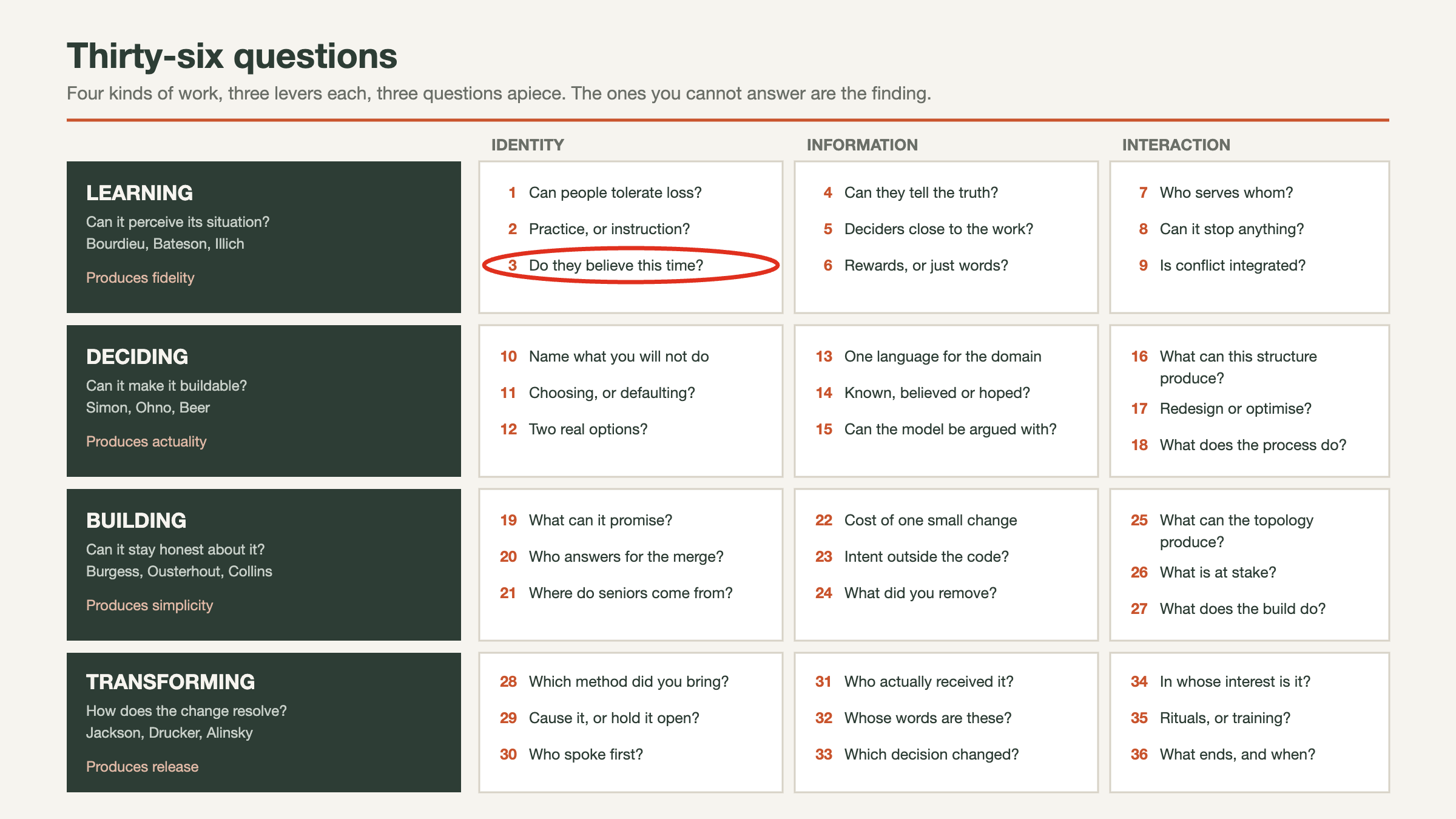
Do people believe that this time will be different?
Never ask it directly, because the direct version invites the reassuring answer and everybody in the conversation knows it. Ask instead what happened to the last three changes, who is still here from them, and what happened to the people who put themselves out for the second one. The answers usually arrive quickly, with dates, which tells you the subject has been discussed at length in rooms you were not in.
Then watch for the behavioural signature, which is compliance without initiative. People do what is asked and nothing next to it. Tasks close on time. Compliance closes tasks, and compliance starts nothing.
2. Purpose
The question separates disagreement from disbelief, and they look identical in a meeting while needing opposite handling. Disagreement is a gift. It can be argued with, and sometimes it is right. Disbelief cannot be argued with, because it is not a position about your plan. Disbelief is an extrapolation from your track record, and every counter-argument you offer is more of the thing that failed to work last time.
It also prices your own history honestly. Every change that was launched and quietly abandoned is a deposit against the next one, and the balance is held by the people you now need. Nobody is withholding effort out of malice. They are declining to spend discretionary energy on a bet that has lost three times, which is what a well-calibrated person does.
The tell is a sentence you have heard often enough to stop noticing. Somebody says, let us see how it goes. It is not resistance and it will never be recorded as a risk, and it means that the person has decided to wait you out, which for many of them is a strategy with an excellent historical return.
3. Context
Martin Seligman found the mechanism in the laboratory. Animals exposed to outcomes they could not influence stopped trying, and the passivity persisted into later situations where control was available and obvious. He called it learned helplessness, and the finding transferred to humans with uncomfortable ease. Fifty years later Seligman and Steven Maier revisited the neuroscience and reversed the emphasis: passivity under prolonged adversity turns out to be the default response, and what gets learned is the detection of control. That reframing matters here. Your organisation has not learned to be helpless. It has failed to learn that it has any control, which is a different problem with a different remedy.
Albert Bandura named the remedy and ranked the options. Belief in one’s own efficacy comes from four sources: doing the thing successfully, watching somebody like you do it, being told you can, and how your body feels at the time. Those four sources sit in descending order of power, and the third is usually the weakest by a distance. Almost every change programme relies on it exclusively, which is why the town hall raises the mood for a day and moves nothing.
Carol Dweck explains who gives up first. Where ability is treated as innate, the effort a change demands is read as evidence of inadequacy, so the safest move is to avoid the situation that requires it. The organisation that celebrates its brilliant people most loudly has the most people quietly declining to be seen learning.
Pierre Bourdieu explains why the belief will not shift under argument. Repeated experience lays down dispositions in the body, and a disposition is not an opinion someone is holding. A disposition is closer to a reflex about what is worth trying, formed by what has been worth trying so far, and a disposition updates through experience rather than through persuasion.
Deci and Ryan add the condition most transformations violate on day one. Sustained effort depends on autonomy, competence and relatedness, and a change that arrives as a mandated method, delivered on a timeline nobody consulted them about, removes the first and threatens the second. Motivation is not something you can instal. You can remove the things suppressing it, and a great deal of what suppresses it was put there by the previous programme.
Karl Weick supplies the way out. A problem framed at enormous scale exceeds what anybody can act on, produces the arousal that makes action worse, and invites the response of doing nothing carefully. Reframe it as a series of small, concrete, complete outcomes and you get small wins, which are modest, visible and difficult to argue with. Each small win tends to change what people believe is possible, and the changed belief is what makes the next small win available.
4. Action
Finish one small thing, in public, and let the people who did it be the ones who describe it.
Pick something a team has complained about for more than a year. Not a strategic priority: a piece of grit, the kind that shows up in every retrospective and never in any plan. It must be small enough to complete inside six weeks, and it must be theirs, chosen by them rather than selected by you as a suitable pilot. Fund it, remove the approval that has been blocking it, and then leave. The temptation to supervise it is the one thing that will spoil it.
Two conditions decide whether it works. The problem has to be their choice, because Bandura’s second source only transmits between people the observer recognises as similar, and a director demonstrating the new way proves nothing to an engineer. And it has to actually finish, because a partial win is read as confirmation of the pattern and costs you more than doing nothing would have.
Alongside that, do the harder thing, which takes ten minutes and most leaders never do it. Name the last three changes out loud, say what happened to each and why, and say what is different about the conditions now. Not different about the intent, which was fine last time as well. Different about the sponsor, the funding, the decision rights, the thing that broke before. If nothing structural is different, you have your answer, and launching anyway spends credibility you will need later on something that cannot work.
Protect the win from your own organisation. The fastest way to destroy it is to make it a programme, at which point it acquires a name, a steering group, a reporting pack and an obligation to demonstrate scale, and the people who did it stop recognising it as theirs. Let the second team copy it badly and in their own way. Copying badly is the mechanism spreading.
Measure the thing that actually indicates belief, which is unasked-for adjacent action. Engagement scores will tell you how people feel about being surveyed. What you want to know is whether anybody has started something next to the change without a business case or an invitation. Until that appears, you have compliance, and compliance survives exactly as long as the attention does. Evidence made the belief, and only evidence will change the belief. Not a message about the change, not a survey about the change, not a town hall about the change. One finished piece of work is evidence. Three abandoned programmes are evidence too, and they are the evidence your people currently hold.
This question sits in the Learning group of the series, the articles asking whether an organisation can perceive its own situation accurately enough to respond to it. What an organisation gets out of that work is fidelity, meaning an account of its situation that matches the situation. The route from there into deciding what to do about it is set out in From Learning to Clarity.
Further Reading
Karl Weick, Small Wins: Redefining the Scale of Social Problems, American Psychologist (1984), free at https://homepages.se.edu/cvonbergen/files/2013/01/Small-Wins_Redefining-the-Scale-of-Social-Problems.pdf, for why a problem stated at full scale cannot be acted on.
Steven Maier and Martin Seligman, Learned Helplessness at Fifty: Insights from Neuroscience, Psychological Review (2016), for the reversal of the original theory and why control is the thing that gets learned.
Albert Bandura, Self-Efficacy: The Exercise of Control (1997), for the four sources of efficacy belief and the weakness of persuasion among them.
Carol Dweck, Mindset (2006), for why effort is read as evidence of inadequacy where ability is treated as innate.
I write about the industry and its approach in general. None of the opinions or examples in my articles necessarily relate to present or past employers. I draw on conversations with many practitioners and all views are my own.