
Two teams in the same company. Same stack, same hiring bar, same director two levels up. One of them ships steadily, argues well in the open, and turns a competent joiner into a good engineer inside a quarter. The other has the stronger people on paper and cannot get out of its own way. Every technology leader has met this pair, and the words we reach for are culture, leadership and luck. All three name the thing without accounting for it. What is the mechanism?
For fifty years Randall Collins worked on that gap, and his answer is uncomfortable in a useful way. The difference sits in the situations people pass through rather than in the people, and situations either charge people or flatten them. Move an engineer from the second team to the first and in six weeks you have a different engineer with the same skills. Nothing about her changed. The rooms did.
This phase of the series asks three questions about building: what a builder is and what a builder can promise, what a builder has to know, and what holds a team together while it works. Burgess answered the first. Ousterhout answered the second. Collins answers the third, with a theory that was never about software at all.
The last article left five practitioners agreeing on one finding: the input mode has changed, the discipline has not, and the load has moved to review. Review is not a stage in a pipeline. Two or more people hold one object in their attention at the same time and arrive at a shared judgement about it. It remains the oldest social technology we have, and the one currently under the most pressure.
The interaction lever has changed register twice already in this series. Illich asked whether an institution’s tools serve the activity or quietly take it over. Beer asked whether the channels could carry the variety the situation was throwing at them. Both are design questions, answerable at a whiteboard. Building asks something smaller and much harder to fake. When people are making a thing together, what is the actual mechanism by which they cohere, and what happens to that mechanism when the making stops passing through them?
Collins was born in 1941 and, as an undergraduate at Harvard, heard Talcott Parsons lecture on Durkheim’s account of religion, in which what holds a congregation together is the ritual rather than the belief. He describes that lecture as the revelation that set the direction of everything after it. A psychology master’s at Stanford followed, then a doctorate at Berkeley in 1969 under Herbert Blumer, Erving Goffman and Reinhard Bendix. He is Dorothy Swaine Thomas Professor of Sociology at Pennsylvania and was president of the American Sociological Association in 2010. Conflict Sociology came in 1975, The Credential Society in 1979, The Sociology of Philosophies in 1998, Interaction Ritual Chains in 2004, Violence in 2008, and Napoleon Never Slept in 2015.
Two of his teachers are already in this series. Goffman gave us the interaction order in the learning phase. Parsons gave us the systems view of institutions. Collins took Goffman’s close observation of face-to-face life and turned it into a mechanism with inputs and outputs, which is what makes him usable on a Monday morning.
1. The situation is the unit, not the person
Sociology usually starts with individuals and builds up to groups. Collins inverts that. His unit of analysis is the situation: a bounded encounter between people, with a beginning and an end. Individuals are what their chain of situations has made them, and they are being remade continuously, including this week.
That sounds abstract until you apply it to hiring. If the person is the unit, a strong team is a procurement problem: find the good ones, pay for them, assemble them. Every organisation I have watched has run that experiment at some point, and the results are famously unreliable. Collins tells you why. The engineer who was extraordinary at her last company was extraordinary inside a chain of situations, and you bought her without buying any of them. She arrives, the situations here are different, and within two months everybody privately concludes that the interview process failed.
It also explains the thing managers find hardest to say out loud. You do not have good people and bad people. You have situations that charge people and situations that flatten them, and the same person passes through both in a single week. When you describe someone as low energy you are usually describing where they have been sitting.
The practical consequence is that the lever is not the person, and it is not the culture either. It is the design of the recurring situations that person is in. Situations are a far smaller thing to change than a culture, and you can start on them immediately.
2. Four ingredients, and most of your meetings have two
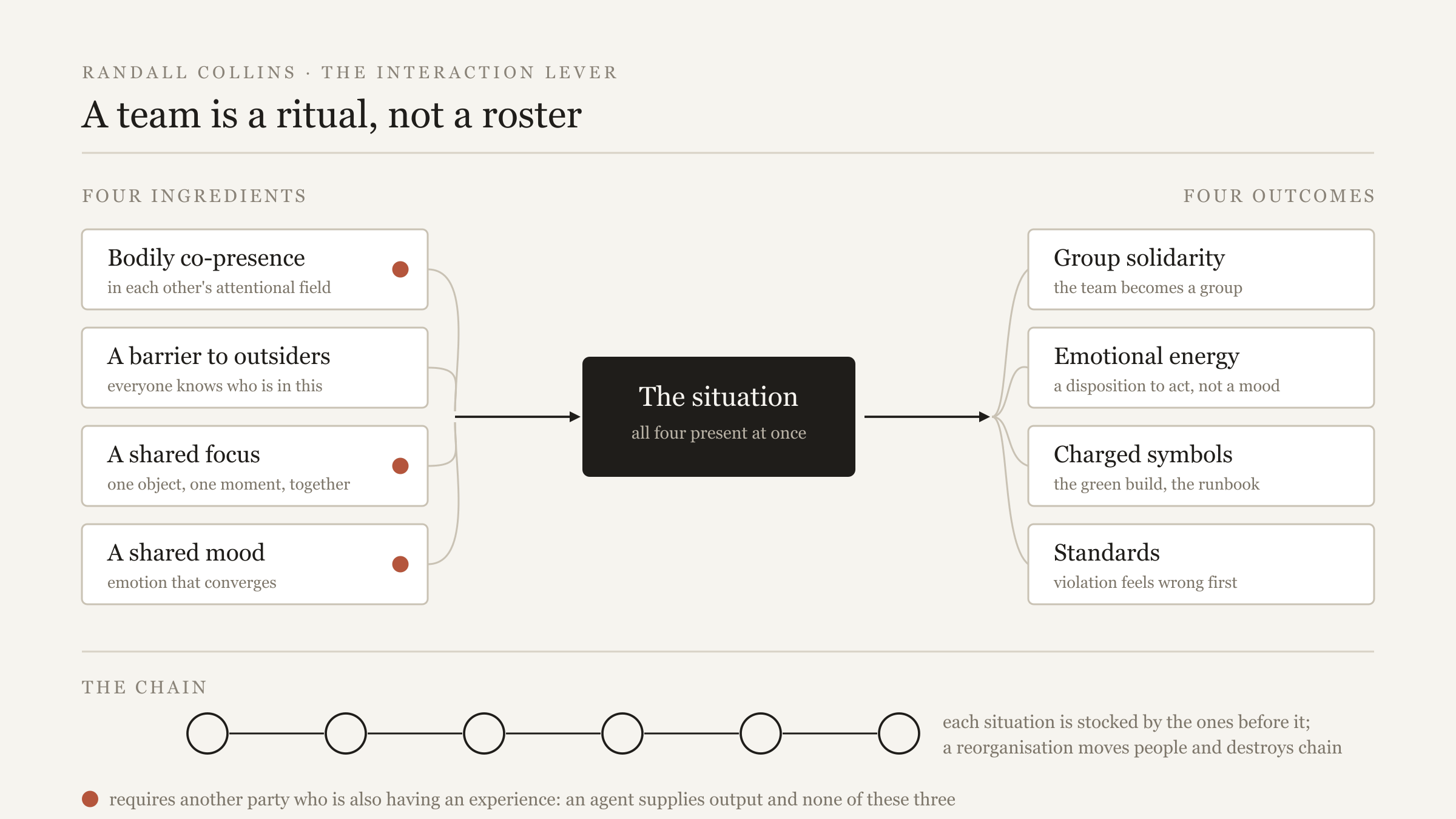
Collins names four ingredients, and all four have to be present at once. Miss one and the gathering still happens. The group does not.
Bodily co-presence: people in each other’s physical or attentional field, aware of one another as bodies rather than as names on a list. A barrier to outsiders: everyone knows who is in this and who is not. A shared focus of attention: at any given moment everyone is attending to the same thing, and knows that the others are too. And a shared mood: an emotion that converges across the group rather than being felt privately by each person.
Test your standing meetings against those four. A daily standup where twelve people report serially to a facilitator has co-presence of a sort and nothing else. Each person attends to their own turn, and there is no moment at which the group looks at one thing together. A quarterly planning session has a barrier and no mood. A recorded all-hands has neither.
Then test an incident call, which passes on all four and passes hard. Everyone is present and knows exactly who else is. The boundary is sharp; you are on the call or you are not. There is one graph and everyone is looking at it. The mood is unmistakable and it is shared. This is why teams bond in incidents and do not bond in planning, and why people who have been through a bad night together will do things for each other for years afterwards. Nobody designed that ritual. In many organisations it is the only one running properly.
The uncomfortable ingredient is the barrier. Open invitations, optional attendance and a recording for anyone who missed it are all reasonable and considerate policies, and every one of them weakens the ritual. A gathering that anyone can drop into is a broadcast. There is nothing wrong with a broadcast, and you should stop expecting it to produce a group.
3. Emotional energy is a disposition to act
The currency Collins tracks is emotional energy, and the phrase invites a soft reading, so take his definition exactly. On page 49 of Interaction Ritual Chains he calls it a sustained feeling of confidence, elation, strength, enthusiasm and initiative in taking action. The last three words carry the concept. The concept names a disposition to act, and you can observe it without asking anybody how they feel.
High emotional energy looks like this. Someone picks up an ugly ticket nobody assigned. Someone argues with a senior person in an open channel. Someone volunteers to own the migration, or starts the work rather than scheduling a meeting about starting the work. Low emotional energy looks like waiting: perfectly polite, perfectly professional waiting, with every process followed.
Because it is produced in situations and carried out of them, emotional energy is not a personality trait. Leaders get this wrong, and it is expensive. The same person is a fountain on one team and flat on another. You did not hire a fountain and you did not hire a flat person. You put a person into a chain. The chain did what chains do.
So the management question at the end of any recurring meeting is not whether people found it useful. Did they leave more likely to act? Morale is what you measure in a survey. Emotional energy is what you can watch happening at four o’clock on a Thursday, and the two frequently disagree.
4. Why the codebase used to be sacred
When the four ingredients combine, Collins says you get four outputs: solidarity in the group, emotional energy in the individual, symbols charged with group significance, and standards of morality that make violating those symbols feel wrong.
The third and fourth outputs are the ones that matter for building. Every engineering team you have admired had sacred objects. The green build. The runbook. The naming convention that somebody defended in a review three years ago (nobody now remembers who) and everyone still follows. Nobody enforces these, and that is precisely the point. They are charged, in Durkheim’s sense, by the rituals that produced them, and violating them feels wrong well before anyone works out which argument to make.
This gives you an account of something engineers report constantly and struggle to justify. The flatness people describe about generated code is a symbol problem. A thing that nobody assembled together carries no charge. When the codebase stops being something the group made in each other’s presence, it stops being a sacred object, and the standards that were held in place by a feeling of wrongness lose the thing that was holding them up.
That is where standards actually go. They do not go in a decision, and they do not go in a memo. They dissolve quietly when the ritual that charged them stops running, and the first anyone notices is a review comment that nobody bothers to make. The measured collapse in refactoring that the last few articles pointed at has a cost explanation and a Collins explanation, and I think you need both of them. Tidying got cheaper, and at the same time it stopped feeling like something you owed anyone.
5. Thinking happens in rooms, and the chain is the asset
The Sociology of Philosophies is Collins’s largest book and the one most worth an executive’s afternoon. He traces two and a half thousand years of intellectual creativity across Greece, China, India and Europe, and finds the same structure everywhere. Ideas are produced in networks of face-to-face contact between rivals. The great names do not work alone; they cluster, they teach each other, they argue with people they know personally, and the chains of contact run for generations.
Out of that comes his law of small numbers. In any field, the count of actively contending positions stays small, roughly between three and six, because attention is a limited resource and a field can only sustain so many live arguments at once. Rivals need each other. Nobody can hold a position in a space where a hundred positions are being asserted, so the field self-organises into a handful.
Both findings land directly on engineering. Your architecture debate has room for about four live positions; past that, people stop attending and start waiting for the decision, which is why the review with nine competing proposals produces less thinking than the one with three. And the deeper claim is the one to take into any argument about remote work, asynchronous review or autonomous agents: on the historical evidence, co-presence produces thinking, and not merely comfort. The claim is a strong one. Collins spent six hundred pages on it, and it deserves better than being waved away as sentimentality about offices.
The word chains does the rest of the work. Each situation is stocked by the ones before it: the symbols, the shared references, the accumulated knowledge of who is reliable under pressure. A team’s capacity to hold its attention together is an asset that was built up over time, and it can be spent as well as built.
Which reframes the reorganisation. When you split a team and redistribute its people, the slide shows headcount moving and capability preserved. What moved is people. What did not move is the chain. The new group starts accumulating from close to zero: no shared symbols, no history of joint attention, no established sense of what the mood in the room means. That recovery takes a couple of quarters and is never planned for, because the asset you destroyed was never on any register.
It also gives a better account of onboarding. A new joiner is slow because they have no chain, and information alone will not supply one; you can hand over information in a week. They have not yet been in the room when the group looked at something hard together, so the symbols mean nothing to them and they cannot read the mood. Every senior engineer knows the moment when a new person becomes one of us, and it is always a situation rather than a milestone.
6. What an agent cannot do, and what that costs
Now the part this phase has been building towards. What happens to a ritual when one of the participants is not having an experience?
An agent supplies output. It cannot supply co-presence, it cannot share a mood, and it cannot receive emotional energy or generate any. This is not a complaint about the technology. It carries no prediction that the tools will stop improving. Three of Collins’s four ingredients require another party who is also having an experience, and capability does not supply that.
Three consequences follow. None of them appears on a delivery dashboard.
The number of situations falls while output rises. Work that used to pass through two people now passes through one person and a model. The pairing, the design conversation at the whiteboard, the fifteen minutes of arguing about an interface: those were rituals, and they have been quietly optimised away, because the value in them was never the artefact they produced.
Shared focus fragments. Each engineer now works inside a private context: their session, their prompt history, their accumulated instructions to the model. Attention has never been more concentrated and never less shared. Two people on the same team can spend a fortnight in the same service without a single moment in which they were looking at the same thing together.
And review changes character. Review used to be a ritual with mutual focus: two people holding one object and reaching a judgement, with the reciprocity that makes a ritual charge rather than drain. Reviewing a large volume of generated code is closer to inspection. It runs one way, nobody is having the experience with you, and the person doing it comes out flatter than they went in. Five practitioners reported last time that the load has moved to review. On this account it moved onto the one activity that was carrying the social work, and we degraded that activity at precisely the moment we made it more important.
Collins is alive to the question himself. In an interview published in Theory and Society in 2024, following the inaugural meeting of the Norwegian Microsociological Network, he addressed whether bodily co-presence still carries the weight it did when he wrote the book, how online rituals compare with offline ones, and what artificial intelligence might do to the ritual landscape. The honest summary for our purposes is that the mechanism is not in question. What is in question is whether anything can substitute for the ingredients, and so far nothing has.
7. Solidarity is not the same as being right
The theory has a limit, and you should carry it into any argument where you use him.
Collins explains why groups cohere. He does not explain whether the group is any good. A team can be tightly bonded around a bad framework, a defensive practice, or a sacred object that should have been deleted in 2019, and the solidarity will be entirely real. High emotional energy in a team that is confidently building the wrong thing is worse than low energy, because it is faster.
A second limit is argued well by Boyns and Luery in 2015: the framework is underdeveloped on its negative side. Failed and hostile rituals also generate energy of a kind. The blame-heavy incident review, the war room that runs on adrenaline, the channel where people bond over shared contempt for another department: all four ingredients present, all four outputs produced, and the energy is corrosive. It charges the people in the room and burns the chain they are standing on.
So this lever needs its two companions. Identity asks who is actually accountable for the thing, which is where Burgess put the weight. Information asks what has been made visible to whoever arrives next. That is Ousterhout’s question. Interaction asks whether the group can hold its attention together long enough to answer either one. Collins is the lever people skip, because it looks like the soft one. It quietly determines whether the other two are answerable at all.
8. What this lever asks of you now
You cannot mandate emotional energy, and the attempt is visible from a long way off. What you can do is design the situations, and there are fewer moves available than you might expect, which is good news for anyone with a full calendar.
Run fewer rituals and give the survivors all four ingredients. One artefact, in front of everyone, at the same moment, with a clear boundary around who is in the room and who is not. A weekly session in which a team looks together at one thing it built will do more than five status meetings, and it will cost less.
Put the pairing where the work now is. If the writing has moved to the model, then pair on the review. Two people, one screen, one diff, one judgement, out loud. That restores the mutual focus the old ritual supplied and attaches it to the activity that now carries the risk.
Keep at least one artefact that the group makes in each other’s presence. It matters less what it is than that it exists: the architecture diagram, the incident write-up, the interface everyone argued about for an hour. Without a jointly assembled object there is nothing for the standards to attach themselves to, and standards that float free do not survive their first busy quarter.
And audit the rituals that drain. Every organisation has a recurring meeting that reliably sends people out flatter than they came in, and it survives because it is on the calendar and because cancelling it would look like a governance failure. On Collins’s account that meeting is doing active damage. Every session of it spends the chain, and you pay for the privilege.
The next article takes all of this into structure. Conway told us that the systems we ship copy the communication structures that produced them. Collins tells you which of those communications are real, because a channel that carries no shared attention transmits information and produces no group. And the telos of this phase, simplicity, turns out to depend on him in a way that is easy to miss. Joint attention is finite and it does not scale. A system that no group can hold in shared focus cannot be kept simple by anybody, whatever the tooling promises you.
(An Organisational Prompt is something you can do now, in your own organisation, with the ideas in the article.)
Organisational Prompt
Count the room, then count what leaves it.
Take one team and one fortnight. List every recurring situation in which that team is together: the standup, the review session, the planning meeting, the on-call handover, the demo. Before each one starts, mark which of the four ingredients is actually present. Are people in each other’s attentional field, or on mute with a second screen. Is it clear who is in and who is watching. Is there one thing everyone is looking at at the same moment. Does the mood converge. Or is each person alone with it.
Then stop assessing the meeting and start watching the twenty minutes after it. Do not send a survey. Watch. Who starts something. Who picks up work nobody assigned. Who raises a hard question in a channel. Who goes quiet and does not reappear until lunch.
Two weeks of that gives you a short list you will find hard to unsee. Any recurring situation with two ingredients or fewer, producing no action afterwards, is a chain you are paying for and not banking. Fix one ingredient or delete it, and do not replace it with a new meeting.
Then the question that costs something. Name the last artefact your team assembled together, in each other’s presence, in the past month. If you can name it, protect that ritual above everything else on the calendar. If you cannot, you have found the reason the standards have been slipping, and it was never a discipline problem.
Further Reading
Randall Collins, Interaction Ritual Chains, Princeton University Press, 2004. The four ingredients and the four outcomes are laid out in the first two chapters, and the definition of emotional energy is on page 49.
The future of interaction rituals, Collins interviewed by Lars Johannessen in Theory and Society, 2024, on co-presence, online rituals and what artificial intelligence may do to the ritual landscape.
Sinisa Malesevic and Steven Loyal, an introduction to the special issue on Collins, Thesis Eleven, 2019. The best short route into the whole body of work.
David Boyns and Sarah Luery, Negative Emotional Energy: A Theory of the Dark-Side of Interaction Ritual Chains, Social Sciences, 2015. Open access, and the strongest criticism in print.
Sociologizing with Randall Collins, a 2018 interview covering emotions, violence and the attention space.
I write about the industry and its approach in general. None of the opinions or examples in my articles necessarily relate to present or past employers. I draw on conversations with many practitioners and all views are my own.