
A team of six ships something difficult on a Thursday afternoon. Somebody says it in the channel, somebody else replies with a picture of a dog in sunglasses, two of them get up and go for coffee still talking about the thing, and by Friday morning the same six people take on a problem they would have flinched at in March. Nothing measurable happened between Thursday and Friday. No process changed, no tool was introduced, no capability was acquired. Something was produced anyway, and every experienced leader has watched it happen and has no vocabulary for it beyond momentum, which explains nothing.
Collins has the vocabulary. His answer is that the thing produced on Thursday afternoon is emotional energy, that it was produced by a ritual, that rituals have four identifiable ingredients and four identifiable outputs, and that the whole business is mechanical enough to design for. This is not a soft claim about culture but a specific account of where a group’s capacity to act comes from, which is why the Interaction lever here belongs to a sociologist rather than an engineer.
Building runs on three lever questions. Identity covers who or what is building and what a builder can honestly promise; Mark Burgess holds that one, and his answer is that an autonomous thing can only promise what lies within its own control. Information covers how the build sees and what it must carry; John Ousterhout holds that one, and his answer is that complexity is the enemy. Interaction covers how teams, components and agents relate, and where the energy comes from to sustain a cadence at all.
Collins holds Interaction. He holds it because the other candidates describe the arrangement of teams while he describes what makes a team a thing rather than a list of names. His account also says most precisely where the human and the agent part company. Agents can produce work. They cannot participate in the ritual, because they have nothing at stake in the outcome, and the ritual is where the energy comes from.
1. What Collins inherited, and from whom
Around 1960, as an undergraduate at Harvard, Collins sat in a lecture where Talcott Parsons explained Durkheim’s account of religion. The claim was not that religion is about belief in the supernatural. Religion began, on Durkheim’s account, as a process by which humans came together in emotional rituals, and those rituals produced symbols standing for membership of the group. Collins describes this as a revelation, and it is worth understanding why. He had grown up attending Protestant churches where nobody seemed especially exercised about theology. What the church actually did was assemble people.
He took a master’s in psychology at Stanford, then went to Berkeley for his doctorate, finishing in 1969 under Herbert Blumer, Reinhard Bendix and Erving Goffman. Both Parsons and Goffman have already appeared in this series, in Learning, which means the Interaction lever in Building runs on a line drawn directly back through it. Goffman gave him the microscope: the study of what actually happens between people in a room, at the scale of seconds. Durkheim gave him the mechanism. Collins spent forty years putting them together.
The result, stated across Conflict Sociology in 1975 and given its full treatment in Interaction Ritual Chains in 2004, is a move most people find counter-intuitive on first contact. The unit of analysis is not the individual but the situation. People are not fixed entities who bring their qualities into encounters; they are the accumulated residue of the encounters they have been through, and they carry different capacities out of different rooms. That inversion is what makes the theory useful to anyone running an organisation, because situations can be designed and personalities cannot.
2. The four ingredients
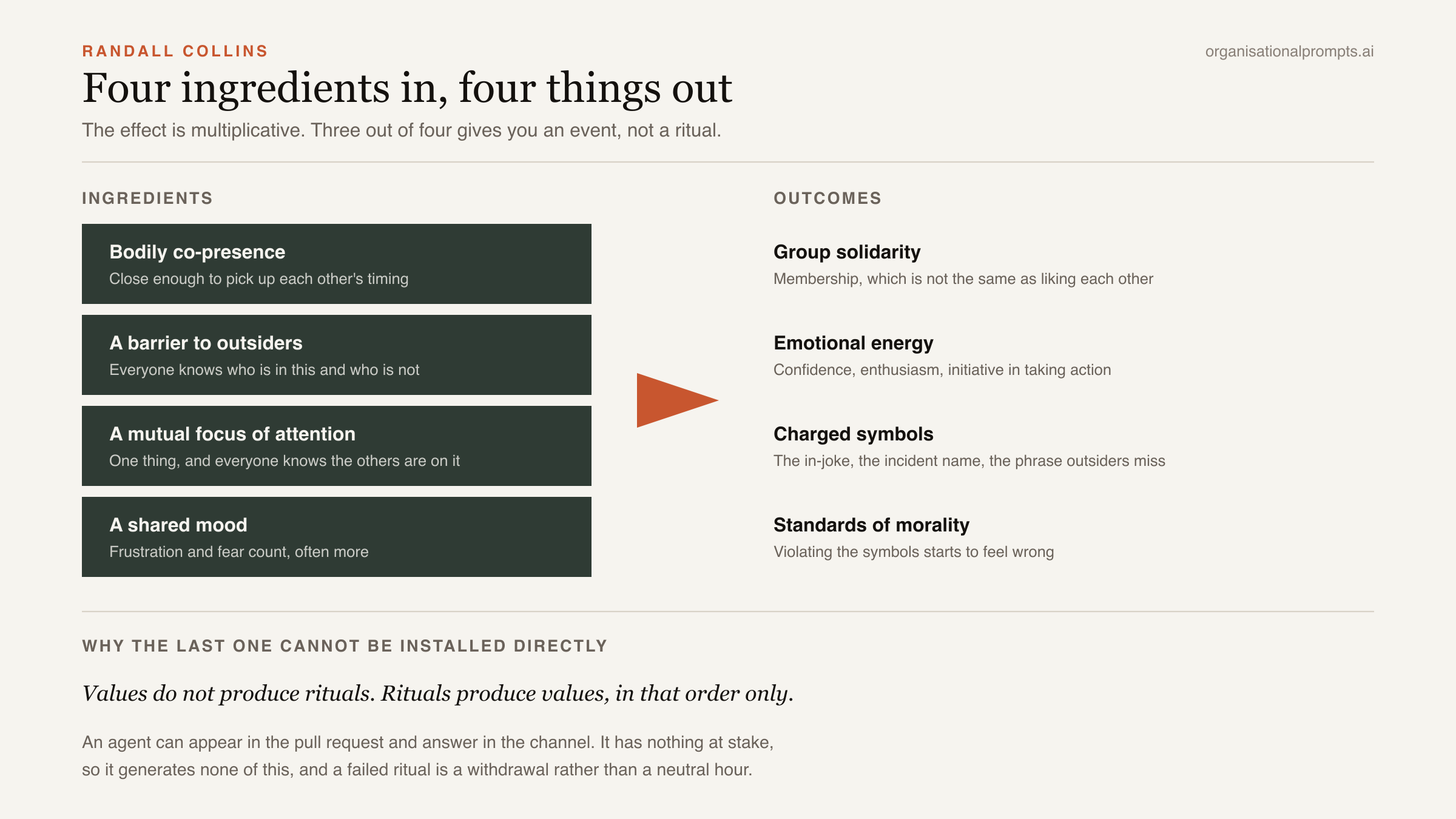
On what an interaction ritual requires, Collins is precise, and the precision is the value. Four ingredients, and the effect is multiplicative rather than additive.
Bodily co-presence. People in the same physical space, able to affect each other in ways below the level of attention: posture, timing, the small automatic rhythms of turn-taking. Collins is careful that this is not about being able to see faces. He means entrainment, the way people in a room synchronise without deciding to.
A barrier to outsiders. The participants know who is in this and who is not. A ritual with no boundary produces nothing, because there is no group for the solidarity to attach to.
A mutual focus of attention. Everyone attending to the same thing, and, importantly, aware that everyone else is attending to it too. Six people looking at the same screen is not the same as six people each reading the same document alone.
A shared mood. Some common emotional state, which does not have to be a pleasant one. Shared frustration works. Shared fear works, and often works better.
Get all four and they feed back on each other. The shared focus intensifies the shared mood, which sharpens the focus further, and the group enters what Durkheim called collective effervescence and what everyone else calls the meeting where something finally clicked. Get three of the four and you get an event, not a ritual. Attendance is not participation, which every organisation knows and almost none acts on.
3. The four outcomes
When the ingredients combine, four things are produced, and it is worth reading them as outputs of a process rather than as virtues.
Group solidarity. A feeling of membership. Not affection for the individuals, which is a different thing entirely and frequently absent; a sense of belonging to the unit.
Emotional energy in the individual. Collins defines this as a sustained feeling of “confidence, elation, strength, enthusiasm, and initiative in taking action”. Note that last item. Emotional energy is not a mood. Collins is naming a disposition to act, which is why it shows up in behaviour rather than in engagement surveys.
Symbols charged with group significance. The in-joke, the name of the incident, the phrase that means nothing to anyone outside. These are Durkheim’s sacred objects rendered ordinary, and they are how a group carries its solidarity between meetings.
Standards of morality. Violating the symbols starts to feel wrong. This is the part organisations most often try to install directly, through values posters, and it is the one output that cannot be installed directly, because it is a consequence of the other three.
That last observation is worth sitting with if you have ever been handed a culture programme. Values do not produce rituals. Rituals produce values, and in that order only.
4. The energy is in the gathering, not the person
The most useful thing in Collins for a working leader is that emotional energy is produced by situations and carried between them, rather than being a property of a person.
You have seen the evidence yourself. The same engineer is transformed in one team and flat in another. The obvious explanation is fit, or management quality, or a bad manager, and those are sometimes true. Collins’s explanation is more mechanical. The person is running down or charging up depending on the rituals they participate in, and they are drawn, over time, towards interactions that pay out and away from those that drain. People do not choose their meetings on the merits. They choose them on the energy return.
This reframes several persistent puzzles. Your quiet high performer who is unrecognisable in one particular working group is not two people. Your reorganisation that moved the same individuals into different rooms and produced entirely different output was not a coincidence. And the person who has become steadily less initiative-taking over eighteen months has probably not lost their ability; they have been sitting in draining rituals, and emotional energy that is not replenished does not persist.
Collins takes this further than most readers expect. He argues that thinking itself is the internalisation of conversation, so the quality of your internal reasoning is downstream of the encounters you have had. The Sociology of Philosophies, published in 1998, tests this at scale: he traces two and a half thousand years of intellectual creativity and finds it clustered in networks of face-to-face contact between rivals. Great ideas do not come from isolated minds. They come from chains of encounters, and they come disproportionately from people who spent time in rooms with the small number of others working on the same problem.
5. Chains: why a team is a stock, not a state
The word chains does the real work in the title, and it is what makes the theory organisational rather than merely social.
Each ritual is stocked by the ones before it. The symbols charged in June are what allow the group to reach a shared focus quickly in July. The solidarity built during a bad outage in August is what makes an honest and difficult conversation possible in October, when somebody has to say that the approach is not working. A team’s capacity to concentrate together is therefore an accumulated asset rather than a standing property. Like any asset it can be built up, drawn down, or written off in a reorganisation without anyone recording the loss.
This explains the thing that most annoys experienced leaders about org design. You move six people into a new structure that is defensibly better on paper, and productivity falls for two quarters. The usual account is storming and norming, which describes the phenomenon without explaining it, and I have sat through that explanation four times without it ever getting better. Collins explains it: you did not move six people. You destroyed a chain and started a new one at zero, and the new chain has no charged symbols, no established rhythm of attention, and no accumulated solidarity to draw on when something goes wrong.
The corollary is more useful. A team that has been through a real crisis together is worth materially more than the same six people who have not, and nothing in your capability matrix will show it.
6. Your organisation already runs rituals
Every engineering organisation runs interaction rituals continuously. Standups, code review, incident calls, demos, retrospectives, planning, the release. What almost none of them do is ask which of these charge the group and which drain it, though the four ingredients give you a checklist you can apply this week.
Take the standup. A standup where six people give sequential status updates to a manager has one ingredient at best. There is no mutual focus, because everyone is waiting for their turn and thinking about their own item. There is no shared mood, unless mild dread counts. A standup where the team looks together at something that is stuck has all four, and the difference is not the duration or the tooling. What separates them is whether the group is attending to one thing or to six.
Or the incident call. Incidents produce the strongest rituals in most technology organisations, and they do so without anyone designing them. All four ingredients arrive by force: co-presence, an obvious barrier between those on the call and everyone else, a mutual focus nobody has to be reminded of, and a shared mood of considerable intensity. That is why teams that have handled a bad outage together behave differently afterwards, and why the war story becomes a charged symbol within days. And it explains why an organisation that outsources its incident response loses something it did not know it was buying.
The retrospective is the interesting case, because it can go either way. Run well it generates symbols and solidarity. Run as a compliance exercise in which nothing is ever changed, it drains, and worse, it teaches the group that its attention is worthless. A failed ritual is not neutral. Failed rituals cost energy, on Collins’s account, which means the meeting nobody wanted is not zero-impact. That hour is a withdrawal.
In every organisation I have worked in, the reliable signals were behavioural rather than reported. Attendance at optional sessions, whether cameras come on unprompted, whether the conversation continues after the formal end, whether the in-jokes are recent. Those are the observable signals, and they are more reliable than any instrument you can buy.
7. Nothing at stake
Here the argument reaches the discontinuity it has been building towards, and Collins gives it a harder edge than any argument about capability.
An agent can produce work of considerable quality. It can take part in something that looks like a ritual. It appears in the pull request, it responds in the channel, and it can be given a name and a personality if you are that way inclined. What it cannot do is participate in the ritual, and the reason is structural rather than sentimental.
The energy is generated by mutual entrainment among participants who are affected by the outcome. The agent is not affected. It does not carry the residue of Thursday into Friday, does not experience the shared mood, does not find the symbol meaningful, and does not act differently in March because of what happened in November. It has nothing at stake, and having something at stake is the precondition for the energy the group runs on.
Burgess arrives here from the Identity side saying the same thing in a different vocabulary. An agent can promise, because a promise is a statement about behaviour within its own control. What it cannot do is care whether the promise holds. Collins tells you what that costs at the group level. The capacity to sustain a cadence, to hold attention together, and to keep going through a difficult month is produced by people being in it together, and the agent is not.
The practical consequence is uncomfortable for anyone planning a headcount reduction on the strength of a productivity claim. You can replace a large fraction of the typing. You cannot replace a participant in the chain without reducing what the chain generates, and the reduction will not show up in the quarter you make it. It will show up as a team that has become oddly brittle, slower to recover, less willing to take on the difficult thing, with no single decision anyone can point to as the cause.
8. The complications, honestly
Three things make this harder than the argument so far suggests, and the argument is more useful if I name them.
The first is that bodily co-presence, Collins’s first ingredient, was already substantially removed from software work before any agent arrived. Distributed teams have been running weakened rituals for years. Collins addressed this directly in an interview published in Theory and Society in 2024, after a visit to Oslo Metropolitan University, and he is not dismissive of digital interaction. His position is that the mechanism still operates and the intensity is lower, which is roughly what most people report from experience. Video sustains a mutual focus reasonably well and sustains entrainment poorly, because the sub-second rhythms that produce it do not survive the latency.
If you are distributed, the conclusion is not that you are doomed. The conclusion is that your rituals are running at reduced power, and that you need more of them, or occasional high-intensity co-present ones, to charge the same chain. The organisations that fly people in twice a year for something that looks like a jolly are often, without knowing it, doing the only thing that works.
The second complication is that emotional energy resists measurement. Collins has been cited far more than he has been elaborated, and the concept has been criticised for exactly this. Boyns and Luery argued in 2015 that the negative side is underdeveloped: failed and hostile rituals also generate energy of a kind, and a group can be charged by shared contempt as easily as by shared purpose. Anyone who has worked in a high-solidarity team that had turned entirely against the rest of the organisation will recognise the gap.
The third is the one that matters most for how you use this. The theory explains why solidarity forms. It says nothing about whether the group that forms is any good. A tightly bonded team with charged symbols and abundant emotional energy can be building the wrong thing with tremendous conviction, and Collins’s framework will register it as a healthy ritual chain. Solidarity is a capacity, not a virtue, which is why this lever needs the other two to stay honest.
9. What a leader actually does with this
Four things, and none of them is a culture programme.
Treat your meetings as an energy budget rather than a time budget. Every recurring session either charges the group or drains it, and the cost of the draining ones is not the hour but the withdrawal from a chain that took months to build. If a meeting cannot pass the four-ingredient test, either fix it so that it can or stop holding it, and stopping is usually the braver and better option.
Protect the chains when you reorganise. Not the individuals, the chains. The question to ask before moving people is which accumulated groups you are about to write off, and whether the structural improvement is worth more than what those groups can currently do together. Sometimes it is. Most reorganisations never ask.
Design for something at stake. If the outcome does not matter to the people present, no ritual you design will produce anything, and this is the deep problem with a great deal of process theatre. Ownership is not a governance nicety; it is the precondition for the energy that makes ownership work. Consequences shared by the group are what turn a meeting into a ritual.
And be deliberate about where the humans are in the loop, for reasons that have nothing to do with quality control. Collins’s later work with Maren McConnell reads leadership itself as the capacity to generate and direct emotional energy in others, the leader as an amplifier in a chain rather than a source of instructions. If your organisation quietly becomes a set of individuals each supervising their own agents, you will have preserved the output and destroyed the mechanism that produces initiative, and initiative is the thing you actually cannot buy.
The last article in the Interaction group takes this from the individual team to the shape of the whole organisation, which is Conway’s territory and, after him, Team Topologies.
Where this sits: Building, the third of four phases; Learning, Deciding, Building, Transforming. Collins is the foundational thinker on Interaction, the questions about how the builders relate, and his claim is that the energy a team runs on is generated in ritual and cannot be supplied by anything with nothing at stake. The Build Is the Test sets out the argument these articles run on.
(An Organisational Prompt is something you can do now....)
Organisational Prompt
Audit one week of meetings against four ingredients.
Take one team’s calendar for a normal week and list every recurring session. There will be more than you expect, somewhere between eight and twenty for most teams.
Score each one out of four. Co-presence: are people in the same space, physical or as close as you can manage, able to pick up each other’s timing? Barrier: is it clear who is in this group and who is not? Mutual focus: is everyone attending to one thing at once, and do they know the others are? Shared mood: is there any common emotional state, including frustration or urgency?
Anything scoring four is generating energy and should be protected, whatever it costs. Anything scoring one or zero is draining, and the cost is not the hour on the calendar. The cost is a withdrawal from something the team took months to accumulate.
Now do the harder half. For each low-scoring session, ask a single question: does the outcome of this meeting matter to the people in it? If nobody present bears any consequence from what is decided, you cannot fix the ritual by changing its format, because the missing ingredient is not in your gift as a facilitator. The missing piece sits in how you have distributed ownership, which is a structural problem with a calendar invitation attached.
Do this once a quarter. The trend in the scores will tell you more about your organisation’s capacity to do difficult things than any engagement survey you will ever run.
Further Reading
Randall Collins: Interaction Ritual Chains (Princeton University Press, 2004). Dense sociology and worth the effort. Chapters one and two carry the ingredients and outcomes; the rest applies the machinery to smoking, sex and stratification, which tells you how general he thinks the mechanism is.
Randall Collins: The Sociology of Philosophies: A Global Theory of Intellectual Change (Harvard University Press, 1998). Long, and the most persuasive argument I know that ideas are produced by networks of people in rooms rather than by individual brilliance. Read it if you are deciding how much co-location is worth.
Lars Johannessen and Randall Collins: The future of interaction rituals (Theory and Society, 2024). Collins at eighty-three on digital interaction, remote rituals and AI, hedged where the evidence is thin. The most current statement of his own position.
David Boyns and Sarah Luery: Negative Emotional Energy (Social Sciences, 2015). Open access, short, and the sharpest published objection to the optimistic reading of the theory, which makes it the corrective to hand anyone who has started treating solidarity as automatically good.
I write about the industry and its approach in general. None of the opinions or examples in my articles necessarily relate to present or past employers. I draw on conversations with many practitioners and all views are my own.