
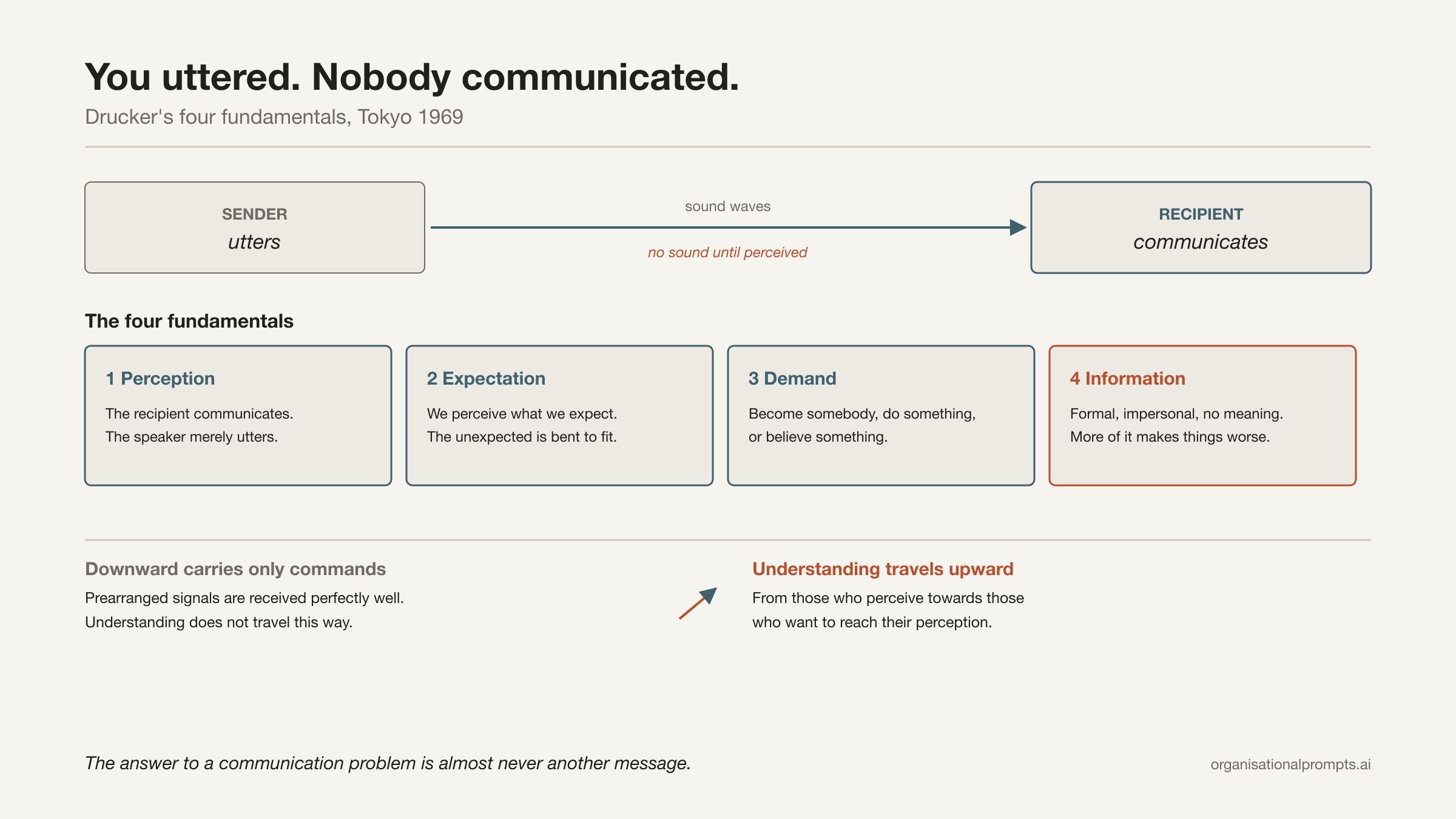
In 1969 Drucker gave a talk in Tokyo that became chapter thirty-eight of his big management textbook. The chapter is called More Talk and Less Communication, and it opens with a riddle he takes from the Zen Buddhists, the Sufis and the rabbis of the Talmud. A tree falls in a forest and nobody is there. Is there a sound? Drucker says no. Sound waves, yes. No sound, because sound is created by perception, and perception is the whole of what communication is.
He sets out four fundamentals in that chapter, and says they were learned mostly by doing the wrong things. Fifty-seven years on, the wrong things are still being done, at greater volume and lower cost than Drucker could have imagined. Uttering is now free. Communicating is exactly as expensive as it ever was, which means the gap between what an organisation utters and what it communicates has never been wider.
1. It is the recipient who communicates
The first of them reorganises everything. Communication is perception. The recipient communicates; the speaker merely utters. That is no modest point about listening skills. The whole act moves to the recipient. The question before speaking is therefore not whether the message is clear, which is a question about the sender, but whether the message sits within the recipient’s range of perception. Can the recipient receive it? If not, no amount of clarity will help, and the sender has produced sound waves.
Every organisation has a mechanism for confirming that the sound waves went out. The email was sent. The town hall was recorded. The strategy is on the intranet. None of these tells you anything about the recipient. A leader who takes them for evidence has stopped measuring communication and started measuring utterance.
2. We hear what we expect to hear
The second explains why the memo that was received was still not the memo that was sent. We perceive largely what we expect to perceive. The unexpected is either not perceived at all or quietly bent into the shape of the expected, so the organisation perceives a familiar thing where an unfamiliar one was said. Announce a new operating model to people who have seen four, and they will perceive the fifth, because the previous four have trained them to expect it. They are probably not being cynical. They are perceiving normally.
Drucker’s instruction follows from this and it is uncomfortable. Find out what the recipient expects before you speak, because the expectation decides what the recipient can perceive. Then decide whether to use those expectations or to break them, and understand that breaking them is a separate and much harder piece of work than saying the thing.
This is also why the weeks after something genuinely happens are worth more than any communications plan. An event removes the evidence that held the old expectations in place. For a short period the recipient can perceive the unexpected. Most organisations spend that window drafting.
3. Communication makes demands
The third disposes of the idea that you can communicate neutrally. Communication always demands something. The demand is that the recipient become somebody, do something, or believe something. That demand lands where it fits what the recipient already wants, and fails where it appeals to nothing the recipient wants. Simply informing people of a change that will alter their work is not available as an option, and the attempt is usually heard for what it is.
Set that against the standard transformation announcement, which demands a great deal and appeals to nothing. The demand is that people work differently, learn new tools, accept new measurement and give up practices they are good at. The reason offered is the organisation’s competitive position. That is a demand with nothing on the recipient’s side of it.
4. Information is the opposite of communication
The fourth has aged into relevance. Communication and information, Drucker writes, are different and largely opposite, though each depends on the other. Communication is perception. Information is logic, formal and impersonal, carrying no meaning of its own. From which he draws the conclusion that more information can make the problem worse rather than better. He was writing when the information explosion meant mainframes and photocopiers, and he noted that the revolution of his day had not produced information at all. It had produced data.
An organisation can now generate more information than at any point in history, at almost no cost, and every piece of it is impersonal by definition. The AI-drafted summary of the AI-drafted strategy is information about information. Perfectly logical, and it demands nothing, appeals to nothing, and lands nowhere. Drucker’s fourth fundamental predicts precisely this outcome, several decades before the tooling existed to produce it at scale.
A corollary in the same chapter tends to get skipped. Downward communication cannot work. What travels downward are commands and prearranged signals, and those are received perfectly well. Understanding travels the other way, upward, from those who perceive towards those who want to reach their perception. So the answer to a communication problem is almost never another message.
5. A liberal art, which is not a compliment
Twenty years after the Tokyo talk, Drucker published the sentence that got him accused of going soft. Management, he wrote in 1989, is what tradition used to call a liberal art. Liberal because it deals with the fundamentals of knowledge, self-knowledge, wisdom and leadership; art because it is practice and application. Managers should draw on psychology and philosophy, on economics and history, on ethics and the physical sciences. And then the clause that stops it being a plea for a broader reading list: they have to focus that knowledge on effectiveness and results.
This ran against the consensus of its moment, which held that management was a science and that quantitative analysis was its method. Drucker never described himself as a management theorist anyway. He called himself a social ecologist, concerned with people’s existence in the man-made environment as a natural scientist is with the physical one, and only fifteen of his thirty-nine books were about management.
The claim reads differently now. The technical half of management, the part that is analysis and reporting and modelling, is the half being automated fastest. What that leaves is knowledge, self-knowledge, wisdom and leadership, which is the part Drucker was pointing at when everyone thought he was being vague.
6. Say it back
All four converge on one test, and it costs nothing to run. Take the last significant thing you announced. Ask four people separately, without notes, to tell you in one sentence what it means they should do differently. Four different answers means you uttered. Four answers that match each other but not your intent means they perceived something, just not what you sent. One or two people saying they were not sure it applied to them is the most useful result of all, because it tells you exactly where the range of perception ends.
The failure this catches is not a failure of writing. It catches a belief. The sending was never the event.
Placement: Transforming, the fourth of the series' phases; Learning, Deciding, Building, Transforming, and this is its Language position. Drucker's third appearance turns on the same distinction each time: what was said is not what was received, and after an event the naming that sticks is whichever one gets there first. The Event Is Not Yours to Make opens this stretch.
(An Organisational Prompt is something you can do now....)
Organisational Prompt
Four people, no notes
Pick the biggest thing you have announced in the last quarter. Ask four people at different levels, separately and without warning, to say in one sentence what it means they should do differently. Write the four answers down next to each other. Do not correct anybody, and do not send a clarifying note afterwards; that would be another utterance. Take the gap between the four answers as your actual communication result for the quarter, and spend the next one closing it upward rather than downward.
Further Reading
Drucker, Management: Tasks, Responsibilities, Practices (Harper and Row, 1973). Chapter thirty-eight, More Talk and Less Communication, is the source of the four fundamentals and is worth reading on its own even if the rest of the volume stays on the shelf.
Drucker, The New Realities (Harper and Row, 1989). Where management is named a liberal art, and where the naming is tied to effectiveness rather than to breadth for its own sake.
Drucker, Managing Oneself (Harvard Business Review, 1999). The self-knowledge half of the liberal art, written as a practical exercise rather than a philosophy.
The Drucker Institute at Claremont, and the Drucker Forum in Vienna. Both carry the management-as-a-liberal-art work forward, and the Forum’s annual proceedings are the best guide to what the idea looks like in current practice.
Disclaimer
I write about the industry and its approach in general. None of the opinions or examples in my articles necessarily relate to present or past employers. I draw on conversations with many practitioners and all views are my own.