
Most accounts of organisational change describe a straight line driven by a leader. Someone with vision decides on the change, communicates it, puts new structures in place, and people start behaving differently. The line is tidy, it fits on a slide, and it gets the cause wrong at the very first step. People do not change organisations. Events do. A leader who tries to will a change into being, with no event behind it, is pushing on a door that opens the other way, which is why so much determined, well-resourced change effort produces so little.
Here is what actually moves an organisation. An event throws the received wisdom about what is possible into question. In doing so it opens up a new language of possibility, a way of talking about what could now be done that could not be said before. People reach for that language and start to organise around it, proposing new ways of working that the old vocabulary gave them no way to imagine. Out of those new arrangements a new kind of agency emerges, one that sustains and extends the change without anyone having to drive it. And then the most important thing happens: the completed change enlarges what people can see, which lets them identify and create the next event. Positive change is generative. It does not just solve the problem in front of it; it builds the organisation’s capacity to generate the change after that. This is a flywheel, and understanding it is the difference between an organisation that has to be dragged through every change and one that produces its own.
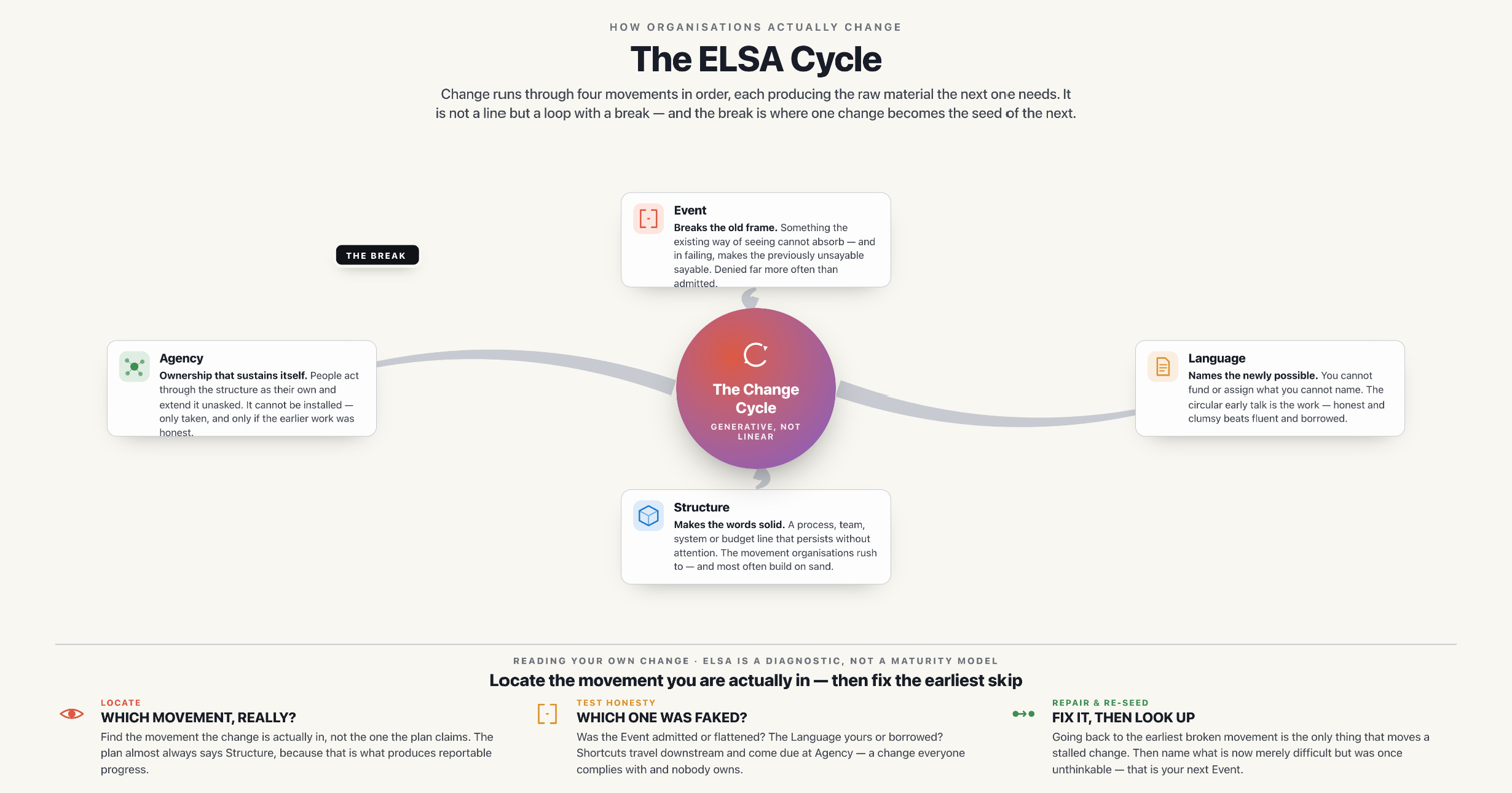
ELSA names the four movements this process passes through, so you can see which one you are in, which one you are avoiding, and why a change that looked complete keeps coming undone. The four are Event, Language, Structure, and Agency. They are not values, not stages of a maturity model, and not a checklist. They are the actual movements a change passes through to take hold, and the order matters, because each one produces the raw material the next one needs. This article explains each movement in its own terms, shows why they run in the order they do, explains the one transition that breaks the pattern, and shows how that break is what makes change generative rather than a thing you survive.
1. The Four Movements, in One Picture
Before the detail, the shape. A change begins with an Event: something happens that the existing way of seeing cannot account for, and in failing to account for it, opens a question about what is now possible. Then comes Language: people find words for the new possibility, because until it can be spoken it cannot be worked on. Then Structure: the new language gets built into something solid, a process, a team, a system, a budget line, or it stays just talk. Then Agency: people take the new structure and make it theirs, act through it without being told to, until it stops being an imposition and becomes simply how things are done.
That is one full turn. The catch, and the reason this is a cycle rather than a ladder, is what happens after Agency. Once a change is fully owned, the organisation can see things it could not see before; the new way of working reveals new possibilities, new questions, new events that were invisible from where it used to stand. The turn does not return you to where you started, and it does not just leave you exposed to the next external shock. It leaves you standing somewhere new, where you can see further, which means you can find and create the next event yourself rather than waiting to be hit by one. Change is not a line and not even a closed loop; it is a loop with a break in it, and the break is the most important part, because the break is where one change becomes the seed of the next.
2. Event: What Breaks the Old Frame and Opens a New One
An Event is not just news, and not every problem is an Event. Organisations handle most of what happens to them without any change at all, by fitting it into categories they already have. A competitor cuts prices: you have a playbook. A system goes down: you have a runbook. A regulation changes: you have a compliance process. None of that is an Event in the sense that matters here, because none of it requires the organisation to see differently. It is absorbed by the way of seeing that already exists.
An Event is the thing that cannot be absorbed that way. It is the development that does not fit any existing category, that the current playbook has no move for, that exposes a gap the organisation did not know was there. The arrival of a technology that makes a core skill cheap. A failure that the existing safety story said was impossible. A shift in what customers want that the segmentation model cannot describe. What makes these Events is not their size but their fit: they reveal that the organisation’s way of seeing has a hole in it, and the hole was always there, waiting for something to fall through.
But exposing a hole is only half of what an Event does, and the lesser half. The more important thing is that by breaking the received wisdom about what is possible, an Event opens a space that was closed before. As long as the old way of seeing held, certain things were simply not thinkable; they were ruled out so completely that nobody even argued against them. When the Event breaks that frame, those things become thinkable for the first time. The technology that makes a core skill cheap does not only threaten the people who had that skill; it makes a whole class of work newly possible that nobody could justify proposing while the skill was expensive. This is why the Event, not the leader, is the true agent of change. A leader can argue all day for a possibility that the prevailing wisdom rules out, and get nowhere, because the organisation has no room to hear it. The Event creates the room. It is the thing that makes the previously unsayable sayable, and only once something can be said can anyone organise around it.
This is why Events are so often denied. The first response to a genuine Event is almost always to treat it as a non-Event, to force it into an existing category and absorb it after all. The technology gets filed under “tools we already use.” The failure gets filed under “one-off, won’t recur.” The customer shift gets filed under “noise in the data.” Forcing the Event into an old category is not stupidity; it is the path of least resistance, because the alternative is admitting the way of seeing is incomplete, and that admission is expensive. But it is also where the possibility is lost, because an Event that is denied opens nothing. An organisation that can recognise an Event as an Event, rather than flattening it into something familiar, has done the first hard thing, and has kept open the possibility the Event arrived carrying. Most of the failure to change happens right here, before any change has even been attempted, in the refusal to admit that something has happened at all.
3. Language: The Vocabulary of the Newly Possible
Suppose the Event is admitted, and the possibility it opened is still alive. The organisation accepts that something has happened its existing categories cannot hold, and that something is now thinkable that was not thinkable before. Now comes the second movement, harder than it looks: building a language for the new possibility. You cannot manage, plan, fund, or assign what you cannot name. Until the new possibility can be spoken, in words the organisation can actually use, it cannot be worked on at all. It sits there as a felt sense that something has opened up, with no purchase for action. The language is not decoration on the change; it is the thing that enables the change, because it is what lets people point at the new possibility together and start to act on it.
Language work is the work of building new vocabulary, and it is genuinely creative, not a matter of looking up the right term. The organisation has to develop ways of talking about the Event that let people point at it, argue about it, and coordinate around it. This is why the early phase of any real change feels like a period of bad meetings and circular conversation. People are reaching for words that do not exist yet, describing the new thing in terms of old things it only half resembles, contradicting each other because they have not yet agreed on what to call what they are all dimly seeing. That apparent confusion is the work. It is the organisation manufacturing the vocabulary it will need before it can do anything else.
The failure mode here is the opposite of the confusion, and more dangerous. An organisation can skip the language work by reaching for a ready-made vocabulary off the shelf, the consultant’s framework, the vendor’s terminology, the industry buzzword, and adopting it wholesale. This feels like progress, because suddenly everyone has words. But borrowed words describe someone else’s Event, not yours. The organisation ends up fluent in a language that does not quite fit its own situation, and the gap between the words and the reality becomes a permanent low-grade dishonesty that everyone learns to talk around. Real language work produces words that fit your Event, even if they are clumsy, even if they would mean nothing to an outsider. Honest and clumsy beats fluent and borrowed every time.
4. Structure: Making the Words Solid
Language alone changes nothing. An organisation can develop a perfectly good vocabulary for a new reality and still do exactly what it did before, because talk is cheap and reversible. The third movement is Structure: building the new language into something that persists whether or not anyone is talking about it. A process. A team with a remit. A system that enforces a rule. A budget line that funds a direction. A role that did not exist before. Structure is what turns a way of speaking into a fact of the environment, something people run into whether they believe in it or not.
The test of Structure is durability without attention. If the change depends on someone championing it in every meeting, it has not yet become Structure; it is still Language being kept alive by effort. When it has become Structure, you can stop talking about it and it persists, because it is now built into how the work flows. The reorganisation that creates a new team, the pipeline that will not let unreviewed code through, the funding model that pays for the new direction rather than the old one: these are Structure, because they shape what happens by default, without anyone having to argue for them each time.
The strongest Structure is not imposed from the top; it is proposed from inside. Once people have a language for the new possibility, they begin to organise around it on their own, suggesting new ways of working, forming the team that ought to exist, drafting the rule that should hold, building the small tool that makes the new way easier than the old. This is the quiet engine of the whole cycle, and it only runs when the language is genuinely shared, because people can only propose structures they have the words to describe. A leader’s real job at this movement is less to design the structures than to notice the ones people are already reaching for and give them room to harden, rather than overriding them with a structure designed elsewhere. Structures that people proposed for themselves arrive already half-owned; structures imposed on them start the next movement at a disadvantage.
Structure is the movement organisations are best at, and that is precisely the danger. Building structures is what management knows how to do, so the strong temptation is to jump straight to it, to skip the Event and the Language and just reorganise, just stand up the new team, just buy the platform. A structure built on skipped work is a structure built on sand. It encodes either a borrowed vocabulary that does not fit, or no clear vocabulary at all, and so it produces a process nobody understands the purpose of, a team whose remit is contested from the first day, a system that everyone games because the reason for it was never made real. The most common artefact of failed change is a structure that works perfectly and serves no purpose anyone can articulate, because the purpose was never built before the structure was.
5. Agency: The Self-Sustaining Ownership That Emerges
A structure can be in place and the change can still not have happened. People can comply with a new process while privately treating it as an obstacle, follow a new rule while waiting for it to be quietly dropped, work inside a new team while their loyalty and their habits still belong to the old arrangement. Compliance is not the end of change. The fourth movement, Agency, is the point at which people stop treating the structure as something imposed on them and start acting through it as their own, exercising judgement inside it, defending it, extending it, using it without being told to.
This is the difference between a rule that is followed and a rule that is owned. A followed rule needs enforcement; the moment the enforcement relaxes, the behaviour reverts. An owned rule needs no enforcement, because the people inside it would not now choose to act any other way; it has become part of how they understand their own work. Agency is the movement where a change finally stops being something the organisation is doing and becomes something the organisation is. You can see it in the small signs: people improving the new process without being asked, defending it to newcomers, treating a violation of it as a violation of something they care about rather than a technicality.
Agency cannot be installed, and that is what makes it the movement organisations find hardest to force. You can mandate a structure; you cannot mandate ownership of it. Ownership has to be taken, by people, from the inside, and it can only be taken if the three movements before it were done honestly. If the Event was denied, people know the change answers no real question. If the Language was borrowed, people know the words do not fit. If the Structure was imposed without either, people know it is arbitrary, and you cannot own what you know to be arbitrary. Agency is where the shortcuts taken earlier come due. An organisation that skipped the hard early work can get all the way to a fully built structure and then stall here, permanently, with a change that everyone complies with and nobody owns, which is to say a change that has not actually happened and never will.
6. One Change, All Four Movements
The abstraction becomes clearer with a single change walked the whole way through. Take a composite example, the kind of thing that recurs across many organisations: a firm whose product teams have always shipped on a fixed quarterly release, and which now has to move to releasing continuously, many times a day. Watch where the change actually lives at each stage, and watch where it usually breaks.
The Event is not the arrival of the tooling that makes continuous release possible. The tooling is just a capability; an organisation can buy it and change nothing. The Event is the moment it becomes undeniable that the quarterly rhythm is now a liability rather than a discipline, that competitors releasing daily are learning from real users at a rate the quarterly firm cannot match, and that the firm’s whole way of seeing release as a periodic, ceremonial, all-hands event has a hole in it. Most firms deny this Event for a long time. They file continuous release under “risky for a business like ours,” or “fine for consumer apps, not for us,” forcing the new reality into a category that lets them carry on. The denial is comfortable, because admitting the Event means admitting that a rhythm the whole organisation is built around is now wrong.
Suppose it is admitted. Now the Language work begins, and it is messier than anyone expects. The firm has no shared words for what it is trying to become. People say “continuous” and mean five different things: some mean deploying daily, some mean deploying on demand, some mean small batches, some mean removing the release-approval committee, some just mean faster. The meetings go in circles because the vocabulary does not exist yet. This is the dangerous moment when someone reaches for a borrowed language off the shelf, adopts a brand-name methodology wholesale, and everyone suddenly has fluent words for someone else’s version of the change. The firm that does the honest work instead builds its own clumsy vocabulary, words that fit its actual constraints, its actual risk appetite, its actual customers, even if those words would mean nothing at a conference.
Then Structure, the part the firm finds easiest and therefore the part it is most tempted to rush. Now the new language gets built into things that persist: a deployment pipeline that will not pass code without automated checks, a standing rule that batches stay small, the dissolution of the quarterly release committee and the funding of the capability that replaces it. If this Structure is built on honest Language, each piece has a purpose people can articulate. If it was built on a borrowed Language or no Language at all, the firm ends up with a pipeline nobody trusts, a small-batch rule everyone games by relabelling large batches as small, and a committee that was formally dissolved but reconstitutes itself informally because the reason for dissolving it was never made real.
And finally Agency, where the change either becomes the firm’s own or stalls forever. Agency has arrived when engineers release small changes daily without being told to, when they would now find the old quarterly ceremony absurd, when they improve the pipeline unasked and treat a skipped check as a violation of something they care about rather than a rule to be dodged. If the earlier work was honest, this ownership grows naturally, because the change answers a question people genuinely feel. If the Event was denied, the Language borrowed, or the Structure imposed, Agency never comes; the firm gets a fully built continuous-delivery apparatus that everyone operates joylessly and nobody owns, reverting to quarterly habits the moment attention moves elsewhere. The change is complete on every dashboard and has not actually happened.
7. Why the Order Cannot Be Rearranged
The four movements run Event, Language, Structure, Agency, and the order is not a preference. Each movement produces the exact raw material the next one needs, and none of them can run on material that has not been produced yet.
Language needs an Event to work on; you cannot find words for a new reality you have not admitted is there. Structure needs Language to build from; you cannot make solid a vocabulary you do not yet have, and if you try, you will build from a borrowed one instead. Agency needs Structure to act through; you cannot own a change that has not been made into anything yet. And the whole sequence needs to have been done honestly, because each movement carries forward the integrity or the dishonesty of the ones before it. A denied Event poisons the Language. A borrowed Language poisons the Structure. An imposed Structure poisons the Agency. The shortcuts do not disappear; they travel downstream and surface at the end as a change that will not take.
This is why so many changes that look complete on paper quietly fail in practice. The structure is built, the announcements are made, the training is delivered, and a year later nothing has really changed, because the work was done out of order or with steps skipped. The organisation jumped to Structure because Structure is visible and fundable and looks like progress, and skipped the Event and the Language because they are slow, confusing, and produce nothing you can put in a status report. Then it waited for Agency to arrive on its own, and it never came, because Agency cannot stand on an Event that was never admitted and a Language that was never built.
8. The Break in the Loop
The first three transitions are transfers. A disturbance produces something to name; the naming produces something to arrange; the arrangement produces something to act on. Each is a translation: the disruption becomes words, the words become a built thing, the built thing becomes owned practice. The material changes form at each step, but it carries through. The line, despite the translations, is continuous.
The fourth transition is different, and getting it right is the whole point of treating change as a cycle rather than a line. Agency does not produce the next Event. There is no smooth translation from a fully owned change to the next disruption. The next Event, when it comes, comes from outside the entire settled situation that Agency produced. It is not the next logical step; it is the thing the new settled way of seeing also cannot absorb, the new hole in the new picture. The move from Agency back to Event is not a transfer at all. It is a rupture.
This matters practically, and it cuts two ways. The uncomfortable half: arriving at full Agency, at a change completely owned and working, does not protect you from the next change. The very completeness of the settled state is what the next Event will throw into question, and a deeply owned way of seeing is a deeply invisible one, so the new settled state carries its own new blind spots. There is no final structure, no terminal state where change is complete and the cycle stops. But the generative half is the more important one, and it is what the next section is about: the same completeness that creates new blind spots also gives people a higher place to stand, and from that higher place they can see possibilities, and create Events, that were invisible from where they used to be. The break is not only how the next shock gets in. It is how the organisation reaches the vantage point from which it can author the next change itself.
9. The Flywheel: Why Change Generates More Change
Put the cycle together and a property emerges that no single movement shows on its own. A completed turn does not just leave a change in place; it leaves the organisation able to see and do things it could not see or do before. People who have lived through one full cycle have a new language, new structures, and the lived experience of having taken something unfamiliar and made it their own. That experience is itself a capability. It lowers the cost of the next cycle, because the organisation now knows, in its body rather than its slide decks, that change can be admitted, named, built, and owned. And it sharpens the organisation’s eyes: from the new vantage point, things that were unthinkable before become merely difficult, and people start to notice Events, and even create them, that the old position could never have surfaced.
This is the flywheel, and it is the most important claim in this whole account. Positive change is generative. It does not consume itself in solving one problem; it builds the capacity to find and make the next change. An organisation that has turned the cycle honestly a few times stops being something that has to be dragged through transformation by exhausted leaders and becomes something that produces its own transformation, because its people can now see possibility where they used to see only the way things are. The leader’s role shifts accordingly, from forcing change against the grain to keeping the flywheel turning: admitting the Events, protecting the messy language work, giving room to the structures people propose, and getting out of the way of the agency that sustains it.
And here is the part that surprises people. The organisation that becomes good at generating its own change, as a by-product, becomes far better at absorbing change that comes from outside. The capability is the same capability. An organisation fluent in admitting Events, building honest language, and turning that into owned practice does not freeze when an external shock arrives; it runs the cycle it already knows how to run. The same machinery that lets it author internal change lets it metabolise external change, and lets it hear its own internal feedback, the quiet signals from the edges that something is shifting, because a culture practised at recognising Events is a culture that listens for them. Resilience to the outside world is not a separate programme you bolt on. It is what you get for free once the flywheel is turning, because the flywheel is built out of exactly the habits that resilience requires.
10. Reading Your Own Change
The practical use of ELSA is diagnostic. Take any change your organisation is currently attempting, or failing to attempt, and locate which movement it is actually in, as opposed to which one the plan says it is in. The gap between those two is usually where the problem lives.
If the organisation is busy and frustrated and going in circles, with lots of talk and no settled direction, it may be in honest Language work, which looks like failure but is not, or it may be stuck because it never admitted the Event and is trying to find words for something it will not name. If it has reorganised and built and announced, and a year on nothing has changed, it almost certainly jumped to Structure over skipped Event and Language work, and is now waiting for an Agency that cannot come. If people are complying without owning, going through the motions of a change they do not believe in, the structure was probably imposed without the language work that would have made it make sense. And if a change feels genuinely complete, fully owned and working without effort, the useful question is not how to defend it but what it now lets you see: from this new vantage point, what was unthinkable before and is merely difficult now? That question is how you turn a finished change into the Event that starts the next one, which is how the flywheel keeps turning.
The four movements give you a vocabulary for change that does not flatter the straight-line story. They tell you that the confusing early work is real work, that the visible late work is worthless without it, that ownership cannot be commanded, and that arrival is temporary. None of that fits on a tidy slide. All of it is what actually happens when an organisation changes, or fails to.
Where this sits: the series runs four phases, Learning, Deciding, Building and Transforming, and this article sets out the four moves all of them run on. Each phase enters the cycle one position later than the last, Learning at Event, Deciding at Language, Building at Structure, Transforming at Agency, so the four phases together complete a single turn of the same four movements. From Deciding to Building is the bridge into the current phase and The Build Is the Test opens it.
(An Organisational Prompt is something you can do now....)
Organisational Prompt
Pick the most important change your organisation is currently trying to make. Do not ask how it is going. Ask which of the four movements it is actually in.
Be honest about the difference between the plan and the reality. The plan almost certainly says you are in Structure, building the new thing, because that is the movement that produces fundable, reportable progress. The reality may be that you skipped the Event, never admitting clearly what happened that made this change necessary, and skipped the Language, never building words that fit your own situation rather than words borrowed from a framework. If so, the structure you are building is standing on nothing, and no amount of building will fix that, because the problem is underneath it.
Then ask the harder question. For each movement you have genuinely completed, was it done honestly or was it faked? Was the Event admitted or flattened into something familiar? Was the Language yours or borrowed? Was the Structure built on real words or imposed over a gap? You will usually find one movement where the shortcut was taken. That movement is where your change will fail, no matter how well the others were done, because the dishonesty travels downstream and comes due at Agency, as a change everyone complies with and nobody owns.
Fix the earliest skipped movement first. If the Event was never admitted, no language work will land until it is. If the Language was borrowed, no structure will hold until you have built words that fit. Going back to the earliest broken movement feels like regression; it is the only thing that actually moves a stalled change forward.
Then, when that change is genuinely owned and running on its own, ask the question that keeps the flywheel turning. Now that your people can see and do what this change made possible, what was unthinkable here a year ago and is merely difficult now? Name it out loud. That naming is how you turn a finished change into the next Event, and an organisation that does this on purpose stops waiting to be disrupted from outside and starts generating its own change from within. That is the whole point: not to survive one change, but to become the kind of organisation that makes the next one.
Disclaimer
I write about the industry and its approach in general. None of the opinions or examples in my articles necessarily relate to present or past employers. I draw on conversations with many practitioners and all views are my own.