
A leader I know at another company described the moment his organisation realised that AI would change everything. Not the strategy offsite. Not the board presentation. The moment a domain expert sat with a language model and, in forty minutes, produced a working specification that would have taken a team two weeks. The room went quiet. Then someone said: “If that works, what are we all doing?”
That was an event. Not in the calendar sense; in the transformational sense. Something happened that could not be unseen. The question is what happened next. In most organisations, what happens next is: nothing structural. The event is discussed, admired, presented upward, and gradually absorbed into existing patterns.
Six months later, the organisation is doing exactly what it did before, with a new vocabulary. The event produced language but not structure. The language produced action but not agency. The cycle stalled, and the organisation lost the capacity to respond to the next disruption because it never finished responding to the first one.
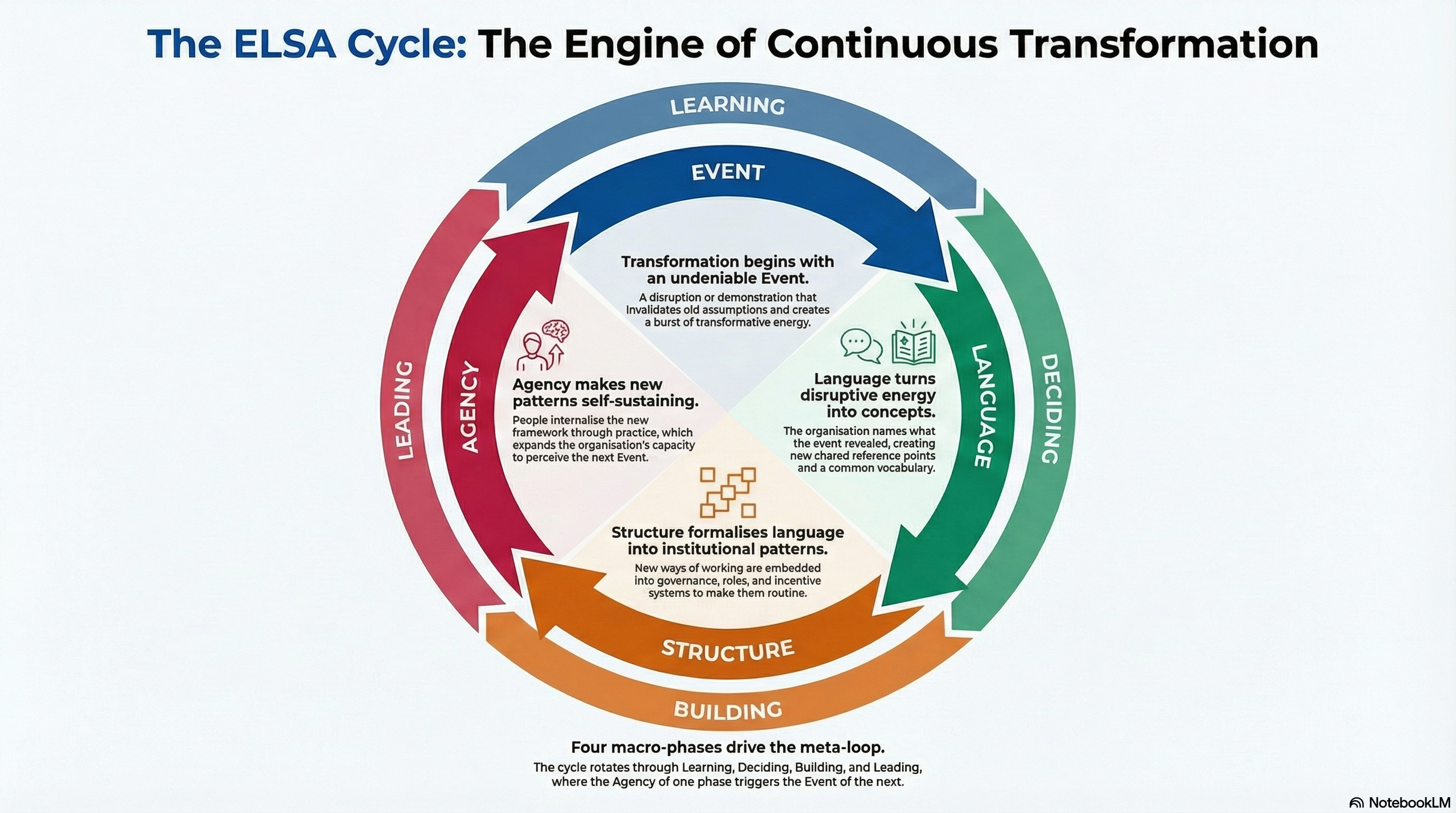
1. The ELSA Cycle: How Change Actually Moves Through Organisations
The ELSA model describes the mechanism by which organisations process change. It has four stages, and each transition is where transformation either advances or dies.
Event is the disruption: the demonstration that cannot be unseen, the competitive move that invalidates assumptions, the technology shift that renders a capability obsolete. Events can be external (a market shift, a competitor’s move) or internal (a gesture; an experiment, a provocation, a deliberate attempt to surface what has been hidden). Events are charismatic in Weber’s sense: they derive their power from direct experience and emotional impact, not from rules or tradition. They disrupt existing frameworks. They create a burst of transformative energy.
Language is what happens when the organisation begins to name what the event revealed. New categories emerge: “prompt engineering,” “agentic workflows,” “specification-driven development.” The language creates shared reference points. It makes the event discussable. It begins the process of routinisation: channelling disruptive energy into stable concepts that people can work with.
Structure is what happens when the new language becomes institutional. Governance frameworks are written. Teams are reorganised. Processes are redesigned. Incentives are realigned. The new patterns are formalised into arrangements that can operate without the charismatic catalyst that started the cycle.
Agency is what happens when the new patterns become self-sustaining. People act from the new framework without being told to. The new way of working reproduces itself through practice, not instruction. The organisation has not merely adopted a change; it has become a different kind of organisation, one whose dispositions generate different behaviour.
The cycle is not a one-time transformation. It is the mechanism by which organisations navigate continuous change. But only if each transition succeeds. And this is where the nine probes become essential.
2. Event to Language: Can the Organisation Name What Just Happened?
The transition from event to language is where most transformation programmes die their first death. The event happens. It is powerful, disorienting, generative. And then the organisation must find words for what it experienced. This is harder than it sounds, because honest language requires conditions that most organisations do not have.
Three probes govern this transition.
Truth-telling. Can people say what they actually saw? The event may have revealed that existing competencies are obsolete, that the current strategy is based on assumptions that no longer hold, that the organisation’s competitive position is weaker than anyone has admitted. If people cannot say these things; if the gap between formal meetings and corridor conversations is wide; the language that emerges will be diplomatic rather than diagnostic. It will name what is comfortable rather than what is true. And language that does not capture reality cannot produce structures that address it.
Proximity. Are the people creating the language close enough to the event to describe it accurately? If the event happened in a team room but the language is being crafted in a boardroom, every layer of hierarchy between the experience and the description is a reduction in fidelity. The leader who saw the domain expert produce a specification in forty minutes has proximity. The steering committee that heard about it third-hand does not. The language they create will describe what they imagined, not what happened. Ohno would recognise the mechanism instantly: go to the gemba. Do not decide from reports.
Loss. Can people tolerate what the event implies they must give up? Every genuine event carries a loss: a competency devalued, a role diminished, an identity threatened. If people cannot tolerate the loss, they will not name the event honestly. They will domesticate it: “AI is a tool that will augment our existing processes” rather than “AI means that the way we have always worked is over.” The domesticated language feels safer. It is also useless, because it cannot produce structures that address the actual disruption.
When all three probes pass, the organisation produces language that is truthful, precise, and unflinching. When any probe fails, the language drifts toward comfort, and the cycle stalls at its first transition.
3. Language to Structure: Can the Organisation Formalise What It Has Named?
The transition from language to structure is where transformation programmes die their second death. The organisation has found words for what happened. The words are circulating in presentations, strategy documents, town halls. But words are not structure. The question is whether the new language will reshape the institution or merely decorate it.
Three probes govern this transition.
Rewards vs words. Is the organisation changing what it rewards, or just what it says? This is the most diagnostic single question in transformation. If the organisation talks about “specification-driven development” but still promotes people who ship code fast, the language is disconnected from the incentive structure. People will learn the new vocabulary and continue the old behaviour, because the old behaviour is what gets rewarded. New language without new incentives is experienced as hypocrisy, and hypocrisy kills the energy that the event generated.
Structures serve or obstruct. Do the new structures serve the work, or does the work serve the structures? When the organisation creates an AI Centre of Excellence, an AI governance framework, an AI risk assessment process, the question is whether these structures enable people to work differently or whether they exist to manage the anxiety of leaders who need to feel that the disruption is under control. When governance exists to protect governance, the institution has inverted. The structure has absorbed the language without changing the practice. This is Weber’s routinisation at its most insidious: the charismatic energy of the event is channelled into bureaucratic arrangements that look like transformation and function as restoration.
Can the organisation stop what no longer works? New structure requires dismantling old structure. If the organisation cannot abandon processes, roles, and governance arrangements whose original purpose has expired, it will layer new structures on top of old ones. The result is not transformation but accumulation: more process, more governance, more overhead, less capacity to act. The inability to stop is often a greater barrier than the inability to start. Every structure that persists past its purpose is a tax on the organisation’s ability to respond to the next event.
When all three probes pass, the organisation produces structures that embody the new language in institutional form: incentives, processes, governance, and team designs that make the new way of working the path of least resistance. When any probe fails, the structure becomes a monument to a change that never happened.
4. Structure to Agency: Can the New Patterns Become Self-Sustaining?
The transition from structure to agency is the most difficult and the least visible. Structure is necessary but not sufficient. An organisation can have all the right governance, all the right team designs, all the right incentive structures, and still fail to develop agency, because agency is not a structural property. It is a behavioural one. Agency means that people act from the new framework without being told to, because they have internalised it as practice rather than received it as instruction.
Three probes govern this transition.
Practice vs instruction. Is the new capability being practised or merely taught? Training changes vocabulary. Practice changes capability. If the organisation’s approach to the new structure is to run workshops, certification programmes, and e-learning modules, it is investing in instruction. Instruction produces people who can describe the new way of working. Practice produces people who can do it. The difference is the difference between reading about swimming and swimming. Bourdieu would recognise the mechanism: the habitus; the embodied dispositions that generate practice below conscious awareness; is changed by practice, not by instruction. You cannot lecture someone into a new habitus.
Belief. Do people believe that the new structure will endure? Learned helplessness from previous failed changes drains the conviction that this time will be different. If the organisation has a history of announcing transformations that quietly expire after eighteen months, people will wait out the current one. They will comply with the new structures while preserving the old practices, because experience has taught them that the old practices will outlast the new structures. Belief is not optimism. It is the assessment, based on observable evidence, that the organisation is serious. The evidence is in the probes that preceded this one: did the language tell the truth? Did the rewards change? Did old structures get dismantled? If yes, belief follows. If no, no amount of leadership communication will produce it.
Can the organisation integrate conflict? The transition from structure to agency always generates friction. People who thrived under the old arrangements resist the new ones. Teams that built their identity around capabilities that the new structure devalues experience the transition as an attack. If the organisation suppresses this conflict; through dominance, avoidance, or the pretence that everyone is aligned; the new patterns cannot stabilise. They exist on the surface while the real dynamics continue underground. Follett’s integration; finding solutions that neither party had imagined, rather than compromising or dominating; is the only mechanism that converts structural change into genuine agency. The conflict is not an obstacle to the transition. It is the transition. How the organisation handles it determines whether the new patterns take root or wither.
When all three probes pass, agency emerges: the new way of working reproduces itself through practice, and the organisation has genuinely changed. When any probe fails, the structure remains a shell, and the organisation reverts to its prior state the moment pressure is applied.
5. Where the Probes Cluster: The Three Levers
The nine probes are not distributed randomly across the ELSA transitions. They cluster by the three levers the entire series runs on: Identity, Information, and Interaction.
The Identity probes (loss, practice vs instruction, belief) appear at the transitions where the person must change: at the moment the event demands giving something up, at the moment the new structure demands new practice, and at the moment where conviction determines whether the change holds. Identity is what decides whether the individual can move. Without it, the event is resisted, the language is domesticated, and the structure is a performance.
The Information probes (truth-telling, proximity, rewards vs words) appear at the transitions where the organisation must describe reality: at the moment the event must be named, at the moment the language must be backed by incentives. Information is what decides whether the organisation can see. Without it, the language is fiction, the structure is theatre, and the cycle operates on fantasy rather than evidence.
The Interaction probes (structures serve or obstruct, can the org stop what no longer works, can the org integrate conflict) appear at the transitions where the parts of the organisation must relate differently: at the moment new structures must replace old ones, at the moment the friction between old and new must be resolved. Interaction is what decides whether the system can reorganise. Without it, new structures accumulate on top of old ones, conflict is suppressed, and the organisation calcifies.
The directional logic holds: Identity constrains Information constrains Interaction. If people cannot tolerate loss, they cannot tell the truth. If they cannot tell the truth, the structures they build will be based on fiction. If the structures are based on fiction, the interactions they produce will reproduce the old patterns. But Interaction is where intervention occurs: change the structures, change the incentives, change the way conflict is handled, and Identity and Information shift in response.
6. The Virtuous Cycle
An organisation that has successfully navigated one complete Learning ELSA cycle has not merely survived a disruption. It has expanded its capacity to perceive and respond to the next one.
This is Bateson’s Learning II made operational. The organisation has not just learned a new response (Learning I). It has learned how to learn from disruption (Learning II). The probes that enabled the first cycle become the sensing apparatus for the next one. Truth-telling, practised during the first transition, becomes the norm that allows the organisation to see the next event clearly. Proximity, maintained during the creation of language, keeps the organisation close enough to reality to notice when reality changes. The capacity to integrate conflict, developed during the transition to agency, means the next event is experienced as generative rather than threatening.
Each successful cycle expands what Levin calls the cognitive light cone: the spatiotemporal scale of the goals the organisation can pursue and the disruptions it can perceive. Each failed cycle contracts it. An organisation that stalls at the language stage; producing new vocabulary without new structure; has a smaller light cone after the event than before it, because it has consumed energy and credibility without producing capability.
This is why transformation is not a project with a start and end date. It is a cycle that the organisation must be able to execute continuously, at varying speeds, across multiple simultaneous disruptions. The nine probes are not a checklist to complete once. They are the conditions that must be maintained for the cycle to keep turning.
7. The Rotation: Why the Phases Start in Different Places
Everything in this article so far describes Learning. Learning runs E → L → S → A. It starts with Event because learning is triggered by disruption; something must happen before you can learn from it. It ends with Agency because learning succeeds when new dispositions are self-sustaining.
But the series has four phases: Learning, Deciding, Building, Leading. And each phase enters the ELSA cycle at a different position. This is not a design choice. It is a structural necessity, because each phase produces a different kind of output, and the kind of thing one phase produces is not the same kind of thing the next phase requires as input. The gap between output and input is what the phase transition must bridge.
Learning ends with Agency: people can now tell the truth, practise new capabilities, tolerate loss, integrate conflict. Agency is a capacity, not a description. You cannot hand a capacity directly to a process that needs description. Agency must be applied to produce description. The first thing an organisation does with its Learning Agency is describe its domain honestly; something it could not do before the Learning conditions were in place. So Deciding begins at Language. The Deciding ELSA cycle runs L → S → A → E.
Deciding ends with Event: a specific, bounded, buildable thing that the organisation has designed its way toward. An Event is a specification, not a system. You cannot hand a specification directly to a process that needs construction. A specification must be built to become structure. So Building begins at Structure. The Building ELSA cycle runs S → A → E → L.
Building ends with Language: the organisation discovers what to say about what it built; what worked, what failed, what the operation revealed that the specification did not anticipate. Language is knowledge, not the capacity to act on it. You cannot hand knowledge directly to a process that needs action. Knowledge must be internalised to become agency. So Leading begins at Agency. The Leading ELSA cycle runs A → E → L → S.
Leading ends with Structure: the institutional redesign that enables the organisation to perceive and respond to the next disruption. Structure is an arrangement, not an experience. You cannot hand an arrangement directly to a process that needs disruption. A structure must be encountered; tested, stressed, surprised; to produce an event. So Learning begins at Event. And the cycle completes.
The four phases of the series are one rotation of ELSA at the macro level. Each phase owns one starting position. Each transition bridges the gap between what one stage leaves behind and what the next needs. The gap is never zero, because a capacity is not a description, a specification is not a system, knowledge is not agency, and an arrangement is not a disruption. The rotation exists because transformation is never a direct transfer. It is always a translation.
This is the architecture of the series. Learning (E → L → S → A) creates the conditions for honest description. Deciding (L → S → A → E) designs toward a buildable event. Building (S → A → E → L) constructs, operates, and discovers. Leading (A → E → L → S) acts, perceives, names, and reorganises. And the reorganisation produces the structure that the next disruption will test.
8. From Learning Agency to Deciding Language
The transition from Learning to Deciding is the first in the series, and it illustrates how all the transitions work.
Learning Agency means the organisation can now tell the truth about its situation. Its people are close enough to reality to see what is actually happening. It has dismantled structures that no longer serve the work. It can integrate conflict. It has practised new capabilities, not merely been instructed in them. In short: it has the conditions for honest description. And honest description, in an organisation that has genuinely learned, is itself a challenge. The organisation now sees, with unflinching precision, the domain in which it must decide. That seeing is not yet a decision. It is the Language that opens the Deciding cycle.
The Deciding cycle has its own probes, mapped to its own ELSA transitions. Where the Learning probes ask “can this organisation learn?”, the Deciding probes ask “can this organisation treat decisions as design challenges?” Can it describe its domain in language practitioners actually use? Can it distinguish what it knows from what it assumes? Can it name what it will not do? Can it hold competing designs without premature closure? Does the decision process produce what it intends? These probes govern the Deciding transitions in the same way that the Learning probes govern the Learning transitions.
And the Deciding cycle ends not with Agency but with Event: a specific, bounded, buildable thing. Not a strategic priority. Not a programme of work. Something precise enough that Building can construct it. The output of Deciding is the input of Building, translated through the same rotation: a specification (Event) must be constructed (Structure) before it can become operational.
This is why Learning must come first, and why organisations that skip it pay the price at every subsequent phase. An organisation that attempts to decide without having learned; without truth-telling, without proximity, without the capacity to integrate conflict; cannot produce honest Language. Without honest Language, it cannot examine its own Structure. Without structural examination, it cannot develop the Agency to commit. And without genuine commitment, it cannot produce the Event that Building requires. The decisions will look like decisions. They will have the form of design. But they will be pattern-matching against a distribution the organisation has never honestly examined. They will be, in the language of the companion essay, organisational hallucinations: confident, fluent, plausible, and wrong.
The organisation that completes the Learning cycle before entering the Deciding cycle has earned the right to its own clarity. Its decisions will be constrained; Simon guarantees that. Its descriptions of reality will be imperfect; Ohno guarantees that, which is why he insisted on going back to the gemba again and again. Its structures will eventually need redesigning; Beer guarantees that. But the constraints will be real, not imagined. The descriptions will be shared, precise, and grounded in what people actually see. The structures will have been built to serve the work, not to reproduce the past.
The cycle turns. Learning leaves an organisation with the agency to describe. Describing produces the architecture to commit. Committing produces the event to build. Building leaves an organisation with the knowledge to lead. Leading produces the structure that the next disruption will test.
The organisation that can navigate this continuously is the one that survives what it cannot predict.
Where this sits: the series runs four phases, Learning, Deciding, Building and Transforming, and this article closes the Learning articles' account of how change actually moves. Each phase enters the same four moves one position later than the last, which is why Learning starts at Event and Deciding starts at Language. From Learning to Clarity is the bridge into Deciding, and Event, Language, Structure, Agency gives the four moves their full treatment.
Further Reading
Gregory Bateson: Steps to an Ecology of Mind (1972). The levels of learning and the insistence that mind is a property of the system, not the individual. Learning II; learning to learn from disruption; is the capacity the ELSA cycle builds when it completes.
Pierre Bourdieu: Outline of a Theory of Practice (1977). The habitus and why practice changes capability where instruction cannot. The transition from structure to agency is a transformation of habitus.
Max Weber: Economy and Society (1922, translated edition). The routinisation of charisma and the iron cage of bureaucracy. Weber explains why the Language to Structure transition so often restores the status quo under a new label.
Mary Parker Follett: Creative Experience (1924). Integration as the mechanism for converting conflict into capability. The Structure to Agency transition depends on Follett’s integration: finding solutions neither party imagined.
Taiichi Ohno: Toyota Production System: Beyond Large-Scale Production (1988). The gemba principle, standard work, and jidoka. Ohno’s insistence on seeing reality as it is, not as it is reported, grounds the Information probes across both the Learning and Deciding ELSA cycles.
Michael Levin: “Technological Approach to Mind Everywhere (TAME),” Frontiers in Systems Neuroscience 16, 768201 (2022). The cognitive light cone concept. Each completed ELSA cycle expands the light cone; each stalled cycle contracts it.
I write about the industry and its approach in general. None of the opinions or examples in my articles necessarily relate to present or past employers. I draw on conversations with many practitioners and all views are my own.
This is a strong articulation of how change either consolidates or stalls. The line that the event produces language but not structure is particularly important.
I wonder if there is a deeper condition beneath that moment.
There are situations where an organisation can articulate a disruption fluently, even convincingly, and yet remain structurally unchanged. In those cases, language does not fail. It performs a different function. It absorbs the event without allowing it to reorganise the system.
It may be useful to name this more directly as a form of organisational trauma: an event exceeds the organisation’s capacity to integrate it, so it is translated into narrative while existing structures remain intact.
From that perspective, the question is not only how the cycle moves from language to structure, but what
allows an organisation to tolerate the implications of an event strongly enough for structural change to occur.