
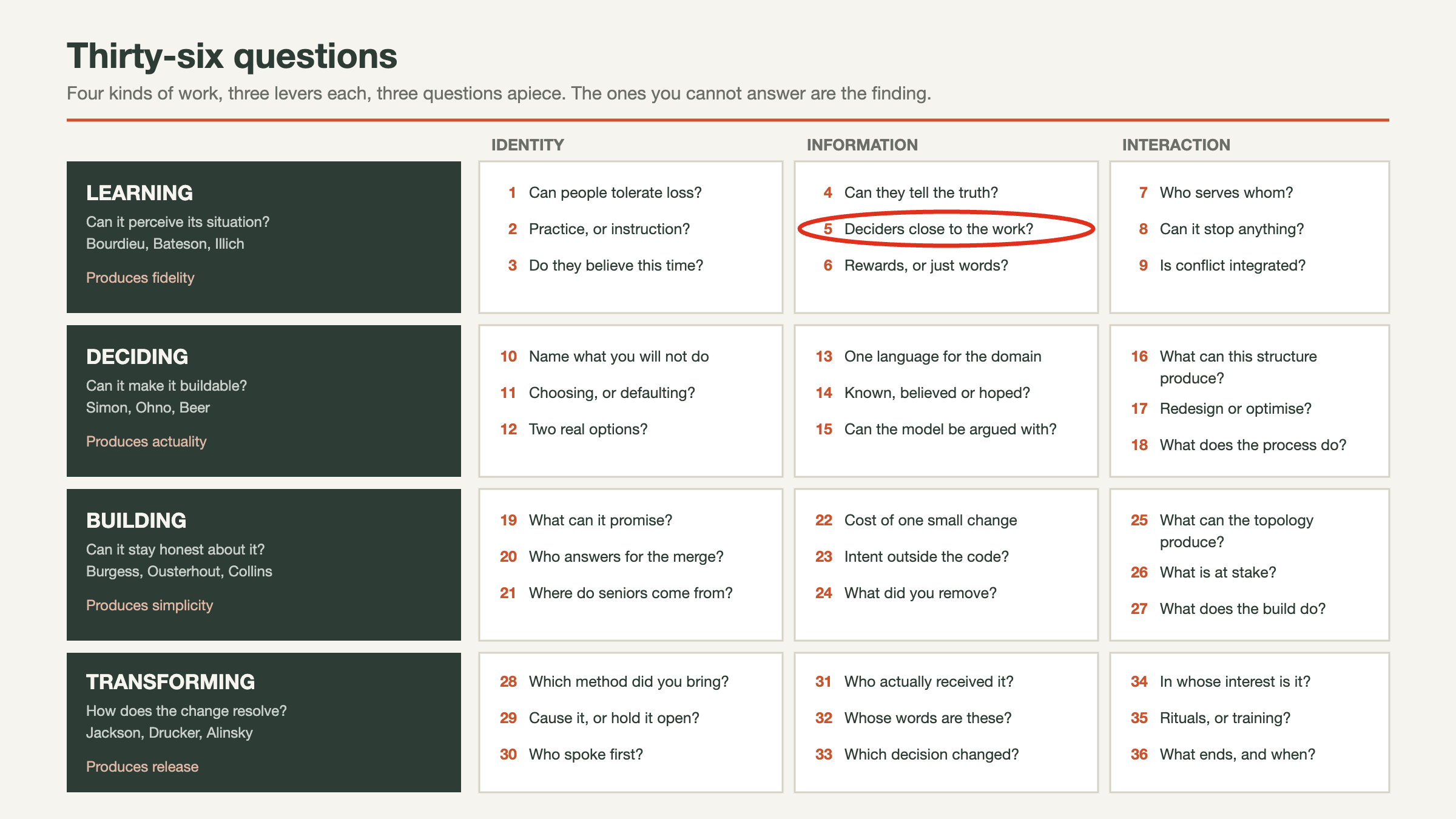
The decision is taken on a Tuesday by seven people, none of whom has watched the work it concerns in the last two years. They are not ignorant. Every one of them has been briefed, and the briefing was built by people who were themselves briefed, and at each step the material got shorter, cleaner and more confident. By the time it reached the room it had no anomalies left in it.
The anomalies were the information. A summary is made by removing whatever does not fit the summary, so the further a description travels from the work, the more coherent and the less true it becomes. The decision is then correct with respect to a document and wrong with respect to the world, and the people who could have said so were not in the room.
1. Question
Are the people deciding close enough to the work to know what is true?
Answer it with a number and a date. For the last significant decision, count the layers between the person who decided and the person doing the work. Then find out when that decider last watched the work happen, for an uninterrupted hour, in person, with nothing prepared for them.
The number is usually four or more. The date is usually never. Write both down before anybody starts explaining why the number is unavoidable.
2. Purpose
The question tells you whether decisions rest on the work or on a representation of the work. Every layer between the two is a compression, and every compression has a loss function, and the loss function is chosen by whoever does the compressing according to what is safe and useful for them. None of that requires bad faith. It happens by default, in every direction, and it accumulates quietly until the picture at the top is a different picture.
The question also separates two failures that get filed together in the post-mortem. A wrong decision is a judgement problem, and better judgement helps. A right decision taken on a wrong description is a proximity problem, and better judgement makes it worse, because sharper reasoning applied to a cleaned-up account produces a more confident error.
Proximity is not seniority, and the question is not whether your leaders are clever. Clever people at distance produce excellent decisions about a place that does not exist, and they produce them faster than anybody can correct the description they are working from.
The measurable signal is surprise. Count how often senior people say they had no idea about something the people doing the work regard as ordinary and unremarkable. A high rate of that is not a communication gap. It is the compression working exactly as designed.
3. Context
Taiichi Ohno built a whole method on the point. Go and see for yourself, at the place where the work happens, because facts live there and nowhere else. He is said to have drawn a circle on the factory floor and made managers stand in it for hours until they stopped seeing what they expected and started seeing what was in front of them. The discipline is not the visit. The discipline is staying long enough for the prepared account to wear off. An hour is roughly the point at which people stop performing for the visitor and go back to working, and everything useful happens after that.
Henry Mintzberg found that managers already know this and are prevented from acting on it. Watching what managers actually did rather than what textbooks said they did, he found work that was fragmented, oral and interrupted, with a strong preference for current and verbal information over aggregated reports. The formal reporting system was largely unused, because managers had worked out that it was slow and thin. Then organisations grew, and the thing managers had learned to distrust became the only channel left. The appetite for proximity did not go anywhere. It was designed out.
Herbert Simon supplies the underlying claim. Nobody decides about the world. Everybody decides inside a representation of the world, bounded by attention, time and the information at hand, and the quality of the decision is capped by the quality of that representation. So the most consequential act is not the decision. It is the construction of the representation, which in most organisations is done by somebody junior assembling a slide two weeks earlier.
Stafford Beer gives the mechanism a law. A regulator needs at least as much variety as the thing it regulates, and since no executive team has the variety of the operation beneath it, the variety must be cut down somewhere. Reports are that cut. Beer’s point is that the reduction is unavoidable and the design of it is a choice, and organisations that make the choice by accident, according to what fits on a page, get a regulator working from a picture with the interesting parts removed.
Gary Klein explains what distance costs you personally. Expert intuition is pattern recognition built from repeated exposure to real cases with real feedback. A decider who has not been near the work for two years has no current patterns, so the intuition that once made them fast is now recognising a world that has moved. They will feel as certain as ever, because certainty is produced by the match to the pattern rather than by the pattern being right. Nothing about the sensation tells you which of the two you have.
4. Action
Before the next big decision, spend one hour at the work with nothing prepared for you.
Choose the decision with the largest consequence in the next quarter, and go and watch the thing it concerns. Sit with the team while they do it. No deck, no demo built for your visit, no walkthrough. Say nothing for the first thirty minutes, because questions asked early steer the session towards the answers you already have.
Tell people you are coming and why. An unannounced visit reads as inspection and produces theatre, and theatre is what you were trying to get away from.
Then change what arrives on the page. For that decision, require one page written by somebody who does the work, unedited by anybody between them and you. Not a summary of their view, which is the same compression running again under a friendlier name. Their words, their examples, their anomalies.
Then change the standing arrangement, because a single visit decays in about a month. Put one practitioner in the room where the decision is taken, with speaking rights, and have them speak before the summary is presented rather than after. Speaking after a summary means agreeing or disagreeing with it, which keeps the summary as the frame. Speaking before it means describing the work, and the summary then has to survive the description rather than replace it.
The test after ninety days is your own surprise rate. If you are being surprised more often than you were, the compression has loosened and you are seeing more. If you are being surprised less, check whether that is because the picture has improved or because you have stopped looking, since both feel identical from where you sit.
This question sits in the Learning group of the series, the articles asking whether an organisation can perceive its own situation accurately enough to respond to it. What an organisation gets out of that work is fidelity, meaning an account of its situation that matches the situation. The route from there into deciding what to do about it is set out in From Learning to Clarity.
Further Reading
Taiichi Ohno, Toyota Production System (1978), for going to the place where the work happens and staying there.
Henry Mintzberg, The Nature of Managerial Work (1973), for what managers were observed to do rather than what they were said to do.
Herbert Simon, Administrative Behavior (1947), for bounded rationality and for the representation as the thing that caps the decision.
Stafford Beer, Brain of the Firm (1972), for requisite variety and for attenuation as a design choice.
Gary Klein, Sources of Power (1998), for expert intuition as pattern recognition built from exposure.
I write about the industry and its approach in general. None of the opinions or examples in my articles necessarily relate to present or past employers. I draw on conversations with many practitioners and all views are my own.