
The strategy deck has six pillars and each pillar has four initiatives. Nothing on the page is wrong. Every one of the twenty-four would improve the business, every one has a sponsor, and the whole thing was approved in ninety minutes by people who had read it properly. What the deck does not contain, anywhere, is a single thing the organisation has decided to stop caring about.
A document that says yes to everything makes no decisions, so the decisions get made anyway, later, by whoever is holding the constraint. Usually it is a delivery manager choosing between two things that both claimed to be critical, at eight in the evening, with no guidance. Your strategy did not fail to reach them. It reached them and told them nothing.
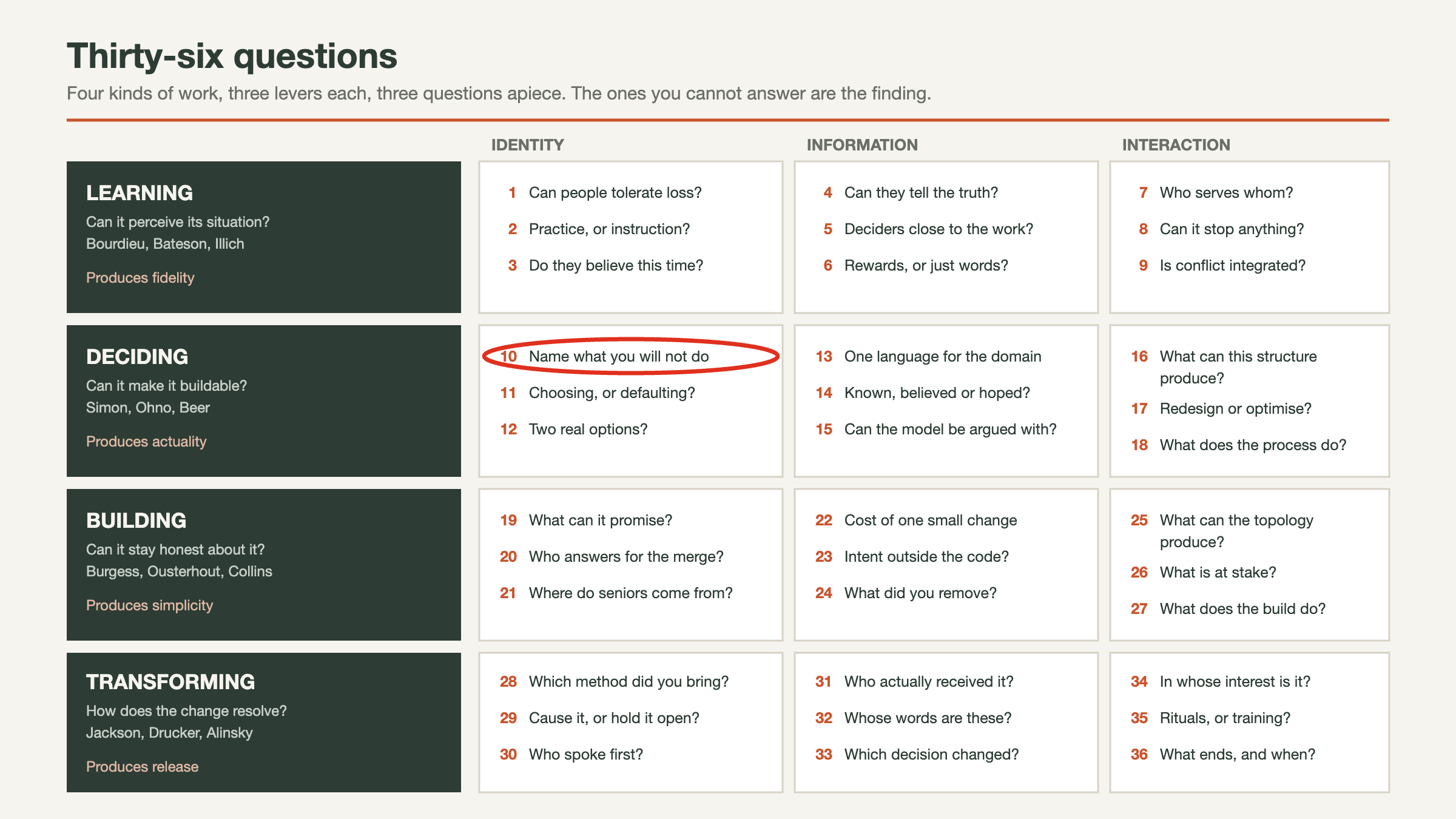
1. Question
Have you named what you will not do?
Ask for the list. Not the priority order, which is a ranking of things you are still doing and therefore not a decision. The list of capabilities you will not build, markets you will not enter, customers you will not serve well, and quality you will accept as good enough. Four columns, one page, no commentary. Written down, circulated, with somebody’s name on it. The name on it does the work. A refusal nobody owns is a refusal nobody will defend when the pressure arrives, and the pressure always arrives.
Most organisations cannot produce that list because it was never made. The ones that can produce it usually made it once, and it is two years old, which tells you how much use it has been.
2. Purpose
The question tests whether a strategy exists at all, in the only sense that matters operationally. A statement of desirable outcomes is not a strategy; it is a description of success. Strategy is the set of choices that make some of those outcomes reachable by giving up others, and where nothing has been given up, nothing has been chosen.
It also finds where the real decisions are being taken. Every unresolved trade-off at the top becomes a resolved trade-off further down, made by someone with less information, less authority and more immediate pressure. They will decide sensibly for themselves and inconsistently with each other, and the pattern that results will look like a strategy nobody wrote.
There is a cost you are already paying and probably not counting. Work that is nominally alive but permanently starved consumes attention, planning capacity and hope, and it consumes most from the people who care about it. Refusing to say no is not kindness. It distributes the disappointment more widely and delays it, and it spends the goodwill of the people you most needed to keep.
The tell is a phrase. When somebody asks what the priority is and the answer names more than three things, the question has been declined rather than answered, and everybody present understands that.
3. Context
Richard Rumelt is blunt about the substitution. What passes for strategy in most organisations is a set of aspirations with numbers attached, which he calls bad strategy, and its signature is that it contains no diagnosis and no coherent action, only goals. A real strategy names the difficulty, takes a position on what will be done about it, and by doing so rules things out. The ruling out is not a side effect of the position. The ruling out is the position. If a proposed strategy could be adopted unchanged by your competitor, it is not one, because it commits you to nothing they are not already free to do.
Herbert Simon explains why the refusal feels rational at the time. Attention is the scarce resource, not information, and every item on a plan claims some. An organisation that admits twenty-four claims has not distributed its attention across twenty-four things. It has guaranteed that attention will be allocated by whatever is loudest that week, which is a mechanism rather than a decision.
James March supplies the trade-off that gets dodged. Exploiting what already works and exploring what might are in direct competition for the same capacity, and each is defensible on its own terms. The organisation that will not choose between them ends up doing both badly, since exploration needs protection from exploitation’s superior short-term arithmetic, and protection is a decision somebody has to make and defend.
Clayton Christensen shows how the refusal becomes fatal rather than merely wasteful. Resource allocation in a well-run company follows the customers and margins it already has, and every individual decision is correct. The aggregate is a company that cannot fund the thing that will replace it. Nobody decided to ignore the new market. They simply never decided not to serve the old one first, every time, for years.
Russell Ackoff offers the reframe that makes the list writable. Planning that starts from the present and projects forwards will always preserve what exists, because what exists is the baseline. Start instead from the outcome you want and work backwards, and the question changes from what should we add to what has no place here, which is a question with real answers.
4. Action
Write the not-doing list, put a name on it, and read it out.
Take the top three or four priorities and, for each, write the sentence that makes it a choice. We are doing this, which means we are not doing that. If the second half of the sentence is empty, the priority is a wish. If it names something nobody wanted anyway, try again with something a real person will be upset about, because that is the test of whether a trade-off has been made.
Do it with the people who own the things being given up, in the room, rather than announcing it afterwards. The conversation is worse and the outcome is better, and it also surfaces the cases where you were wrong about what the thing was worth. Expect two of your intended refusals to survive that conversation intact and one not to. The one that does not survive is the reason to hold the conversation at all.
Then publish it. A not-doing list that lives in an executive folder does none of the work, because its whole function is to let somebody three levels down stop something without asking permission. Say plainly what is out, for how long, and who to talk to if the world changes.
Attach the consequence to each item. Not doing something means a team is freed, a budget line closes, or a customer gets a worse answer than they used to. Where none of those follows, nothing has actually stopped. In six months the item will reappear under a different name, with the same people working on it, and nobody will connect the two.
Review it quarterly and expect it to shrink. A not-doing list that survives untouched for a year has stopped being a decision and become a policy, and the world will have moved. The test is whether anybody has used it to decline something without escalating. If nobody has, the list is decoration.
This question sits in the Deciding group of the series, the articles about turning an accurate picture of a situation into something an organisation can actually build. What that work produces is actuality, meaning a decision that touches the real constraints rather than a plan that describes an ideal.
Further Reading
Richard Rumelt, Good Strategy Bad Strategy (2011), for the diagnosis, the guiding policy and the coherent action, and for why aspirations are not strategy.
Herbert Simon, Administrative Behavior (1947), for attention rather than information as the binding constraint.
James March, Exploration and Exploitation in Organizational Learning, Organization Science (1991), for why the two compete and which one loses by default.
Clayton Christensen, The Innovator’s Dilemma (1997), for resource allocation that is correct at every step and fatal in aggregate.
I write about the industry and its approach in general. None of the opinions or examples in my articles necessarily relate to present or past employers. I draw on conversations with many practitioners and all views are my own.