
A working system is not a transformed organisation. The system is a fact about what the organisation can now do, and the distance between that fact and a transformation is what this article is about. Building ended with something real: a system in production, a group of people who know things they did not know a year ago, and a vocabulary for the work that nobody had before they did it. All of that is hard-won. None of it, on its own, changes anything. There are enterprises running excellent systems, built by teams who learned a great deal, inside structures that are precisely what they were.
Each part of this series ends with something the next part cannot use directly. The gap is the point. Learning ended with a capacity, and a capacity is not a description, so Deciding had to begin by producing one. Deciding ended with a specification; a specification is not a system, so Building had to begin by constructing one. Building now ends with a system and everything the building of it revealed, and none of that is a change in the organisation. Which means the last part has to begin somewhere else entirely: with a person taking a position.
1. What Building Produced
Building ran its own path. It began at Structure, because a specification has to be constructed before it can do anything, and construction is first a structural act. The work gets divided into teams and the system gets divided into components. Those are the same division, whether or not anyone admits it. It moved to Agency, in two senses at once, the autonomy of the team that owns a component and the promises the component itself makes about what it will and will not do. It moved to Event, where the built thing met reality and returned a verdict, and where the useful result was always the disconfirming one. And it ended at Language. The operational knowledge of a system in use is a description nobody could have written in advance.
That final position feeds straight back to the first, which is why Building is iterative in a way the earlier phases are not. Continuous integration and continuous delivery are not delivery fashions; they are this cycle running fast enough for the learning to compound.
Building hands over three things rather than one. First comes the artefact, the system itself, which is the least interesting of the three. Second comes a capacity, which Building called simplicity and which is more precisely the ability to subtract. Remove a component. Stop a line, kill a feature, say no to generation that nobody asked for. Third comes a vocabulary, the operational language of people who have watched their own assumptions meet production and lose.
There is also a fourth thing, unlisted and rarely welcome. Building redistributes competence. The people who did the work now know something the people who commissioned it do not, and some of what senior people used to know has quietly stopped being the valuable kind of knowing. A build that changed nothing about who is expert in what was probably not much of a build.
2. Why a Working System Is Not a Transformation
The intuitive model of what happens next is diffusion: the thing worked, so it spreads, and leadership’s job is to sponsor the spreading. That model has now failed publicly three times in the working memory of most readers, and each failure looked the same from the outside.
Agile spread as a set of ceremonies while the funding model, the reporting lines and the annual planning cycle stayed where they were. DevOps produced DevOps teams, which is the one structure the idea rules out. Cloud arrived and was billed as a data centre with a different invoice. In every case the tools were absorbed, the vocabulary was captured, and the shape of the organisation came through unchanged. I have sat through all three of those waves, and each one felt at the time like the exception. The absorption was not stupidity. It was the organisation doing what an organisation does with new capability in the absence of anybody taking a position on it.
The mechanism runs like this. A build changes what is possible. It does not decide what the new possibility means, and meaning does not assign itself. Where nobody takes a position, the organisation resolves the question by default, and the default is restoration. The new capability gets fitted into the old shape, and the shape wins, because the shape is what everybody is paid by. A capability absorbed without a position taken on it is a capability neutralised.
Which is why Transforming is not a delivery function or a communications exercise. Its subject is the resolution: how the disturbance a build creates gets settled, who settles it, and whether the settlement leaves the organisation able to do this again. The hypothesis here is that transforming is taking a position on how change resolves. Everything that follows rests on that one sentence.
3. Why Transforming Starts at Agency
Each part enters the cycle at the point the previous one forces, and the last begins at Agency for a reason that is easy to miss.
There is no external shock arriving. Building did not hand over a crisis; it handed over knowledge, capability and a slightly disturbed distribution of expertise. Nothing about that compels anybody to act. So Transforming cannot open at Event, because there is no event yet, and the whole error of the conventional change literature is to assume one will be provided by circumstance. It opens instead with somebody deciding what to do in a situation that does not demand anything in particular.
Michael Jackson holds this position, set out across two books in 2003 and 2019, and his contribution is more practical than his field’s reputation suggests. Faced with a genuine mess, one with no agreed problem statement and no agreed owner, the leader’s real skill is not choosing a solution. The skill is choosing which approach to use. Then it is orchestrating that approach through disciplined practice rather than sponsoring it from a distance. Different messes want different methods, methods carry assumptions about power and purpose, and picking the wrong one produces confident work on the wrong question. That act of choosing, made explicitly and defended, is what agency looks like when it is executed rather than announced.
There is one further claim about that agency, and it is the claim most likely to annoy people who have read a lot of leadership books. The leader does not generate the event. The agency here is custodial: it creates and holds the space in which an event can emerge, protects the change already made from the organisation’s appetite to restore itself, and stays out of the way of what follows. That is a smaller account of leadership than the field usually offers and a considerably harder one to live up to, because it removes the part everyone enjoys.
4. What Transforming Will Argue
The rotation runs Agency, then Event, then Language, then Structure, and the shape of its argument can be set out here.
After Agency comes Event, and this is the sharpest move here. René Girard, in Violence and the Sacred in 1972, read collective crisis as mimetic. People want what the people around them want, the distinctions that used to order a group collapse, and rivalry becomes general. The group then resolves the whole thing by converging on somebody to blame and expelling them. Afterwards it feels restored. It is unchanged. The scapegoat mechanism is the most efficient machine ever devised for converting a real crisis into no learning at all, and every one of us has watched it run, usually shortly after an incident review. The leader’s first act at this position is refusal: declining the sacrifice at the moment the organisation most wants it. Refusal alone will not do, because the energy is real and has to go somewhere, and that is where Ronald Heifetz, writing in 1994, works alongside Girard. The craft is holding the disequilibrium at a temperature people can survive, long enough for the adaptive question to be asked, without turning the heat down so far that the question goes away. Underneath both sits Alasdair MacIntyre’s epistemological crisis: the point at which a tradition can no longer explain its own failures in its own terms. A tradition in that position becomes able to change, and is most tempted to blame an individual instead.
Then comes Language, and George Lakoff supplies the mechanism, as he has since 1980. Frames are ordinarily slow to move, which is why most internal communication achieves nothing. The exception is the period immediately after an event has dissolved the supports the old frame rested on, when new frames install with startling speed. What the organisation starts calling things in the weeks after a crisis becomes what it believes about them for years, and the naming is usually done carelessly, by whoever gets to the all-hands first. I have watched a company’s whole understanding of an outage get settled by one phrase in a Friday email. The window is short, it closes without warning, and it does not reopen because somebody senior has finally got round to thinking about the wording.
Then Structure, where Kurt Lewin returns with his most abused idea corrected. Refreezing, described in 1947, was never meant as the point at which change stops. Read properly it is provisional settling: the new arrangement holds firmly enough to be worked in and loosely enough to be revised. A structure that presents itself as the end state has quietly announced that it will resist the next event, and it will keep that promise.
The capacity what comes out of it is is release. Not delegation, which is a management technique, and not detachment, which is a mood. Release is the ability to let the change carry on without you. It means having made an organisation that no longer requires the person who held it open, and being willing to see the thing you started transformed by an event you did not choose. Release is the hardest of the four capacities, which is why it comes last.
5. The Handover
So the bridge can be stated plainly. Building produced a system, a capacity to subtract, an operational vocabulary, and a disturbance in who knows what. Transforming takes that disturbance and refuses to let it settle by default. It begins with somebody choosing an approach and standing behind it, holds the crisis open rather than resolving it onto a person, names what happened while the naming still moves, and settles into a structure that admits it is provisional.
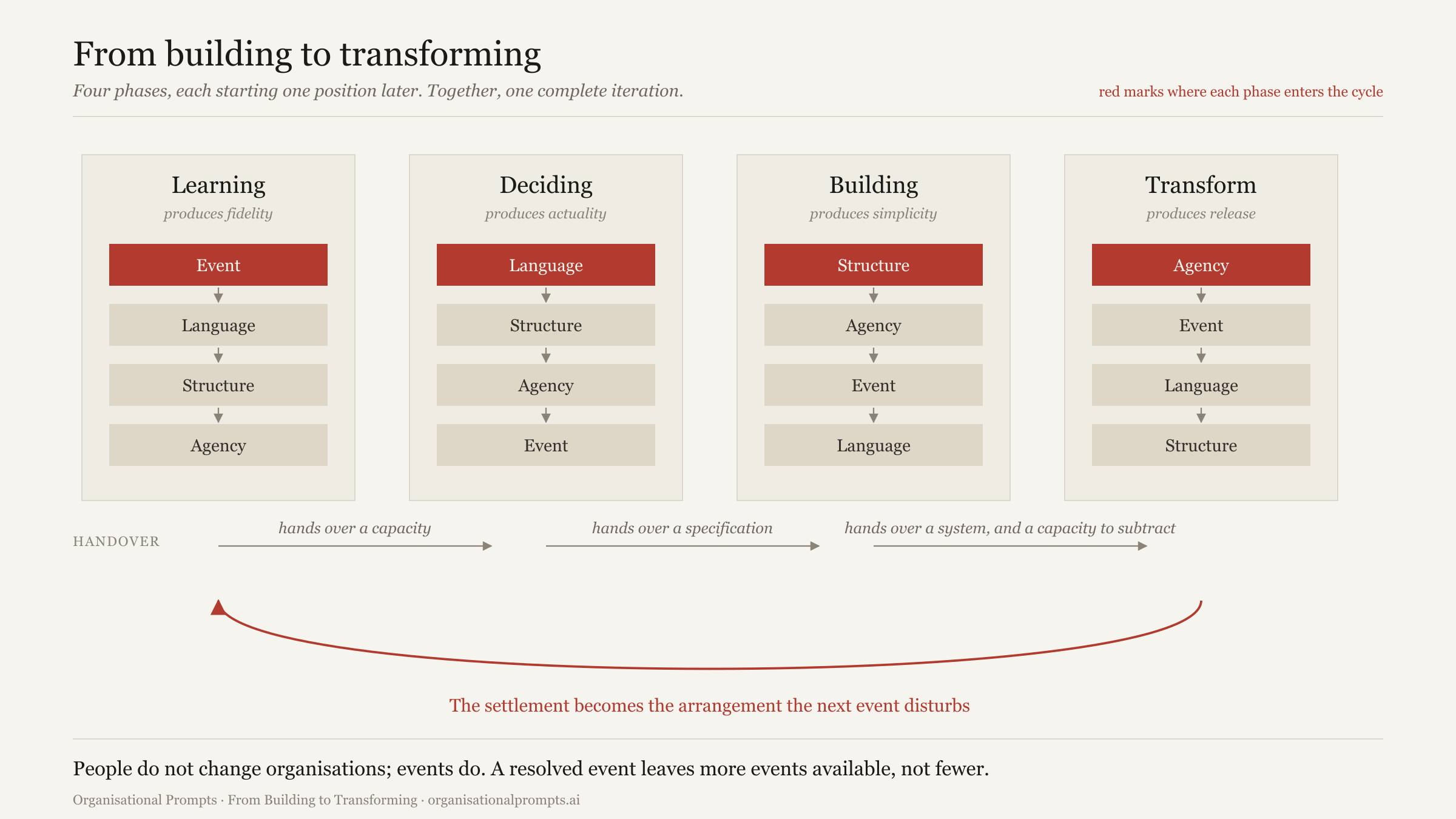
Look at the four phases together and a pattern shows up that was not designed and is probably not a coincidence. Learning ran Event, Language, Structure, Agency. Deciding began one position later, at Language. Building started one later again, at Structure. Transform begins at Agency, which is the fourth, and the four phases together make one complete iteration of the same four moves, at the scale of the whole change rather than any part of it.
Which means the last part does not close anything. The settlement it produces becomes the arrangement the next event will disturb. An organisation that has been through this once is better at recognising an event and better at making one, because it has a vocabulary for what happened and people who survived it. This is the argument the series has been making since the first article. People do not change organisations; events do. And an organisation that resolves an event well ends up with more events available to it, not fewer, which is why positive change compounds and why the alternative is not stability but slow arrest.
Building asked how an organisation makes the thing real and stays honest while reality tells it what it got wrong. Transforming asks the question the whole series has been walking towards, and it is a personal one: what kind of leader can you be in the organisation you are actually in? That is where the series goes next.
One orientation before the change of question. The series runs four phases; Learning, Deciding, Building and Transforming. Each starts one position later than the last in the same four moves, so the four together complete a single turn: Learning at Event, Deciding at Language, Building at Structure, Transforming at Agency. From Deciding to Building was the previous bridge and The Build Is the Test opened the stretch this one closes.
I write about the industry and its approach in general. None of the opinions or examples in my articles necessarily relate to present or past employers. I draw on conversations with many practitioners and all views are my own.