
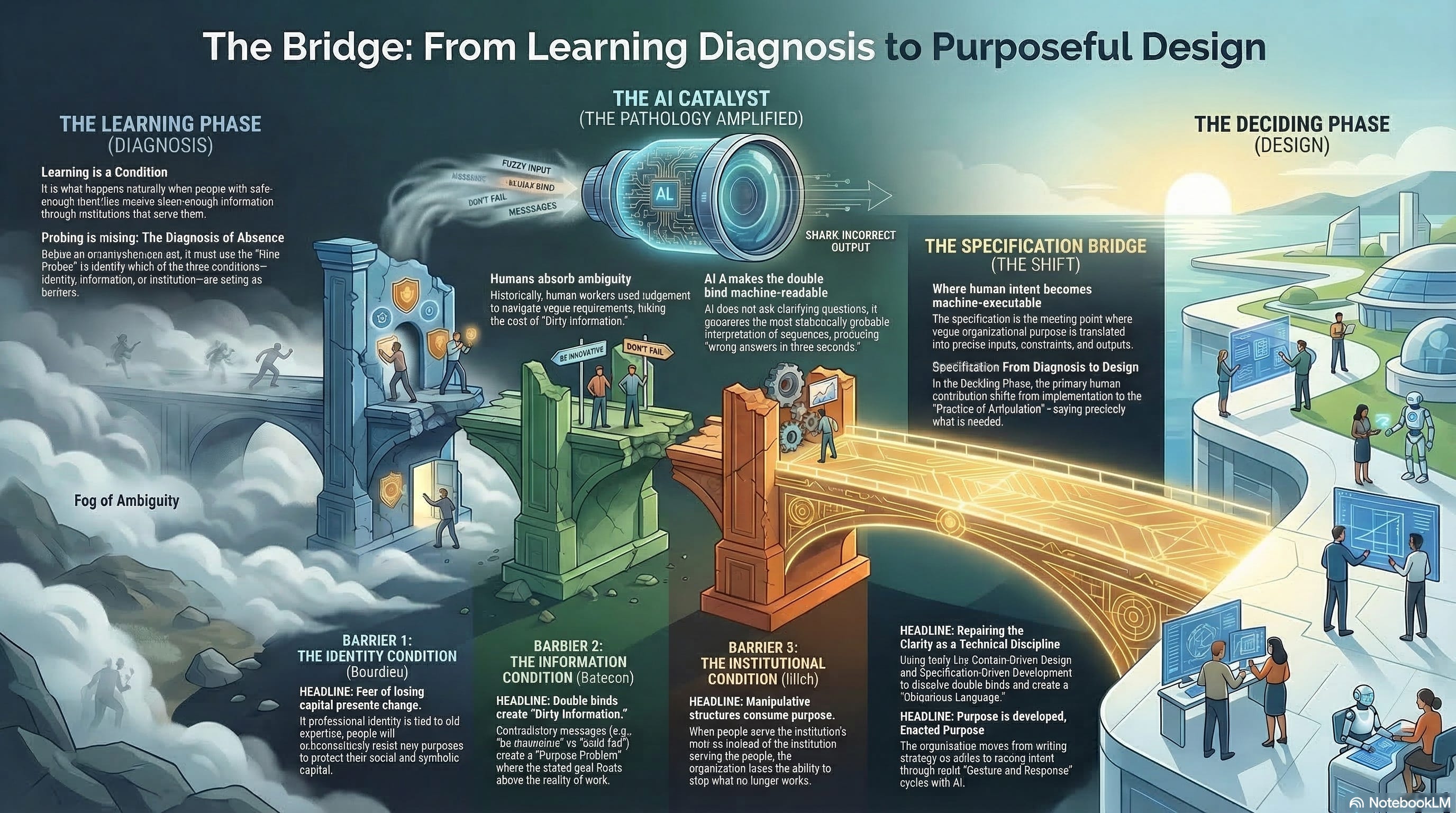
Every AI transformation programme has a purpose statement. It is on the second slide of the strategy deck. It says something about “leveraging artificial intelligence to drive innovation, efficiency, and competitive advantage.” Everyone has seen it. Not everyone can connect it to what they are supposed to do differently on Monday morning.
This is the gap between clarity and action. Not the absence of purpose, but the presence of a stated purpose that floats above the reality of work: disconnected from how people actually operate, what they believe they are trying to achieve, and what the organisation rewards them for doing. This article is a bridge. The series has spent its first phase asking why organisations cannot learn. Now it turns to a harder question: how does an organisation design its way to action? And the answer, it turns out, lies in the same model that governed Learning; the ELSA cycle; but entered from a different position.
1. What the Learning Phase Found
Learning profiled thinkers who diagnosed the barriers to organisational learning. The synthesis established a hypothesis: learning is a condition, not a process. It emerges when three conditions are met, each with a foundational thinker whose work anchors that part of the architecture.
The Identity condition, whose foundational thinker is Bourdieu: identity must be safe enough to change. Can people tolerate losing what they have? Is learning happening through practice, or through instruction? Do people believe that effort produces results? Habitus; the embodied dispositions that generate practice below conscious awareness; is reshaped through participation, not through training. Learned helplessness is itself habitus: a sedimented disposition that effort does not produce results.
The Information condition, whose foundational thinker is Bateson: information must be clean enough to act on. Can people tell the truth about what is happening? The double bind; contradictory messages at different logical levels with no permission to name the contradiction; is the mechanism that kills information flow. Are decision-makers close to the work? Information degrades with distance. Is the organisation changing what it rewards, or just what it says? New language without new incentives is a structural double bind.
The Interaction condition, whose foundational thinker is Illich: the institutional form must be convivial enough to permit learning. Does the institution serve the people, or do the people serve the institution? Can the institution stop doing what no longer works? Can the institution integrate conflict, or must it suppress it?
These nine probes tell a leader where the learning condition is absent. They do not tell the leader what to do with the learning once the condition is present. And that is where the series turns.
2. How the Learning ELSA Cycle Runs
The ELSA model describes how change moves through organisations. In Learning, the cycle runs E → L → S → A.
Event is the disruption: the demonstration that cannot be unseen, the competitive move that invalidates assumptions, the technology shift that renders a capability obsolete. The event can be external (a market disruption) or internal (a gesture; an experiment, a provocation, a deliberate attempt to surface what has been hidden). Events are charismatic in Weber’s sense: they derive their power from direct experience, not from rules or tradition.
Language is what happens when the organisation begins to name what the event revealed. New categories emerge. The language creates shared reference points and makes the disruption discussable. It begins the process of routinisation: channelling disruptive energy into stable concepts that people can work with.
Structure is what happens when the new language becomes institutional. Governance frameworks are written. Teams are reorganised. Processes are redesigned. Incentives are realigned. The new patterns are formalised into arrangements that can operate without the charismatic catalyst that started the cycle.
Agency is what happens when the new patterns become self-sustaining. People act from the new framework without being told to. The new way of working reproduces itself through practice, not instruction. Bourdieu would recognise the mechanism: the habitus has been reshaped. The organisation has not merely adopted a change; it has become a different kind of organisation, one whose dispositions generate different behaviour.
The nine Learning probes govern the transitions between these stages. Three probes at each transition, drawn from whichever lever the transition functionally requires. When a transition’s probes fail, the cycle stalls: the event produces diplomatic language rather than honest language; the language decorates existing structures rather than reshaping them; the structures are complied with rather than practised into new dispositions.
When the cycle completes, the organisation has Agency: the capacity to tell the truth, to practise rather than merely learn, to tolerate loss, to integrate conflict, to stop what no longer works. These are not strategic capabilities. They are conditions. And conditions, once present, make something else possible.
3. Every Absent Condition Is a Barrier to Deciding
Read together, Learning thinkers reveal something none of them states alone: every absent condition for learning is simultaneously a barrier to deciding.
Where the Identity condition is absent, the organisation cannot decide because the habitus of its members generates practice that reproduces the old commitments automatically. The senior developer whose reflexes are calibrated to a world where coding is the primary work cannot adopt a new direction through intellectual assent. Their embodied dispositions will produce code-centric behaviour regardless of what the strategy says. Deciding requires identity transition, and identity transitions take far longer than any programme timeline allows.
Where the Information condition is absent, the organisation cannot decide because its double binds prevent reality from becoming visible. Beer’s law captures this: the purpose of a system is what it does, not what it says it does. The gap between the strategy slide and Monday morning is not a communication failure. It is a structural double bind: “our purpose is innovation” delivered through structures that reward predictability. The organisation cannot describe its own domain honestly, and without honest description, every decision is made against a fiction.
Where the Interaction condition is absent, the organisation cannot decide because the institutional form has replaced purpose with the consumption of its own services. The programme’s metrics measure its own activity; training delivered, milestones reached; rather than the capability it was designed to develop. The organisation cannot stop what no longer works, and therefore cannot make room for what must replace it.
The directional logic connects the three. Identity constrains Information: what people can perceive determines what information they can process. Information constrains Interaction: what information is available determines how parts can relate. But Interaction is where change actually occurs: shifts in interaction patterns change what information flows, which changes what people perceive, which changes identity. The causation runs one way for understanding; it runs the other way for intervention.
This is why Learning must come first. Without these conditions, Deciding operates on corrupted input. The language will be diplomatic rather than precise. The models will be unchallengeable because challenging them is unsafe. The commitments will be premature consensus rather than designed artefacts. The decisions will be, in the language of the companion essay, organisational hallucinations: confident, fluent, plausible, and wrong.
4. AI Breaks the Information Condition First
Everything described so far is a human and organisational problem. But AI introduces a structural change that transforms the clarity problem from an organisational challenge into a production challenge. It does so at the Information condition.
In the pre-AI world, ambiguity about purpose was absorbed by the humans who did the work. A vague requirement could still produce a reasonable outcome because the developer brought contextual knowledge, asked clarifying questions, made assumptions, and navigated the gap between what was specified and what was needed. Humans tolerated information pathology. The cost was hidden in time, rework, and compromise. But the work got done.
AI does not tolerate information pathology. It amplifies it. A model given a vague specification generates the most statistically probable interpretation of that vagueness. It will not ask clarifying questions. It will produce something, confidently and quickly, that is precisely as unclear as the specification that prompted it. The vague requirement that would have taken a human team three weeks to implement, with clarification along the way, now produces a wrong answer in three seconds.
This is Bateson’s double bind made machine-readable. The organisation sends contradictory signals about what it wants. The human absorbs the contradiction. The machine amplifies it. If the specification encodes ambiguity, contradictory constraints, or unresolved conflicts about purpose, the AI will faithfully reproduce all of them.
AI adoption exposes the clarity problem rather than creating it. The ambiguity was always there. The double binds were always active. The humans were absorbing them. Now the humans must resolve them before the machine acts, because the machine cannot absorb them.
The specification, properly understood, is where purpose meets production: where “create value for this customer in this way” becomes “accept these inputs, enforce these constraints, produce these outputs.” The quality of the specification determines the quality of the output. And the quality of the specification depends on whether the organisation can describe its domain honestly, precisely, and in language that practitioners actually use. This is why Deciding begins where it does.
5. The Rotation: Why Deciding Starts at Language
Here is the structural move that connects the phases.
The Learning ELSA cycle runs E → L → S → A. It starts with Event because learning begins with disruption: something happens that the organisation must respond to. It ends with Agency because learning succeeds when new dispositions are self-sustaining.
The Deciding ELSA cycle runs L → S → A → E. It starts with Language because deciding begins with description: can you name the domain precisely enough to design within it? It ends with Event because the output of deciding is not a strategy document but a specific, bounded, buildable thing; an Event that triggers the next phase.
The rotation is not arbitrary. It follows from what each phase produces. Learning Agency; the organisation’s capacity to tell the truth, to practise, to tolerate loss, to integrate conflict; is precisely what makes honest Language possible. The conditions produced by Learning are the operating conditions for the first step of Deciding. The connection is structural: Agency enables Language. Without Agency, the Language stage of the Deciding cycle operates on the same diplomatic fictions the Learning articles were written to dismantle.
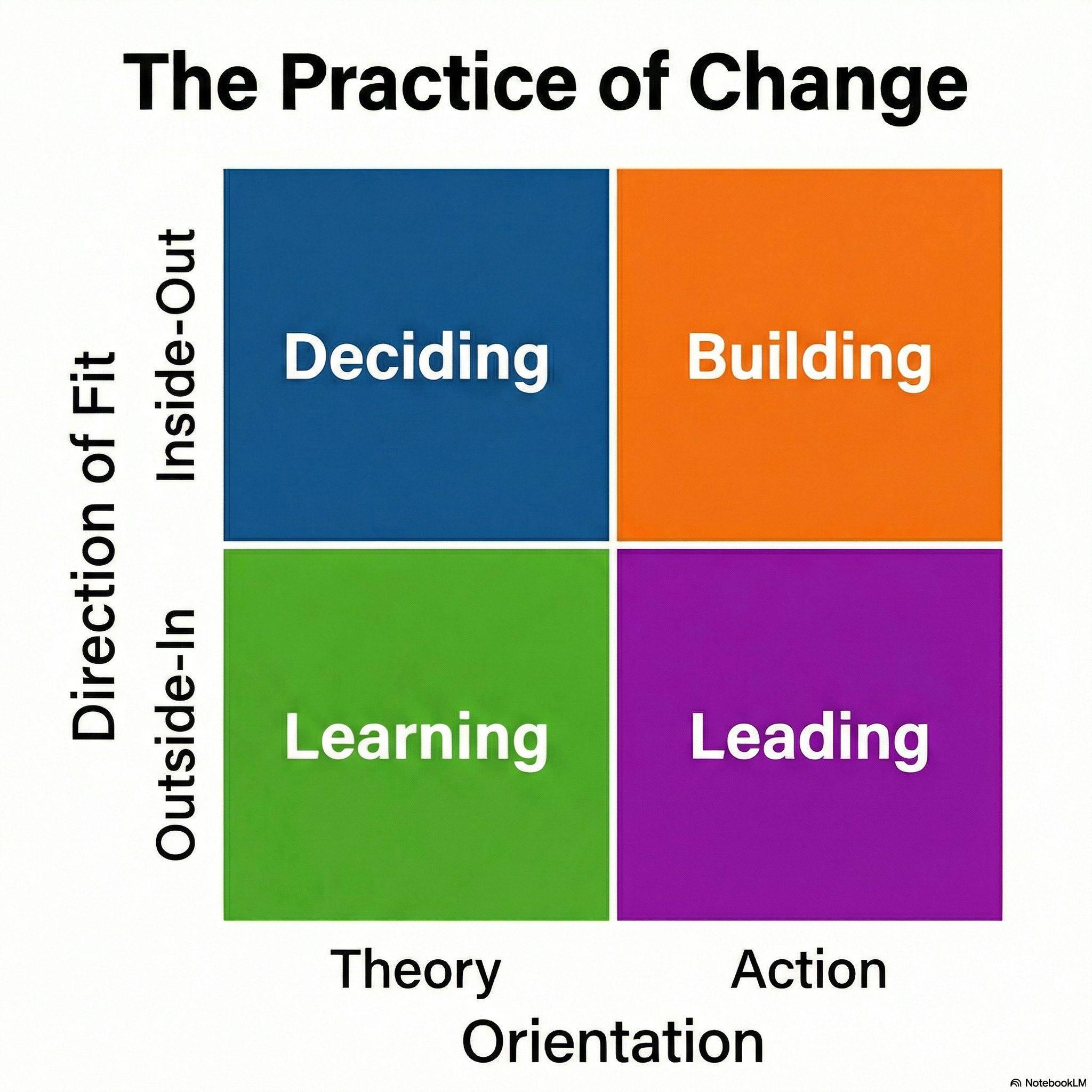
And the rotation continues. Building will run S → A → E → L. It starts with Structure because building begins with the implementation architecture; the thing being constructed. It ends with Language because the organisation learns what to say about what it built and what it discovered. Leading will run A → E → L → S. It starts with Agency because leading begins with the leader’s capacity to act. It ends with Structure because the leader’s final contribution is the reorganisation that enables the next cycle.
The four phases of the series are one rotation of ELSA at the macro level. E → L → S → A, each group opening on one question, and what one leaves behind becoming the entry condition for the next. The series is not four separate frameworks applied in sequence. It is one framework, rotated, with each phase deepening the same cycle.
6. The Handoffs Between Phases
The three conditions operate in both phases. The foundational thinker changes because the nature of the constraint changes, but the parallel structure is exact.
Identity: Bourdieu, then Simon. Bourdieu is the foundational thinker for Identity in Learning because he explains the sociological constraint on what is available to the person: the habitus that generates practice below conscious awareness, the capital that determines what is at stake, the field that defines which identities are legitimate. Simon takes Identity in Deciding because he explains the cognitive constraint on what is available to the decision-maker: bounded rationality, satisficing, decision premises, the architecture of complexity. Both govern through constraint on what is available. Bourdieu constrains through embodied dispositions. Simon constrains through cognitive limits. Both explain why people act within a narrower range than their situation permits.
Information: Bateson, then Ohno. Bateson is the foundational thinker for Information in Learning because he explains the epistemological conditions for information to be meaningful: levels of learning, the double bind, the ecology of mind. His definition of information; “a difference which makes a difference”; establishes the principle. Ohno takes Information in Deciding because he provides the discipline for seeing reality as it is rather than as it is reported. Go to the gemba. Do not decide from reports. Standard work; the precise, shared description of how work is actually done, not how it is imagined; is Bateson’s principle made institutional. When the description matches reality, the organisation can act on what it sees. When the description matches only what is convenient, the organisation hallucinates.
Evans’ domain-driven design; ubiquitous language, bounded contexts, knowledge crunching; is the software instantiation of Ohno’s principles. The ubiquitous language is standard work applied to domain description. The bounded context is a value stream boundary applied to knowledge. Evans matters for the series because his work shows what Ohno’s principles look like when applied to the domain of specification. But the foundational insight is Ohno’s: precision of description depends on proximity to reality, and the structures of work must enforce this proximity rather than leaving it to chance.
Interaction: Illich, then Beer. Illich is the foundational thinker for Interaction in Learning because he diagnoses the pathology of institutional inversion: the point at which the institution becomes counterproductive to its own stated purpose. Beer takes Interaction in Deciding because he provides the cybernetic architecture that prevents or corrects the inversion: the Viable System Model, POSIWID, the recursive structure that ensures each part of the organisation has the autonomy to respond to its environment while remaining coordinated with the whole. Illich tells you that your transformation programme has replaced learning with the consumption of its own services. Beer tells you what to build instead: an information architecture that makes the actual purpose visible, and a diagnostic that cuts through every stated intention to reveal what the system actually does.
7. The Deciding Cycle as a Decision Process
The Deciding hypothesis is: decisions are design challenges, and design is a sequence of decisions under constraint. The ELSA rotation makes this operational.
Language (Information lever): can you describe the domain precisely enough to decide within it? The three probes that govern this stage ask whether a shared vocabulary exists that practitioners actually use, whether the organisation can distinguish what it knows from what it assumes, and whether the models used to decide are visible and challengeable. These are not diagnostic questions to be answered once. They are tasks to be performed. You build shared language by getting practitioners together. You sort knowledge from assumption by marking every assertion. You make models visible by drawing them where someone can disagree.
Structure (Interaction lever): do you understand how the parts relate when this decision is made? The three probes that govern this stage ask whether the organisation recognises that its structure shapes its decisions, whether it can redesign the system rather than optimise within it, and whether the decision process produces what it intends. Again, these are tasks. You examine structural constraints before debating options. You ask, when a problem recurs, whether the problem is in the decision or in the system that generates it. You compare what the process produces with what it claims to produce.
Agency (Identity lever): do the people making this decision have the capacity to commit? The three probes that govern this stage ask whether people can distinguish choosing from defaulting, whether the organisation can name what it will not do, and whether it can hold competing designs without premature closure. These are the hardest tasks because they operate on identity. You find inherited commitments by asking when a decision was last consciously taken. You force exclusion by requiring every proposal to state what it rules out. You hold tension by requiring at least two structurally different options before any commitment.
Event (the output): the specific, bounded, buildable thing the organisation has designed its way toward. Not a strategic priority. Not a programme of work. A describable thing precise enough that Building can construct it.
The ELSA gates are binary. If Language is imprecise, stop; everything downstream operates on the description. If Structure is invisible, stop; the architecture you build will be governed by constraints nobody surfaced. If Agency is insufficient, stop; the commitment will be premature consensus that collapses under pressure. A failed gate sends you back to the previous stage, not to the beginning.
8. Why Deciding Requires Technical Content
Learning was about people and organisations. Deciding introduces technical content, and for a reason that follows from the series’ own argument.
When an AI model can generate working software from a description of what is needed, the constraint on production shifts from the capacity to build to the capacity to specify. The specification is the means of production. The precision with which an organisation describes what it needs determines, directly, the quality of what the machine produces. This means that repairing the Information condition is no longer exclusively an organisational challenge. It is also a technical one.
Domain-driven design is an information architecture. Specification-driven development is an information discipline. Contract testing is an information verification practice. The OO design tradition spent six decades proving that every module boundary, every interface, every contract between components is a decision about what to reveal, what to hide, what to promise, and what to defer. These are the practices through which Language in the Deciding ELSA cycle becomes precise enough to act on.
A reader who skips the technical articles will understand the organisational argument. A reader who engages with them will understand something the organisational argument alone cannot convey: that the practice of description has become a technical discipline, and that the technical discipline is, at its root, a practice of honesty about the domain. The two are the same thing, seen from different angles.
9. The Bridge
Learning told you what prevents clarity. Deciding shows how to design toward it.
The learning conditions do not become irrelevant. They become the operating conditions within which the Deciding cycle can run. An organisation without Learning Agency; without truth-telling, without practice, without the capacity to integrate conflict; cannot produce honest Language. Without honest Language, it cannot examine its own Structure. Without structural examination, it cannot develop the Agency to commit. And without commitment, it cannot produce the Event that Building requires.
The cycle turns. Learning ends with Agency. Deciding begins with Language. The transition is the series’ central mechanism: the conditions you create in one phase are the operating conditions for the next. Skip the conditions and the process runs but produces nothing real. Protect them and the cycle advances, each completed transition producing the input for the next.
The organisation that completes the Learning cycle before entering the Deciding cycle has earned the right to its own clarity. Its decisions will be constrained; Simon guarantees that. Its descriptions of reality will be imperfect; Ohno guarantees that, which is why he insisted on going back to the gemba again and again. Its structures will eventually need redesigning; Beer guarantees that. But the constraints will be real, not imagined. The descriptions will be shared, precise, and grounded in what people actually see. The structures will have been built to serve the work, not to reproduce the past.
And the Event that falls out of the Deciding cycle; the specific, bounded, buildable thing; will be something the organisation designed its way toward, honestly, through the only process that works: description, structural examination, and genuine commitment, in that order, with the Learning conditions holding the whole thing together.
One more orientation before the probes. The series runs four phases and this article sits between the first two. The Learning articles ask whether an organisation can perceive its own situation; Deciding what it can describe and design under constraint; Building whether it can build an effective response; Transforming what the change was ultimately for. Each phase enters the same four moves one position later than the last, so the four phases together complete a single turn. From Deciding to Building is the next bridge, and The Build Is the Test opens the third phase.
Further Reading
Peter Drucker, Management Challenges for the 21st Century (1999). The knowledge worker must define the task. In the AI-mediated world, defining the task is the work.
Eric Evans, Domain-Driven Design (2003). The discipline of making domain models explicit, shared, and contestable. The practical mechanism for dissolving the double binds that prevent clear specification.
Stafford Beer, Brain of the Firm (2nd edition, 1981). The Viable System Model: the cybernetic architecture that prevents institutional inversion and ensures autonomous units can learn and decide.
Herbert Simon, The Sciences of the Artificial (3rd edition, 1996). The architecture of complexity, bounded rationality, and design as the core human activity. The foundational thinker for the Identity lever in Deciding.
I write about the industry and its approach in general. None of the opinions or examples in my articles necessarily relate to present or past employers. I draw on conversations with many practitioners and all views are my own.