
Your organisation has just invested heavily in a decision-support platform. It aggregates data from fourteen sources, applies weighted scoring to thirty-seven criteria, and produces a recommendation with a confidence interval. The business case was compelling: better data produces better decisions. Remove the guesswork. Eliminate bias. Optimise.
Six months in, decisions are slower. The platform generates so much information that committees spend their time debating the inputs rather than making the call. The people who used to decide well — the ones with twenty years of domain knowledge and a reliable instinct for what matters — now defer to the dashboard. When the dashboard is ambiguous, which it often is, nobody decides at all.
This is not a technology failure. It is an epistemological one.
The Bias Industry
Earlier in this series, we examined Kahneman’s work on the two cognitive systems — the fast, associative System 1 and the slow, deliberative System 2 — and the catalogue of biases that arise when System 1 handles problems that properly belong to System 2. The implications for organisations were clear: human judgment is unreliable, systematically distorted by anchoring, availability, overconfidence, and a dozen other heuristic shortcuts. The corrective seemed obvious. Slow down. Gather more data. Build decision frameworks that force deliberation and override intuition.

An entire industry has grown from this logic. Behavioural economics consulting. Debiasing workshops. Nudge units. And now, AI-powered decision platforms that promise to do what humans apparently cannot: weigh all the evidence without cognitive distortion.
Gerd Gigerenzer, director of the Harding Center for Risk Literacy and for decades the most formidable intellectual opponent of the Kahneman-Tversky programme, argues that this corrective is built on a misunderstanding. Not a small one. A foundational one.
The error is this: the assumption that heuristics are cognitive failures to be corrected, rather than cognitive tools to be understood.
Simon’s Scissors
To see what Gigerenzer is doing, we need to return briefly to Herbert Simon, whose concept of bounded rationality has already appeared in this series. Simon argued that humans cannot optimise; they lack the computational capacity, the time, and the information. Instead, they satisfice — they search until they find an option that meets their threshold, then stop. This was a descriptive claim about cognitive limits.
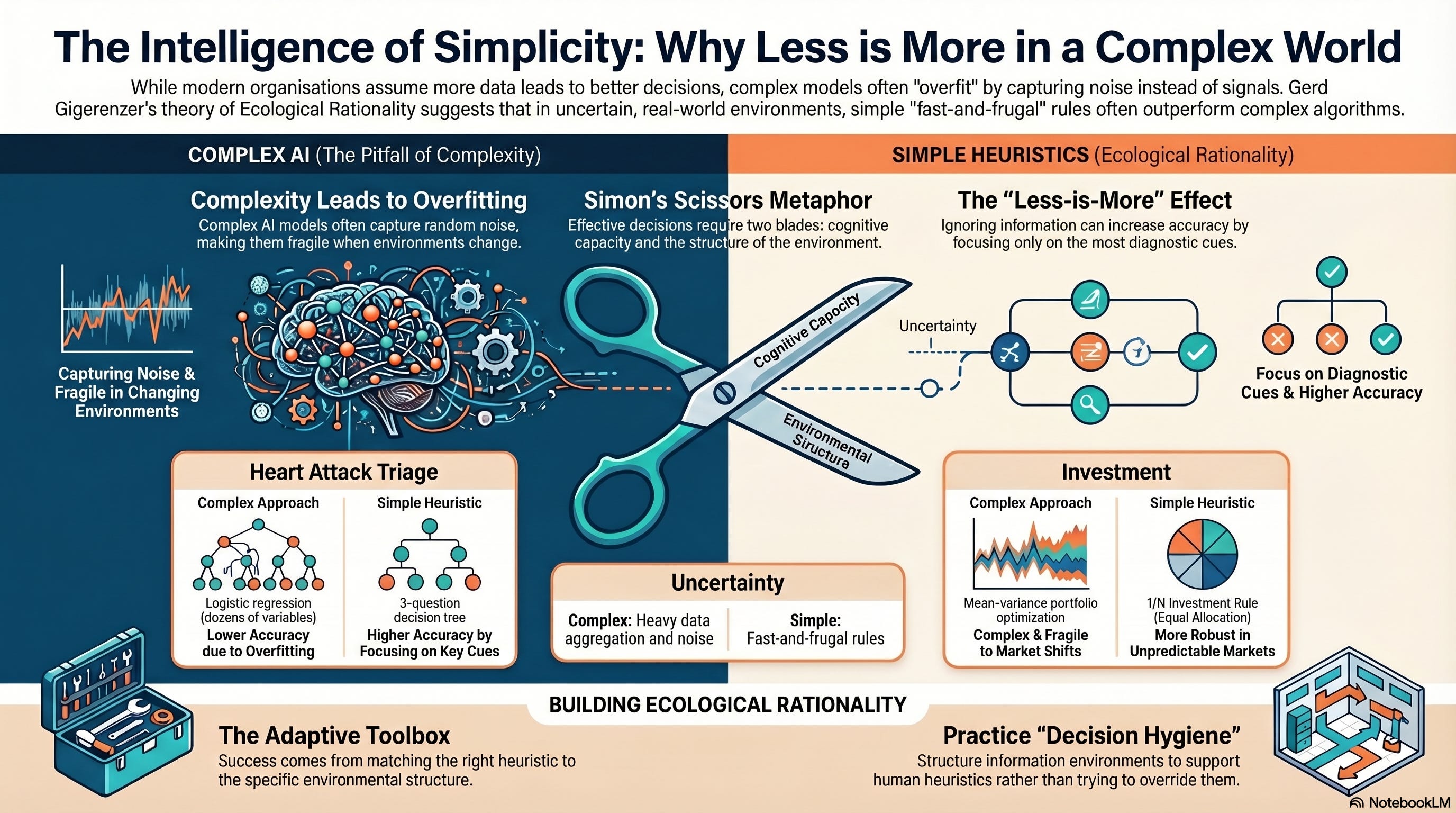
But Simon said something else, less often quoted, that Gigerenzer takes as his starting point. Human rationality, Simon wrote, operates like a pair of scissors: one blade is the cognitive capacity of the decision-maker, the other is the structure of the environment. You cannot understand how a pair of scissors cuts by looking at only one blade.
The Kahneman-Tversky research programme looks almost exclusively at the cognitive blade. It examines how people deviate from optimal statistical reasoning — from Bayesian updating, from expected utility maximisation — and catalogues the deviations as biases. The implicit benchmark is a decision-maker with unlimited information and unlimited computational capacity. Against that benchmark, of course, human judgment looks deficient.
Gigerenzer’s argument is that the benchmark is wrong. Not just impractical, but wrong as a description of what good decision-making looks like under the conditions in which real decisions actually occur.
Ecological Rationality
The core of Gigerenzer’s programme is the concept of ecological rationality. A heuristic is not rational or irrational in the abstract; it is rational to the degree that it fits the structure of the environment in which it is deployed. A simple rule that ignores most available information can outperform a complex model that uses all of it — not despite its simplicity, but because of it.
This is the less-is-more effect, and it is not a curiosity. It is a robust empirical finding across domains from medical diagnosis to investment to personnel selection.
Consider: emergency physicians at a Michigan hospital needed to decide quickly whether patients presenting with chest pain should be sent to the coronary care unit or a regular bed. The standard protocol used a complex logistic regression model incorporating dozens of variables. A fast-and-frugal decision tree — asking at most three yes-or-no questions — matched or outperformed the complex model. It asked whether the ECG showed ST-segment changes, whether chest pain was the chief complaint, and whether any of five other factors were present. Three questions. Better outcomes.
Why? Because the environment had a specific structure: a few cues were highly diagnostic while the rest added noise. Under those conditions — which, Gigerenzer argues, characterise most real-world decision environments — the complex model overfits. It captures not only the signal but the noise in the historical data, and the noise does not generalise. The simple heuristic, by ignoring most of the information, is more robust. It travels better from the past to the future.
The Adaptive Toolbox
Gigerenzer does not argue that one heuristic fits all situations. His model of the mind is not a single algorithm but what he calls the adaptive toolbox: a repertoire of heuristics, each adapted to a particular class of environment. The recognition heuristic — when in doubt, choose what you recognise — works when recognition correlates with the criterion of interest, as it does in many consumer and investment decisions. The take-the-best heuristic — search cues in order of validity, stop at the first one that discriminates — works when cue validities are skewed and information is redundant. The 1/N rule — divide resources equally among options — outperforms mean-variance portfolio optimisation when the number of options is large relative to the available data.
The art of good decision-making, on this account, is not the elimination of heuristics but the selection of the right heuristic for the right environment. This is what Gigerenzer means by risk literacy: not the ability to calculate probabilities (though that helps), but the ability to match a decision strategy to the structure of the problem.
The Kahneman-Gigerenzer Debate
It would flatten the intellectual landscape to pretend this is a settled question. The disagreement between Kahneman and Gigerenzer is genuine, substantive, and unresolved.
Kahneman’s position, put simply, is that heuristics produce systematic errors in a wide range of conditions, and that awareness of these errors — combined with structured decision processes — can improve outcomes. The evidence for specific biases (anchoring, framing effects, base-rate neglect) is extensive and replicable. Gigerenzer does not deny that these effects occur in laboratory settings; he argues that they occur primarily in environments that have been specifically designed to make heuristics fail — narrow experimental conditions that strip away the environmental structure on which heuristics depend. Transpose the same decision-maker into a natural environment with ecological validity, and the ‘bias’ often disappears or reverses.
Klein, whose work on recognition-primed decision-making we have already discussed, sits closer to Gigerenzer on this question. Kahneman himself acknowledged the convergence in his later work with Klein, conceding that expert intuition is reliable when the environment is regular enough to be learned and when the decision-maker has had adequate opportunity to learn it. The disagreement is about how often those conditions obtain — and about what to do when they do not.
For the purposes of this series, the productive tension matters more than the resolution. Kahneman tells us where human judgment fails. Gigerenzer tells us where it succeeds and why. An organisation that heeds only Kahneman builds systems designed to override human judgment. An organisation that heeds only Gigerenzer trusts domain expertise without examining the conditions under which it was formed. The intelligent position is to hold both: to know when the environment supports heuristic reasoning and when it does not, and to design accordingly.
What This Means for Organisations Adopting AI
The relevance to AI adoption is immediate and largely ignored.
The prevailing assumption in enterprise AI is that more data produces better decisions. This is true in stable, data-rich environments with well-defined outcome variables — the complicated domain, in Snowden’s terms. It is not true in the environments where most consequential organisational decisions actually occur: volatile, ambiguous, and poorly structured, where the relevant variables are not yet identified and the future will not resemble the training data.
In those environments — which is to say, in most of the decisions that actually matter to a technology leader — Gigerenzer’s research suggests that organisations should be investing not in more comprehensive models but in better heuristics. Simple decision rules, transparent and debuggable, that capture the structure of the specific environment and ignore everything else.
This runs directly counter to the AI sales pitch, which is precisely why it deserves attention. The vendor tells you that the model considers thousands of variables. Gigerenzer asks: in an uncertain environment, is that a feature or a liability?
The Decision Hygiene Question
There is, however, a place where Gigerenzer and the debiasing tradition converge, and it matters for practice. Gigerenzer’s work on risk literacy demonstrates that many decision failures are not failures of heuristic reasoning but failures of representation. Doctors misinterpret screening results not because they use bad heuristics but because the results are presented in conditional probabilities rather than natural frequencies. The heuristic is fine; the information format is hostile to it.
This connects to what Kahneman, Sibony, and Sunstein have called decision hygiene — the structural conditions under which decisions are made. The question is not only ‘which heuristic?’ but ‘has the environment been structured to support good heuristic use?’ For organisations, this reframes the AI question entirely: the goal is not to replace human judgment with algorithmic judgment, but to structure the information environment so that the adaptive toolbox works well.
The Organisational Prompt
Identify one recurring decision in your organisation that is currently supported by a complex scoring model, a multi-criteria framework, or an AI recommendation engine. Now ask:
What simple rule would your most experienced domain expert use if forced to decide in sixty seconds with no dashboard?
Articulate that rule explicitly. It will likely use one, two, or at most three cues. Test it against the complex model’s track record. If the simple rule performs comparably — and Gigerenzer’s research suggests it often will — then the complexity of the model is not adding predictive value. It is adding cost, latency, and opacity.
The point is not that you should replace every model with a heuristic. The point is that you should know, empirically, whether the complexity is earning its keep. Most organisations have never asked.
Placement: Deciding, the second of four phases; Learning, Deciding, Building, Transforming. Gigerenzer is a Deciding thinker because his subject is how much description a decision actually needs, and his answer is less than the platform's business case assumed. What an organisation gets out of that work is a decision that can be acted on under real constraint. Why Your Organisation Can't Decide closes the phase, and From Deciding to Building leads to the articles that test it.
Further Reading
Gerd Gigerenzer, Peter M. Todd, and the ABC Research Group, Simple Heuristics That Make Us Smart (Oxford University Press, 1999). The foundational text. Available as a précis: Behavioral and Brain Sciences, 23, 727–780.
Gerd Gigerenzer, Gut Feelings: The Intelligence of the Unconscious (Viking, 2007). The accessible introduction; starts from the gaze heuristic and builds outward.
Gerd Gigerenzer, Risk Savvy: How to Make Good Decisions (Viking, 2014). Risk literacy in practice — medicine, finance, everyday life.
Gerd Gigerenzer, “Why Heuristics Work,” Perspectives on Psychological Science 3, no. 1 (2008): 20–29. The clearest short statement of the less-is-more argument. Freely available PDF.
Gerd Gigerenzer and Wolfgang Gaissmaier, “Heuristic Decision Making,” Annual Review of Psychology 62 (2011): 451–482. The comprehensive review. Freely available PDF.
Daniel Kahneman and Gary Klein, “Conditions for Intuitive Expertise: A Failure to Disagree,” American Psychologist 64, no. 6 (2009): 515–526. The remarkable partial convergence between the two programmes.
Victor DeMiguel, Lorenzo Garlappi, and Raman Uppal, “Optimal Versus Naive Diversification: How Inefficient Is the 1/N Portfolio Strategy?” The Review of Financial Studies 22, no. 5 (2009): 1915–1953.
I write about the industry and its approach in general. None of the opinions or examples in my articles necessarily relate to present or past employers. I draw on conversations with many practitioners and all views are my own.