
Four companies in the same sector announced platform strategies within eleven weeks of each other last year. The architectures were not identical, but they ‘rhymed’. Each deck contained a slide about becoming the intelligence layer for its industry. None of the four had been asked for this by a customer.
Ask any of the executives involved and you will get a coherent account of market forces, and the account will be sincere. What nobody will say is that they are copying each other, because copying is not how it feels from inside. It feels like independent analysis arriving at the same conclusion. Independent analysis does sometimes arrive at the same conclusion. It also looks exactly like copying, from outside, to everyone except the people doing it.
Girard was born in Avignon in 1923, took a doctorate in history at Indiana in 1950, and spent the rest of his life in American universities: Johns Hopkins, Buffalo, then Stanford from 1981. He was elected to the Académie française in 2005 and died in 2015. Across all of it he pursued one idea, from literature into anthropology and then into theology, and the idea is this: we do not know what we want. We take our wants from other people. Everything else in his work follows from that, up to and beyond the part organisations most need to understand, which is what a group does when the resulting rivalry becomes unbearable.
These articles hold that the event which changes an organisation is not the leader’s to make. Girard holds the Event position, and he is there because he gives the best available account of where the crisis actually comes from. Not a competitor, a regulator or a technology. The crisis is generated inside the group, by the group, out of the ordinary mechanics of wanting things, and it has a default resolution that works, costs one person, and teaches the organisation nothing.
1. Desire is borrowed
Girard’s first book, Deceit, Desire and the Novel, came out in 1961 and looked like literary criticism. He had been teaching French literature in America and noticed something the novelists he most admired all seemed to know.
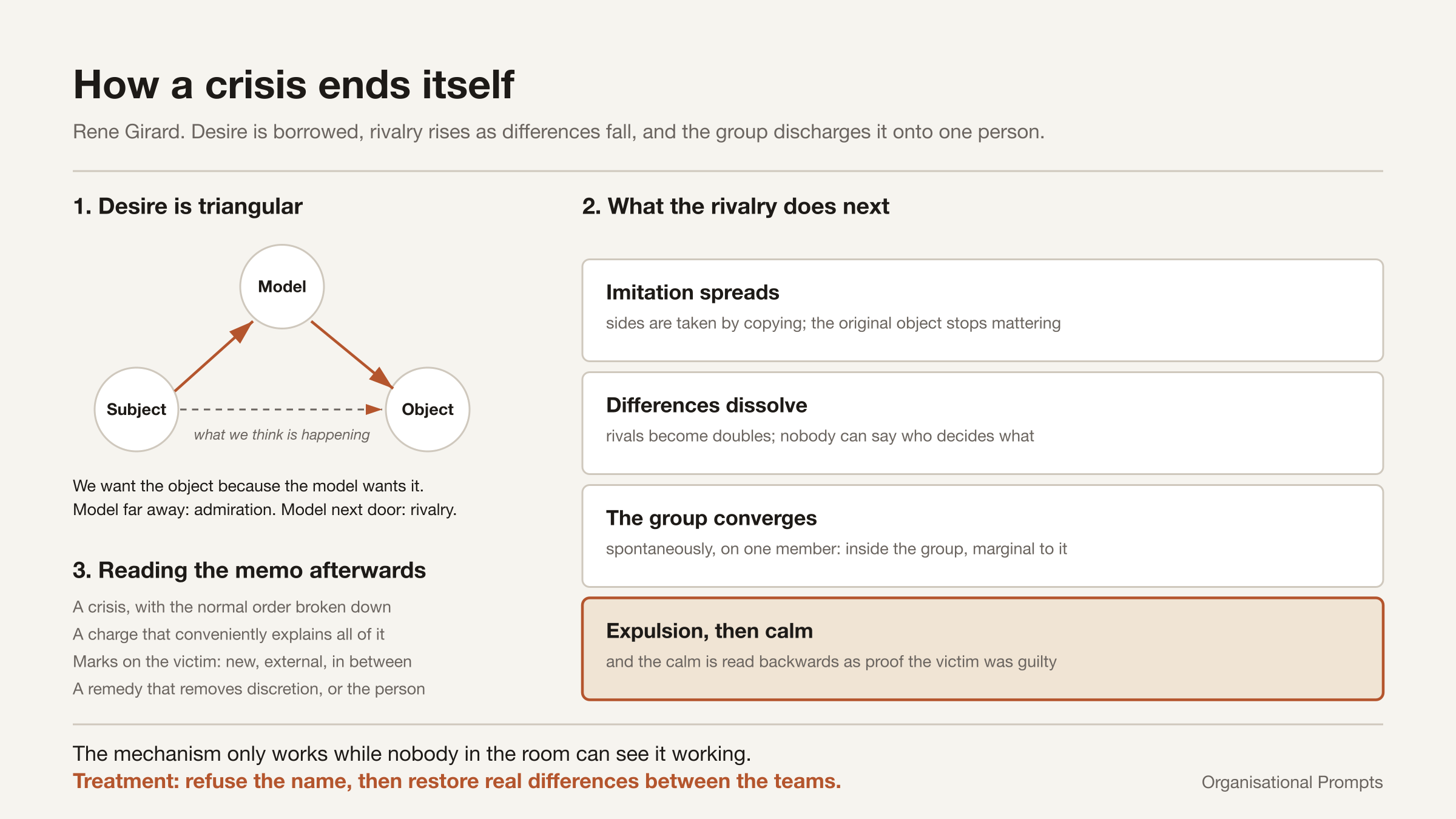
We tell ourselves that desire runs in a straight line. A subject wants an object because of what the object is. Girard called this the romantic lie. What the great novelists show instead is a triangle. Between the subject and the object stands a model, and the subject wants the object because the model wants it, or has it, or seems to.
Don Quixote does not spontaneously want chivalry. He wants what Amadis of Gaul wanted. The wanting is borrowed, all of it, and Cervantes says so on the first page. Emma Bovary wants the life she read about in books. Proust’s social climbers want the drawing room they cannot enter, and lose interest the moment they are inside. Dostoevsky’s characters torment each other over objects that neither party cared about before the other one did.
Girard’s move was to say that this is not a literary device. He read it as a description of how human wanting works, found by novelists because sustained attention to actual behaviour turns it up.
Sit with that for a moment, because it contradicts something most of us believe about ourselves. You did not independently arrive at your preferences in cars, schools, holidays or technology strategies. You acquired them from people whose position you were paying attention to. I find this uncomfortable, and after some years of looking I have not found a way around it.
2. The nearer the model, the worse it gets
The distinction that does the practical work is between two kinds of model, and Girard is unusually clear about it.
External mediation is when the model is remote. Another world, another era, another league. Don Quixote can imitate Amadis all he likes without ever meeting him, and the imitation stays admiring. There is no possibility of collision because the two do not occupy the same space, so the model remains a model.
Internal mediation is when the model is right there. Same market, same floor, same promotion round. Now the model wants the same object you do, and the model is in your way. The imitation continues, but its emotional register flips. The person you are copying becomes the person you resent, and the resentment is proportional to the closeness rather than to any wrong they have done you.
Notice what this does to the usual story about competition. We assume rivalry comes from difference: different interests, different incentives, different worldviews. Girard says the opposite. Rivalry comes from similarity, and it intensifies as the parties become more alike. The teams that fight hardest in your organisation are not the teams with nothing in common. They are the two platform teams with overlapping remits, or the two directors at the same grade with adjacent portfolios, who agree with each other about almost everything.
An uncomfortable corollary follows for anyone who has flattened a hierarchy. Removing distinctions removes distance, and distance is what kept the imitation admiring rather than rivalrous. Some of the most poisonous organisations I have been near were also the flattest, and everyone in them could tell you sincerely that they had removed hierarchy to reduce politics.
3. Everyone is building the same thing
Now take the last three years of technology strategy and read them through this.
Boards want AI capability. Ask a board why, and you get an answer about competitive necessity, and that answer resolves on inspection into a statement about what other boards want. The desire is mediated, and the model is the peer group, and nobody in the chain is lying. Each firm can point to real evidence that the other firms are moving. That is the mechanism exactly: the model’s wanting is the evidence, and the evidence is the model’s wanting.
This would matter less if the mediation were external. Nothing about it is. These are firms of similar size, in similar markets, hiring from the same pool, advised by the same three consultancies, reading the same analysts. Similar firms, similar models, similar desires. Internal mediation at industry scale, and internal mediation is the kind that turns into rivalry.
And something new sits on top of it, which Girard did not live to see. Everyone now consults the same models, trained on the same corpus, prompted in roughly the same way, and the strategic advice converges. Ask a frontier model to design your AI transformation and it will produce something coherent and defensible and very close to what your competitor received when they asked the same question the same week. The tool that was supposed to confer advantage is a powerful engine of undifferentiation.
I do not think this is a reason to avoid the tools. But the scarce thing has moved. Once the analysis is commodity, differentiation has to come from somewhere the model cannot reach: your actual constraints, your actual customers, the thing your organisation is oddly good at that nobody else can copy because it took eleven years to build.
The four platform strategies I opened with are what happens when nobody checks. They spend heavily. They arrive at the same place. They then discover that a thing everyone has is not an advantage, and that the money went on becoming less different from each other.
4. When the differences dissolve
Girard’s second book, Violence and the Sacred, published in 1972, follows the logic into what happens when mimetic rivalry runs unchecked in a group.
Rivalry spreads by the same imitation that started it. A conflict between two parties recruits others, who take sides by copying, and the copying accelerates. The original object of contention becomes irrelevant. Only the rivalry is left, and the rivals become more and more alike as it goes on, until they are behaving identically while insisting on their differences.
He calls the resulting state undifferentiation, and it is the centre of his account of crisis. The distinctions that ordered the group have failed. Nobody can say who is who. Myth represents this as plague, flood, monstrous twins, all of them images of collapsed distinction.
The organisational version needs no translation. Two teams with overlapping charters, both briefing upwards, both producing roadmaps that cover the same ground. A matrix in which nobody can say who decides. A programme where platform, enablement and the centre of excellence are three names for teams doing substantially the same work while each insists its remit is distinct.
Look at what the words are doing there. Two teams, one remit. Two remits, no difference. When a team cannot say what it decides that the other team cannot overturn, the team has no boundary, and a team without a boundary is not really a team. It is a claim on the same work. The more the two teams talk, the more alike the two teams become, and the more alike they become the harder they fight.
The danger is that it feels like a coordination problem, and coordination problems have familiar remedies. More alignment meetings. A shared roadmap. An offsite. Every one of those brings the parties closer together, which is to say it increases internal mediation, which is to say it feeds the thing it was meant to fix. The temperature goes up after the alignment session and everyone finds this mysterious.
5. The single victim
Here is where Girard’s argument becomes genuinely disturbing, and where he is most often accused of going too far.
His claim is that groups in this state do not resolve their crisis by negotiation or insight. They resolve it by converging, spontaneously and with near unanimity, on one member. The choice looks motivated to the participants and is substantially arbitrary. The requirement is that the victim be inside the group and marginal to it, so that expelling them costs nothing and provokes no retaliation.
The expulsion works. People resist that, and it is the part that explains why the mechanism lasts. The rivalry that was running everyone against everyone gets discharged in a single direction, and afterwards the group experiences real peace. Girard’s account of the sacred begins here: a community that has just discharged its violence onto one person and found calm reads the calm backwards, first as proof that the victim was guilty, then as evidence that the victim had some power over the group’s fortunes.
And the whole thing requires misrecognition. The mechanism only works while the participants believe they have correctly identified who was responsible. A group that knows it is scapegoating cannot get the benefit. That is why the phenomenon is so hard to see from inside and so obvious from outside, and why the people who did it will describe the meeting afterwards as the one where things finally became clear.
Modern organisations do not sacrifice anyone. They do something structurally identical and much politer. The executive whose departure explains two years of underperformance. The supplier who becomes the reason. The team that gets restructured out, whose removal is described as simplification. The team lead named in the incident review as the one who missed the alert.
Each converts a systemic question into a personnel answer. Each is followed by real relief. And each leaves the conditions that produced the crisis entirely intact, which is why the same organisation runs the same play against a different person about two years later. Same conditions, same crisis, different person.
6. Four marks on the page
In The Scapegoat, published in 1982, Girard does something more useful for a working leader than any of the theory. He gives you a way to read a document.
His argument is that texts written by persecutors, who do not know that they are persecutors, carry four recurring features. First, a description of general crisis, of a situation in which the normal order has broken down. Second, accusations against the victim of crimes that themselves destroy distinctions, so that the alleged offence conveniently matches the crisis it is meant to explain. Third, marks of selection on the victim, signs of being both inside the group and set apart from it. Fourth, the violence itself, narrated as necessary and as restoring order.
Where all four appear together, Girard says, you are reading an account of a real persecution written by people who believed they were describing justice.
Now go and read your last serious post-incident review with those four in hand. I have done this and it is not a comfortable exercise.
A crisis will be described in the opening paragraphs, usually with the word “systemic” somewhere. You will find the failure attributed to a specific act that, conveniently, explains the whole thing. The person will be identified in terms that mark them: relatively new, or brought in from outside, or holding an unusual role that sits between two teams. And you will find the remedy, framed as strengthening controls, which in operational terms means removing that person’s discretion or that person.
The same reading works on a reorganisation memo. A crisis, an account of what went wrong that centres on one team, marks of selection on that team, and the restructure of that team presented as clarification.
I want to be careful here. Sometimes a person did the thing. Sometimes a team really should not exist. Girard’s four marks are not proof of injustice and using them as a trump card would be its own kind of foolishness. What they give you is a prompt to check, at exactly the moment when checking is least welcome, whether the account being agreed explains the crisis or merely ends it.
7. Why it works less well than it used to
Girard’s later work is theological, and readers split sharply over it. Some treat it as the point of the whole enterprise and others as a departure from the anthropology. The two do not separate cleanly, so the theology is better stated plainly than skipped.
His claim: the Hebrew and Christian scriptures differ from myth in one decisive respect. They tell the story from the victim’s side. Where myth reports the crisis and the expulsion as the persecutors understood them, and so hides the mechanism inside its own account, these texts insist repeatedly that the expelled one was innocent. Once that perspective is available, the mechanism is exposed, and an exposed mechanism stops working.
You can accept or reject the theology and the sociological observation still stands. Modern societies are unusually preoccupied with victims. Historically that is strange, and Girard’s explanation for it is at least interesting: we inherited a text that took the victim’s side, and the concern outlasted the belief.
The consequence is not comfortable, though. A society that cannot scapegoat innocently is a society whose crises no longer discharge. We are all now sophisticated enough to know that blaming one person is unfair, and this has not stopped anyone blaming one person; it has made the blaming self-conscious, defensive and prone to escalation. Girard also noted the newest move, which is for rival parties to compete over who is the real victim, so that the language developed to protect victims becomes the weapon of the persecution.
Read the last eighteen months of public argument about AI and labour with that in mind. Both sides are speaking the language of the wronged.
8. What a leader actually does with this
Two moves follow, and the second is the one nobody teaches.
The first is refusal, which the opening article set out. As the room converges on a name, the person with standing declines the resolution, and does it before the relief arrives rather than after. That costs something and it is a single sentence. MacIntyre’s test is the useful check: does the proposed account explain why what we believed turned out to be inadequate? A name explains nothing. Heifetz then supplies what to do with the undischarged energy, which is to hold it at a temperature people can survive.
The second move is structural and it is where Girard becomes practically useful rather than merely illuminating. If rivalry is generated by undifferentiation, then the treatment is to restore real differences. Not cultural differences, and not personality types. Real differences: distinct remits, with boundaries somebody can point at.
Building spent months on the same instrument, arriving from an entirely different direction. Parnas said modules should hide their decisions from each other. Conway said the interfaces will mirror the organisation whether you like it or not. Beer said each viable unit needs genuine autonomy inside a defined scope. All three are describing differentiation. Girard tells you what differentiation prevents.
So when two teams are at each other’s throats, an offsite is not the intervention. A boundary is the intervention. Decide what each team owns. Write it down. Make the ownership real by giving each team control of something the other team cannot override, and accept that the result will look less integrated than the diagram you had before.
The criticisms of Girard should be stated, because he attracts uncritical followers and that does his argument no favours. He explains one thing and tends to explain everything with it. He is better at accounting for how crises resolve than at predicting who gets chosen. His use of anthropological evidence has been called selective by people qualified to judge, and I am not qualified to adjudicate that. Take him as a lens rather than a law, and he earns his place.
But hold on to the central claim, because I think it is right and I think it is nearly always missed. The crisis in your organisation is not arriving from outside. It is being generated inside, continuously, by ordinary people wanting what the people next to them want. You cannot stop it, because wanting works that way in everyone, including you. What you can decide is whether it ends with a name.
Where this sits: Transforming, the last of the series' four phases; Learning, Deciding, Building, Transforming. These articles start at Agency and move here to Event, and Girard supplies the sharpest move available: a crisis resolved by finding somebody to blame leaves an organisation feeling restored and entirely unchanged. The Event Is Not Yours to Make opened this stretch.
(An Organisational Prompt is something you can do now....)
Organisational Prompt
Read your last incident review as a persecution text
Find the most serious post-incident review or reorganisation memo your organisation produced in the last year. Print it. Set aside forty minutes and find a pen.
Mark it against Girard’s four. One: where is the crisis described, and does the description say that normal order had broken down? Two: what is the victim accused of, and does the accusation happen to explain the whole crisis rather than part of it? Three: what marks the person or team out as both inside and marginal? New, external, interstitial, unpopular, unusual role. Four: how is the remedy described, and does it restore order by removing someone’s discretion?
If all four are present, you are not looking at proof of injustice. You are looking at a document that resolved a crisis rather than explaining it, and the conditions are still in place.
Then do the structural half. Name the two teams in your organisation with the most overlapping remits, the pair that generate the most heat per unit of actual conflict. Write one sentence for each, saying what that team decides which the other cannot overturn. If you cannot write those two sentences, you have found what your next reorganisation is actually for.
Further Reading
The Scapegoat (Johns Hopkins University Press, 1986). The most direct statement of the mechanism and the four stereotypes, and the one to read first.
Deceit, Desire and the Novel (Johns Hopkins University Press, 1965) is where it all starts, and it works as literary criticism even if you take nothing else from it. The chapter on external and internal mediation is the one that pays for the book.
Violence and the Sacred (Johns Hopkins University Press, 1977) is the hardest of the three and the most ambitious, taking the argument into ritual, prohibition and the origins of the sacred.
The Internet Encyclopedia of Philosophy entry is free, careful, and fair about the objections. The St Andrews Encyclopaedia of Theology has a longer treatment as a full PDF if you want the theological argument set out properly.
I write about the industry and its approach in general. None of the opinions or examples in my articles necessarily relate to present or past employers. I draw on conversations with many practitioners and all views are my own.