
The common version of John Boyd’s OODA loop is a simple cycle: Observe, Orient, Decide, Act, repeat. The common lesson drawn from it is equally simple: go faster. This is a dangerous misreading. Boyd, a fighter pilot turned military strategist who never published a book but reshaped American military doctrine through briefings that lasted six hours or more, argued something far more uncomfortable. Speed of action is irrelevant if your orientation is wrong. Cycling faster through a flawed understanding of reality produces faster failure, not faster success. The competitive advantage is not tempo. It is the quality of the reorientation.
Lindblom showed that organisations muddle. Boyd asks: can you muddle faster than the problem changes? And the answer depends entirely on what sits inside the Orient phase, which is where mental models live, where they degrade, and where they must be destroyed and rebuilt if the organisation is to survive. This is the most demanding claim in Deciding, because it does not merely say that decisions should be better. It says that the frames through which decisions are made must be continuously broken and remade, and that the organisation’s survival depends on its willingness to do so.
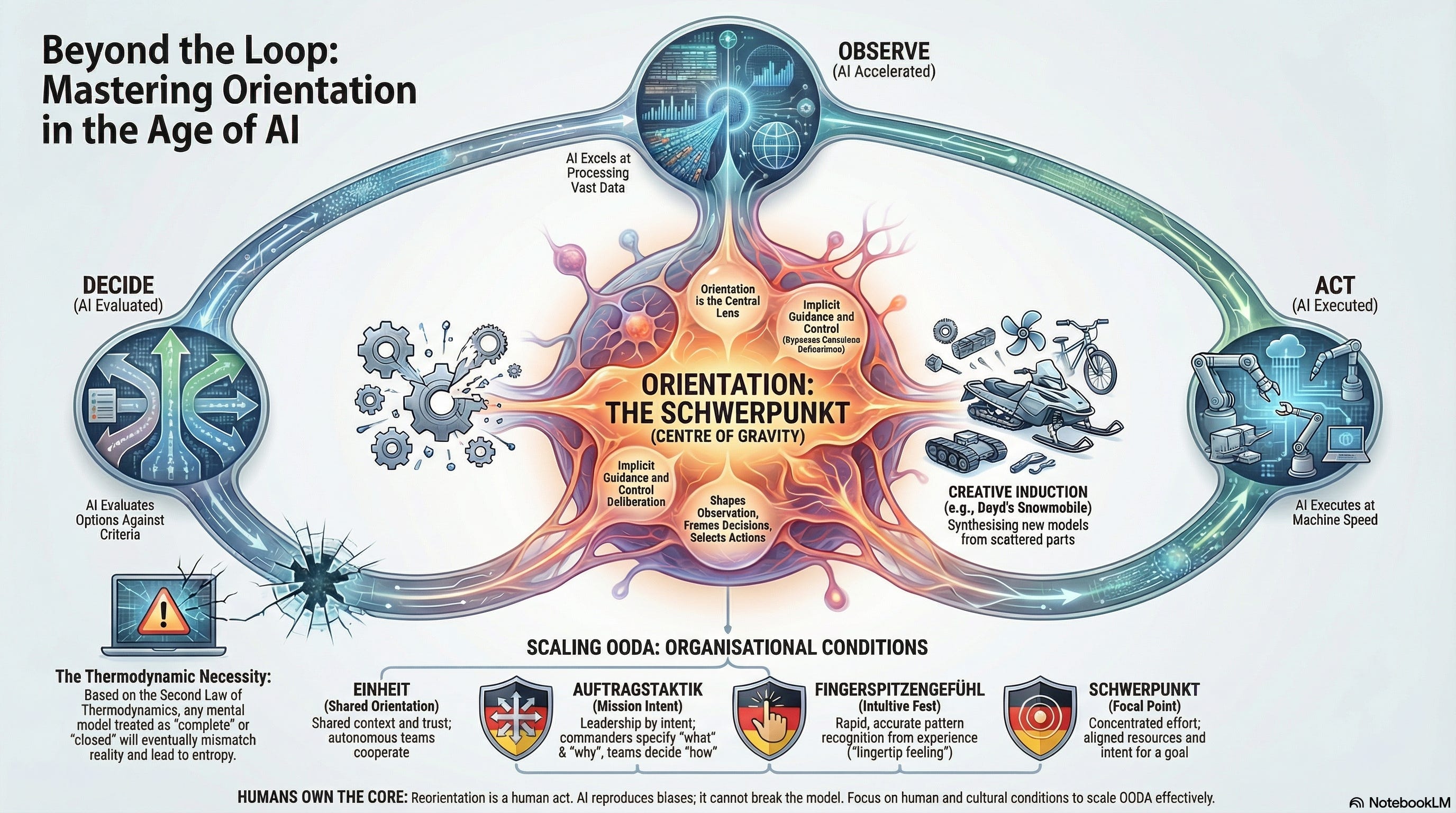
1. Orientation Is the Schwerpunkt
Boyd called orientation the schwerpunkt, the centre of gravity, of the entire OODA process. Orientation is the lens through which observations are interpreted, decisions are framed, and actions are selected. It is shaped by cultural traditions, previous experience, new information, and the process Boyd called analysis and synthesis. You see what your orientation prepares you to see. You consider the options your orientation makes visible. You dismiss the options it hides.
This is Simon’s decision premises given a dynamic engine. Simon showed that the architecture determines which premises reach which decisions. Boyd shows that the premises themselves are products of an orientation that may be stale, closed, or wrong, and that unless the orientation is continuously updated, the premises degrade. Every decision the organisation makes is only as good as the orientation that generated it.
Senge’s mental models are orientation at the individual and team level. Argyris’s theories-in-use are the defensive structures that prevent orientation from being updated. Bourdieu’s habitus is orientation made sociological: the embodied dispositions that generate practice without conscious deliberation, and that reproduce themselves precisely because they operate below awareness. Boyd adds the epistemological argument for why all of this matters urgently: closed systems degrade.
2. Destruction and Creation: Why Mental Models Must Be Broken
Boyd’s briefing paper “Destruction and Creation” (1976), the only piece of writing he considered truly his own, builds the philosophical foundation beneath the OODA loop. Drawing on Gödel’s Incompleteness Theorems (no system can fully explain itself from within), Heisenberg’s Uncertainty Principle (observation has fundamental limits), and the Second Law of Thermodynamics (closed systems tend toward entropy), Boyd argued that any mental model treated as complete will become mismatched with reality. The mismatch is not optional. It is thermodynamic.
The remedy is a continuous cycle of destructive deduction (breaking existing models into parts, severing the relationships between parts and their original domains) and creative induction (finding new connections among the scattered parts and synthesising new models). Boyd’s famous snowmobile: take skis from skiing, treads from a tank, a motor from a boat, handlebars from a bicycle. Destroy each element’s relationship to its original context. Synthesise something entirely new. This is not metaphor. It is the fundamental process of adaptation.
The series has already encountered this principle in different terms. Argyris’s double-loop learning is Boyd’s destruction and creation applied to governing variables. Ackoff’s dissolving is Boyd’s synthesis applied to messes. Popper’s conjectures and refutations is the same epistemological engine in the philosophy of science. Boyd’s contribution is the urgency: in a competitive environment, the organisation that stops destroying and rebuilding its models does not merely stagnate. It dies. The Second Law guarantees it.
3. The OODA Loop Is Not a Cycle
The common depiction of OODA as a sequential cycle (observe, then orient, then decide, then act, then repeat) is what Boyd spent years trying to correct.
His actual diagram, presented across hundreds of briefings but never formally published, shows at least five feedback paths. Orientation feeds directly into action through what Boyd called “implicit guidance and control,” bypassing conscious decision entirely. Orientation shapes observation, determining what you look for next. Action feeds back into observation, generating new data. The loop is not a loop at all. It is a set of interacting, concurrent processes with orientation at the centre of everything.
This matters for Deciding because it explains why the relationship between deciding and acting is not sequential. Klein’s recognition-primed decision model, discussed earlier in the series, is Boyd’s implicit guidance and control: the expert who acts without conscious deliberation is operating on an orientation so refined that the decide phase has compressed nearly to zero. This is not recklessness. It is deep expertise. The condition for it is that the orientation must be accurate, which means it must have been continuously updated through experience in a high-validity environment (Kahneman and Klein’s two conditions for trustworthy intuition).
Beer’s VSM provides the architectural complement. Boyd describes the dynamic process of orientation and reorientation. Beer describes the structural conditions (recursion, variety management, System 4’s environmental scanning) that enable the process to operate at organisational scale. Boyd without Beer produces individual agility without systemic coherence. Beer without Boyd produces structural elegance without the engine of adaptation. Deciding needs both.
4. AI Accelerates the Loop but Cannot Fix the Orientation
AI transforms every phase of the OODA loop except the one that matters most.
Observation: AI processes data at speeds and scales no human team can match. Sensor data, market signals, customer behaviour, operational metrics: AI can observe everything, continuously, in real time.
Decision: AI can evaluate options against defined criteria faster than any human process. Given a clear orientation and well-defined constraints, AI decision support is genuinely transformative.
Action: AI can execute at machine speed. Automated deployment, real-time pricing adjustment, dynamic resource allocation: the act phase can be compressed almost to zero.
Orientation: AI cannot do this for you. Orientation is where mental models live: the assumptions about what the data means, what the options are, and what success looks like. AI can enrich orientation by surfacing patterns human analysts would miss. But the destruction and creation cycle, the willingness to break the current model and build a new one, remains a human act. An AI trained on the organisation’s historical data will reproduce the organisation’s historical orientation, including its blind spots, its biases, and its outdated assumptions. Faster cycling through an inherited orientation does not produce adaptation. It produces faster repetition.
This is the trap most programmes fall into. They invest in faster observation, faster analysis, faster execution, and leave the orientation untouched. The organisation cycles faster through the same flawed understanding of its environment, producing more decisions per quarter that are all wrong in the same direction. Boyd would diagnose this immediately: you have accelerated the loop without improving the schwerpunkt. You are inside your own OODA loop, operating against a model of reality that no longer exists.
5. Einheit and the Conditions for Distributed OODA
Boyd’s organisational design principles, drawn from his study of German military doctrine, provide the conditions for scaling the OODA loop beyond the individual. The key concepts are Einheit (shared orientation across the organisation), Auftragstaktik (mission-type orders that specify intent but not method), schwerpunkt (a focal point that aligns all effort), and fingerspitzengefühl (intuitive feel developed through experience and trust).
These map directly to the series architecture. Einheit is Nonaka’s ‘BA’ at organisational scale: a shared context that enables autonomous agents to cooperate without central coordination. Auftragstaktik is Marquet’s intent-based leadership: “I intend to” replaces “permission to.” Schwerpunkt is Rumelt’s kernel: the focal point where resources are concentrated. Fingerspitzengefühl is Klein’s pattern recognition: the expert judgment that makes the decide phase nearly instantaneous.
The design implication for AI transformation:
The organisation that deploys AI effectively is not the one with the fastest models or the largest data sets. It is the one with the strongest shared orientation about what AI is for.
This means… the clearest mission-type intent that enables teams to act without waiting for central approval, and the most developed capacity to recognise when the current orientation has expired and must be destroyed and rebuilt. These are not technology problems. They are leadership problems that technology makes more urgent.
6. Boyd’s Limits
Boyd must be read with his limitations visible. His framework is optimised for competitive and adversarial environments; it is less directly applicable to cooperative, commons-based, or service contexts where the goal is not to outmanoeuvre an opponent. He underestimates political constraints: the power structures that Bourdieu and Giddens describe can prevent reorientation even when the need is obvious. And the psychological cost of continuous destruction is real. People and organisations need stability as well as adaptation. Heifetz’s holding environment, the space in which the discomfort of reorientation can be contained without overwhelming the people who must endure it, is the necessary complement to Boyd’s relentless epistemology.
Boyd never published a book. His ideas survive through briefings, a single published essay, and a handful of interpreters. The fragility of this intellectual legacy is itself a lesson: the thinker who understood tempo better than anyone could not find the time to write it all down.
Placement: Deciding, the second of four phases, after Learning and before Building and Transforming. Boyd belongs here because orientation is the act of turning what you have observed into something you can decide with, which is the whole business of the phase. What an organisation gets out of Deciding is a description and a commitment, and tempo is what stops both going stale. Why Your Organisation Can't Decide closes the phase, and From Deciding to Building is the bridge out.
(An Organisational Prompt is something you can do now....)
Organisational Prompt
Name the orientation your AI programme is operating from.
Every AI programme has an implicit model of what AI is, what it changes, and why it matters. This model was formed early, probably during the first executive briefing or vendor presentation, and it has not been revisited since. Write it down. One paragraph. Then ask: is this still true? Has the technology moved? Has the competitive environment shifted? Has the organisation learned anything from deployment that contradicts the original model? If the answer to any of these is yes, your orientation is stale, and every decision flowing from it is compromised. The first act of adaptation is admitting that your current map no longer matches the territory.
Further Reading
John Boyd: Destruction and Creation - The only essay Boyd considered truly his own. The epistemological foundation beneath the OODA loop: why mental models degrade and must be continuously rebuilt.
Robert Coram: Boyd: The Fighter Pilot Who Changed the Art of War - The definitive biography. Essential for understanding why Boyd’s ideas took the form they did and why he never wrote the book.
Grant Hammond: The Mind of War: John Boyd and American Security - The intellectual history. More focused on the ideas than the life. Read it alongside Coram.
Chet Richards: Certain to Win: The Strategy of John Boyd, Applied to Business - The most rigorous application of Boyd to business strategy. Richards was one of Boyd’s closest collaborators.
Frans Osinga: Science, Strategy and War: The Strategic Theory of John Boyd - The academic treatment. Reconstructs Boyd’s intellectual framework from the briefings and traces his sources in science, philosophy, and military history.
Disclaimer
I write about the industry and its approach in general. None of the opinions or examples in my articles necessarily relate to present or past employers. I draw on conversations with many practitioners and all views are my own.