
The workshop was booked six weeks ago and the template arrived before the facilitator did. By eleven the wall is covered in coloured squares. The squares have been grouped, the groups have owners, the owners have dates. Everyone leaves lighter than they came in. Nothing in those four hours asked whether the people in the room actually want the same thing.
That is the commonest failure in transformation work and it is almost never noticed, because the method did its job. It produced squares, groups, owners and dates, which is what it produces. The question it could not ask was whether this situation was the kind of situation it suits. Michael Jackson spent forty years on that question. His answer is that every way of intervening in an organisation carries assumptions about the world, about knowledge and about power. No method is neutral. Choosing between them, in the open and with reasons, is the first serious act a leader performs.
This part of the argument began with a hard claim: the event that changes an organisation is not yours to make. You do not author the crisis. What you do is take a position on how it resolves. Jackson supplies the content of that position. If the leader cannot generate the event, the leadership sits entirely in what happens next. How is the situation looked at, which approach is brought to it, whose interests does that approach serve, and can anyone say why this approach and not another. Agency here is custodial rather than heroic. I have watched that choice get made a hundred times by people who did not know they were making it.
1. Every method is partial, and partial methods travel
Jackson trained as an operational researcher and spent most of his career at Hull, where he founded the Centre for Systems Studies and edited Systems Research and Behavioral Science for a quarter of a century. The field he inherited had a problem he could not stop seeing. It had produced a shelf of powerful approaches, each built by someone serious, each demonstrably successful somewhere, and each sold as though it worked everywhere.
Systems dynamics modelled stocks and flows. Soft systems methodology surfaced competing worldviews. The viable system model diagnosed whether an organisation could survive in its environment. Interactive planning had the organisation design its own idealised future. Every one of them worked. Each was also built on assumptions about what kind of mess it was facing, and those assumptions were rarely stated, because the person applying the method had usually stopped noticing them.
A method applied outside the conditions it suits does not announce the mismatch. It usually produces confident, well-structured, entirely wrong work. The wall fills with squares. The model runs. The report is delivered on time and the situation is unchanged, or worse, because the intervention has now consumed the credibility that a better one would have needed.
So the skill is not solving. The skill is choosing.
2. The grid that classifies the situation, not the tool
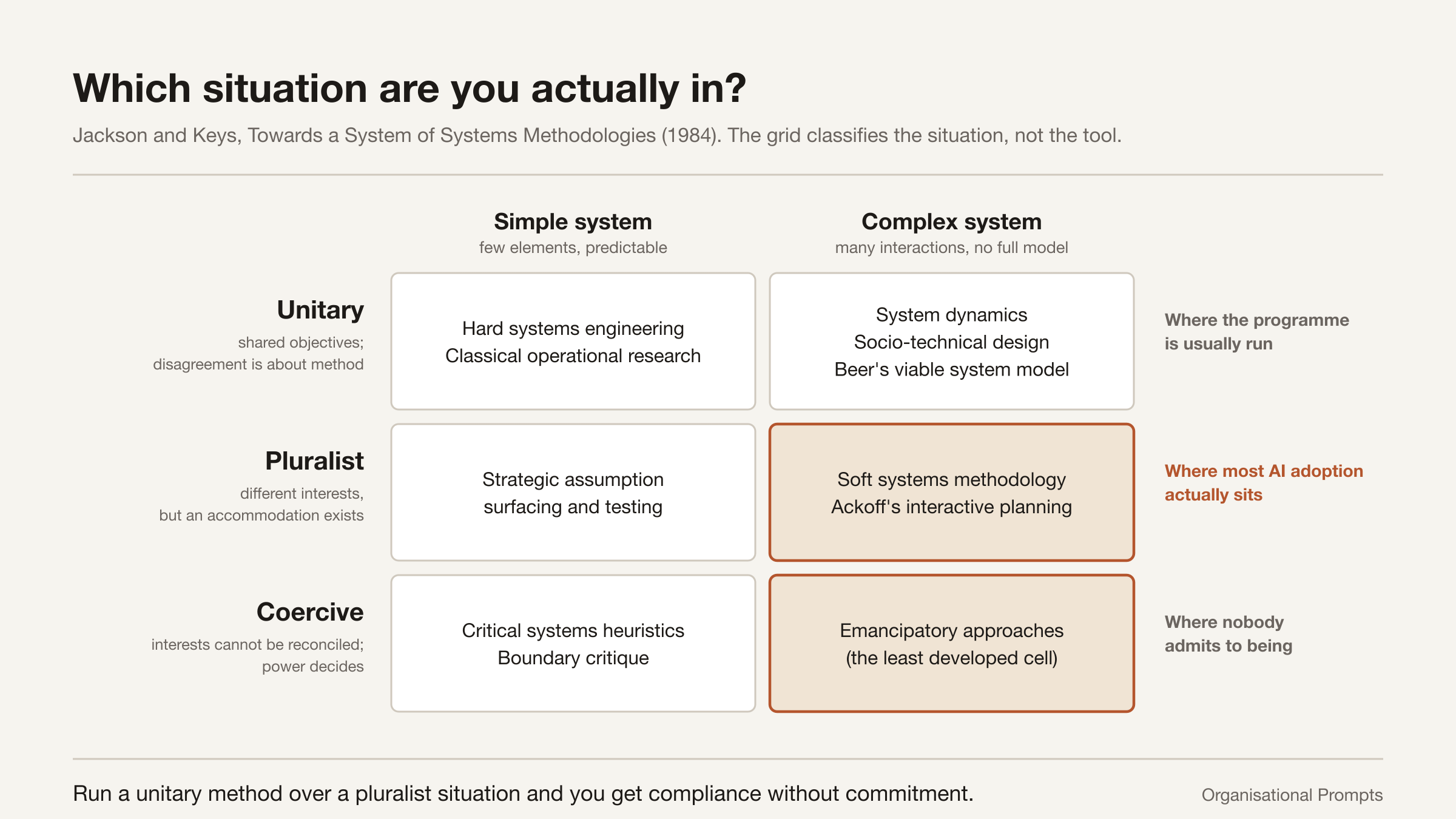
In 1984, with Paul Keys, Jackson published “Towards a System of Systems Methodologies” in the Journal of the Operational Research Society. It proposed a grid with two axes. The first asks about the system: is it simple or complex? Few elements and predictable behaviour, or many elements, many interactions, and behaviour nobody can fully model. The second asks about the people: are their relationships unitary, pluralist or coercive?
Unitary means shared objectives. Everyone genuinely wants the same outcome and disagreement is about how to get there. Pluralist means different interests and compatible ones. People want different things, they know it, and a negotiated accommodation is available if anyone convenes it. Coercive means the interests cannot be reconciled and the matter will be settled by power, whether or not anyone says so out loud.
Cross the axes and you get six kinds of situation, each with its own family of approaches. Simple and unitary suits hard systems engineering and classical operational research. Complex and unitary suits system dynamics, socio-technical design and Beer’s viable system model. Simple and pluralist suits assumption-surfacing methods. Complex and pluralist suits soft systems methodology and Ackoff’s interactive planning. Coercive contexts, simple or complex, want critical systems heuristics and the emancipatory approaches, and Jackson was honest that the complex-coercive cell was the least developed of the six.
Read the grid the wrong way, as I did for years, and it becomes a lookup table for consultants. Read it the right way and it is a diagnostic on the situation. Beer supplies a superb method for a complex-unitary context. Jackson’s question comes first and it is more awkward: is this context unitary at all?
Most enterprise transformation is run as though the answer is yes. The strategy deck says one company, one direction. Ask the middle of that organisation what they want and you will hear at least four answers, several of which are incompatible with the deck and all of which are rational from where they sit. Run a unitary method over a pluralist situation and you get compliance without commitment, which is the state most large programmes live in and cannot explain.
3. Where AI adoption actually sits on the grid
Take an AI adoption programme, the kind now running in every large enterprise. Complex, plainly: the technology changes underneath the plan, the effects are second and third order, and nobody can model what six thousand people will do with a tool that answers back.
The people axis is the one that gets skipped. The board wants margin. Engineering leadership wants throughput and, quietly, wants to keep its best people. The engineers want to do interesting work and would rather not train their replacement. Legal wants defensibility. The operating units want their own thing shipped, not the platform. No communications plan I have ever seen has fixed any of it. They are different positions held by people with different stakes, which is the definition of a pluralist situation.
And in places it is worse than pluralist. When the same programme is presented as a productivity initiative to the board and as a capability uplift to the workforce, and only one of those framings appears in the business case, the situation has a coercive element. Nobody needs to be a villain for this to be true. A situation is coercive when the interests are irreconcilable and the resolution will probably be settled by whoever holds the budget.
You can run a coercive situation as though it were unitary. Organisations do it constantly. Everything you learn afterwards is then filtered through what people think it is safe to say, and your instrumentation tends to fail at exactly the moment you need it. An organisation that cannot tell you the truth cannot be steered.
4. Five ways to look at the same mess
Jackson’s more recent work, consolidated in the 2024 practitioner’s guide, replaced the grid’s front end with something more usable. Before choosing anything, look at the situation through five systemic perspectives. Each has a long history, each has produced real insight, and each is blind in a different direction.
The mechanical perspective sees a system built to do a job, with parts that can fail and be fixed. It asks about efficiency, throughput, defects, waste. The interrelationships perspective sees feedback, delay and unintended consequence; it asks what loops are running and where the leverage sits. The organismic perspective sees a living thing that must adapt to survive; it asks about environment, viability and learning. The purposeful perspective sees people who hold different worldviews and pursue their own ends; it asks what the various parties think is going on and who has the power to make their version stick. The societal and environmental perspective asks who else is affected, including people with no seat at the table, and what the intervention does to them.
Run those five over the same AI programme and you get five different accounts of the same trouble.
Mechanically, the pipeline has a bottleneck at review; generated code arrives faster than anyone can verify it. In terms of interrelationships, the faster generation raises the review load, which lengthens the queue, which pushes people to review less carefully, which raises the defect rate, which raises the review load again. Organismically, the organisation is not learning: the metric it watches is output, so it cannot see the compounding cost. From the purposeful perspective, the reason it watches output is that output is what the business case promised, and the people who wrote the case need it to be true. From the societal perspective, the junior engineers who would once have learned by doing the work the machine now does are being quietly deskilled, and they were never asked.
All five are correct. Only the first one is on the dashboard. Jackson’s discipline is to insist that the exploration produces a primary issue and secondary ones, and that you are able to say why you picked the primary. Most programmes never get there, because they only ever had one lens and they mistook it for the situation.
5. EPIC, and the loop that evaluates the instrument
Critical systems practice is Jackson’s answer to the obvious objection, which is that a philosophy of pluralism does not tell anyone what to do on Monday. He set it out across four papers in Systems Research and Behavioral Science between 2019 and 2023 and consolidated it in the 2024 book. Four stages: Explore the problem situation, Produce an intervention strategy, Intervene flexibly, Check on progress. He calls it EPIC, and the acronym is doing more work than it looks.
Explore is the five perspectives, applied before any method is selected. Produce designs the combination: one dominant approach carried by the primary issue, others in support, with objectives and a schedule attached so the thing is real. Intervene runs it, and runs it flexibly, which means the dominant method can be swapped when the situation shifts and the swap is a planned move rather than an admission of failure. Check evaluates what happened.
Check is where the discipline lives, because it evaluates two things. It asks whether the situation improved, which every programme claims to ask. It also asks whether the methods were the right ones, which almost nobody asks, because by the time you get there the method has become the identity of the team running it. I have sat through a great many programme reviews and I cannot remember one that asked whether the method had been the right method. Say that a soft systems approach surfaced the real disagreement but had no way to fix the queue, and you have learned something you can use twice: once about this situation, and once about your own instrument.
The double loop has come up in this series before. Argyris found that organisations correct actions and protect the assumptions underneath them. Schön found that the practitioner’s real skill lies in reframing the problem while inside it. Ohno’s insistence that you go and see stands behind the whole of Check. Jackson applies the same move to the toolkit itself. The four stages are iterative in practice, not sequential in the way a bar chart is sequential, and the output of each pass is a sharper account of what kind of situation you are in.
6. Pluralism is not helping yourself to whatever you like
There is an easy misreading of all this, and it is worth killing early. Combining methods is not the same as being relaxed about methods. Jackson’s pluralism is disciplined, and it rests on three commitments that only do their work when they are held together.
Critical awareness means knowing what each approach assumes and what it therefore cannot see. Every method carries a theory of the organisation. Pick one without saying so and the theory arrives anyway, unexamined, and starts making decisions on your behalf.
Pluralism means using approaches from genuinely different traditions together, on purpose, each retaining its own assumptions rather than being flattened into a house methodology. The hard part is that the traditions are not compatible. A mechanical view and a purposeful view of the same organisation contradict one another, and the practitioner has to hold both without dissolving the tension into mush. Total Systems Intervention, which Jackson developed with Robert Flood in 1991, was the first serious attempt at this; critical systems practice is what it became after thirty years of finding out where it broke.
Emancipation means asking whose interests the intervention serves. That commitment is what makes the tradition critical rather than merely clever, and it does most of its work through boundary critique. Werner Ulrich’s argument, which Jackson carries, is that every improvement has a boundary. The boundary decides who counts as a stakeholder and whose knowledge counts as expertise. That is a value judgement, and it is usually presented instead as a technical decision that somebody made for sound operational reasons. An AI productivity programme whose boundary includes the engineering leadership and the vendor, and excludes the people whose work is being measured, has already answered the question of whose improvement this is. It just has not said so.
You can hear the objection forming, because I have made it myself. This sounds like a lot of philosophy for a Tuesday. Jackson would half agree; the tradition has been criticised for years, sometimes by its own, for being more comfortable in the seminar than in the situation. His response over the last decade has been to reach back to the pragmatists, to Dewey and James, and argue that the test of a perspective is what it lets you do. Use the ones that work here. Say why. Be ready to be wrong about it.
7. What a machine cannot do for you
An AI will produce a change methodology in about nine seconds. It will be coherent, it will be referenced, it will have phases and workstreams and a RACI, and it will look exactly like the output of a competent consultancy, because that is what it was trained on. The cost of a plausible method has collapsed. A wrong method costs what it always did.
That gap is the whole of the current risk. When method was expensive, the expense itself imposed a rationing discipline; somebody senior had to justify the engagement, and the justification was at least a moment where the question got asked. Now the deck arrives free and arrives first, and it arrives with the situation already classified, silently, by whatever the training data thought normal. Which is unitary. Almost always unitary, because that is how change programmes are written up.
Ask the machine to design your transformation and you will most likely get a unitary method for a pluralist situation, delivered with total confidence, in a document nobody will interrogate because it reads as though someone already did.
The same trap sits inside agentic systems themselves. An agent estate is mechanically legible in a way most organisational subjects are not: you can see the calls, the tokens, the latency, the failure rate. All of that is real and worth watching. It also makes the mechanical perspective irresistible, because it is the only one with numbers, and a perspective with numbers will beat four perspectives without them in any meeting you have ever attended. The purposeful view of an agent programme, which is that different parts of the organisation want incompatible things from it, generates no dashboard at all.
So the human contribution is not the plan. The machine will write a better-formatted plan than you will. The human contribution is the classification of the situation and the choice of approach that follows from it. Then the willingness to defend both, in a room where a free and beautifully formatted alternative is already open on somebody’s laptop.
8. Method as the exercise of agency
Return to where the argument started. Somebody in the review says a name, the room relaxes, and a crisis becomes a personnel matter. That room has one method for crises and it has never chosen it. Girard’s account of why is uncomfortable and hard to unsee: the group discharges its tension onto a single figure because the discharge works. Heifetz says the leader’s job is to hold the disequilibrium rather than relieve it. Jackson says something narrower and more usable. The leader’s job is to make the choice of approach explicit, so the default one can be argued with.
Kotter’s eight steps are not wrong. They are a complex-unitary method, they work well when the situation is complex and unitary, and they have been applied for thirty years to situations that were neither. Ackoff’s dissolving is a real move and it belongs to a particular kind of mess. Beer’s model diagnoses viability and assumes the parts want the whole to survive. Each of these thinkers gave the field a real instrument. Jackson is the one who insists that having several instruments obliges you to say which you are picking up and why.
This is what custodial agency looks like in practice. You did not cause the event. You cannot make people want the same thing. What you can do is refuse to run the default method on a situation it does not fit, and that refusal is visible, unpopular and cheap to make. It costs one meeting. In most organisations it may also be the only moment in the whole programme where a real choice is available, because once the method is set everything downstream follows from it and looks like execution.
Choose the approach in the open. Say what it assumes. Say who it serves. Then let people argue with it, which they will, and the argument is the first honest information you will have had about what kind of situation you are actually in.
Placement: Transforming, the fourth and last of the series' phases; Learning, Deciding, Building, Transforming, which starts at Agency. Jackson's subject is the first act of agency there: choosing which approach the mess actually wants, then holding it through disciplined practice rather than sponsoring it from a distance. The Event Is Not Yours to Make opens this stretch.
(An Organisational Prompt is something you can do now....)
Organisational Prompt
Classify the situation before you defend the plan
Take the largest change programme you currently own. Give yourself one page and forty minutes, alone first.
Write five short paragraphs, one per perspective. Mechanically, what is the bottleneck? In terms of feedback, what loop is running and what does it amplify? As a living thing, what is this organisation failing to learn? Purposefully, what do the four or five main parties each want, stated as they would state it rather than as the deck states it? Societally, who is affected who has no seat, and what is happening to them?
Then answer two questions in writing. Is this situation unitary, pluralist or coercive? And which method are you actually running, whether or not anyone named it?
If the honest answers are “pluralist” and “a unitary method”, you have found the thing that will defeat the programme, and you have found it early enough to matter. Take both answers to your next steering meeting and put them on the first slide. Whatever comes back at you is the most useful data the programme has produced so far.
Further Reading
Pragmatism and critical systems thinking: Back to the future of systems thinking is Jackson’s own short statement of where the tradition should go next. Free in full, and the clearest short thing he has written.
Martin Reeves interviews him for the BCG Henderson Institute in Critical Systems Thinking with Michael C. Jackson, covering EPIC and the five lenses, aimed at leaders rather than academics.
Critical systems practice 1: Explore, in Systems Research and Behavioral Science, 2020, is the first of the four EPIC papers and arguably the one that matters most, because getting Explore wrong tends to make the situation worse.
An extended summary of the 2024 practitioner’s guide, with concept maps, sits at CSL4D. Worth reading if you want the architecture of the book before you buy it.
The full statement is Critical Systems Thinking and the Management of Complexity, Wiley, 2019, with the history of every methodology in the grid and a fair account of the objections to his own position.
I write about the industry and its approach in general. None of the opinions or examples in my articles necessarily relate to present or past employers. I draw on conversations with many practitioners and all views are my own.
Big thanks for all the write-ups and texts, Justin. This one really resonated. I once tried to bring my rather naive methods and waterfall approach into a SAFe-“inspired” company, simply because I thought they made sense for the situation. It did not land well. 😄
In hindsight, I was basically bringing a knife to a gunfight or perhaps, more accurately after reading this, bringing the wrong instrument to the wrong kind of mess.