
Chapter three of Leading Change explains how to raise urgency in an organisation that has none. Allow a financial loss to happen. Let errors escalate rather than be quietly corrected. Expose managers to the places where competitors are beating them. Get rid of the executive dining room. Set targets that cannot be hit by working the way people work now. Send managers to sit with unhappy customers and suppliers. Bring in consultants to force honest data into management meetings.
John Kotter published that list in 1996 and it has been the operating instruction for enterprise change ever since. Three of those tactics construct a crisis. The rest increase the flow of real information about a crisis that already exists. Nobody drew the distinction at the time, and most of what has gone wrong with transformation programmes since sits in the gap between the two halves of one list. Kotter noticed. He spent the following sixteen years correcting step one in public, across two more books, and I would take the correction over the original.
1. The step he found everybody skipping
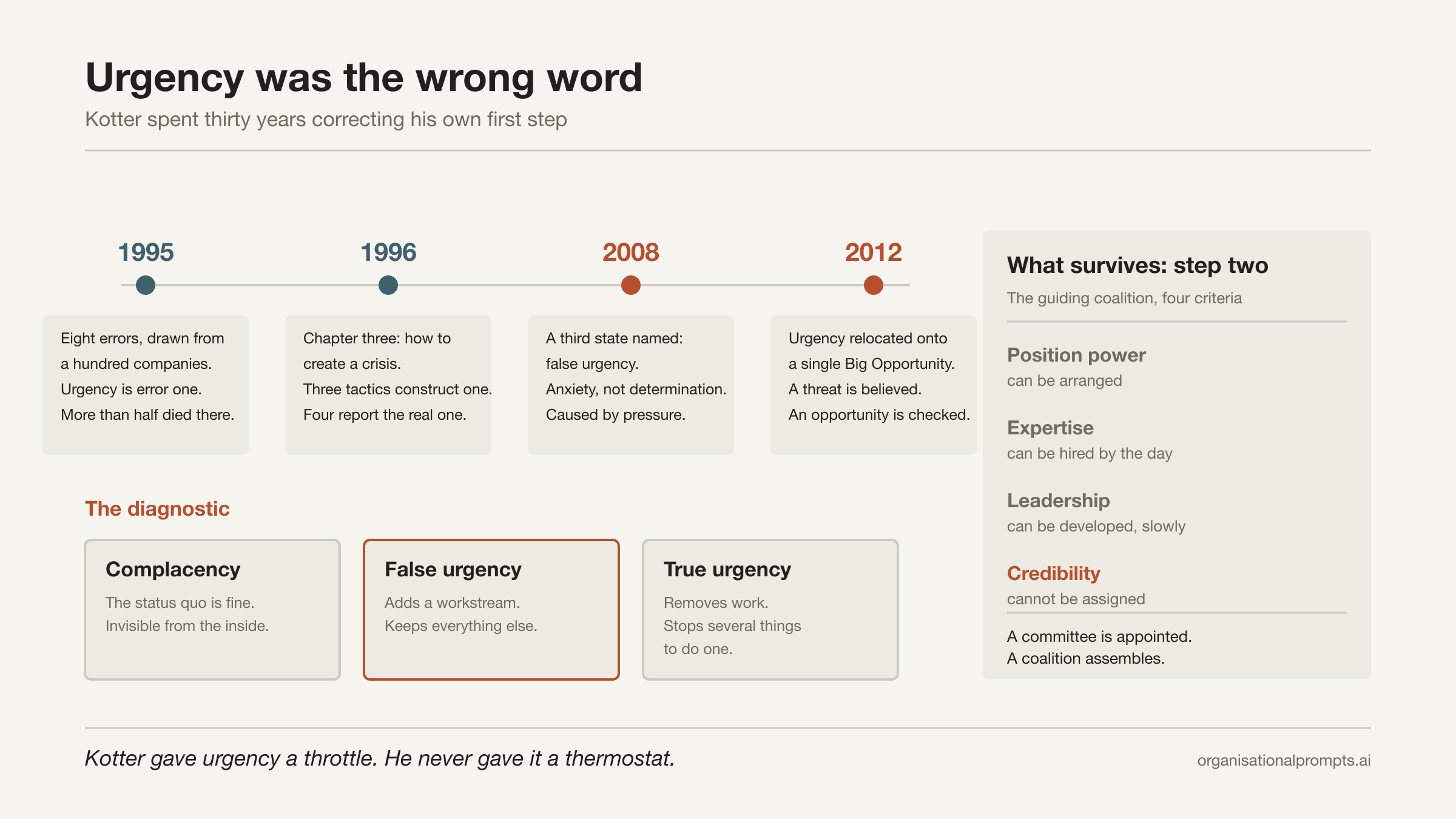
The 1995 Harvard Business Review article came out of ten years watching more than a hundred companies try to remake themselves. He listed eight errors. He put not establishing enough urgency first, because that is where most of them died. More than half never got past it. The finding is empirical and it has held: an organisation with no felt need to move will produce plans, workshops, programme boards and no movement.
Complacency is the hard part, and Kotter is good on why. It is invisible to the complacent. It tends to grow out of past success rather than failure, so the organisations most exposed to it are usually the ones with a good decade behind them. He set a threshold as well. Roughly three quarters of management have to believe, genuinely, that staying as they are is more dangerous than changing. Three quarters is a high bar. Most programmes launch with the executive committee convinced and call that alignment.
2. The correction he published in 2008
Twelve years after Leading Change, Kotter published an entire book about its first step. A Sense of Urgency is a correction, though it never quite says so.
The correction is a third category. Everybody already knew about complacency and everybody knew about urgency. He put a third state between them and called it false urgency. From any distance it looks real. Meetings, task forces, long days, visible strain, people moving quickly between rooms. What drives it is anxiety and anger rather than a determination to win, and the activity it produces goes nowhere. False urgency, Kotter writes, is almost always produced by failure or by intense pressure applied to a group.
Intense pressure applied to a group is what step one instructs.
He left the reader to notice. An organisation in true urgency removes work. It stops doing several things so that it can do one. An organisation in false urgency adds a workstream and keeps everything else. Count what your transformation has stopped. If the answer is nothing, you have the counterfeit.
3. The second correction, in 2012
In 2012 he moved urgency off the crisis altogether. The Accelerate article, which won that year’s McKinsey Award, relocates the whole first step onto what he called a single Big Opportunity. He compared the two periods himself: the early work was about ridding an organisation of complacency, the later work treats sustained urgency as a competitive advantage in its own right.
A threat has to be believed. An opportunity can be checked. A threat is a claim about the leader. An opportunity is a claim about the world. When a leader announces that the company is in danger, the only responses available are belief and disbelief, and disbelief is the safer bet for anybody who has been through this before. When a leader points at something the organisation could now do and could not do last year, people can go and look. Some will look and disagree. That is fine, because the disagreement is then about the world rather than about the leader’s motives.
The rest of Accelerate follows from the relocation. The eight steps stop being a sequence and become accelerators that run at the same time and never stop. A volunteer army replaces the cascade. A network sits alongside the hierarchy, drawing people from every level and function, while the hierarchy carries on doing what hierarchies are good at. Holding the network together is a guiding coalition.
4. Why the manufactured version costs more than it earns
An instruction can be complied with. An event cannot.
Manufactured urgency therefore fails in a way that looks like success for about two quarters. Announce urgency and the organisation produces the observable signs of urgency, because producing observable signs is the thing organisations are best at. Attendance rises. A workstream appears. Somebody stands up at the town hall and says the right thing. None of this is cynical. People are responding to an instruction in the way instructions are meant to be responded to. Being able to respond at all is the proof that no event occurred. Nobody complies with an outage.
Reviewers of Leading Change reported managers telling them that routinely setting unreachable targets dampened urgency rather than raising it. Anybody who has worked in a large company for five years already knows this, and I include myself. The first announced emergency moves people. The second moves fewer. The third moves nobody. By then the organisation has learned that an announcement carries no information about the world, and that waiting is the correct response. Waiting is cheap. Waiting is usually right.
The bill arrives later and it is usually large. When something real finally happens, the organisation has no way of telling it apart from the last three things that did not. Every manufactured crisis spends the same credibility, and nothing replaces it. Ronald Heifetz gives the leader in the room the version to work with: adaptive work only happens inside a band of discomfort, too little and nothing changes, too much and people panic and look for somebody to blame. Kotter gave urgency a throttle. He never gave it a thermostat.
5. AI did not need a memo
Nobody needed a memo about AI.
The event happened somewhere around the point at which generating a working thing stopped costing anything, and engineers found out the way engineers find things out, in the evenings, on their own machines, before anybody had approved anything. Whatever else is true about the last three years, complacency was not the constraint. The felt sense that the status quo was fine did not survive first contact.
Organisations ran step one anyway. Adoption targets. Mandates. The AI-first memo. Licence utilisation on a dashboard beside the delivery metrics. An adoption target measures adoption. A mandate measures compliance with the mandate. Neither measures whether the work changed. This is manufactured urgency about a fire everybody was already standing in, and it produces what manufactured urgency usually produces, which is a compliance number. Seat utilisation measures whether people opened the tool. It has never measured whether anything changed about how the work gets done, and in most enterprises the two have come apart badly.
Run Kotter’s own 2008 test. Since AI arrived, what has the organisation stopped doing? Not what it has added: the platform team, the guild, the governance forum, the training programme, the centre of excellence. What has it stopped? Most AI programmes have added eleven things and removed none, which is Kotter’s own definition of the counterfeit, published eighteen years ago, applied to the thing his readers are doing now.
6. The part that survives
What survives the correction is step two.
The guiding coalition has four criteria and they have not moved since 1996. Position power: enough of the people who could block the work if they were left out of it. Expertise: the actual range of skills and perspectives the work requires. Credibility: reputations strong enough that when the group says something, people take it seriously. Leadership: proven leaders, who are found throughout an organisation and are not the same population as its managers.
He is emphatic that this is not a steering committee, and the distinction is sharper than most organisations allow. A committee has a mandate and a budget. A coalition has shared conviction. A committee is appointed. A coalition assembles. When the programme ends and the consultants leave, the committee dissolves on schedule and the coalition is still there, because it was never constituted in the first place.
Three of the four criteria can be arranged. Position power is a calendar invitation. Expertise can be hired by the day. Leadership can be developed, slowly, if somebody is paying attention. Credibility is the one that cannot be assigned, because it is held by whoever the people doing the work actually believe, and that person sits several levels below the steering group and has never been asked to join anything. I cannot remember a programme board that failed for want of position power. I have watched several fail for want of credibility. Look at who is in the room for your AI programme. If everybody is there because of their title, you have assembled the one kind of group Kotter spent a career warning about.
The coalition is not what causes the event. It is what carries one after it arrives.
Placement: Transforming, the fourth of the series' phases; Learning, Deciding, Building, Transforming, at the Event position. Kotter appeared first in Learning, where the eight steps were read as a theory of how change gets narrated. Here urgency is read as a constructed event rather than a discovered one, which is the harder claim and the more useful one. The Event Is Not Yours to Make opens this stretch.
(An Organisational Prompt is something you can do now....)
Organisational Prompt
Cross out the titles
Take the attendee list for your AI programme board and cross out everybody who is on it because of their job title. Count who is left. Those are the people whose names carry weight with the engineers, and if there are fewer than three of them you have a reporting line rather than a coalition. Find the two people your teams actually believe, add them, and give them the same decision rights as everybody else in the room.
Further Reading
Kotter, Leading Change: Why Transformation Efforts Fail (Harvard Business Review, 1995). Ten years of watching more than a hundred companies, reduced to eight errors. The full text is hosted by UCSF. Read it for the finding rather than the model: most transformations died at the first step.
Kotter, Leading Change (Harvard Business School Press, 1996). The book the eight steps come from. Chapter three is the one to read, because it sets out the tactics for raising urgency plainly enough to argue with.
Kotter, A Sense of Urgency (Harvard Business Press, 2008). A whole book on step one, twelve years later. Read it for the three-state taxonomy and for the diagnostic about what an organisation stops doing.
Kotter, Accelerate! (Harvard Business Review, November 2012), later expanded into a book. Kotter’s own firm hosts the article. The dual operating system, the volunteer army, and urgency relocated from a crisis onto an opportunity.
Disclaimer
I write about the industry and its approach in general. None of the opinions or examples in my articles necessarily relate to present or past employers. I draw on conversations with many practitioners and all views are my own.