
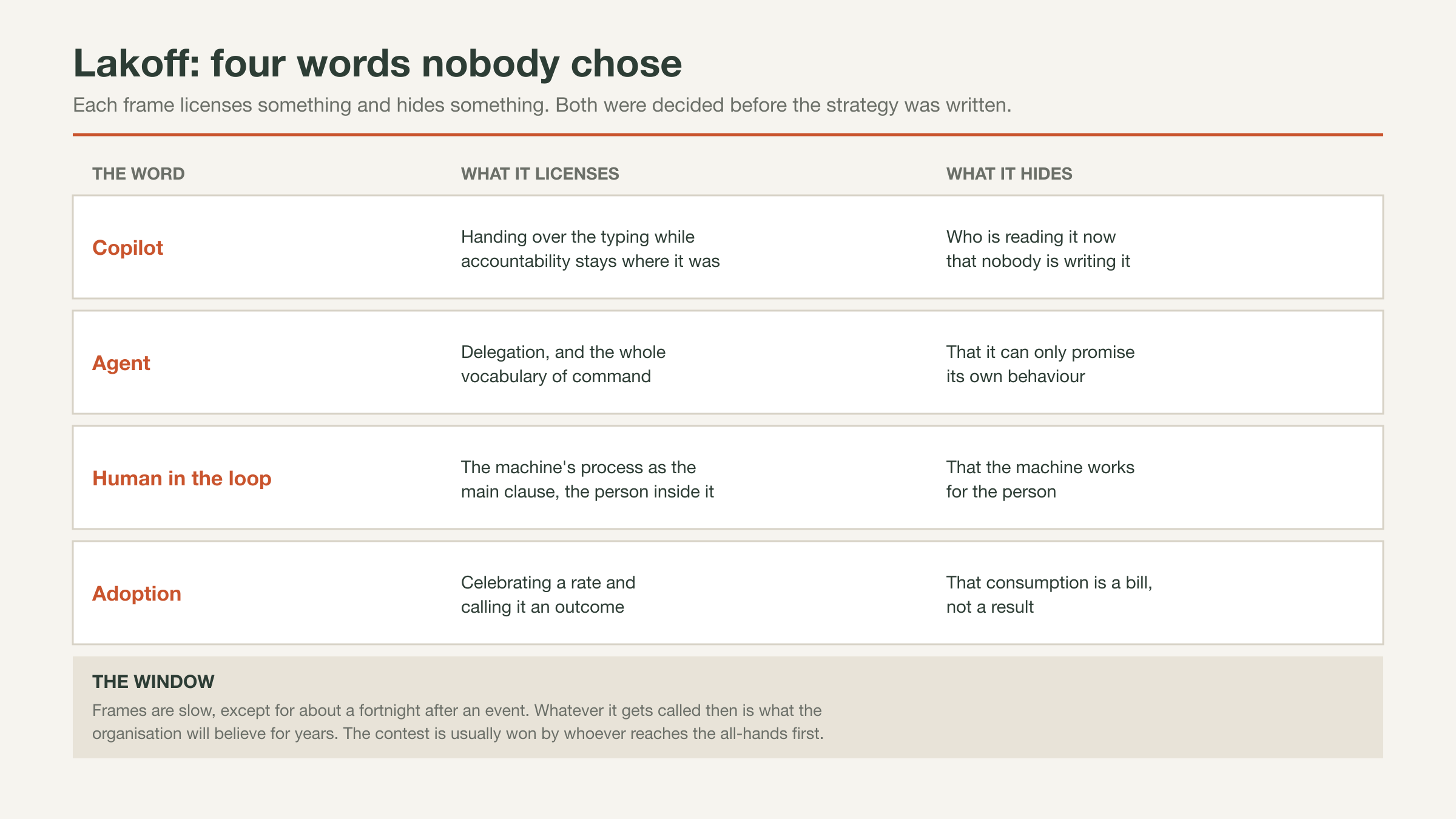
Copilot. Agent. Human in the loop. Adoption. Four words, none of them chosen by anyone in particular, and between them they have already settled how most organisations think about the largest change to arrive in the trade in thirty years. A copilot sits beside you while you fly the aircraft. An agent acts on your behalf, which implies it can be given a task and left. A human in the loop is a step inside a machine’s process rather than a person the machine works for. Adoption is something you measure the rate of, so it sounds like an outcome, when what it describes is a bill.
George Lakoff has spent since 1980 explaining why none of that is decoration. Frames decide which facts count as relevant, which inferences follow without anybody drawing them, and which sentences are even sayable. Get the frame in first and the argument is mostly over. So the naming of a change does the work the announcement takes credit for. And the naming is done carelessly, by whoever wrote the first email.
1. Frames are not spin
The standard managerial view of language is that it is packaging: you decide the substance, then you decide how to communicate it, and communication is what you do to the substance afterwards. Lakoff’s work, from Metaphors We Live By with Mark Johnson in 1980 onwards, says the order is wrong. We think in metaphor. Argument is war, so positions are attacked and defended and somebody wins. Time is money, so it is spent, saved and wasted. Nobody selected those and everybody reasons inside them.
The consequence for a change programme is unwelcome. A frame is built by long repetition and holds because the world keeps confirming it, so facts that do not fit it are not weighed and rejected. They bounce. That is why your carefully evidenced deck moved nobody. The evidence was fine. The frame it landed in had already assigned it a meaning.
2. Negation invokes
Lakoff’s most quoted demonstration is the elephant. Told not to think of an elephant, you think of an elephant, because a frame is activated by the words that name it whether they affirm or deny. Now count how many times your organisation has said, in writing, that this is not about replacing anyone. Each repetition installs replacement as the subject under discussion.
The same trick runs through the tax relief framing he analysed for years: relief presupposes an affliction and somebody who lifts it, so the argument is lost before it starts by anyone who accepts the word. If you find yourself denying a frame, you have adopted it. Say the thing you do mean, in its own words, and let the denial go unmade.
3. The window opens after the event
Frames are slow. That is the rule, and it is why most internal communication achieves so little. You are pushing against structures laid down over years by everything the organisation has lived through. The exception is short and it is the one a leader can use. When an event has knocked the supports out from under the old frame, and people can see for themselves that the old account no longer explains what just happened, new frames install with startling speed.
Girard describes the crisis in which the distinctions a group lives by collapse. What follows that collapse is a naming contest, and it is settled within a fortnight, by whoever gets to the all-hands first. Whatever the organisation starts calling the thing in those two weeks is what it will believe about the thing for years, and the people who win the contest are rarely the people who thought hardest about the wording.
4. What our words about AI already decided
Take the four from the opening and read what each licenses. Copilot frames the model as an assistant to a pilot who remains in command. It is comforting, it keeps accountability where it was, and it implies the human is still flying when the human is now mostly reading.
Agent frames it as a worker given tasks. That licenses delegation and imports the whole vocabulary of command. Command is the wrong frame for a thing that can only promise its own behaviour, as Burgess argues at length. Human in the loop puts the machine’s process in the main clause and the person in a subordinate one; it is a phrase from control engineering and it has been doing quiet work on how organisations reason about responsibility ever since it escaped. Adoption frames consumption as achievement, which is why adoption rates keep appearing on slides where an outcome ought to be.
None of these was selected. All four arrived from vendors, papers and posts. Each has been shaping design decisions, org charts and governance documents in organisations that believe they are reasoning from first principles. We in technology are particularly bad at this, because we think of ourselves as people who deal in mechanisms rather than words, which makes us the easiest audience in the world for a metaphor arriving inside a product name.
5. Choose the governing metaphor on purpose
The remedy is not to purge metaphor, which cannot be done, but to pick one and know what it costs. Every metaphor lights part of the thing and hides the rest, so the test for any candidate is two questions: what does this license, and what does it hide?
Try one. Treat the model as a very fast, very confident graduate who has read everything and worked nowhere. That frame licenses supervision, review, apprenticeship and a named human owner, all of which you want. It hides the novel parts, the scale and the speed, and no graduate can be run in parallel a thousand times, so it will need correcting on those.
Compare it against agent and see which one produces better decisions about who is answerable when something breaks at three in the morning. The winner is not the more accurate metaphor, because neither is accurate. It is the one whose hidden part you can afford.
6. Listen for the words nobody issued
The strongest evidence that a change has actually landed is linguistic and it comes from below. People start using a phrase for the new thing that was in no announcement, no deck and no training. The phrase is usually blunt, often faintly rude, and it is the sound of an organisation building its own account of what happened.
Collect those. If the list is empty after a quarter of effort, the change exists only in your language and nobody has received it. If the list is full of the previous programme’s vocabulary, the old frame has absorbed the new thing and is running it as a subsidiary. And when a phrase does emerge that captures what you meant better than your phrase did, take theirs. The frame that holds is the one people already use.
Placement: Transforming, the fourth of the series’ four phases, after Learning, Deciding and Building. This one sits at the Language position, in the short window after an event when what a thing gets called is still open. Naming it well is not communication. It is the structure everything afterwards gets built on.
(An Organisational Prompt is something you can do now....)
Organisational Prompt
Audit five words.
Write down the five phrases your organisation uses most often about the change you are leading. Take them from what people actually say in meetings, not from the strategy document.
Beside each one, write two lines: what this word licenses, meaning what it makes reasonable to do next, and what it hides, meaning the question it stops anybody asking. Copilot licenses handing over the typing and hides who is reading. Adoption licenses celebrating a rate and hides whether anything got better.
Then change exactly one word, and change it where repetition happens: the weekly note, the standing meeting, the template everyone copies. Not in a campaign about language, which will fail and deserve to. Say the new word four times in the places people hear things four times, and watch whether it comes back to you in a month from someone who thinks it was theirs.
Further Reading
George Lakoff and Mark Johnson, Metaphors We Live By (1980), the book that made conceptual metaphor a serious subject and still the fastest way into the argument.
George Lakoff, Don’t Think of an Elephant (2004), short, political, and the clearest statement of why negating a frame reinforces it.
Lakoff’s essays and lectures on framing are collected at
https://georgelakoff.com
including the material on how frames are entrenched by repetition rather than argument.
I write about the industry and its approach in general. None of the opinions or examples in my articles necessarily relate to present or past employers. I draw on conversations with many practitioners and all views are my own.