
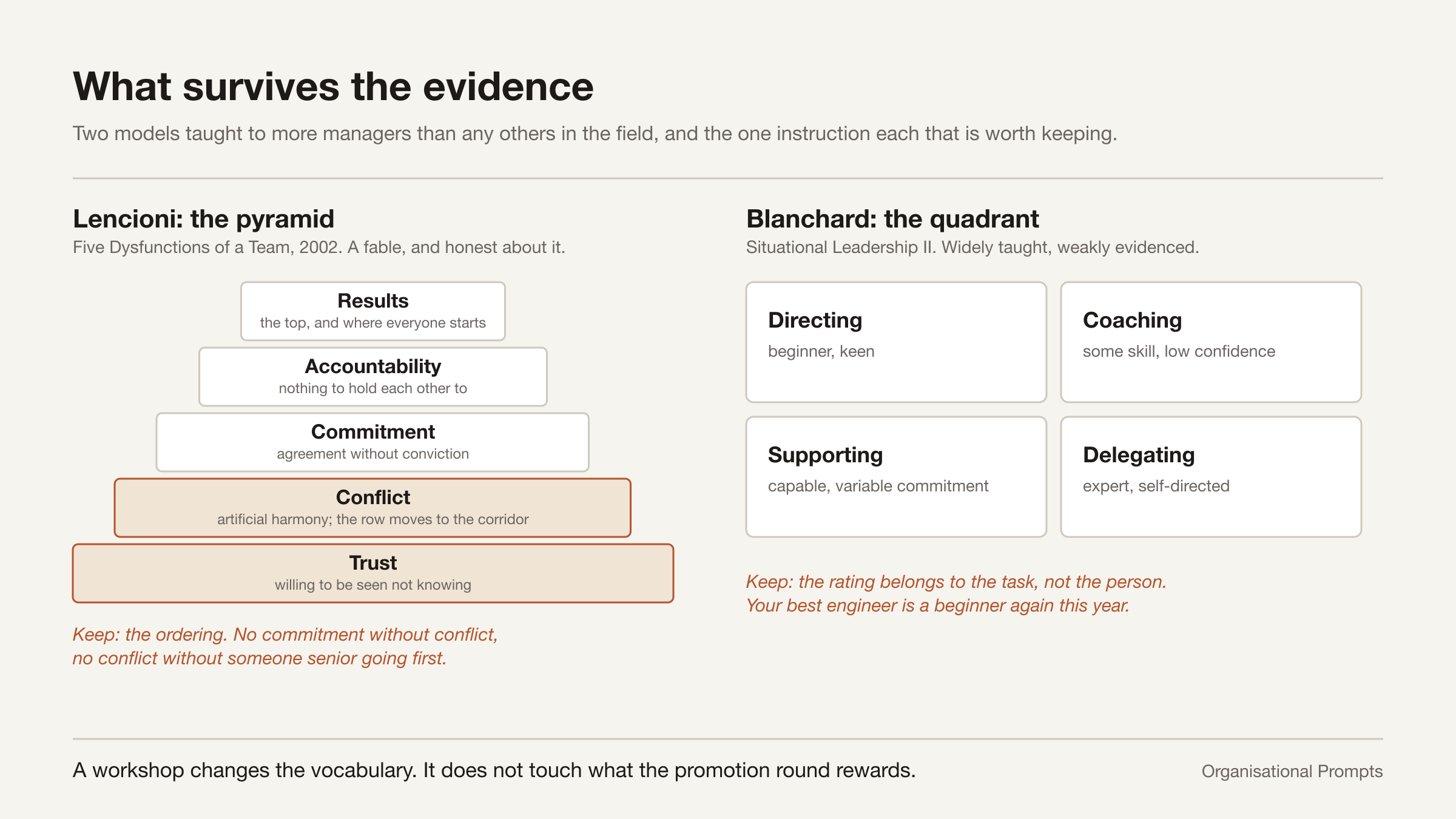
The offsite is in its second hour and the pyramid is on the flipchart. Absence of trust at the base, then fear of conflict, then lack of commitment, then avoidance of accountability, and results at the top. Everyone in the room has seen it before. Everyone agrees the problem is the base layer, which is a comfortable thing to agree because it makes the problem nobody’s in particular. Six weeks later the leadership meeting behaves in exactly the way it did in June.
Something similar happens with the other one. Four boxes, four styles, directing through to delegating, and a diagnosis of where each of your people sits. Between them, Patrick Lencioni’s pyramid and Ken Blanchard’s quadrant have been taught to more managers than any other pair of ideas in the field. They are also, by a distance, the two with the thinnest evidence behind them. That combination is worth taking seriously rather than sneering at, because both contain something real, and what gets taught is usually not it.
1. The pyramid and the quadrant
Lencioni published The Five Dysfunctions of a Team in 2002 as a business fable, which is to say a short novel with a model at the back. The five stack: without trust people will not risk conflict; without conflict they will not genuinely commit; without commitment there is nothing to hold each other to; and without accountability the team drifts from results to individual status. Trust in his sense is specific. It means being willing to be seen not knowing something, which he calls vulnerability-based trust to distinguish it from predictability.
Blanchard’s model came out of work with Paul Hersey in the late 1960s and was reworked as Situational Leadership II with Drea Zigarmi and Patricia Zigarmi. The claim is that there is no best leadership style, only a style appropriate to the person’s development level on a particular task. Four levels, four matching styles: directing, coaching, supporting, delegating. Give a beginner delegation and they flounder; give an expert direction and they resent it.
Both are elegant, both fit on a slide, and both have sold in the millions. Blanchard has written more than seventy books. The Table Group has built a substantial practice on the pyramid. Neither man is a fraud and both are describing something they have watched happen many times.
2. What the evidence actually says
Situational Leadership is among the best-known and least well-substantiated models in the whole field, and the gap is not a secret. The serious leadership textbooks note it. General management textbooks reproduce the quadrant without mentioning that it has been tested and largely failed to confirm.
Claude Graeff set out the theoretical objections in 1983 and again in 1997: weak or absent argument for critical parts of the model, internal inconsistencies, and conceptual ambiguity that got worse rather than better in the second version. On the empirical side, only four studies have ever fully tested the three-way interaction the theory predicts, between how directive the leader is, how supportive, and how ready the follower. Taken together they offer minimal support, often only directional, and mostly at the low-readiness end where the advice is least surprising. Thompson and Vecchio tested three versions across ten Norwegian financial institutions and found the 2007 revision a worse predictor of performance and attitudes than the original.
There is a deeper problem, and in practice it does more damage than the statistics do. The leader is the sole judge of the follower’s readiness. That exposes the whole diagnosis to attribution error and halo effect, and the predictions hold up only where the leader’s rating and the person’s own rating agree. When they disagree, which is often, the model tells you to treat someone according to a picture of them they do not share.
Lencioni is a different case and a fairer one, because he never claimed to be doing research. The pyramid comes from consulting practice and is offered as such. The causal ordering has not been tested. If you want the same territory with evidence underneath it, Amy Edmondson’s work on psychological safety is where to go, and it is a group property you can measure rather than a virtue the leader is supposed to embody.
3. What survives in Blanchard
Strip away the quadrant and one instruction remains, and it is the one almost nobody follows: the diagnosis is per task, not per person.
The model says a person can be a beginner on one thing and an expert on another, this week, in the same job. What organisations do instead is type people. She is a D4. He needs a lot of direction. The label attaches to the human being, goes into the talent review, and survives contact with everything.
Now look at what has happened to your engineering organisation in the last two years. Your most senior developer, twenty years of judgement, is a rank beginner at orchestrating agents and evaluating generated code at volume. On that task she is D1: keen, and without the pattern library that makes her formidable elsewhere. Treating her as the expert she is on everything else means she gets no direction on the one thing that is new, and is too senior to ask for it. Meanwhile a two-year engineer with no habits to unlearn may be D3 on exactly that task and is being managed as a novice.
I have watched this exact mismatch produce a rollout that went badly in both directions at once. The per-task instruction is nearly forty years old and it has never been more useful than it is right now.
4. What survives in Lencioni
The pyramid’s value is not the diagnosis. It is the ordering, and the ordering is a claim about sequence that most leaders violate every time they try to fix a team.
You cannot get commitment from people who have not argued. What you get instead is the thing Lencioni names precisely, artificial harmony, in which the meeting ends with agreement and the actual disagreement moves to the corridor. And you will not get argument from people who cannot afford to be seen not knowing. So the sequence runs backwards from what most interventions attempt: teams get told to commit, when the missing thing is two levels down.
The other durable piece is that somebody has to go first, and it has to be the most senior person in the room. Not a facilitated exercise. An actual admission, about something that costs, in front of people who report to you. Adkins would recognise this as the same move at a different scale: the instrument is your own tolerance for exposure.
The AI version of artificial harmony is now easy to spot. Somebody demonstrates a workflow, the room nods, and three people privately think the output is worse than what they had. Nobody says so, because saying so reads as being against the direction of travel, and the direction of travel has executive sponsorship. That is a team that will commit to nothing and deliver a pilot.
5. Why the training does not stick
Both models are taught in two-day workshops, and the workshop is where the failure lives rather than in the content.
A workshop is a language event. People leave with vocabulary, which is real, and Lakoff would say we underrate what vocabulary does. But the field the vocabulary lands in has not changed. Lewin’s point holds: any current behaviour is held in place by restraining forces, and adding a new model on top of untouched restraints produces a snap back to the original state, usually within a quarter.
The restraints are not mysterious. Promotion still rewards the person who had the answer. The review meeting still runs to a slide deck that leaves no space for someone to say they were wrong. The senior person still speaks first. None of that is addressed by a workshop, and all of it teaches the room what is actually safe, more convincingly than a flipchart ever could.
So if you want either model to hold, change one restraint rather than running the training again. Remove the thing that punishes the behaviour you asked for. That is a smaller and more awkward job than booking a facilitator, which is why it is rarely the one that gets done.
Placement: Transforming, the fourth of the series' phases; Learning, Deciding, Building, Transforming. Both belong at Agency, where the question is how much support a person needs before they can act, and the honest answer changes with their readiness rather than with your preference. The Event Is Not Yours to Make opens this stretch.
(An Organisational Prompt is something you can do now....)
Organisational Prompt
Rate the task, not the person
Take the six people who report to you. For each one, write down two things they are currently doing: something they have done for years, and something that arrived in the last eighteen months. Rate their development level separately for each, from beginner to expert.
Almost everyone will land in two different places. Now check your last three interactions with each person against those two ratings. Were you directive on the old thing and hands-off on the new one? Most of us are, because we manage the person we know rather than the task in front of them.
Then one thing for the team. Name the disagreement your team is currently not having, the one that lives in the corridor. Take it into the next meeting yourself, and open by saying what you have got wrong about it. If you cannot think of anything you have got wrong, you have found the reason nobody else is arguing either.
Further Reading
Patrick Lencioni, The Five Dysfunctions of a Team (Jossey-Bass, 2002). Two hours to read, a fable, and honest about being one. The model is in the last thirty pages if you want to skip the story.
Claude Graeff’s Evolution of Situational Leadership Theory: A Critical Review (Leadership Quarterly, 1997) is free in full and is the careful version of everything above. Read it before you commission the training.
Geir Thompson and Robert Vecchio, Situational leadership theory: A test of three versions (Leadership Quarterly, 2009). The empirical assessment. It includes the awkward finding that the 2007 revision predicted performance and attitudes less well than the version it replaced.
Amy Edmondson, The Fearless Organization (Wiley, 2018), for the same ground with two decades of field research behind it.
I write about the industry and its approach in general. None of the opinions or examples in my articles necessarily relate to present or past employers. I draw on conversations with many practitioners and all views are my own.