
Unfreeze, change, refreeze. It is on the second slide of every change management deck in circulation, it is attributed to Kurt Lewin, and he never proposed it. Stephen Cummings, Todd Bridgman and Kenneth Brown went back through the papers in 2016 and found the model assembled after his death in 1947, by other people, from fragments of an argument that was doing something else.
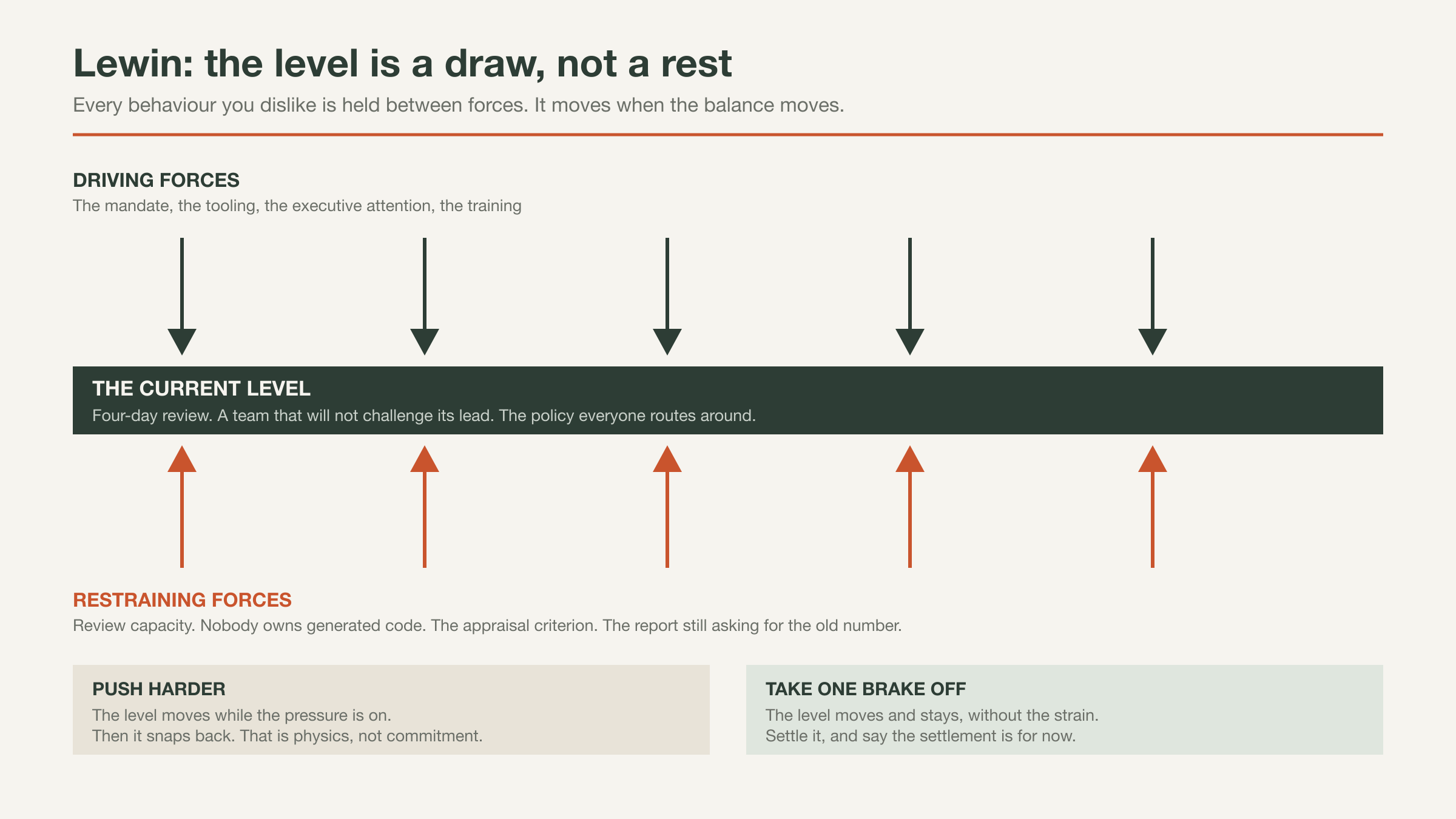
What Lewin actually described is more useful and considerably less comfortable. Any current behaviour, in a team or a company or a family, sits at a level held by opposing forces pushing against each other. He called it a quasi-stationary equilibrium: not stillness, but a draw. Nothing is resting. Everything you can see is the visible result of a fight that is already going on, and the level moves when the balance of that fight changes, not when somebody announces a new level.
1. The equilibrium is the finding
Picture a stream running at a constant depth. It looks static. It is not: water is arriving and leaving continuously, and the depth holds because the two rates match. Add water and the flow out rises to match. You are back where you started, with more water moving and nothing to show for it.
Organisational behaviour works the same way. The current level of anything you dislike, code review that takes four days, a team that will not challenge its lead, a policy everybody routes around, is held in place by forces pushing towards it and forces pushing away from it. Both are live. What you are looking at is their sum. So the useful question is never why people behave like this. It is what holds this level here. And what the forces would do if you took one of them away.
2. Take the brakes off, do not press harder
Two ways exist to raise the level. Increase the driving forces or reduce the restraining ones. They arrive at the same number and they do not produce the same organisation.
Push harder and you raise the tension in the system. The level moves while the pressure is on, everybody feels the strain, and the moment attention goes elsewhere the restraints, still fully loaded, take it straight back. Every mandated behaviour change you have watched fail did exactly this. It looked like insufficient commitment. It was ordinary physics. Take a restraint out and the level moves and stays moved, without the strain, because nothing is holding it back any more.
This is why the AI mandates are producing the results they are. The driving force is enormous: executive attention, budget, a stated expectation that everyone will use the tools. The restraints are untouched. Review capacity has not grown. Nobody has said who is answerable for generated code. The appraisal criteria still reward the outputs they always rewarded. Add force to that and you get compliance, tension, and a snap back the week the programme ends. Remove one restraint instead. Name the owner of a generated change and the level moves on its own.
3. Behaviour sits in a field, not in a person
Lewin’s formula is that behaviour is a function of the person and their field, and that both terms belong in the sentence. He meant it literally. You cannot read a person’s conduct off their character, because the same person in a different field behaves differently, which is a thing every leader has watched happen to a hire who was excellent somewhere else.
Bourdieu arrived at a version of the same thing from another direction, with dispositions laid down by a position and then carried into it. The practical consequence is identical and it is unwelcome: most attempts to change behaviour address the person, through training, through communication, through incentives aimed at individuals, when the thing holding the behaviour is the field. Lewin’s wartime food studies made the point plainly. Trying to change what families cooked, a lecture shifted a few per cent of them; a group that discussed the problem and made its own decision shifted around ten times as many. Same information, same room, different result. The second changed the field. The first only addressed the people standing in it.
4. Freezing was always provisional
The three-step caricature does its worst damage at this step. Lewin did write about making a new level permanent, and the phrase he used was permanent for a desired period. The whole point of settling was that the change should hold long enough to be worked in, not that it should hold forever. A quasi-stationary equilibrium is by definition temporary, and he knew that better than anyone, because he had spent his career describing why levels move.
The version the industry adopted made refreezing the end of the story, and organisations have been dutifully building end states ever since. A target operating model is an end state. So is a platform strategy with a completion date, and so is every AI usage policy being written this quarter, most of which will be wrong within two releases of the tools they govern. A structure that presents itself as final has made a promise about the future, and the promise is that it will resist the next event. It will keep that promise.
The corrected reading gives you the design rule. Settle deliberately, and settle in a form that can be unsettled: name the conditions under which this arrangement should be revisited, put a date on the review before anybody asks for one, and say out loud that this is the arrangement for now. An organisation that can say that has built something it can change. An organisation that cannot has built something it will have to break.
5. Study it by changing it
Lewin coined action research in 1946, and the underlying claim is that you understand a social system by trying to move it and watching what pushes back. The resistance is the data. You do not get to the restraining forces by analysis at a distance, because most of them are invisible until something disturbs them, and the people holding them usually cannot name them either.
Schön built a whole account of professional practice on the same insight, and Argyris, who worked in Lewin’s tradition, added the sharpest part: the forces people describe in the meeting are their espoused theory, and the ones actually holding the level are in what they do when the meeting ends. Run the small change first, then read the objections it produces. Those objections are your force field, drawn accurately and for free.
6. Provisional settling as a leader’s job
At this point in a change, the leader’s work is neither dramatic nor especially satisfying. The event has happened, the language has moved, and what is left is arranging the place so that the new behaviour is the easy one. That is structure, and it is mostly the removal of things.
Lewin’s contribution to that job is the discipline of asking what is holding the current level before proposing anything, and then arranging the new one so it can be dismantled by whoever comes next. It is a smaller claim about leadership than the field usually makes. It also survives contact with real organisations, which the three-step model has never managed.
Placement: Transforming, the fourth of the series’ four phases, after Learning, Deciding and Building. This one sits at the Structure position, where a change either gets an arrangement it can live in or waits to be undone. The capacity the phase produces is release, which means letting the settlement be revised by people who were not there when it was made.
(An Organisational Prompt is something you can do now....)
Organisational Prompt
Draw the brakes, not the reasons.
Take one change that keeps not sticking. On the left of a page, list what is pushing towards the new behaviour: the mandate, the tooling, the executive attention, the training. On the right, list what is holding the old behaviour in place, in specific terms: the appraisal criterion, the review queue, the person who has to approve, the report that still asks for the old number, the time nobody has.
Then leave the left column alone. It is already crowded and adding to it is what got you here.
Pick one item from the right and remove it this month. Not reduce, not review, remove. Watch whether the level moves without anybody being asked to try harder. That is the experiment, and the argument it produces afterwards will tell you which restraint to take out next.
Further Reading
Kurt Lewin, Frontiers in Group Dynamics (1947), the paper where quasi-stationary equilibria and force field analysis are set out, is available through many university libraries and is worth reading in the original for how little it resembles what is attributed to it.
Stephen Cummings, Todd Bridgman and Kenneth Brown, Unfreezing change as three steps: Rethinking Kurt Lewin’s legacy for change management, Human Relations (2016), free at https://journals.sagepub.com/doi/10.1177/0018726715577707.
Kurt Lewin, Action Research and Minority Problems (1946), which names the method and states the case for changing a system to understand it.
I write about the industry and its approach in general. None of the opinions or examples in my articles necessarily relate to present or past employers. I draw on conversations with many practitioners and all views are my own.