
The previous article argued that organisations cannot specify what they cannot articulate, and that Argyris’s defensive routines ensure the most important knowledge stays undiscussable. That was the diagnosis. This article provides the positive theory: how knowledge actually moves from the tacit to the explicit, what the conversion requires, and why AI makes the conversion simultaneously more urgent and more difficult.
Ikujiro Nonaka and Hirotaka Takeuchi, studying successful Japanese innovators in the 1980s and 1990s, built a model of organisational knowledge creation that answers a question these articles have been circling since Evans: if the domain expert knows how the business works but cannot write it down, what is the process by which what they know becomes something an AI can act on? Their answer is the SECI model, and its most important claim is that the conversion is not a documentation exercise. It is a creative act that requires specific conditions, specific interactions, and specific kinds of leadership. Most organisations provide none of them.
A footnote before we begin: Nonaka and Takeuchi also wrote “The New New Product Development Game” in 1986, the Harvard Business Review article that introduced the rugby metaphor for overlapping development phases. That article inspired Jeff Sutherland and Ken Schwaber to name their framework Scrum. The thinkers who gave us the theory of knowledge creation also, almost accidentally, gave us the most widely adopted agile methodology. The connection is not coincidental: both contributions rest on the same insight, that knowledge is created through iterative, cross-functional interaction, not through sequential, specialised handoffs.
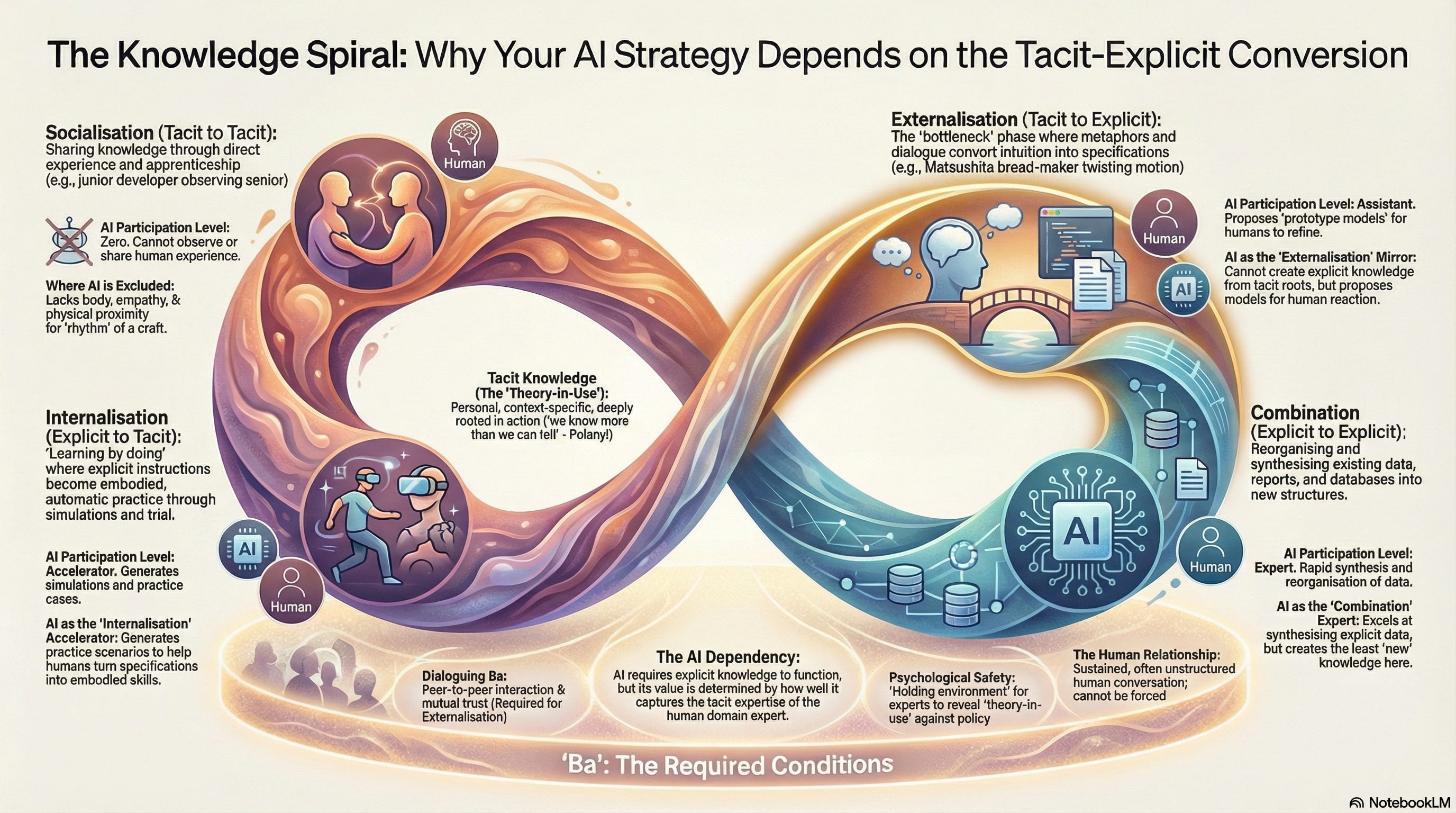
1. The Tacit-Explicit Distinction: We Know More Than We Can Tell
Nonaka and Takeuchi built on Michael Polanyi’s foundational observation: “we can know more than we can tell.” Tacit knowledge is personal, context-specific, acquired through experience, and deeply rooted in action. The domain expert who can price a complex insurance risk in seconds is deploying tacit knowledge. The experienced developer who looks at a system design and senses it will not scale is deploying tacit knowledge. The leader who walks into a team and feels something is wrong is deploying tacit knowledge. In each case, the knowledge is real, valuable, and almost entirely inarticulate.
Explicit knowledge is the opposite: articulated, systematic, codified, and easily communicated. A specification is explicit knowledge. A policy document is explicit knowledge. An API contract is explicit knowledge. Western organisations, Nonaka and Takeuchi argued, are systematically biased toward the explicit. They invest in documentation, processes, knowledge management systems, and databases. They treat knowledge as something to be captured, stored, and retrieved. And they consistently undervalue the tacit knowledge that makes the explicit knowledge meaningful.
The connection to Argyris is precise. The gap between espoused theory and theory-in-use is the gap between explicit and tacit knowledge. The espoused theory (the process document, the policy manual, the specification) is explicit. The theory-in-use (how people actually work, the workarounds, the informal rules) is tacit. Argyris explained why the gap exists: defensive routines prevent articulation. Nonaka provides the process model for closing it.
The connection to Bourdieu is equally precise. Habitus is tacit knowledge in Nonaka’s terms: the embodied dispositions that generate practice below conscious awareness. The domain expert’s pricing judgment is habitus made productive. The organisation’s resistance to change is habitus made defensive. In both cases, the knowledge governs practice without being available for examination. Simon’s decision premises are the mechanism: the tacit knowledge shapes the premises that enter decisions without anyone noticing, because nobody has made the premises explicit.
2. The SECI Model: Four Conversions
Nonaka and Takeuchi’s central framework describes four modes of knowledge conversion, forming a continuous spiral.
Socialisation (tacit to tacit): knowledge shared through direct experience. Observation, imitation, practice, shared activity. This is apprenticeship: the junior developer who learns how to review code by sitting next to a senior developer. The domain expert who absorbs how the business works by spending years inside it. Socialisation is slow, requires physical or at least sustained proximity, and produces knowledge that remains tacit. It cannot be replaced by documentation.
Externalisation (tacit to explicit): the critical and most creative conversion. This is where tacit insights are made explicit through dialogue, metaphor, analogy, and conceptualisation. The famous Matsushita bread-maker example: an engineer named Ikuko Tanaka apprenticed herself to a master baker at the Osaka International Hotel because he could not articulate what made his bread exceptional. She noticed his distinctive twisting motion when kneading dough and translated that physical observation into a specification for the bread machine’s kneading mechanism. The observation was socialisation. The translation into a specification was externalisation. Without both, the bread machine would not have worked.
This is what specification writing demands. The domain expert knows how the business works. The specification writer must convert that tacit knowledge into explicit requirements that an AI can act on. If the conversion is done badly, the specification captures the espoused theory (what people say the business does) rather than the theory-in-use (what it actually does). Argyris explained why the conversion fails. Nonaka explains what it requires: sustained dialogue, metaphor (”it’s like kneading dough”), analogy (”the pricing logic works like a negotiation, not like a formula”), and the willingness to stay in the conversation long enough for the tacit to surface.
Combination (explicit to explicit): organising and integrating existing explicit knowledge. Merging documents, synthesising reports, restructuring databases. This is the easiest mode to automate and the mode AI performs best. An LLM that summarises a set of policy documents, cross-references specifications, or generates a consolidated report is performing combination. The danger, which Nonaka identified decades before AI made it acute, is mistaking exceptional combination for genuine knowledge creation. AI can recombine explicit knowledge at unprecedented speed. It cannot perform externalisation, because it has no access to the tacit knowledge that externalisation converts.
Internalisation (explicit to tacit): learning by doing. Converting explicit knowledge into embodied practice. Reading the specification and then building until the understanding becomes automatic. This completes the cycle: internalised knowledge becomes the new tacit knowledge that can be shared through socialisation, restarting the spiral. Dweck’s growth mindset provides the psychological precondition: internalisation requires treating explicit knowledge as something to be embodied through practice, not merely memorised.
3. Why Externalisation Is the Bottleneck
The four modes are not equally important. Externalisation, the conversion from tacit to explicit, is the bottleneck of the entire knowledge creation process, and it is the bottleneck of specification-driven development. Everything else depends on it. Socialisation transfers tacit knowledge without making it explicit. Combination reorganises what is already explicit. Internalisation embeds the explicit back into practice. Only externalisation creates the new explicit knowledge that the organisation, and the AI, can work with.
Evans’s knowledge crunching is externalisation in action. The iterative dialogue between developers and domain experts, in which the domain model is constructed through conversation, challenge, and revision, is precisely the process Nonaka describes. The developer asks “how does the pricing work?” The domain expert says “it’s complicated.” The developer proposes a model. The expert says “that’s not quite right.” The model is revised. This cycle, repeated dozens of times, gradually externalises the tacit knowledge that the expert could not articulate in a single sitting.
Klein’s pattern recognition adds a layer. The domain expert whose intuition Klein validated is the person with the richest tacit knowledge. They are also the person for whom externalisation is hardest, because the more expert you are, the more your knowledge has been compressed into patterns that fire below conscious articulation. Asking the expert to explain their judgment is asking them to decompress what years of experience have compressed. The process is uncomfortable, slow, and essential.
Kahneman’s noise enters here too. If externalisation is always imperfect, always a lossy conversion from rich tacit knowledge to simplified explicit representation, then different externalisation sessions will produce different explicit knowledge from the same tacit base. Two specification workshops with the same domain expert on different days will produce different specifications, not because the expert’s knowledge has changed but because the externalisation process is inherently noisy. Decision hygiene, structuring the externalisation dialogue with defined dimensions and independent assessment, reduces this noise without eliminating it.
4. Ba: The Conditions Externalisation Requires
Nonaka introduced the concept of ba (a Japanese term meaning place or context) to describe the conditions required for each mode of knowledge conversion. Externalisation requires what he called dialoguing ba: a context of peer-to-peer interaction, mutual trust, and sustained conversation. This is not a meeting room with a facilitator and a timer. It is a relationship between people who trust each other enough to say “I don’t know how to explain this, but let me try.”
The connection to Edmondson’s psychological safety is direct: dialoguing ba requires that the domain expert can say “actually, it doesn’t work the way the policy says” without professional consequence. The connection to Heifetz’s holding environment is equally direct: the leader’s job is to create and protect the space in which externalisation can happen, which means protecting the participants from the political consequences of making the undiscussable explicit.
Beer’s architecture provides the structural dimension. Nonaka’s ba is the social context; Beer’s System 3* (the audit channel) is the architectural mechanism that connects the externalised knowledge to the decision system. Without System 3*, the knowledge externalised in a workshop stays in the workshop. With it, the new explicit knowledge enters the decision premises that shape organisational action. The architecture and the social context are both necessary. Neither is sufficient alone.
5. Where AI Sits in the Spiral
The SECI model clarifies exactly what AI can and cannot do in the knowledge creation process.
AI excels at combination. It can synthesise, reorganise, cross-reference, and recombine explicit knowledge at a speed and scale no human team can match. This is genuinely valuable. But combination is the mode that creates least new knowledge. It reorganises what is already known.
AI cannot perform socialisation. It cannot learn by sitting next to a master practitioner, absorbing the rhythms and intuitions of a craft. It has no body to observe with, no empathy to share experience through, no relationship in which tacit knowledge transfers.
AI cannot perform externalisation. It can assist: it can ask questions, propose models, challenge descriptions, and generate drafts that the domain expert reacts to. But the conversion from tacit to explicit must happen in the human, because the tacit knowledge lives in the human. The AI is a mirror, not a source. Evans’s knowledge crunching, assisted by AI-generated prototype models that the expert can react to (”that’s not quite right; the pricing actually works more like this”), may be the most productive use of AI in the entire specification process. But the creative act remains human.
AI can accelerate internalisation by generating worked examples, simulations, and practice scenarios from explicit knowledge. A developer learning a new domain can use AI to generate cases that test their understanding, turning the specification into practice exercises that build tacit mastery.
The implication for Deciding: organisations that deploy AI primarily for combination (summarising documents, generating reports, cross-referencing data) are using AI where it adds least value to knowledge creation. Organisations that use AI to support externalisation (generating prototype models for domain experts to react to, proposing specification drafts that surface tacit assumptions through the expert’s corrections) are using AI where it adds most value. The difference is whether AI is reorganising what is already known or helping to surface what has never been articulated.
6. Nonaka’s Limits
Nonaka must be read with his limitations visible. The SECI model emerged from Japanese corporate culture, with its emphasis on socialisation, group harmony, and apprenticeship. Its applicability in Western individualist contexts is contested. The tacit-explicit distinction may be a continuum rather than a dichotomy. The empirical evidence, including the bread-maker case, is illustrative rather than rigorous. And critically, the model does not address power, politics, or conflict. Stacey would argue that Nonaka presents knowledge creation as a manageable, facilitatable process when in reality it emerges from messy, political, anxiety-laden interactions. Argyris would add that the defensive routines preventing externalisation are not merely obstacles to be overcome but structural features of the organisation that serve real protective functions.
The practical limitation is that externalisation cannot be scheduled. You cannot put “convert tacit knowledge to explicit” on a project plan and expect it to happen by Thursday. It happens through relationships, through sustained dialogue, through the kind of unstructured conversation that most organisations have systematically eliminated in the name of efficiency. The leader’s task is not to manage the knowledge spiral but to protect the conditions in which it can turn.
Placement: Deciding, the second of the series' four phases, after Learning and before Building and Transforming. The knowledge spiral belongs here because externalisation is the act of turning what a group knows into something the group can decide with. What an organisation gets out of that work is a description precise enough to design against; what it cannot produce is the tacit knowledge underneath it, which is why Building keeps sending work back. Why Your Organisation Can't Decide closes the phase.
(An Organisational Prompt is something you can do now....)
Identify one piece of tacit knowledge your AI needs.
Pick one domain where your organisation is deploying AI. Ask: what does the most experienced practitioner in this domain know that is not written down anywhere? Not the process documentation. Not the policy manual. The thing they know that nobody has ever articulated, the judgment call, the exception that is not in the rules, the pattern they recognise but cannot explain. Now ask: does your AI deployment plan include any mechanism for converting that knowledge into something the AI can use? If the answer is no, your AI is being built on explicit knowledge only, which means it is being built on what the organisation says it does rather than on what it actually does. The conversion from tacit to explicit is the work your project plan has not accounted for, and it is the work that determines whether the AI will produce useful output or confident nonsense.
Further Reading
Ikujiro Nonaka and Hirotaka Takeuchi: The Knowledge-Creating Company - The foundational text. The SECI model, the knowledge spiral, and the argument that Western organisations systematically undervalue tacit knowledge. Read it for the bread-maker case and the conditions for knowledge creation.
Ikujiro Nonaka: The Knowledge-Creating Company - The article that introduced the ideas to a management audience. Shorter and more accessible than the book.
Ikujiro Nonaka and Hirotaka Takeuchi: The New New Product Development Game - The article that inspired Scrum. Overlapping development phases, cross-functional teams, and the rugby metaphor. Essential for anyone who uses agile methods and wants to understand their intellectual origin.
Michael Polanyi: The Tacit Dimension - The philosophical foundation. “We can know more than we can tell.” Short, profound, and the starting point for everything Nonaka built on.
I write about the industry and its approach in general. None of the opinions or examples in my articles necessarily relate to present or past employers. I draw on conversations with many practitioners and all views are my own.