
Eighteen months in, the programme has a name, a logo, a target operating model and a slide showing four workstreams in green. Attrition is flat. The metrics that were meant to move have moved, some of them considerably. Nothing anybody does on a Tuesday is different from what they did on a Tuesday two years ago.
That gap is the subject of this piece. These articles have been working through leading as a practice rather than a personality: what a leader can and cannot cause, what a crisis does to the distinctions a group relies on, why the word urgency was the wrong one, why nobody turns up for your problem, and why a message sent is not a message received. The claim underneath them is that leading is taking a position on how change resolves. You do not start the event and you rarely choose its timing. What falls to you is the resolution: whether the disturbance ends in something released, or in somebody blamed, or in a programme that absorbs it and leaves the organisation exactly as it was.
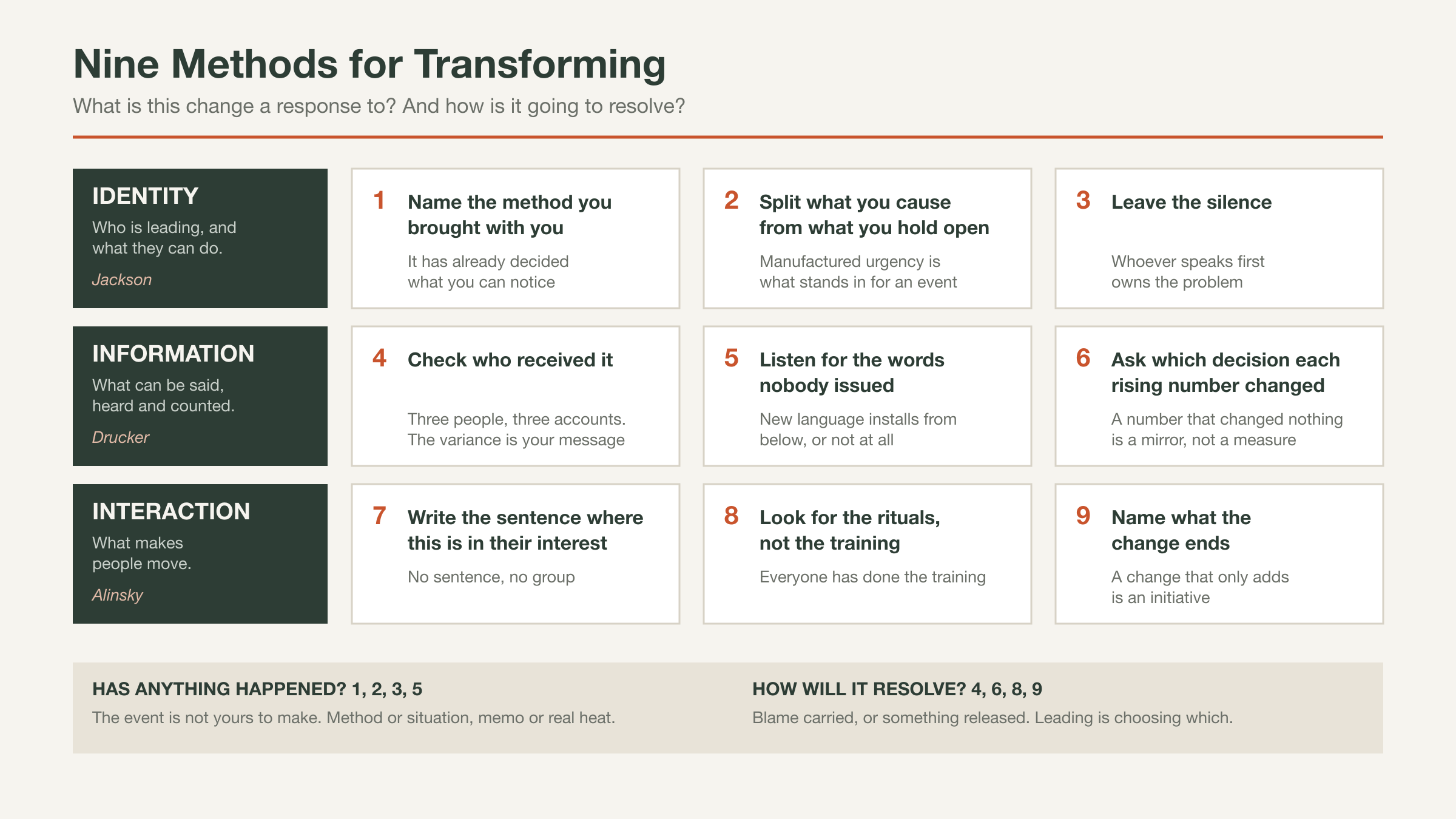
The nine methods below consolidate that into things you can observe this month and act on next. They group under the three families of question that run through every phase of this series and change only which thinker holds them: Identity, Information and Interaction, which ask who the organisation takes itself to be, what it can see, and how its parts talk to each other. In transforming, Identity asks who is leading and what they can actually do. Information asks what can be said, heard and counted about the change. Interaction asks what makes people move. Michael Jackson holds the first, Drucker the second, Saul Alinsky the third. Girard runs underneath all nine, because most of what organisations call transformation is imitation of a competitor, and mimetic desire is the instrument that tells you which is which.
Two questions sit under the nine. What is this change a response to? And how is it going to resolve? An organisation that cannot answer the first is running a programme rather than a transformation. An organisation that has not answered the second has left the answer to whoever is most frightened.
Identity: Who Is Leading, and What They Can Do
The Identity questions here are about the leader before the intervention: the method they arrived holding, the difference between what they can cause and what they can only make survivable, and the discipline of not filling the silence. Jackson is the foundational thinker. The critical systems thinking he set out in Critical Systems Thinking and the Management of Complexity in 2019 begins from an uncomfortable premise: every systems method carries assumptions about the kind of situation it faces, works well inside that kind and badly outside it, and none of them is neutral. You do not observe your organisation and then select an approach. You arrive with an approach, and it has already decided what you are able to notice.
1. Name the method you brought with you. Before diagnosing anything, write down which method you are using and what it renders invisible. A leader trained in operating models sees structure and misses meaning. A leader trained in coaching sees relationships and misses the incentive that makes those relationships rational. A leader trained in delivery sees dependencies and cannot see why a technically complete programme changed nothing. Jackson’s answer is pluralism, holding several methods and choosing between them deliberately rather than defaulting to the one that made your career. The method: write two sentences before your next diagnosis, the first naming the lens you are using and the second naming what that lens cannot show you. Then ask a colleague who works differently what they see in the same situation. The gap between the two accounts is the part of the problem you were going to miss.
2. Separate what you can cause from what you can only make survivable. Kotter taught a generation to start by creating urgency, and the word has not aged well, because manufactured urgency is what organisations reach for when no event has occurred. A real event throws received wisdom into question and nobody has to be persuaded that something has happened. Urgency by memo asks people to feel something the situation has not given them, and they can tell. What a leader can do is different and smaller and harder: keep the disturbance at a heat the organisation can survive without resolving it early, which is Heifetz‘s work in one line. The method: for the change you are leading, list what you can genuinely cause and what you can only hold open. If the first list is long, you are probably describing a project. If the second list is empty, you have not started.
3. Leave the silence. A leader hears a problem and answers it, usually within a couple of seconds, usually competently, and every time this happens the problem travels back up. The coaching tradition Lyssa Adkins set out in Coaching Agile Teams in 2010 makes a discipline of the pause: the few seconds after someone stops talking, in which the person with the problem either finds their own next move or hands it over. Whoever speaks first owns it. We are all faster than we think we are, and most of us have never counted the seconds. The method: in the next three conversations where somebody brings you a problem, wait, visibly, before responding. Then ask what they think should happen. Count how often you get an answer that was already there.
Information: What Can Be Said, Heard and Counted
The Information questions are about whether the change exists in the organisation’s language and its numbers, or only in the deck. Drucker is the foundational thinker, and his sharpest claim about communication is the one most often ignored: communication is an act of the recipient, not of the sender. Nothing has been communicated until somebody has received it, in their own terms, in a form they can use. The utterance was never the thing.
4. Check who received it. Ask three people at different distances from you, in separate conversations, to say what the change is and what it means for their work. Do not correct them. Write down what they say. The variance between the three accounts is your actual communication, and the number of them who describe the change in terms of their own work rather than yours is your actual reach. Argyris explained why this is uncomfortable enough that most leaders skip it: the people best at defending an unexamined position are usually the ones who most sincerely believe they have communicated. The method: run the three conversations, then rewrite the message from the words that came back rather than the words you sent.
5. Listen for the vocabulary nobody issued. After a genuine event, a new language installs fast, and it installs from below. People start using a phrase for the new thing that was in no announcement. The presence of that vocabulary is the strongest evidence you will get that something has actually happened, and its absence is the strongest evidence that nothing has, whatever the engagement scores say. Weick understood organisations as continuous sensemaking, and sensemaking leaves a residue in the words. The method: for one month, collect the phrases people use for the change that came from nobody official. If the list is empty, the change is still yours alone. If the list is full of the previous programme’s vocabulary, you are being absorbed.
6. Ask which decision each rising number changed. Delivery metrics are almost all up. Deployment frequency, lead time, the volume of change, the counts on the dashboard you review monthly: up, and rising faster since the tooling arrived. Take each number that improved and name the decision that got made differently because of it. Where a number moved and no decision changed, it is not a measure, it is a mirror, and the organisation is admiring itself. Beer‘s instrument applies here with force: the purpose of a system is what it does, and a measurement system that reliably produces reassurance has reassurance as its purpose. The method: take last quarter’s improved metrics and, for each, write the decision it changed. Retire the ones with a blank beside them.
Interaction: What Makes People Move
The Interaction questions are about the conditions under which people actually act, which are rarely the conditions described in the change narrative. Alinsky is the foundational thinker, and the reason to read a community organiser writing in 1971 rather than another management author is that he had no authority whatsoever and could not confuse compliance with movement. His starting point is that people act on their own interests, in their own experience, and that an organiser who cannot state a change in the language of somebody else’s self-interest has not yet begun.
7. Write the sentence in which this is in their interest. For each group whose behaviour has to change, write one sentence in which the change makes their working life better, in words they would use. Not the organisation’s benefit; theirs. If you cannot write the sentence for a group, you do not have that group, and no amount of communication will get them, because there is nothing there to receive. Alinsky would add the harder half, which is that where the change genuinely is not in their interest you must say so plainly and negotiate rather than dress a loss as an opportunity. People forgive a cost named honestly. They do not forgive being sold one. The method: write the sentences, one per group, and show each one to somebody in that group.
8. Look for the rituals, not the training. Everyone has already done the training. The leadership programme, the values workshop, the two days on psychological safety: they exist, they were attended, and they changed the language for about a fortnight. Collins explains why. Groups are made in repeated encounters where people are together, attending to the same thing, with something at stake, and what those encounters produce is energy and standards the group will defend on its own. A training day has no stakes. It has a facilitator. The method: list what recurs in your organisation weekly or fortnightly with a real outcome attached, and ask whether the change you are leading appears in any of them. If it lives only in all-hands presentations and a quarterly offsite, it has no ritual and it will not survive contact with a busy month.
9. Name what the change ends. A transformation that only adds is an initiative. Ask what stops: which report, which committee, which product, which promise to a customer you have been keeping badly for years. Ackoff put the general case sharply, that the highest move is to dissolve a problem by redesigning the system that generates it, and dissolution always ends something. Most organisations I have worked with cannot answer this question, and the inability is the finding. An organisation that cannot stop anything has no capacity for change, only capacity for accumulation. The method: publish the list of what ends, with dates, before the list of what begins.
How It Resolves
Girard’s account of a group in crisis, worked out across Violence and the Sacred in 1972 and everything after it, is the least comfortable idea in these articles and the most useful. When the distinctions a group relies on collapse, and everyone wants what everyone else wants because they want it, the tension has to go somewhere. The oldest resolution, and the cheapest, is to find somebody to carry it: a function, a supplier, a leader, a team that was already unpopular. The organisation feels better immediately. Nothing has been learned and the same crisis returns on a schedule.
We can watch the mimetic half of this happening in public at the moment, and we in technology are the ones doing it. Every large organisation is building the same thing, on the same timeline, with the same three vendors, and very few of us can say what event in our own situation made it necessary. That is not strategy, it is imitation of a rival, and imitation is fragile in exactly the way Christensen‘s incumbents were fragile: every step is defensible and the direction was never chosen. Methods one, two and seven are the ones that catch it, because each asks whose change this is.
The nine do two jobs. Methods one, two, three and five test whether anything has actually happened: whether the leader has seen the situation or their method, whether the disturbance is real or manufactured, whether the organisation is generating its own language for it. Methods four, six, eight and nine test how it is resolving: whether the message has landed anywhere, whether the numbers are informing decisions or providing comfort, whether the change has a ritual to live in, and whether anything is being let go. Method seven tests both, since a change nobody else wants has neither happened nor resolved, whatever the programme board decides.
Transform comes from transformare, to change the shape, and the subject of the verb never changes: the thing that gets a new shape is the thing you already have. You cannot transform an organisation by creating another organisation, which is what a transformation office is, and it is why the successful ones dissolve themselves early and the unsuccessful ones are still there in year four with a headcount to protect. The work is done in the organisation you have, in its meetings, with its people, in its language. The position a leader takes on how the change resolves is, in my view, nearly the whole of the job.
I write about the industry and its approach in general. None of the opinions or examples in my articles necessarily relate to present or past employers. I draw on conversations with many practitioners and all views are my own.