
The initiative is three years old. It has a name, a lead, a quarterly update and a slot in the plan, and it has not produced anything anybody can point to since the first six months. Everyone involved knows this, and none of them says it. The updates have been getting more abstract for two years, which is how these things speak when they have nothing to say. The last four steering meetings each ended with an agreement to review it next quarter, and each of those agreements was reached in under a minute.
Starting things is easy and every organisation is good at it. Stopping is a different capability, it is rarer, and its absence costs more than anybody counts. An organisation that cannot stop anything has no free capacity, and an organisation with no free capacity cannot respond to anything new, however much it wants to and however loudly it says so.
1. Question
Can the organisation stop something that is not working?
Answer it with evidence rather than policy. Name the last three things you stopped, with dates. Not things that finished, not things that were renamed, not things quietly starved of people while remaining on the plan. Stopped, deliberately, and announced to the people affected.
If you cannot name three in two years, the answer is probably no. Everything else here is about why, and about the one date in the calendar that changes it.
2. Purpose
The question measures free capacity, which is the resource every change actually runs on. Money is rarely the binding constraint. Attention is, and attention is fully committed by definition, because whatever exists is already occupying somebody. New work therefore cannot start; it can only displace, and where nothing can be displaced, new work gets added to people who are already full and then fails slowly and unaccountably.
It also reveals how failure is treated, which people read far more carefully than any statement about learning from mistakes. Where stopping is impossible, ending a project means somebody admitting it was wrong, so nothing ends, and the organisation accumulates a layer of undead work that consumes attention while producing nothing.
There is a diagnostic bonus. The things an organisation cannot stop tell you where its real authority lies. Trace the sponsor of the oldest surviving initiative and you usually have a map of who cannot be contradicted. That map tends to be more accurate than the org chart, and it is free.
The tell is language. When an update stops containing nouns you can check and starts containing progress, alignment and foundations, the work has probably ended and the reporting has not. Abstraction is what a report does when it has nothing left to report.
3. Context
Peter Drucker made stopping a discipline rather than an event. His practice of planned abandonment asks, of everything currently being done, whether you would start it today knowing what you now know, and treats a no as a decision to stop rather than as an interesting observation. He insisted the review be scheduled, because abandonment rarely happens spontaneously. There is always a reason to wait one more quarter, and the reason is usually true. A true reason is harder to refuse than a false one, which is precisely the difficulty.
Taiichi Ohno built stopping into the machinery. Any worker could halt the line, and halting it counted as a contribution rather than a fault. That sounds costly and is the opposite, because a defect that keeps moving gets more expensive at every station it passes. The organisational point: stopping has to be cheap, normal and available to people near the work. Otherwise it will only ever be done by people far from it, and far too late to matter.
Daniel Kahneman explains the pull in the other direction. Losses weigh about twice as heavily as equivalent gains, so the visible loss of ending something outweighs the invisible gain of the capacity released. Add in what has already been spent, which should be irrelevant and never is, and continuing becomes the comfortable choice for everybody in the room. Nobody is being irrational here. They are being human in a way that is entirely predictable, which means it can be designed around rather than argued with, and designing around it is cheaper than arguing.
Karl Popper gives the missing condition. A claim that cannot fail tells you nothing, and most initiatives are launched without any statement of what would count as failure, which makes them unfalsifiable and therefore permanent. The fix belongs at the start rather than at the end. An initiative that cannot say in advance what result would justify stopping it has not been designed, and it will run until somebody senior gets bored.
James March sets out the trade-off you are managing. Organisations must both exploit what already works and explore what might, and exploration is the one that gets squeezed, because its returns are uncertain and distant while exploitation’s are neither. Capacity for exploration comes from stopping exploitation that has stopped paying. So the ability to stop is not housekeeping, and it is not tidiness. Stopping is the mechanism by which an organisation stays able to find anything new, and an organisation that cannot stop has quietly decided to live on what it already knows.
4. Action
Put one date in the calendar and stop three things on it.
Choose a day this quarter, tell people what it is for, and take to it every initiative older than eighteen months. For each one ask Drucker’s question exactly as he framed it: knowing what we now know, would we start this today? Take the answer as a decision rather than as a discussion, and expect the room to want to defer, because deferring is always available and always defensible.
Give the meeting a quota. Three things stop. A quota is crude and it works. Without one the meeting will find a reason for each individual case and end having changed nothing, and all of those reasons will be separately good, which is how the meeting will justify itself afterwards.
Handle the people first and visibly. The reason nothing gets stopped is that stopping reads as a verdict on whoever ran it, so decide in advance where those people go and announce it in the same breath. Where somebody who closed a project lands somewhere good, stopping becomes survivable. Where they quietly disappear, it becomes fatal, and you will never manage it twice.
Then fix the front end. Do that and this is the last purge you need. Require every new initiative to state, before it starts, what result by what date would mean stopping it. Not success criteria, which are always written to be met. The condition under which the sensible thing is to close it, agreed by the sponsor, in writing, before any money moves.
The test is what happened to the capacity you released. Ninety days after the purge, name where the released attention went, by team and by piece of work. If you cannot name it, the work was reabsorbed, and the next purge will find exactly as much as this one did.
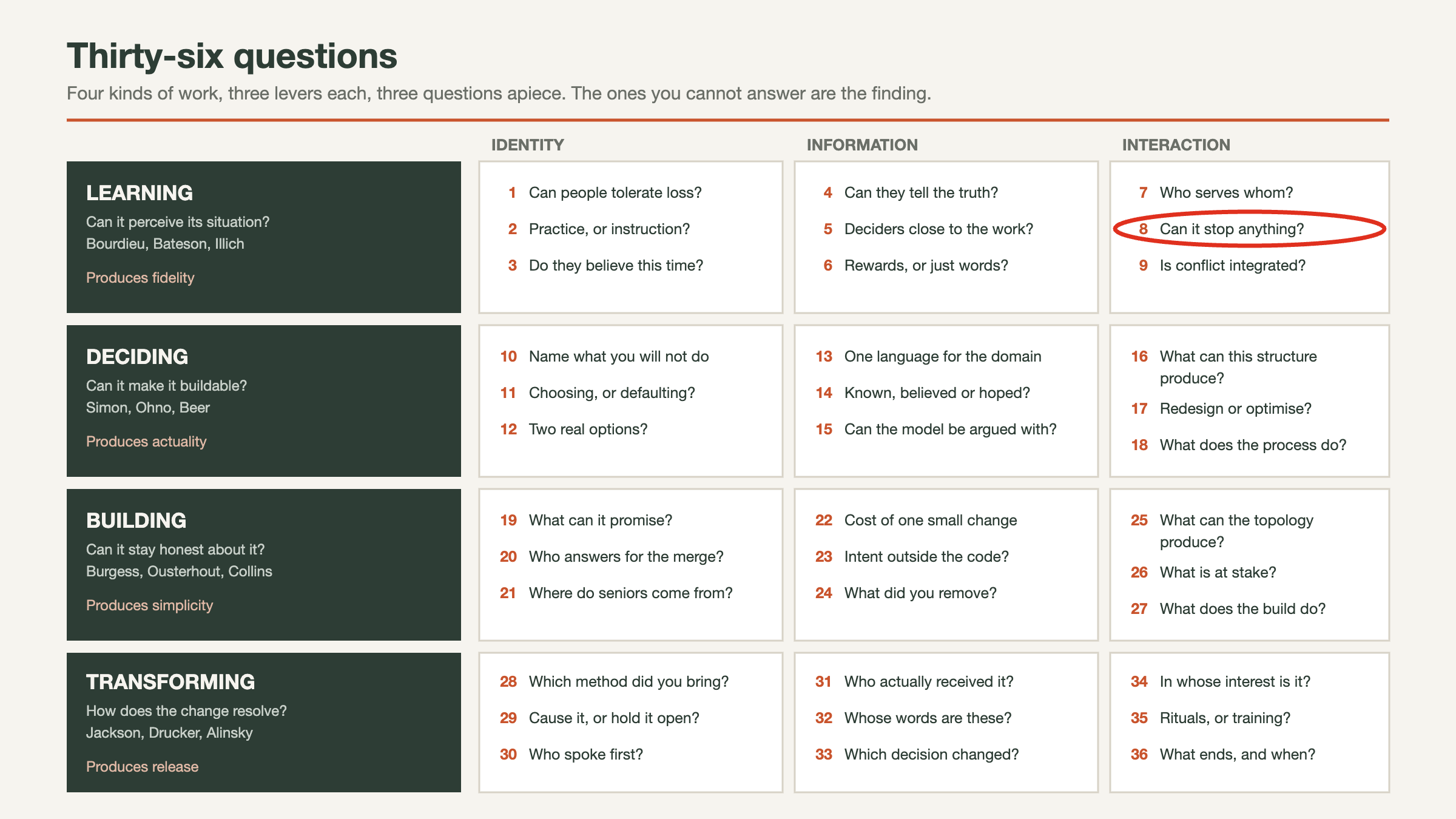
This question sits in the Learning group of the series, the articles asking whether an organisation can perceive its own situation accurately enough to respond to it. What an organisation gets out of that work is fidelity, meaning an account of its situation that matches the situation. The route from there into deciding what to do about it is set out in From Learning to Clarity.
Further Reading
Peter Drucker, Management: Tasks, Responsibilities, Practices (1973), for planned abandonment as a scheduled discipline rather than an occasional decision.
Taiichi Ohno, Toyota Production System (1978), for stopping the line as a contribution.
Karl Popper, Conjectures and Refutations (1963), for why an unfalsifiable claim tells you nothing at all.
James March, Exploration and Exploitation in Organizational Learning, Organization Science (1991), for the trade-off that squeezes exploration first.
I write about the industry and its approach in general. None of the opinions or examples in my articles necessarily relate to present or past employers. I draw on conversations with many practitioners and all views are my own.