
The weekly report showed the production line running at target. Throughput was within range, defects sat inside tolerance, the summary was green. On the floor, the same line was stopping every few minutes; the operators had learned to absorb the interruptions into the rhythm of the shift, and the numbers still came out flat. The report was not lying. It was doing what reports do: it had averaged, summarised and rounded until the thing that mattered had disappeared.
Every organisation decides on the strength of descriptions like that report. The description is never the reality; it is an account of the reality, assembled by people, each of whom had a reason to smooth it. By the time a description has climbed three levels of an organisation it has been attenuated at every step, and the decision taken on top of it inherits every omission silently. This is not a failure of honesty. It is the ordinary physics of information moving through a hierarchy, and it is the problem the second lever of Deciding exists to address.
That lever is Information: whether an organisation can describe the thing it is deciding about with enough precision to decide within it at all. Learning placed Bateson at this lever, and he gave it an epistemology; information is a difference that makes a difference, and the double bind is the pathology that corrupts the signal and keeps it circulating. Bateson tells you what meaningful information is and how it is degraded. He does not tell you what to do on a Tuesday. Taiichi Ohno does, and that is why Deciding needs him here.
Ohno built the Toyota Production System over roughly three decades, and although it is remembered as a manufacturing method it is more accurately a theory of how an organisation sees. Gemba, standard work, jidoka, the five whys: each is a mechanism for closing the gap between the account and the actual. Several of these articles have already leaned on him without naming the debt. The treatment of domain-driven design described Evans’s ubiquitous language and bounded contexts as a decision discipline, and they are one; but they are a software instance of an older and more general idea, and the idea is Ohno’s. This article makes the debt explicit and sets out the discipline on which the rest of the Information lever rests.
1. Gemba: Go and See
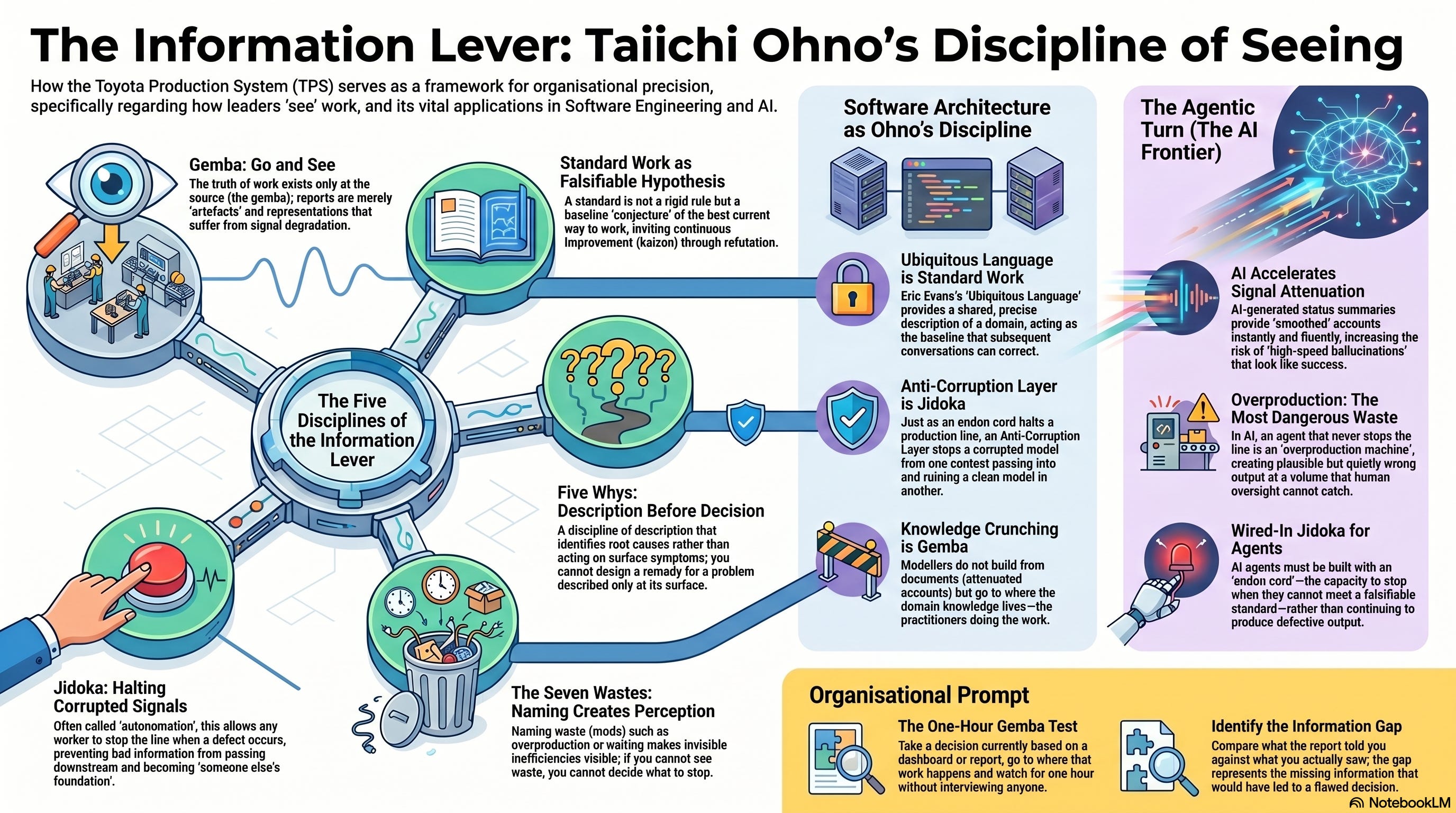
Gemba is a Japanese word meaning the actual place: the spot where the work is done and where value is, or is not, being created. Ohno’s instruction was uncompromising. The truth about the work is held only at the gemba, and a manager who manages from a conference room is managing an artefact. The report on the screen is not the work; it is a representation of the work, and a representation made by someone who had to decide what to leave out.
The practice Ohno is most associated with makes the point physical. He would chalk a circle on the factory floor and require a manager to stand inside it, sometimes for the better part of a day, with a single instruction: watch the work, and tell me what you see. Most could not, at first. They saw what they expected to see, which is not the same as seeing. Ohno’s circle was a training device for a capacity that does not arrive by default. Looking is automatic; seeing is a discipline, and the discipline has to be built.
Gemba is the corrective to the problem Bateson named. Bateson showed that the signal degrades as it travels; Ohno’s answer is not a better reporting template but a change of physical location. Go to where the signal originates, before it has been averaged, summarised and rounded by everyone whose job depended on its shape. A report is a description of the work written by someone who needed it to look a particular way, and no amount of refinement to the document removes that fact. Only standing at the source does.
For software, this is not a metaphor that needs stretching. Evans’s knowledge crunching, the long sessions with domain experts that produce a model, is gemba. You do not learn a domain from a requirements document, because the document is already an attenuated account; you go to where the domain knowledge actually lives, which is the practitioner doing the work, and you watch and ask until the model matches what they do rather than what they wrote down. Going to see is the first move of the Information lever. But it is only useful if you have something to see against.
2. Standard Work as Hypothesis
Standard work is the current best-known way to perform a task, documented precisely: the sequence of steps, their timing, the small inventory of materials the task requires. It is the most misread idea in Ohno’s system. Read carelessly, it looks like the bureaucratic enemy of improvement, the laminated procedure that punishes initiative. It is the exact opposite, and the misreading matters because it inverts the purpose.
Ohno’s own formulation closes the question: where there is no standard, there can be no kaizen. The standard is not a cage; it is a baseline. Without a written standard, every observation of the work is merely an anecdote, one person’s impression set against another’s. With a standard, an observation becomes a measured difference: the work either matched the standard or it did not, and the deviation is now a fact rather than an opinion. The standard is what makes a difference visible, which is Bateson’s definition of information made into a shop-floor object.
The deeper move is to see what kind of claim a standard is. It is an explicit, falsifiable statement about the best way currently known to do the work. It invites refutation. The next person to perform the task, or to stand in the circle and watch it, can demonstrate that the standard is wrong, and when they do, the standard changes that day. This is the series’ Popperian thread rendered as practice: the standard is a conjecture, kaizen is the refutation, and the improved standard is the next conjecture. A standard held as a hypothesis improves continuously. A standard held as a rule ossifies, and then deserves the bad reputation the misreading gives it.
This is why an organisation with no standards is not free but blind. It has nothing to notice change against. It cannot tell improvement from drift, or a real problem from a bad day, because every state of the work looks much like every other. Standard work is the instrument that lets an organisation see precisely, and seeing precisely is the whole task of the Information lever. The standard tells you, reliably, when something has gone wrong. It does not tell you why.
3. The Five Whys: Description Before Decision
The why is answered by asking it again. Ohno’s discipline for reaching a cause was to ask why repeatedly, conventionally five times, refusing to stop at the first answer that sounded sufficient. His own example runs from a stopped machine to a blown fuse to a seized bearing to inadequate lubrication to a worn pump shaft. Stop at the fuse and you replace the fuse, and the line stops again next week. Reach the shaft and the problem is gone.
The five whys is not a root-cause ritual to be performed in a workshop and forgotten. It is a discipline of description, and its target is the most common failure in organisational decision-making: acting on a symptom because the symptom is what the report described. A decision taken at the first why is a decision about a surface, and it will be re-taken, again and again, because the cause underneath it was never touched. The organisation experiences this as a recurring problem and treats the recurrence as bad luck. It is not bad luck. It is a description that stopped too early.
This connects directly to the hypothesis the whole Deciding phase rests on: decisions are design challenges, and design is a sequence of decisions under constraint. You cannot design a remedy for a problem you have described only at its surface, any more than you can design a bridge from a photograph of a river. The five whys is how an organisation earns a description precise enough to design against. The recently published methods for deciding asked whether the model behind a decision is visible and challengeable; the five whys is one of the plainest ways to build such a model, because each why forces a claim into the open where it can be examined. Seeing precisely, and describing to the root, still leaves one question: what should happen the instant a defect appears.
4. Jidoka: Build Quality In
Jidoka is usually translated as autonomation, or automation with a human mind. A machine equipped with jidoka detects its own defect and stops itself, rather than continuing to produce flawed parts at speed. The principle extends past machines through the andon cord: a line, a signal, or a button by which any worker who sees a problem can halt the entire production line.
The radicalism of this is easy to understate. A single worker, at any moment, can stop the whole system. Most organisations would regard that as an invitation to chaos. Ohno regarded the alternative as the chaos: a known defect, undetected or detected and ignored, travelling downstream where it is built into larger assemblies, multiplied, and buried so deep that by the time it surfaces it has cost a hundred times what it would have cost at source. Stopping the line is not the expensive option. It is the cheap one, paid early.
Jidoka is, at its core, an information principle. A defect is information; it is a difference that very much makes a difference. Jidoka makes that information impossible to ignore by giving it the authority to stop production. Quality is built in at the source rather than inspected in at the end, and the reason is precisely about description. By the time a defect reaches final inspection it has been described as a finished unit, wrapped in all the work performed on top of it, and the original signal is almost impossible to recover. Where Bateson’s double bind corrupts a signal and keeps it quietly circulating, jidoka is the mechanism that stops the corrupted signal dead. It is the Information lever’s refusal to let a bad description pass downstream and become someone else’s foundation.
5. The Seven Wastes: Seeing What Is Not There
Ohno catalogued seven forms of waste, or muda: overproduction, waiting, transport, over-processing, inventory, motion, and defects. The list is useful, but the insight beneath it is the part worth keeping. Waste is invisible until you have a language that makes it visible. A team can work hard for an entire day, produce mostly waste, and go home feeling productive, because without the categories there is simply nothing to see. Effort is felt; waste is not, until it is named.
Naming creates perception. This is the quiet link back to the rest of the series: a vocabulary is not a description of a world already seen, it is the instrument that lets the world be seen at all. Give a team the seven categories and they begin, within days, to notice things that were always there and always invisible. Ohno held that overproduction was the worst of the seven, and the reasoning is instructive: overproduction manufactures the appearance of progress, the full shelves and the busy line, and that appearance hides the other six wastes behind it. The most dangerous waste is the one that looks like success.
For Deciding this is direct. An organisation that cannot see its waste cannot decide what to stop, and stopping is half of deciding. The probes that run through this phase asked exactly that question: can the organisation halt what no longer works, or does everything it has ever started simply continue. The honest answer is usually that the organisation cannot see clearly enough to know what to stop, because it has no shared language for waste and so experiences its waste as ordinary work. These are not five or seven separate techniques. Gemba, standard work, the five whys, jidoka and the wastes are one discipline seen from different angles, and naming the discipline lets us settle a question these articles have been carrying.
6. Why Evans Is Ohno in Software
Earlier in this series, domain-driven design was treated as a foundational decision discipline, and on its own terms it is. But it is not foundational in itself, and the distinction matters for how the architecture of this series holds together. Evans’s ubiquitous language is standard work for a domain: a shared, written, precise description of how the domain is talked about, maintained as the baseline that the next conversation can correct. Bounded contexts are value-stream boundaries. Ohno drew the edges of a work cell where the flow of value naturally divided; Evans drew the edges of a model where the language naturally divided; it is the same act of seeing a seam and cutting along it rather than across it.
The parallels continue once you look for them. Knowledge crunching is gemba: the modeller does not build from a document but goes to where the domain knowledge actually lives. The anti-corruption layer is jidoka installed at a boundary: it exists to stop a corrupted model from one context passing into a clean model in another, halting the bad signal exactly as the andon cord halts the line. None of this diminishes Evans. It locates him. He is the shaping thinker who showed an entire profession what Ohno’s discipline looks like rendered in their own medium, and that translation was indispensable; most software practitioners would never have reached Ohno directly.
But Ohno is the foundational thinker for the Information lever because the discipline is general. It governs a factory, a hospital ward, a domain model and a fleet of software agents with equal force, because in every case the task is the same: see the work precisely, at its source, and hold the description as a claim that reality can correct. Evans is Ohno for software. That framing is not a demotion of Evans; it is a promotion of the principle, and it is exactly the principle that now faces its hardest test, because the newest medium of work is one in which the worker is a model.
7. The Agentic Turn
Software agents generate work at a scale and speed that makes the gemba problem acute rather than incidental. Two descriptions are now suspect at once. There is the description the agent is given to act on, and there is the description the agent produces of what it did, and both are smoothed accounts. An AI-generated status summary is attenuation performed instantly, fluently and with great confidence; it is the green weekly report, written in a second, for a thousand lines at once.
Standard work as hypothesis becomes the governance mechanism here, and it is hard to see what replaces it. An agent’s method has to be an explicit, written, falsifiable standard, because if there is no standard you cannot tell when the agent has drifted. You can only tell when it has failed visibly, and most drift does not fail visibly; it produces plausible output that is quietly wrong. Jidoka becomes the second requirement. An agent has to be built so that it stops when it cannot meet the standard, rather than producing confident, defective output at volume. An agent that never stops the line is not an efficient worker; it is an overproduction machine, and overproduction was the waste Ohno feared most because it looks like success. The andon cord has to be wired into the system deliberately, because the agent will not reach for it on its own.
This argument is structural, not normative. AI does not change what good description requires; the requirement was always to see the work at its source and hold the account as a correctable claim. What AI removes is the time you used to have. An organisation with weak gemba discipline survived for decades because work moved at human speed, and a wrong description could be caught before it had done much damage. At machine speed there is no such grace period. The organisation that never learned to see precisely will not be punished more harshly by AI; it will simply be punished faster, and with less warning, than it was before.
Ohno equips the Information lever fully: a description seen at its source, held as a falsifiable standard, with a mechanism that stops the corrupted signal before it travels. But a precisely seen reality is not yet a good decision. The signal, however clear, has to move; it has to reach the part of the organisation that holds the authority and the variety to act on it, and whether it can is a question of structure, not of seeing. That is the Interaction lever, and it is where these articles turn next, to Stafford Beer and the Viable System Model. Beer would recognise Ohno’s andon cord at once: it is an algedonic signal, the alert that bypasses the hierarchy because the news is too important to be attenuated on the way up. He would recognise the gemba as the audit channel, the direct and unfiltered contact with operations that no viable system can do without. Ohno built the practices. Beer built the architecture that determines where those practices must sit for the signal to survive the journey. Seeing clearly is the beginning of deciding. Whether what you see can move is the next problem.
Placement: Deciding, the second of four phases; Learning, Deciding, Building, Transforming. Ohno holds Information here, the questions about whether an organisation can describe what it is deciding about precisely enough to decide within it. He carries into Building twice over, as the andon cord and as the warning about overproduction once making is free. From Deciding to Building is the bridge.
(An Organisational Prompt is something you can do now....)
Organisational Prompt
Go to the gemba for one decision you are about to take on the strength of a report.
Pick a decision currently circulating in your organisation on the basis of a dashboard, a status deck or a written summary. Before the next meeting about it, go to the place where the work that report describes actually happens, and watch it for an hour. Do not interview anyone, and do not ask the team to present to you; if you ask, you will get another report. Just watch. Then write down, in one column, what the report told you, and in another, what you saw. The gap between the two columns is the information your decision was about to be missing. If there is no gap, you have a rare and genuinely well-run process. If there is a gap, you have just discovered that you were about to decide on a description rather than a reality, and you now have the one hour of seeing that changes the decision.
Further Reading
Taiichi Ohno: Toyota Production System: Beyond Large-Scale Production (1978; English translation 1988). The foundational text. Just-in-time, autonomation, the seven wastes, and the discipline of asking why five times.
Taiichi Ohno: Workplace Management (1982; English translation 2013). Short, aphoristic reflections on gemba, standard work, and the manager’s task of seeing reality precisely.
Jeffrey Liker: The Toyota Way (2004; 2nd edition 2021). The most widely read synthesis of Ohno’s system, with worked detail on standard work and jidoka.
Lean Enterprise Institute. Overviews of the Toyota Production System, jidoka, standard work and gemba, with links to primary sources.
I write about the industry and its approach in general. None of the opinions or examples in my articles necessarily relate to present or past employers. I draw on conversations with many practitioners and all views are my own.