
Every serious engineering decision is a transfer of cost to people who are not in the meeting. The migration deferred, the interface left broader than it needed to be, the model trained on data whose provenance nobody wrote down, the platform whose only operator knowledge lives in one person’s head: each one buys something now and posts the invoice forward. Discounting the future is not an occasional lapse in this trade. It is the default arithmetic, and it is built into how we approve work.
Derek Parfit spent the last part of Reasons and Persons, in 1984, taking that arithmetic apart. His target was the social discount rate, the practice of weighing a future harm less because it is further away, and his argument was blunt: remoteness in time is not itself a moral reason for anything. If a policy will kill people in two hundred years, the deaths are not less bad for being late. What Parfit could not do, and knew he could not do, was tell a person on a Tuesday what to actually do about it. Alasdair MacIntyre, writing three years earlier, had the mechanism that Parfit’s argument needs.
1. The discount nobody will defend out loud
Ask a technology leader whether a defect that harms users in five years counts for less than one that harms them next quarter, and nobody says yes. Look at how work is prioritised and the answer is unmistakably yes, at a fairly steep rate.
Some of that is legitimate. A financial discount rate exists because money can be invested, because the future is uncertain, and because we may be richer later and better able to fix things. Parfit accepted all of that and separated it cleanly from the thing being smuggled in beside it: a moral discount, in which the interests of people further away in time simply count for less. The first is a claim about resources and probability. The second is a claim about the worth of persons, and once it is stated in those words nobody will sign it.
Most organisational discounting is the second, defended with the reasons that justify the first. The technical debt register is the artefact where you can watch it happen. Everything on it was recognised, written down, agreed to be real, and then weighted at nearly zero because its consequences fall outside the horizon anybody is measured on.
2. Where the arithmetic runs out
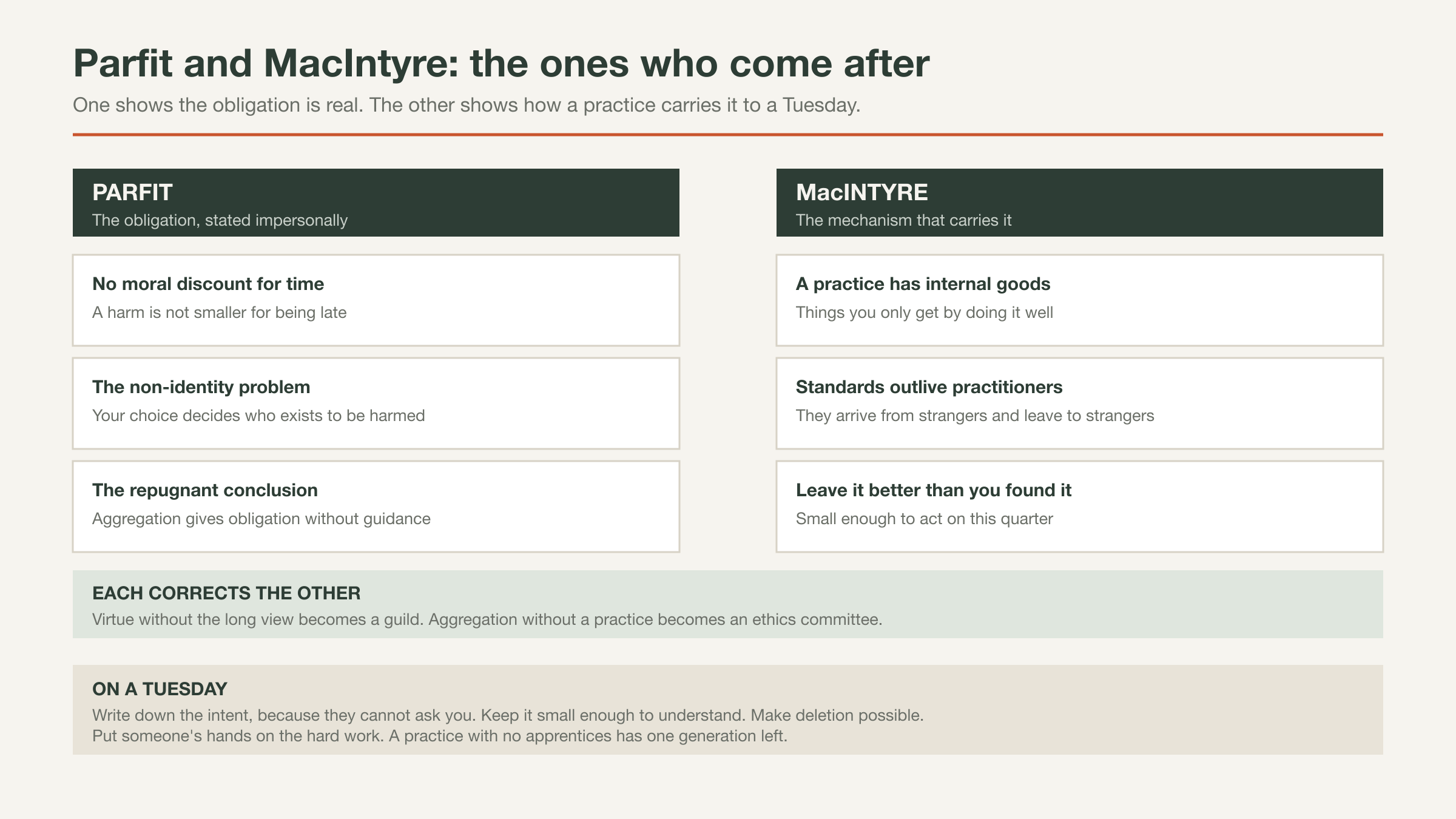
Parfit is worth reading precisely because he does not let his own side win easily. Two of his results block the obvious move of just doing the sums on future welfare.
The first is the non-identity problem. Decisions made now determine who exists later, not just how well they live, so the people who inherit a depleted world are people who would never have existed had we chosen differently. They cannot straightforwardly claim to have been harmed by the choice that made them. That is philosophically devastating. It is also immediately recognisable. The engineers who will maintain the system you are approving are people who will be hired because of it, into roles it creates. They cannot be consulted, and in an odd sense they cannot be wronged by the arrangement that summoned them.
The second is the repugnant conclusion. Aggregate welfare far enough and total utilitarianism recommends an enormous population of lives barely worth living over a smaller flourishing one, which nobody accepts and which no one has yet decisively escaped. Parfit worked at it for the rest of his life.
What this establishes is a real and slightly uncomfortable position: the obligation to the future is genuine, the temporal discount is indefensible, and impersonal aggregation will not tell you what to do. Obligation without guidance. That is where most corporate ethics statements sit. It is why they change nothing.
3. What a practice carries that a calculation cannot
MacIntyre begins After Virtue with the claim that modern moral language is fragments of an older scheme, rearranged and no longer working, so that public argument consists of incompatible assertions with no way to settle them. Anscombe had opened that line in 1958, arguing that we kept the moral ought after abandoning the framework that gave it force. MacIntyre’s constructive answer is the practice.
A practice, in his precise sense, is a coherent form of activity with goods internal to it, standards of excellence that partly define it, and a history. Medicine is one. Farming is one. Software engineering is one, on a good day. The internal goods are the ones you can only get by doing the thing well: the satisfaction of a design that holds up, a system a stranger can understand. The external goods are money, status and promotion. Those can be had by doing the thing badly. That is why practices are always under pressure from the institutions that house them.
The thing to notice for Parfit’s problem is what a practice does with time. Standards of excellence outlive every individual practitioner. They arrive from people you never met and they leave in the hands of people you will not meet, and the obligation each practitioner carries is stated in a form small enough to act on: leave the practice at least as capable as you found it. That is not a calculation about future welfare. It is a duty to a craft, and it discharges obligations to strangers that no one could ever compute.
4. Each corrects the other
Held on its own, either idea fails in a way you can watch happening in real organisations.
Virtue without the long view becomes a guild. A tradition confident in its own standards drifts into protecting the practitioners rather than the practice, and every professional body in history has done a stretch of this. MacIntyre knew it; he wrote that a living tradition is an argument extended through time, including an argument about what the tradition itself is for, and a tradition that has stopped arguing has become an interest group. Parfit’s impersonal test is the external check that keeps it honest: never mind what our standards say, who bears the cost of this and does their distance from us make it acceptable? That question comes from outside the guild, and a guild cannot generate it.
Aggregation without a practice produces the ethics committee. Real concern, sound reasoning, no transmission mechanism. No engineer whose Tuesday is changed by any of it. The gap between the two is precisely where every corporate responsibility programme I have watched has failed. The values were not wrong. There was no practice carrying them, so they lived in a document and the practice went on doing what it had always done.
5. Who is the entity that owes
Parfit has one more result that lands directly on this, and it is the one that unsettles people most. His account of personal identity is reductionist. Psychological continuity and connectedness are what carry a person forward, not some further deep fact of the self, and identity itself is not the thing to care about. Push that into an organisation and the awkwardness is obvious. The company in ten years shares almost no people, no code and possibly no market with the company now. In what sense is it the same thing, and how can it be bound by a promise this one makes?
MacIntyre’s answer is narrative. A life, and by extension an institution, is intelligible as a story with a subject who can be asked to account for it, and the continuity that matters is the continuity of the story and the practices inside it rather than of the substance. This is, I think, the more useful answer for a leader. It identifies what has to be maintained: not the entity, which will change entirely, but the practices, the standards and the people who carry them. Every departure of a senior engineer with no apprentice is a break in that continuity, and it is a bigger break than a reorganisation.
6. What it looks like on a Tuesday
The practical translation is unglamorous and it is already familiar from this series, which is the point. The obligations to people you will never meet are discharged through the ordinary standards of the craft.
Write down the intent behind a system, because the people who inherit it cannot ask you. Keep it small enough to be understood, since Ousterhout‘s complexity is a cost paid entirely by successors. Make it possible to remove things, because a system that can only accumulate, as Parnas saw, hands the next generation a problem it cannot solve. Put people’s hands on the difficult work, since Sennett‘s craftsman is made in the doing and a practice with no apprentices has one generation left. None of these requires a view about population ethics. All of them are how the far future gets served by somebody who has a sprint to finish.
The two thinkers meet on a single sentence, and it is the one worth taking away. You cannot calculate your obligations to the people who come after, and you can keep the practice they will inherit in a condition you would have been glad to receive.
Placement: Transforming, the fourth of the series’ four phases, after Learning, Deciding and Building. The capacity this phase produces is release, the willingness to let a change carry on without you and be revised by people who were not there. An obligation to inheritors is what release looks like when it is taken seriously rather than described.
(An Organisational Prompt is something you can do now....)
Organisational Prompt
Name the inheritors.
Take the largest system your teams are building this year. On one page, write who inherits it in five years: the engineers who will operate it, the team that will extend it, the customers who will depend on it, the person who will be woken at three in the morning by it.
Then write the one thing you are currently planning to leave them that you would be angry to receive from a predecessor. There is always one and everybody on the team can name it in about four seconds.
Fix that one thing this quarter, and say plainly why you are doing it. Not for the roadmap, not for the risk register, but because the people who will hold this next are owed the same standard you were owed. That sentence, said out loud by someone senior, does more for a practice than any values document ever written.
Further Reading
Derek Parfit, Reasons and Persons (1984). Part Four contains the argument on future generations, the non-identity problem and the social discount rate; Part Three is the account of personal identity that makes the ownership question so hard.
Alasdair MacIntyre, After Virtue (1981), for practices, internal and external goods, and the narrative unity of a human life.
Elizabeth Anscombe, Modern Moral Philosophy (1958), the paper that reopened virtue ethics, free at https://www.pitt.edu/~mthompso/readings/mmp.pdf.
I write about the industry and its approach in general. None of the opinions or examples in my articles necessarily relate to present or past employers. I draw on conversations with many practitioners and all views are my own.