
3 Leader Levers for Organisational Learning
A diagnostic model for three conditions, nine observable tests, and the structural reason your transformation programme produces graduates without producing learning.
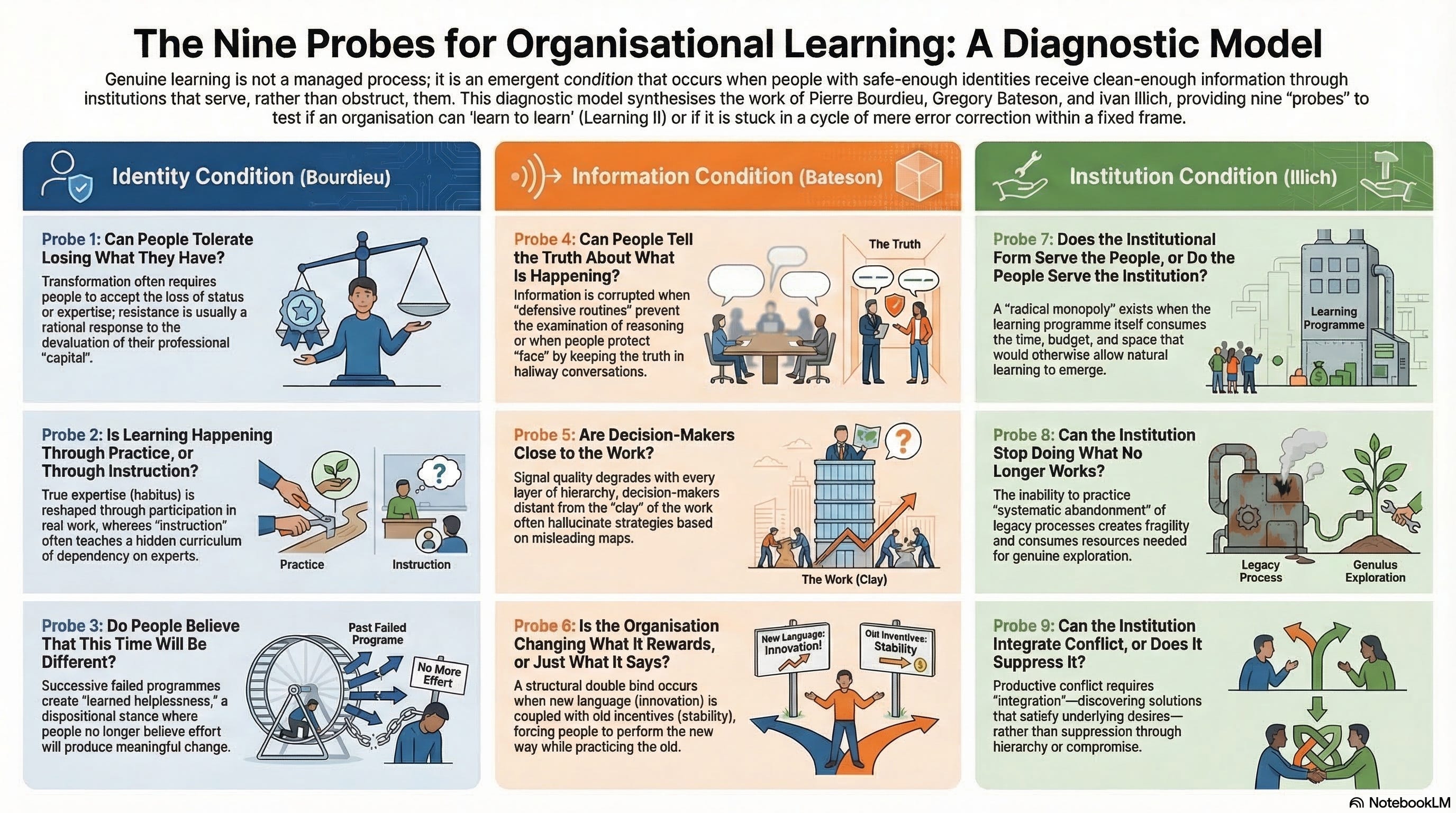
Learning is not a process. It is a condition. It is what happens when people with safe-enough identities receive clean-enough information through institutions that serve rather than obstruct them. If those conditions are absent, no process will produce learning. If those conditions are present, learning will happen with or without a programme.
Every thinker in this series has, from a different angle, diagnosed the same underlying failure: organisations are structured to prevent the learning they claim to want. They respond by designing more learning processes. More workshops. More curricula. More governance. And every additional process intervention leaves the underlying conditions untouched, because the conditions are not about what the organisation does. They are about what the organisation is: the identities people hold, the information that flows or does not, and the institutional forms that either create the space for learning or consume it.
Illich provides the deepest explanation for why the process model persists despite its consistent failure. Institutions designed to deliver a capability end up replacing that capability with the consumption of institutional services. Schools do not produce learning; they produce the need for more schooling. Learning programmes do not produce organisational capability; they produce the need for more learning programmes. The mechanism is what Illich calls the institutionalisation of values: the programme defines learning as something that requires its mediation, establishes a monopoly over what counts as legitimate learning, and creates dependency. The team learning through practice on a real problem outside the programme is, within the programme’s framework, not learning at all: their activity is not tracked, not measured, not credited. The programme has made genuine learning invisible by defining learning as something that requires the programme.
This article synthesises the series into a single diagnostic model. It identifies three conditions for learning, each governed by a thinker whose work illuminates why the condition is so difficult to create:
Identity must be safe enough to change. Pierre Bourdieu provides the theory: habitus, capital, and the embodied dispositions that reproduce the old world below conscious awareness.
Information must be clean enough to act on. Gregory Bateson provides the theory: the double bind, logical types, and the communicative pathologies that prevent organisations from hearing what they need to hear.
The institutional form must be convivial enough to permit learning. Ivan Illich provides the theory: the confusion of process and substance, radical monopoly, the hidden curriculum, and the distinction between institutions that serve human purposes and institutions that replace them.
For each condition, three probes test whether it is present. A probe is not a metric. It is a question you can answer by going and looking. If the condition is present, the probes will tell you. If it is absent, the probes will show you where to look for the obstruction.
These three governing thinkers share a quality that makes them honest rather than comfortable. They are all pessimistic about the possibility of deliberate control. Bourdieu: your dispositions reproduce the old world before you are aware of it. Bateson: the communicative traps operate at logical levels you cannot access from within. Illich: the institutions you build to create learning will replace learning with the consumption of their own services. The other thinkers in each cluster provide the practices that make action possible despite these constraints. The framework says: this is harder than you think. Then it says: here is what you can do anyway.
Before the management scholars object: yes, this synthesis compresses decades of research into a practitioner framework, and the governing thinkers themselves would resist the categorisation. Illich would warn that the framework itself could become the kind of manipulative institution his work diagnoses. Bourdieu would insist that the barriers are more deeply embodied than any framework can capture. Bateson would note that the framework could become a logical-type error of the kind his work identifies. These objections are valid. What follows is offered not as the final word but as a working tool: a set of lenses that can be refined through use.
The Governing Hypothesis
Learning is a condition, not a process. It emerges when three conditions are met: identity is safe enough to change, information is clean enough to act on, and the institutional form is convivial enough to permit learning. The leader’s role is not to design or manage learning but to create and protect these conditions.
This rejects the standard transformation model where leaders design a learning programme and deliver it to staff. It also rejects the more progressive model where leaders “learn from their people” and “teach the new ways.” Both frames treat learning as something transferred between parties through a channel. The channel metaphor is the problem. Learning is not content that travels along a pipe. It is what the pattern of interaction produces when the conditions allow it.
Follett saw this a century ago. Her concept of circular response, where each party’s behaviour continuously reshapes the other’s, and her insistence that the group produces ideas that no individual could generate alone, describe learning as an emergent property of interaction, not a transfer between individuals.
Bateson provides the deepest theoretical foundation. His hierarchy of learning levels, from Learning I (correcting errors within a fixed frame) through Learning II (learning to learn, changing the frame itself) to the rare Learning III (transforming the identity of the learner), maps the territory this article covers. Most organisations operate permanently at Learning I: they correct errors without questioning the governing assumptions. The nine probes that follow are, collectively, a diagnostic for whether your organisation has the conditions for Learning II. They test whether the organisation can learn to learn.
The Identity Condition
Identity must be safe enough to change
Identity is the deepest condition. It concerns who people are, what they are worth in the field, and whether their embodied dispositions can shift. Bourdieu’s concept of habitus, the system of durable, transposable dispositions acquired through lived experience, explains why this condition is the most difficult to create. You do not choose your habitus. It is deposited in you through years of participation in a particular field: the instinctive deference to seniority, the automatic framing of problems in terms the organisation recognises, the professional reflexes that tell you what counts as good work. These are not choices. They are embodied dispositions that operate below conscious awareness.
Identity constrains everything else. If your professional capital is at stake, you will not share information that threatens it. If your habitus is calibrated to the old field, your interactions will reproduce the old patterns regardless of what the new strategy says. The condition is present when people can engage with the change without experiencing it as an existential threat to who they are and what they are worth. It is absent when people perform the new way of working while privately preserving the old.
Probe 1. Can People Tolerate Losing What They Have?
This is the probe that most transformation programmes refuse to apply. When you tell a senior professional that their role is evolving, that the skills they have spent a decade perfecting are no longer the primary source of value, you are not asking them to learn a new skill. You are asking them to accept a loss. The loss may be temporary, partial, or ultimately compensated by gains. But it is experienced as a loss, and the experience governs the response.
Bourdieu names the mechanism: hysteresis, the painful lag between a changed field and an unchanged habitus. When the rules of the game shift but your embodied dispositions remain calibrated to the old rules, the result is not discomfort. It is a crisis of capital. The professional whose cultural capital consists of a specific technical expertise faces devaluation if transformation renders that expertise secondary. Resistance to transformation is, in most cases, resistance to capital devaluation. It is entirely rational.
Giddens provides the theoretical depth. His concept of ontological security explains why resistance is disproportionate to the rational threat. Routines are not just convenient; they are psychologically necessary. Disrupting them produces existential anxiety that will express itself as resistance regardless of how compelling the business case is. Kahneman’s prospect theory explains the intensity: losses loom roughly twice as large as equivalent gains. The first steps of any change, being closest to the current reference point, produce the most acute sensitivity.
Kegan’s theory of adult development adds a dimension the other thinkers miss. The capacity to manage loss depends on the developmental stage. At the socialised mind, identity is derived from the expectations of the community; a shift in what the community values is experienced as personal identity crisis. At the self-authoring mind, the individual has an internal compass that can navigate changing expectations. Most programmes assume a self-authoring workforce. Many organisations have a predominantly socialised one.
Heifetz makes this probe actionable. People do not resist change. They resist loss. The leader’s job is not to eliminate the loss but to name it, to create the holding environment in which it can be processed, and to help people distinguish what is essential from what is expendable.
Goffman reveals how the loss is enacted socially. Transformation creates what he calls stigma: the informal labelling of those whose identity is now discredited. These labels are communicated through expressions given off: a slight pause, a glance exchanged, an invitation that does not arrive. The person whose capital has been devalued finds their contributions received differently. The colleagues who route around them are managing the interaction: including the stigmatised perspective would require everyone to adjust their performance. The result is that the people who understand most deeply what is being lost are systematically excluded from the conversations that would benefit most from their knowledge.
What to look for: Compliance without commitment. People going through the motions of the new way of working while quietly preserving the old. Passive resistance that never quite surfaces as objection. Hostility that seems disproportionate to the change being proposed. All of these are signals that the loss has not been named or addressed.
What to do: Identity transitions require three things: social support (others making the same transition), role models (people who have already made it), and narrative resources (stories that make the transition meaningful rather than diminishing). The leader must also attend to their own loss: the transition from the person who knows the answer to the person who creates the conditions for answers to emerge.
Probe 2. Is Learning Happening Through Practice, or Through Instruction?
Most organisations, when they decide to transform, create a training programme. They commission e-learning modules, hire consultants to run workshops, and build a curriculum. Then they wonder why nothing changes. This is the process fallacy in its purest form.
Habitus can only be reshaped through participation in a changed field. You cannot lecture someone into new embodied dispositions. This is not a pedagogical preference. It is a claim about what identity is and how it changes. The distinction between instruction and practice determines whether your investment in learning produces transformation or produces people who can describe transformation without being able to do it.
Illich names the deeper problem. The training programme does not merely fail to change habitus. It teaches a hidden curriculum: that learning requires a programme, that capability is certified by completion, that the organisation does not trust you to learn on your own, and that the transformation is something being done to you rather than something you are doing. This hidden curriculum directly undermines the identity condition by positioning people as recipients rather than agents.
Wenger and Lave provide the most complete account. Their concept of legitimate peripheral participation describes how expertise develops: newcomers start at the edges of a community of practice, performing simple but genuine tasks, and gradually move toward the centre as their competence grows. Learning is not something that precedes participation. It is participation. Nonaka and Takeuchi’s SECI model describes the knowledge conversion practice-based learning requires: the critical step is externalisation, making tacit knowledge explicit, which cannot be done in a classroom. It requires people working together on real problems, struggling to articulate what they know, and discovering through the struggle what they did not know they knew.
Giddens’ distinction between practical consciousness and discursive consciousness is the theoretical foundation. Transformation requires changing practical consciousness: the things people do without thinking. Training programmes change discursive consciousness: people learn to talk differently about their work. Talking differently does not mean working differently.
March’s technology of foolishness makes the case for sensible irrationality: sometimes you must act before you know your preferences, play before you are serious, and experiment without justification. Organisations that permit only rational, justified action will never discover anything their existing rationality could not predict.
What to look for: What percentage of your transformation budget is spent on training courses versus on giving people time, tools, and real problems to work on? Are people developing new capabilities through practice, or developing new vocabulary through instruction?
What to do: Stop trying to govern learning. Create the conditions for it: psychological safety, time, access to tools, proximity to real problems. Then pay attention to what emerges. The teams quietly solving real problems outside the governance framework are not insubordinate. They are the emergent strategy trying to tell you where the value is.
Probe 3. Do People Believe That This Time Will Be Different?
Learned helplessness is habitus. It is not a mood or a passing attitude. It is a sedimented disposition formed through repeated experience that effort does not produce results. Organisations with a history of failed change programmes have employees whose embodied orientation toward transformation has been shaped by each successive failure. “Change fatigue” is not fatigue. It is a dispositional stance, and it is rational.
If the identity condition requires that people feel safe enough to change, learned helplessness is the evidence that the condition has been destroyed by previous attempts to create it. Each failed transformation taught the same lesson: the process was run, the learning was mandated, and nothing changed. The condition was never present. Only the process was.
Seligman identifies the mechanism: explanatory style. A pessimistic style, permanent, pervasive, and personal, sustains helplessness. An optimistic style, temporary, specific, and external for bad events, predicts recovery. The explanatory style that dominates an organisation is cultural, reproduced in the stories people tell about previous change, in the cynicism that greets new announcements, and in the knowing looks exchanged when the latest programme is unveiled.
Bandura’s self-efficacy research provides the path to recovery. The most powerful source of belief is mastery experience: actually doing the thing and succeeding. A live demonstration where a team tackles a real problem using new methods bypasses intellectual debate. It creates the belief that the new way is possible. Csikszentmihalyi’s flow research describes the conditions under which this work becomes intrinsically engaging: clear goals, immediate feedback, and progressive challenge matched to skill.
Dweck’s research addresses the disposition directly. Organisations that celebrate talent reinforce the belief that ability is fixed, making every challenge a test. Organisations that celebrate process and effort reinforce the belief that ability is developed, making challenge an opportunity. Review what your organisation celebrates. The pattern of celebration is reshaping habitus in real time.
What to look for: Listen to the language. When people describe the transformation using the same phrases they used about the last one, learned helplessness is present. When the most talented people are not volunteering for the new work, they have made a rational calculation about where value is recognised.
What to do: Counter learned helplessness with small wins (Weick). Demonstrate through action, not argument. Find ways to make learning visible and valued before it produces measurable output. Watch for the signals: if people are engaged, curious, and arguing about how to make things better, the condition is forming. If they are filling in templates and waiting for approval, the process is running but the condition is absent.
The Information Condition
Information must be clean enough to act on
Information is the middle condition. It concerns whether accurate data can flow through the organisation, whether contradictory signals are being sent at different logical levels, and whether the organisation can distinguish its stated reality from its actual one.
Bateson’s concept of the double bind is the governing mechanism. A double bind occurs when someone receives contradictory messages at different levels of communication and cannot comment on the contradiction. “We encourage honest feedback” delivered in a meeting where honest feedback has historically produced negative consequences is a double bind. The person cannot respond to the explicit message without ignoring the implicit one, and cannot comment on the contradiction without violating the implicit message. The result is paralysis disguised as compliance.
The double bind is the link between identity and institution. It is sustained by habitus (the manager who punishes honesty does so from embodied disposition, not conscious choice) and reinforced by institutional form (the governance structure that demands both innovation and predictability). When information is dirty, it does not matter how safe identity feels or how convivial the institution is. The signals people act on are corrupted. They are navigating by a map that contradicts the landscape, and nobody can say so.
Goffman provides the micro-mechanism that maintains the double bind in daily practice. Every meeting is a performance in which participants collaborate to maintain a shared definition of the situation. The formal meeting is the front stage. The hallway conversation is the back stage. The gap between the two is not a communication failure. It is the interaction order working exactly as designed. Both parties collaborate to protect each other’s face, because a face-threatening act endangers the entire interaction. Defensive routines are not unilateral. They are mutual.
The information condition is present when the formal conversation and the shadow conversation say the same thing. It is absent when people know something to be true but cannot say it without career risk.
Probe 4. Can People Tell the Truth About What Is Happening?
Argyris identified the mechanism that corrupts organisational information more precisely than anyone else in the series: defensive routines. The gap between espoused theory and theory-in-use is a double bind that Argyris described in behavioural terms and Bateson would recognise in communicative ones.
Goffman reveals why these routines are so resistant to intervention. Training individuals in Model II behaviour works in the workshop but not in the meeting, because the meeting is a different social situation with different face-work requirements. The person trained to “test their assumptions publicly” walks into a meeting where the senior leader has just presented a strategy, and the face-work calculus kicks in: testing the assumption would threaten the leader’s face, disrupt the shared definition of the situation, and require every participant to adjust their performance. The trained behaviour collapses under the weight of the interaction order. This is why “create openness” interventions consistently fail. The safe-space announcement is itself a front-stage performance.
Schön added the concept of frame reflection: the capacity to surface the tacit frames through which parties construct their understanding. Most undiscussables are not facts that people are hiding. They are frames that people do not realise they hold. The leader who frames every initiative as cost-reduction and the practitioner who frames it as a threat to craft are not lying. They are operating within different frames that make different conclusions inevitable. Until both frames are surfaced, the disagreement is unintelligible to both parties.
At the organisational level, Westrum’s typology classifies information architectures. In pathological cultures, messengers are punished. In bureaucratic cultures, they are channelled into mechanisms designed to slow information. Only in generative cultures does information flow to where it is needed. Edmondson’s psychological safety provides the floor, with the critical caveat that safety without high standards produces comfort, not learning. Deming cuts through the abstraction: most variation is common cause, produced by the system. Blaming individuals for systemic failures teaches people to hide information about how the system works.
What to look for: The gap between what is said in formal meetings and what is said in hallway conversations. That gap is the double bind made visible. Pay particular attention to the voices from below.
What to do: Name the double bind explicitly. “I notice that we say we want honest feedback but the last person who gave it was sidelined. That contradiction is a problem I want to address.” Naming the contradiction is the first step to dissolving it, because the double bind’s power depends on the prohibition against naming.
Probe 5. Are Decision-Makers Close to the Work?
Information degrades with distance. Every layer of hierarchy between the person deciding and the person doing is a reduction in signal quality.
Drucker’s insight is foundational: the knowledge worker must define the task. The person defining the task must be intimate with the domain. Peters translated this into Management by Walking Around: the only way to know what is going on is to go and see. Mintzberg’s research supports this: the strategist who is not touching the clay is hallucinating a strategy.
Normann’s map-landscape dialectic reveals the deepest version. Leaders distant from the work are not merely missing details. They are carrying a map that makes the real landscape invisible. Kahneman’s WYSIATI amplifies this: the coherent narrative constructed from the distant vantage point suppresses awareness of what the leader does not know.
The double bind operates here too: “We trust our teams” delivered through a governance structure requiring five layers of approval. The team receives two messages: you are trusted, and you are not trusted.
What to look for: Count the layers between the person making the transformation decision and the person doing the work. If the people designing the transformation have never done the work it changes, the quality of their decisions is structurally limited.
What to do: Cancel the steering committee. Go and watch people work. Sit with a team as they tackle a real problem. The information you need cannot travel upward through the hierarchy. You must go and get it.
Probe 6. Is the Organisation Changing What It Rewards, or Just What It Says?
This is the structural double bind: contradictory messages encoded in the institution itself. “We value innovation” (signification) while promoting those who maintain stability (legitimation) while funding the old programmes (domination). Giddens’ three dimensions of structuration must move together. When they do not, the organisation is a double bind made structural.
This is where the information condition and the identity condition meet. The habitus formed around the old reward structure generates the information pathology. People do not merely observe that the old behaviour is rewarded. Their embodied dispositions produce the old behaviour before the question of reward even arises. Weber explains the persistence: bureaucratic rationality is not a surface feature but the constitutive logic of modern institutions.
Senge’s systems thinking reveals the dynamic: the feedback loops sustaining the current structure are faster and stronger than those supporting change. Transformation often follows initial enthusiasm followed by regression: the reinforcing loops of early success are overwhelmed by the balancing loops of structural reproduction.
What to look for: Examine the last three promotions. What was actually rewarded? Examine the last three performance reviews. What was measured? Examine budget allocation. Where did the money go? These reveal the theory-in-use, regardless of the strategy deck.
What to do: You cannot change the culture by talking about culture. You change it by changing the practices: the meetings, the metrics, the promotion criteria, the budget allocation, the definition of “done.” Heifetz names the discipline: distinguish the technical work (changing the policy) from the adaptive work (changing what people value). Both are necessary. Neither alone is sufficient.
The Institutional Condition
The institutional form must be convivial enough to permit learning
Institution is the surface condition: the one the leader can most directly shape. It concerns the formal and informal structures that mediate between people and their activity. These structures either create the space from which learning emerges or consume it.
Illich’s foundational observation is that institutions designed to deliver a human capability end up replacing that capability with the consumption of institutional services. The mechanism operates in three stages. First, the institution defines the activity as requiring professional mediation: you cannot learn without a training programme. Second, the institution establishes a monopoly over delivery: learning outside the programme is not recognised. Third, the institution creates dependency: people come to believe they cannot learn without the programme. When the monopoly is complete, Illich calls it a radical monopoly: not a monopoly over competing products but a monopoly over the conditions of the activity itself.
The programme also teaches a hidden curriculum: that learning requires a programme, that capability is certified by completion, that the organisation does not trust you to learn on your own. This hidden curriculum reshapes habitus: people do not merely learn the content; they learn the dispositions the institution requires.
When the institutional response to a problem makes the problem worse, Illich calls it iatrogenesis. Clinical iatrogenesis: direct harm (governance overhead, the delay the approval process adds). Social iatrogenesis: the redefinition of normal capability as requiring institutional mediation (informal competence reclassified as “untrained”). Cultural iatrogenesis: the destruction of the capacity for autonomous action (professionals who cannot imagine learning without a programme). Each level deepens the next. The cascade is self-reinforcing.
Illich’s diagnostic distinction is between convivial and manipulative institutions. A convivial institution provides resources people can use according to their own purposes: tools, time, access to problems, access to people who know things. A manipulative institution prescribes the content, controls the sequence, measures the consumption, and produces the credential. The institutional condition is present when the structures serve the people. It is absent when the people serve the structures.
Probe 7. Does the Institutional Form Serve the People, or Do the People Serve the Institution?
This is Illich’s convivial/manipulative test applied to every element of the transformation. The programme measures completion rates, certification numbers, training hours: all measures of process consumption. None measure capability development. The teams that completed the modules can describe techniques in the language the platform provided. The teams that have been quietly using AI to solve real problems for months are uncertified. Within the programme’s logic, they are untrained. The programme has confused its own activity with the outcome it was designed to produce.
Radical monopoly deepens the diagnostic. The programme has reshaped the environment so that the outcome cannot be produced without it. The certification requirement prevents experimentation. The budget starves informal learning. The governance fills meeting agendas with programme management rather than problem-solving. The conditions under which learning would emerge naturally have been consumed by the programme.
Stacey’s gesture concept operates here. In a convivial institution, people make gestures and attend to the responses. In a manipulative institution, the institution makes gestures on people’s behalf and channels the responses through governance rather than letting them be experienced directly.
Goffman explains the stability. The governance structures are front-stage performances that produce impression-managed information. The leader who relies on governance for information about whether learning is happening is watching the performance and mistaking it for reality.
Peters provides the emotional dimension. The twelve-month analysis process is the performance of diligence while systematically preventing the only activity that produces understanding. Weick’s sensemaking is retrospective: waiting for understanding before acting gets the sequence backwards.
Schön names the mechanism: reflection-in-action. The practitioner engages in a reflective conversation with the situation, adjusting as the material talks back. The specification is not a document you write before work begins. It is an ongoing dialogue between intent and emergence.
What to look for: Apply Illich’s test to every element. Does this element provide resources for learning (tools, time, real problems), or prescribe and control learning (modules, sequences, certifications)? Count the convivial elements and the manipulative ones. The ratio reveals the institutional character. How many layers of approval stand between a team and an experiment?
What to do: Create spaces where action is permitted before understanding is complete. A real problem. A real team. A day to experiment. But Heifetz adds: the instinct to provide the answer is itself a barrier. The leader’s role is to create the space, not prescribe the action. Redirect resources from institutional infrastructure toward conditions: tools, time, real problems, mentors, protected experimentation space.
Probe 8. Can the Institution Stop Doing What No Longer Works?
Every resource devoted to preserving an activity whose purpose has expired is a resource unavailable for transformation. The inability to abandon is not a failure of nerve. It is a structural feature of institutions that have optimised for their own continuation.
Illich provides the diagnosis through iatrogenesis. At the clinical level: direct dysfunction and overhead. At the social level: informal competence reclassified as “untrained,” organic adaptation reclassified as “ungoverned.” At the cultural level: the destruction of autonomous learning capacity. Each layer of institutional response deepens the dependency and consumes resources that would otherwise be available for the conditions the institution was supposed to create.
The institution resists abandonment because it generates its own justification. It measures what it does (training delivered, milestones reached) and presents these as evidence of progress. The metrics measure institutional activity, not human capability. Asking “but can the teams actually do the work?” is treated as an attack on the programme rather than a diagnostic question.
Drucker’s systematic abandonment asks the practical question: “If we were not already doing this, would we start now?” Illich goes further: has the institution made it impossible to even imagine doing without it?
March provides the theoretical foundation. Exploitation (refining what you know) produces measurable, proximate returns. Exploration (trying something genuinely new) produces ambiguous, distant returns. The manipulative institution is an exploitation machine. Exploration is structurally prevented. Christensen’s disruption theory reveals the market consequence: incumbents fail because their proximity is to the wrong customers. Taleb adds that the inability to abandon creates fragility.
What to look for: Ask Drucker’s question about your transformation programme itself. How many activities exist solely because they were created at the start? Apply Illich’s iatrogenesis test at each level. At which level is the harm deepest?
What to do: Institute a regular abandonment review. Not what to add, but what to stop. If the programme were abolished, would the organisation be able to learn? If the answer is no, the programme has achieved radical monopoly and is itself the primary barrier. The freed capacity is where the learning condition becomes possible.
Probe 9. Can the Institution Integrate Conflict, or Does It Suppress It?
When an institutional gesture produces resistance, what does the institution do with it? Most suppress it: through hierarchy (the senior person prevails), through process (a committee resolves it), or through avoidance (acknowledged and never revisited). Each method loses the divergent signal, and the institution continues with the illusion of consensus.
Illich’s framework reveals why suppression is structural. The manipulative institution cannot permit genuine conflict about its own purpose because its continuation depends on the confusion of process with substance. If the conflict were explored, someone might ask “Is this programme actually producing learning?” Weber would call this the displacement of value rationality by means-ends rationality. Illich would call it the institutional logic working as designed.
Follett, writing a century ago, saw this with clarity. Her distinction between domination, compromise, and integration is the earliest and cleanest statement of what productive conflict looks like. Integration requires surfacing the real desires beneath the stated positions. Until both desires are visible, the only available resolution is domination or compromise. Neither produces learning.
Stacey deepens this. Legitimising dissent is not better communication technique. It is a political act requiring someone with sufficient power to make it safe for others to speak, and sufficient courage to tolerate what they say. Heifetz provides the operational discipline: the holding environment where conflict can be expressed without destroying the group. The leader regulates the temperature: too little heat and nothing changes; too much and people retreat into defensive routines.
Edmondson’s psychological safety is the floor. Without it, people will not take the interpersonal risk of expressing a divergent view. But safety alone is not sufficient. A safe team can tell each other small truths while collectively avoiding the large one.
What to look for: Watch what happens when someone disagrees in a meeting. Is the disagreement explored or managed? When the shadow conversation contradicts the formal conversation, which one changes?
What to do: Treat resistance as information. Follett’s integration requires joint study: the parties must study the situation together, not negotiate from fixed positions. The leader who responds to resistance by restating the strategy has closed the loop prematurely. The leader who responds by asking “What are you seeing that I am not?” has opened it.
How the Conditions Compound
The three conditions are not independent. They form a directional hierarchy: identity constrains information constrains interaction. But the causation runs the other way for intervention: interaction is where the leader acts, and sustained change in interaction patterns changes information flow, which over time changes identity.
Identity constrains information. If your professional capital is at stake, you will not share information that threatens it. The senior architect whose identity is built around system design will not surface data suggesting specification-writing is more valuable. Not because they are dishonest, but because their habitus filters the information before it reaches conscious awareness. They literally do not see what threatens their capital.
Information constrains interaction. If the organisation is saturated with double binds, the institutional response will be manipulative, because the institution cannot resolve contradictions it cannot name. It adds governance to manage contradictions rather than dissolving them. Every unresolved double bind generates institutional complexity: another committee, another reporting line. Illich’s iatrogenic cascade operates here: the institutional response to the information pathology deepens the information pathology.
But interaction is where the leader acts. You do not reshape identity directly. You do not resolve double binds directly. You shape institutional form. And sustained institutional change, if genuinely convivial, reshapes information flow (because convivial institutions do not produce double binds), which over time reshapes identity (because people participating in a convivial institution develop different habitus from those trapped in a manipulative one). The conversion from manipulative to convivial is the leader’s primary institutional act.
This is why transformation takes so long and why it so often fails. Institutional form can change relatively quickly. Information environments change slowly. Identity structures change very slowly. A transformation that changes only institutional form will feel productive but will not persist if the information and identity conditions remain unchanged. One that addresses all three simultaneously has a chance.
It also explains why learning programmes fail. They are manipulative institutions applied to a condition problem. If the conditions are absent, the process runs and nothing changes. If the conditions are present, the process is unnecessary. Illich goes further: the programme does not merely fail to produce the condition. It actively prevents it from emerging, by establishing a radical monopoly over the definition of learning.
Ackoff would insist: these barriers constitute a mess, not a collection of problems. A mess is a system of problems that cannot be solved individually. Addressing one probe while leaving the others untouched produces the appearance of progress within a system that has not actually changed.
Bringing It All Together
The leader’s role is to shape the institutional form so that it creates rather than consumes the conditions for learning. This is not institutional design in the conventional sense. Stacey’s warning applies: there is no position outside the institution from which to design it. What the leader can do is participate skilfully: noticing which conditions are absent, making gestures that create the missing condition, and having the courage to not know in advance what will emerge.
Heifetz operationalises this as the oscillation between the balcony, where patterns become visible, and the dance floor, where they are lived. Normann adds the conceptual dimension: question whether the map itself is correct. Kahneman warns that the leader’s own biases will make all of this harder than it sounds: System 1 will generate a coherent narrative, confidence will feel like evidence, and the losses entailed by change will loom larger than the gains.
Bateson provides the deepest frame. Most organisations operate at Learning I. The nine probes are a diagnostic for the conditions required for Learning II: learning to learn, changing the framework itself. This is where real transformation occurs. It is also where anxiety is highest, because the framework being questioned is the one that provides the organisation’s identity, coherence, and sense of purpose.
Bourdieu explains why this is so hard. The framework is not just an intellectual structure. It is inscribed in bodies, reflexes, and taken-for-granted assumptions. Changing it requires changing habitus, and habitus changes only through sustained practice in a changed field. There are no shortcuts.
Illich provides the pivot between diagnosis and action. His framework explains why the institutional response to the difficulty of learning, building a learning programme, reliably makes things worse. The leader who understands this will stop asking “How do I design a better learning programme?” and start asking “How do I create the conditions from which learning emerges, and then get out of the way?” The practical test is the convivial/manipulative distinction: for every element of the institutional form, ask whether it provides resources for self-directed activity or prescribes, controls, and credentials. Redirect from the manipulative toward the convivial. Protect the teams already learning outside the programme. Make informal learning visible and valued.
The probes are not specific to any particular transformation. They are the conditions for any organisational learning. What makes them urgent now is that the cost of not having them has become impossible to ignore. Organisations where the condition is present will adapt with intention, craft, and responsiveness. Organisations where it is absent will absorb the tools while preserving the structures, capture the terminology while avoiding the transformation, and emerge essentially unchanged.
The barriers are not new. They were diagnosed decades ago. What is new is the cost of leaving them in place.
Further Reading
Pierre Bourdieu, The Logic of Practice (1990). Bourdieu and Wacquant, An Invitation to Reflexive Sociology (1992) is more accessible. Bourdieu, The Forms of Capital (1986) is freely available.
Gregory Bateson, Steps to an Ecology of Mind (1972). The essays on learning levels and the double bind.
Ivan Illich, Deschooling Society (1971). Freely available as PDF. Tools for Conviviality (1973) develops the convivial/manipulative distinction.
Chris Argyris, Overcoming Organizational Defenses (1990). Erving Goffman, The Presentation of Self in Everyday Life (1959). Karl Weick, Sensemaking in Organizations (1995). Mary Parker Follett, Creative Experience (1924). Freely available. Ronald Heifetz, The Practice of Adaptive Leadership (2009). Ralph Stacey, Complex Responsive Processes in Organizations (2010). Russell Ackoff, Ackoff’s Best (1999).
I write about the industry and its approach in general. None of the opinions or examples in my articles necessarily relate to present or past employers. I draw on conversations with many practitioners and all views are my own.