
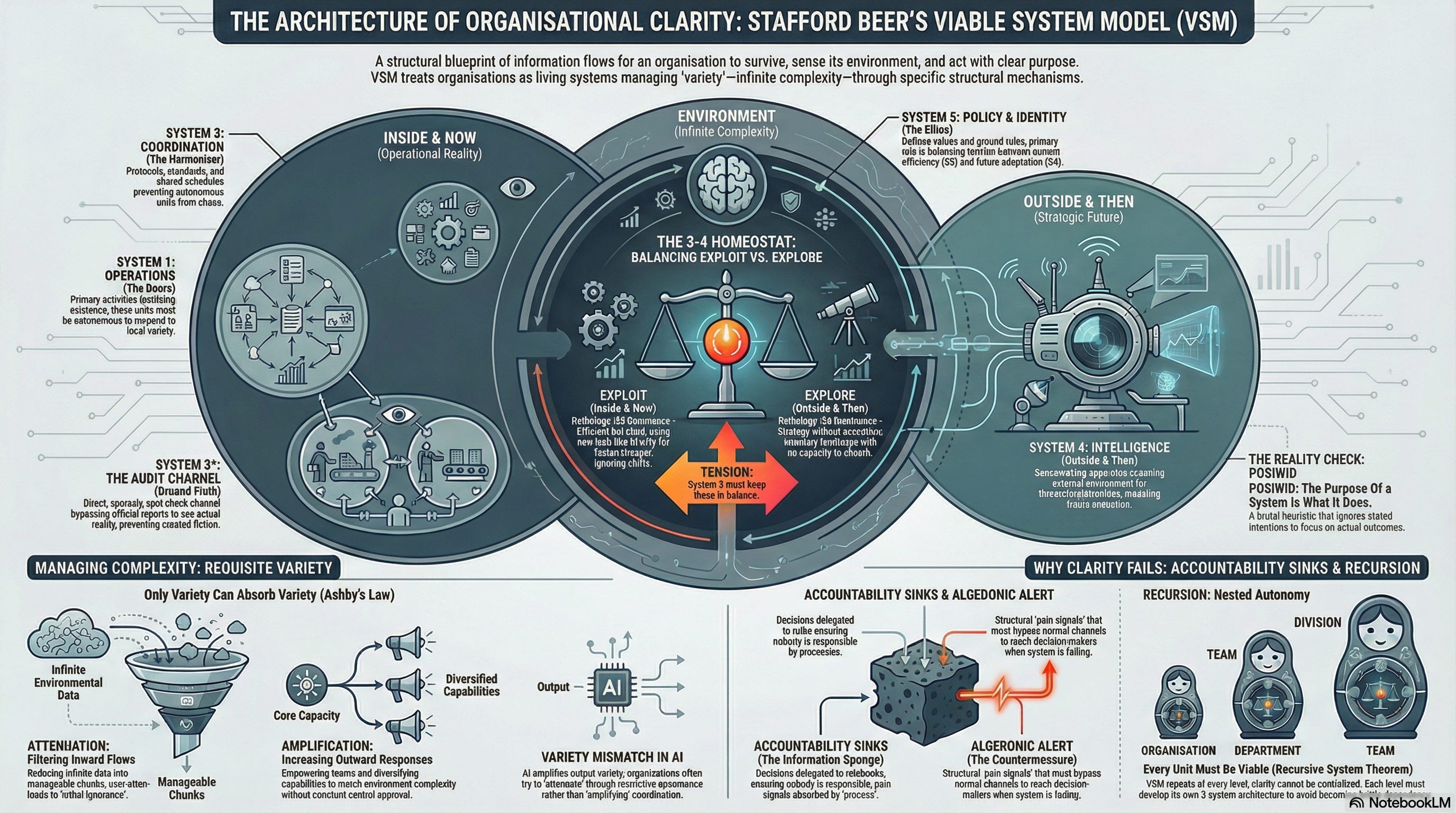
A quick recap: Deciding of this series rests on three levers, the same three Learning ran on, now applied to a different object. In Learning, the object was the organisation’s capacity to learn. In Deciding, the object is the domain’s capacity to be understood, described, and structured so that decisions can be made. Simon is the foundational thinker for the Identity lever: bounded rationality constrains what is available to the decision-maker, just as Bourdieu’s habitus constrains what is available to the learner. Evans is the foundational thinker for the Information lever: the precision and pathology of domain description determines what can be specified, just as Bateson’s double bind determines what can be communicated. The third lever is Interaction: how the parts of a system relate to each other, and whether those relationships produce viable decisions or merely the appearance of them.
In Learning, Illich held Interaction. His critique was devastating and precise: institutions designed to serve a purpose tend, over time, to replace the interaction they were meant to enable. The school prevents learning. The hospital prevents health. The training programme prevents development. The structure colonises the activity. Illich diagnosed the pathology. He did not provide the architectural alternative.
Stafford Beer does. His Viable System Model is a testable structural claim about the information flows that any system requires to remain viable in a changing environment. Where Illich shows you what institutional pathology looks like, Beer shows you what healthy interaction requires. Where Simon tells you that decisions are bounded and Evans tells you that descriptions must be precise, Beer tells you that neither constraint matters if the architecture through which decisions flow cannot process the variety the environment presents. You can have brilliant, well-bounded decision-makers working from precise domain models, and the system will still fail if the interaction between its parts cannot absorb what the environment throws at it.
Beer spent four decades building this argument. He began in operations research at United Steel in the 1950s, installed one of the first computers dedicated to management cybernetics, co-founded SIGMA consultancy, led the extraordinary (although ill-fated) Project Cybersyn in Allende’s Chile, and held positions at nearly thirty universities worldwide. His key works span from Cybernetics and Management (1959) through Brain of the Firm (1972) and The Heart of Enterprise (1979) to Diagnosing the System for Organizations (1985). His motto was “absolutum obsoletum”: if it works, it is out of date. He meant it as a cybernetic principle, not a joke.
1. POSIWID: The Design Constraint That Collapses Intent into Function
Beer’s most famous contribution is a heuristic: POSIWID, the Purpose Of a System Is What It Does. In Learning, this served as a diagnostic for spotting the gap between what organisations say they do and what they actually do. Applied to Deciding, it becomes something harder: a design constraint on decision architecture itself.
Deciding hypothesis is that decisions are design challenges, and design is a sequence of decisions under constraint. POSIWID is the constraint that collapses the distinction between intended and actual design. You do not evaluate a decision architecture by its stated intent. You evaluate it by the decisions it actually produces. If your AI governance board was designed to enable responsible adoption and it actually produces delay, then delay is its purpose. The design has produced exactly the interaction it was structured to produce. This is not a failure of the people involved. It is a feature of the architecture.
The connection to Anscombe is direct. Her test of intentional action asks whether the people involved can trace the “Why?” chain from what they are doing to what the organisation is trying to achieve. POSIWID asks the same question of the system. Under which description is the governance board’s activity intentional? The members can trace their “Why?” chain to “because the process requires review before deployment.” That is a genuine reason connecting to a genuine purpose. The problem is that the purpose it connects to is not transformation but compliance. The compliance activity is intentional. The transformation is not. Both descriptions are true. Only one is connected to reasons the participants can articulate. Beer and Anscombe, from entirely different traditions, converge on the same insight: look at what the system does, not what it says.
This reframes the leader’s task. The question is not “why are we making bad decisions?” as though the participants are deficient. The question is “what interaction has this architecture been designed to produce?” Because the architecture is producing precisely the decisions it was built to produce. Changing the decisions means redesigning the interaction.
2. Requisite Variety: Why Your Decision Architecture Cannot Process What It Needs
Beer built his entire framework on a single law from cybernetics, formulated by W. Ross Ashby: only variety can absorb variety. A system that must respond to a complex environment needs at least as much internal variety (possible states, possible responses) as the environment presents. A thermostat works because two states match the two states that matter. An organisation’s environment has effectively infinite variety: customers, competitors, regulators, technologies, economic shifts, and social changes generate more possible states than any management system can enumerate, let alone process.
Organisations manage the gap through two mechanisms: attenuation (reducing incoming variety by filtering, summarising, categorising) and amplification (increasing outgoing variety by empowering local responses, diversifying capabilities, broadening the repertoire of action). Every report that compresses a hundred data points into three RAG ratings is attenuation. Every team empowered to respond to local conditions without seeking approval is amplification. Both are necessary. The pathology is in the ratio.
Most organisations are far better at attenuation than amplification. They filter, summarise, aggregate, and simplify until the information reaching decision-makers bears almost no resemblance to the reality on the ground. Beer’s warning is blunt: “the lethal variety attenuator is sheer ignorance.” Every decision about what to measure is implicitly a decision about what not to measure, and therefore a decision about what environmental variety to ignore. When the AI transformation dashboard shows “87% of staff have completed AI training,” it has attenuated away the only information that matters: whether anyone’s actual work has changed.
For Deciding, this is not merely an observation about information processing. It is a constraint on the quality of decisions the organisation can make. Simon’s bounded rationality is cognitive: the decision-maker cannot process everything. Beer’s requisite variety is structural: the architecture must be designed so that what reaches the decision-maker is worth processing. These are different constraints operating at different levels, and both must be met. An organisation can have the most rational, least biased decision-makers in the industry and still fail because the architecture feeding them information has attenuated the variety to the point where the decisions, however rational, are answers to the wrong questions.
The AI context makes this acute. AI massively amplifies the variety of possible outputs from any given input. A single specification can generate dozens of possible implementations. A single prompt can produce analyses that would have taken a team weeks. The organisation’s existing decision architecture, its review processes, approval chains, quality gates, was calibrated for human-speed, human-variety work. AI introduces variety that exceeds the requisite variety of the existing control systems. The typical organisational response is to attenuate: restrict approved models, constrain outputs to approved patterns, limit use cases to the familiar. This reduces AI’s value to fit the organisation’s existing variety capacity. Beer would argue the viable response is the opposite: amplify organisational variety through new coordination mechanisms, new forms of local autonomy, new channels for information flow, so the decision architecture can match what AI makes possible. Attenuation is the reflex. Amplification is the design challenge.
3. The Viable System Model: An Architecture for Decision Interaction
The VSM describes five interacting systems required for viability. Beer derived them not from management theory but from the architecture of the brain and nervous system. This is not metaphor. Beer claimed, and spent decades defending, the position that the structural requirements of any viable system are isomorphic: the same cybernetic description applies regardless of the substrate. The claim is strong, and it is testable, which is more than can be said for most management frameworks.
System 1: Operations. The primary activities that produce value. Multiple operational units, each interacting with its own portion of the environment. Each System 1 unit is itself a viable system; this is recursion, which I will return to. The critical principle: operational units must be as autonomous as possible. This is not a management philosophy. It is a cybernetic requirement. Without autonomy, the system lacks the variety to match its local environment. Beer characterised each System 1 through a triple vector: actuality (what we manage to do now), capability (what we could do with existing resources if we really worked at it), and potentiality (what we ought to be doing by developing resources and removing constraints). From these he derived three measures: productivity is actuality divided by capability; latency is capability divided by potentiality; performance is actuality divided by potentiality. Most organisations obsess over productivity and ignore latency entirely. The gap between what you could do and what you ought to be doing is invisible because nobody is measuring it. System 4’s job, as we will see, is essentially to realise potentiality. But it can only do this if someone has named the gap.
System 2: Coordination. The mechanisms that prevent autonomous operational units from shaking the system apart through oscillation and conflict. Shared schedules, communication protocols, standards, resource-sharing agreements. System 2 does not command; it harmonises. The conductor’s timekeeping function: it does not tell the musicians what to play, but it prevents them from playing at different tempos. Without System 2, autonomous teams generate chaos. With too much of it, autonomy is crushed and variety is destroyed.
System 3: Optimisation. The function that looks across the entire cluster of operational units from above and asks: how can the whole work better than the parts in isolation? System 3 allocates resources, establishes what Beer called the resource bargain (operational units perform in exchange for resources), and ensures synergies across operations. System 3 is concerned with the inside and now. System 3* is the audit channel: direct, sporadic access to what is actually happening on the ground, bypassing the normal reporting hierarchy. Without System 3*, the meta-system operates on curated information and cannot know its own reality. This is Argyris’s “making the undiscussable discussable” rendered as information architecture.
System 4: Intelligence. The function that scans the external environment for threats and opportunities and models possible futures. System 4 is concerned with the outside and then. It maintains a model of the environment with sufficient variety to detect relevant change. Its job is to close the gap between capability and potentiality by sensing what the environment will demand next. Evans’s knowledge crunching, the iterative dialogue between developers and domain experts that produces the domain model, is a System 4 activity: it builds the organisation’s model of the domain with enough precision to act on. When System 4 is weak, the organisation makes decisions based on a model of an environment that no longer exists.
System 5: Policy and Identity. The function that defines what the organisation is: its values, its ethos, its ground rules. System 5 is not management. It is identity. Its most critical role is balancing the tension between System 3 and System 4. “Rules come from System 5,” Beer wrote, “not so much by stating them firmly, as by creating a corporate ethos, an atmosphere.” Without System 5, the organisation fragments: Systems 3 and 4 pull in opposite directions, one demanding efficiency and the other demanding adaptation, with no mechanism for resolution.
The parallels to the other foundational thinkers of Deciding are structural, not decorative. Simon’s nearly decomposable systems are Beer’s recursive System 1 units: semi-autonomous subsystems with strong internal interactions and weaker inter-system links. The architecture of complexity that Simon described in 1962 is the architecture that Beer operationalised. Evans’s bounded contexts are Beer’s System 1 units seen from the domain modelling perspective: each has its own ubiquitous language, its own model, its own boundary. When Evans says a bounded context needs explicit interfaces to its neighbours, Beer says System 2 must coordinate the interaction between System 1 units. They are describing the same structural requirement in different professional vocabularies.
4. The 3-4 Homeostat: How Organisations Decide What to Decide
The most useful diagnostic in the VSM for deciding is the balance between System 3 and System 4: the homeostat between inside-and-now and outside-and-then. This is not the exploit/explore tension that every strategy textbook recites. It is the mechanism that governs how organisations decide what to decide.
System 3 decides within the current model. It optimises, allocates, improves. Its questions are operational: how do we do what we are doing better, faster, cheaper? System 4 decides whether the model itself needs changing. It scans, senses, models futures. Its question is strategic in the deepest sense: should we be doing something different entirely?
When System 3 dominates, the organisation makes decisions that optimise the present. AI is used to do current work faster; the Taylorist path, in which the technology serves the existing paradigm. The decision architecture is efficient but blind to environmental change. When System 4 dominates, the organisation generates strategic possibilities it cannot implement. The innovation lab produces brilliant prototypes. The strategy team publishes visionary roadmaps. But System 3 cannot absorb them because it is fully occupied managing today. The result is strategy without execution: a familiar pathology in enterprises that run AI centres of excellence detached from the teams doing the work.
Beer’s architecture requires System 5 to hold this tension without collapsing into either pole. Some teams exploit. Others explore. The identity accommodates both. This is the structural expression of what Ackoff called dissolving a problem: rather than choosing between exploit and explore, you redesign the system so the tension is maintained as a permanent, productive feature. The viable system does not decide between present and future. It maintains the interaction between them.
For AI, the 3-4 homeostat is the strategic diagnostic. Ask: is your organisation’s AI effort dominated by System 3 (making current processes faster) or System 4 (sensing how AI changes what is possible)? If the answer is overwhelmingly System 3, you are optimising your way into irrelevance. If the answer is overwhelmingly System 4, you are strategising your way into impotence. The decision about what to decide, whether to invest in optimisation or exploration, is itself a decision that requires System 5 to hold.
5. Accountability Sinks: How Decision Architecture Absorbs Its Own Feedback
Dan Davies, in The Unaccountability Machine (2024), revived Beer’s ideas for a contemporary audience by naming the mechanism through which organisations destroy the feedback their decision architecture requires. He called them accountability sinks: systems in which decisions are delegated to processes, rule books, or committees, making it impossible to identify who is responsible for outcomes.
Beer anticipated the principle: “Unless conscious steps are taken to prevent it, any organisation in a modern industrial society will tend to restructure itself so as to reduce the amount of personal responsibility attributable to its actions. This tendency will continue until crisis results.”
Accountability sinks absorb variety the way a sponge absorbs water. The feedback that would tell the organisation what is really happening, the pain signal that would force a decision, the clarity that would demand action: all of it is absorbed by the process. Nobody is accountable because everyone followed the process. The AI review board approved the approach. The risk assessment was completed. The governance framework was satisfied. The outcome was a failure that nobody owns.
This is where Beer meets Bourdieu. Beer’s algedonic alerts, pain and pleasure signals that bypass normal channels to reach decision-makers, assume that people will pull the cord when something goes wrong. Bourdieu explains why they will not: the field punishes those who disrupt the doxa. Pulling the algedonic cord means saying, publicly, that the system is not working. In an organisation where the system’s purpose is to appear to work, this is a career-limiting act. The accountability sink is the cybernetic expression of misrecognition: the system’s actual purpose is concealed from its participants by the very structures that reproduce it.
Beer’s solution is architectural: design systems where pain signals escalate automatically rather than being absorbed by process. The algedonic alert is the structural countermeasure to the accountability sink. But it only works if the culture permits it, which is why Beer’s structural model, powerful as it is, requires the conditions that Westrum’s generative culture describes.
6. Recursion: Why Decision Architecture Cannot Be Centralised
The most structurally radical feature of the VSM is recursion. Every viable system contains viable systems and is contained within a viable system. The same five-system structure applies at every level. A team is a viable system within a department within a division within a corporation. This is not hierarchy. It is nested autonomy.
The implication for deciding is profound. Decision quality cannot be designed at the top and deployed downward. A team adopting AI-assisted development is a viable system that must have its own System 1 (doing the work), System 2 (coordinating internally), System 3 (optimising its own operations), System 4 (sensing its own environment), and System 5 (maintaining its own identity in relation to the change). The programme management approach, a single AI strategy deployed uniformly, violates what Beer called the Recursive System Theorem: each viable system must develop its own viability at its own level of recursion.
This is where Beer and Evans converge most directly. Evans’s insistence that each bounded context needs its own model, its own language, its own team is the domain design expression of Beer’s recursive principle. You cannot have a single enterprise domain model for the same reason you cannot have a single enterprise decision architecture: the variety at each level of recursion is different, the environment at each level is different, and the decisions that matter at each level are different. The specification that works for the payments domain will not work for the fraud domain, because they are different viable systems operating in different environments with different variety requirements. Recursion is not a metaphor for decentralisation. It is the structural law that makes decentralisation a cybernetic necessity.
7. Cybersyn: The Test That History Interrupted
Beer was not merely a theorist. In 1971, Fernando Flores invited him to apply the VSM to the management of Chile’s nationalised economy under Salvador Allende. Project Cybersyn aimed to create a real-time information network connecting approximately 500 enterprises via telex to a central computer, processing production data through economic models, and reporting variables outside normal parameters. The critical design principle: consistent with both cybernetic theory and Allende’s political commitments, the system was designed to preserve worker and enterprise autonomy, not to implement centralised control. Each enterprise remained a viable system. The network provided coordination (System 2) and intelligence (System 4) without crushing operational autonomy (System 1).
Cybersyn reached an advanced prototype stage before the Pinochet coup destroyed it in 1973. Its legacy is double-edged. It demonstrates that Beer’s ideas were not merely academic; they were implementable at national scale. It also demonstrates that a system designed for autonomy requires a political context that values autonomy. Enterprise AI transformations face an internal version of the same lesson: the information flows the transformation requires may be incompatible with the political structures that govern the organisation. The architecture can be designed. Whether the politics will permit it is a different question, and one that Beer’s model, for all its power, cannot answer on its own.
8. Beer’s Limits: Structure Is Necessary but Not Sufficient
Beer must be read with his limitations visible. His framework is structural. It tells you what information flows must exist for an organisation to be viable. It does not tell you how to navigate the politics of who benefits from the current architecture. It does not tell you how to overcome the defensive routines that distort information regardless of the channels available. It does not model habitus, ontological security, or the emotional dynamics of change. Jackson’s critique is fair: the VSM is a unitary, functionalist model that assumes shared purpose and provides no mechanism for the democratic derivation of that purpose. The question “viable for whom?” is real, and Beer does not adequately address it.
Argyris addresses what Beer cannot: the psychological mechanisms that filter and suppress information regardless of architecture. Bourdieu explains why redesigning the architecture may reproduce the old power relations in the new structure. Heifetz names the adaptive challenge that Beer’s System 5 must hold but cannot create: the willingness to redefine identity when the environment demands it. Beer provides necessary structure. Culture, psychology, and politics provide the conditions that make the structure work.
The synthesis this series points toward: Beer gives you the architecture. Without the information flows he describes, viable decisions are structurally impossible. But the architecture is not sufficient. It must be animated by the generative culture Westrum describes, the psychological safety Edmondson identifies, and the holding environment Heifetz creates. Architecture without culture is a diagram. Culture without architecture is a wish. Viability requires both.
Where this sits: Deciding, the second of the series' four phases; Learning, Deciding, Building, Transforming. Beer is the foundational thinker on Interaction in Deciding, the questions about how the parts of an organisation relate at the moment a decision is made. Building inherits POSIWID directly, because a system in production is judged by what it does rather than by what its specification claimed for it. From Deciding to Building is the bridge.
(An Organisational Prompt is something you can do now....)
Organisational Prompt
Map one stuck decision against the 3-4 homeostat.
Pick a decision about AI that has been circulating without resolution. Ask two questions. First: is this a System 3 decision (how do we do what we already do, better?) or a System 4 decision (should we be doing something different entirely?). Second: who is responsible for holding the tension between the two? If the answer is “a committee,” you have found your problem. Committees attenuate variety; they do not hold creative tension. Beer’s architecture requires a System 5 function: someone whose job is not to resolve the tension but to maintain it, ensuring the organisation neither optimises itself into blindness nor strategises itself into paralysis. If that function does not exist, create it. The decision will not unstick until the architecture permits it to move.
Further Reading
Stafford Beer: Brain of the Firm - The original statement of the Viable System Model, using the neurocybernetic metaphor. Dense but rewarding. This is where Beer makes the case that the structural requirements of a viable system are isomorphic regardless of substrate.
Stafford Beer: The Heart of Enterprise - The companion to Brain of the Firm. Develops the VSM from first principles using managerial rather than neuroscientific language. Contains the four principles, three axioms, and the formal statement of requisite variety as an organisational design constraint. The more rigorous of the two; read it if you want the architecture derived rather than illustrated.
Stafford Beer: Diagnosing the System for Organizations -The practical handbook. If you read only one Beer book, read this one. It walks you through the VSM as a diagnostic tool with worked examples. This is where POSIWID is formally stated.
Stafford Beer: Designing Freedom - The six Massey Lectures. Short, accessible, and passionately argued. Beer’s conviction that cybernetics is not about control but about liberty: the design of systems that maximise the freedom of their participants within the constraints of coherent purpose.
Dan Davies: The Unaccountability Machine - The best contemporary introduction to Beer’s ideas, applied to modern institutional failure. Davies’s concept of accountability sinks extends Beer’s framework into the question of why organisations that could know what is happening choose, structurally, not to know.
Eden Medina: Cybernetic Revolutionaries: Technology and Politics in Allende’s Chile - The definitive history of Project Cybersyn. Essential reading for anyone interested in the relationship between cybernetic architecture and political context. Medina shows both what Cybersyn achieved and the tensions between Beer’s systems thinking and the Chilean political reality.
I write about the industry and its approach in general. None of the opinions or examples in my articles necessarily relate to present or past employers. I draw on conversations with many practitioners and all views are my own.