
A senior technology leader described a steering committee where twelve leaders reviewed an AI strategy. They had data. They had options. They had a mandate from the board. They made commitments: investment in tooling, a training programme, a governance framework. What they did not do was touch the organisational structure, the incentive model, or the role definitions that would need to change for any of it to work. “We committed to everything except the thing that would actually matter,” she told me. The strategy was approved. The deep structural change it required was not.
If you have sat in that room, you know it was not a failure of information or process. It was a failure of developmental capacity. The room was full of talented professionals who could not do what the situation demanded: hold a position that contradicted the consensus, evaluate competing options against self-authored criteria, and commit to structural change that would make colleagues uncomfortable. Robert Kegan, the developmental psychologist who spent four decades at the Harvard Graduate School of Education, has the structural explanation for why. Most adults have not developed the complexity of mind that genuine decision-making requires. And most organisations are designed to make sure they never do.
1. Why Agreement Is Not Decision
Kegan’s framework, introduced earlier in this series, describes five orders of mental complexity, each representing a qualitatively different way of constructing meaning. Order 1, the Impulsive Mind, is governed by impulses and perceptions; the child is their experience. Order 2, the Imperial Mind, is governed by needs and interests; the person can reflect on impulses but is embedded in their own desires, seeing other people instrumentally. Around 6% of adults remain primarily here. Order 3, the Socialised Mind, is governed by interpersonal relationships and the expectations of valued others; the person can reflect on their own needs but is embedded in their social environment. Order 4, the Self-Authoring Mind, is governed by an internal system of values; the person can reflect on relationships and social expectations but is embedded in their own ideology. Order 5, the Self-Transforming Mind, can hold even its own value system as an object of scrutiny, seeing across multiple frames without needing to resolve them. Development moves through these orders sequentially, but it is not age-determined; adults at any age may be at different stages, and most spend significant time in transitions.
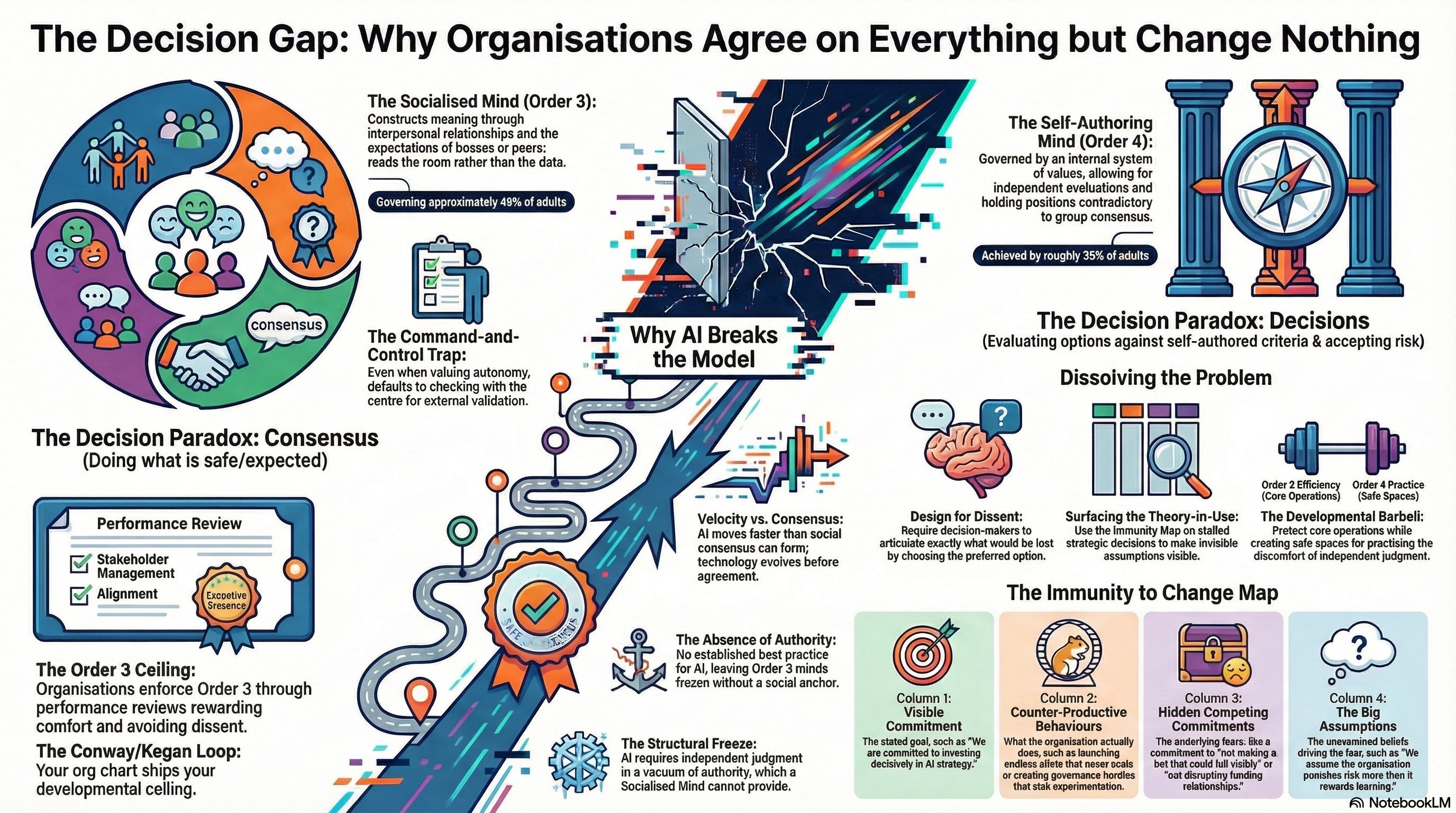
For professional decision-making, three orders matter. The Socialised Mind (Order 3) constructs meaning through the expectations of the boss, the team, the profession. Roughly 46% of adults operate here, with a further 12% below. The Self-Authoring Mind (Order 4) has an internal compass and can generate independent evaluations; approximately 35% of adults reach this stage. The Self-Transforming Mind (Order 5) can integrate contradictions and see the limits of its own framework; less than 1% of adults operate here. The critical gap: most modern professional work demands Order 4 capacity, but the majority of adults are at Order 3 or in the transition between the two.
The implication for decisions is devastating. An Order 3 professional in a strategy meeting does not make a decision. They read the mood. They detect what the senior voices favour, what the group seems to be coalescing around, what would be safest to endorse. They do this not out of cowardice but because their meaning-making is constituted by those social signals. Asking an Order 3 mind to override the consensus is not asking them to be brave. It is asking them to dismantle the structure through which they understand the world. They will not do this, and calling it a “culture problem” misses the point entirely.
A room full of Order 3 professionals produces consensus. It does not produce decisions. Decisions require someone to evaluate options against criteria they have authored themselves, to accept that reasonable people may disagree, and to commit knowing that the commitment forecloses other paths. That is Order 4 work. Most steering committees are staffed by people whose developmental capacity has not been assessed, whose meaning-making has never been examined, and whose agreement is mistaken for commitment every single week.
Simon argued that all decision-making is bounded: limited information, limited computation, limited time. Satisficing, choosing the first option that meets your criteria, is rational under these constraints. But Kegan exposes a prior constraint Simon did not name. You cannot satisfice if you cannot author your own criteria. An Order 3 professional does not satisfice; they conform. They adopt the criteria of whoever holds authority. The decision looks satisficed. It is actually socialised. And the difference matters enormously, because a socialised decision will be abandoned the moment the social signal changes.
2. The Hidden Veto: Immunity to Change in Strategic Decisions
Kegan and Lisa Laskow Lahey’s immunity map, a four-column diagnostic of why willing people fail to change, is usually applied to individual behaviour. But it works at the level of strategic decisions too, and when you apply it there, the results are uncomfortable.
Column 1: “We are committed to investing decisively in AI.” Column 2: what the organisation actually does instead. It launches pilots that never scale. It commissions studies that delay action. It creates governance processes that require so many approvals that experimentation is functionally impossible. Column 3: the hidden competing commitments. “We are also committed to not making a bet that could fail visibly.” “We are committed to not being the executive team that wasted the AI budget.” “We are committed to not disrupting the relationships with the business units that fund us.” Column 4: the big assumptions. “We assume that a visible failure will be career-ending. We assume that the organisation punishes risk more than it rewards learning. We assume that the safe path is to invest enough to show effort but not enough to produce exposure.”
These assumptions are not irrational. In most enterprises, they are empirically correct. The immunity is not a bug; it is an accurate reading of the actual incentive structure. Taleb would recognise the dynamic immediately: the organisation has designed a system that is fragile to initiative. Any individual who bets and loses is punished; any individual who delays and waits is rewarded with survival. Via negativa applies. The obstacle to decisive AI investment is not the absence of courage. It is the presence of a punishment structure that makes decisive investment irrational for any individual decision-maker. Until you remove that, no amount of strategy will produce commitment.
Boyd’s OODA loop requires something Kegan makes explicit: the capacity to destroy your existing orientation and build a new one. That is a Subject-to-Object move. The orientation that worked last year, the assumptions about what the market rewards, what customers value, what the technology can do, must become visible before it can be reconstructed. But if that orientation is Subject to the leadership team, if it is the lens through which they see rather than an object they can examine, then the “Orient” step in Boyd’s loop is blocked. The organisation cycles through Observe-Decide-Act without ever genuinely reorienting. It gets faster at doing the same thing. Boyd called this a death spiral. Kegan explains the developmental mechanism that produces it.
3. The Order 3 Organisation: How Structure Enforces the Ceiling
Organisations are not developmentally neutral. They are designed, usually without anyone noticing, to operate at a particular order of mind. Most large enterprises are Order 3 organisations. Their structures reward alignment, penalise dissent, and treat consensus as evidence of good leadership.
Consider the signals. Performance reviews evaluate “collaboration” and “stakeholder management,” which in practice mean “did you keep everyone comfortable?” Promotion criteria include “executive presence,” which often means “did you read the mood correctly and position yourself accordingly?” Strategy processes demand “alignment” before action, which means no decision survives contact with a dissenting senior leader. Every one of these signals tells the Order 3 professional: your job is to socialise, not to author. The organisation says it wants independent thinkers. Its incentive structure selects for sophisticated conformists.
Beer’s Viable System Model requires each operational unit to exercise autonomy within agreed constraints, with variety attenuated at the boundaries rather than crushed at the centre. Kegan shows why this is so hard to implement. Autonomy requires Order 4 capacity: the ability to generate independent judgments about what your unit should do, even when those judgments conflict with what the hierarchy expects. An Order 3 manager running an “autonomous” unit will default to checking with the centre before acting, not because they lack authority but because their meaning-making requires external validation before a decision feels real. The Viable System Model on paper; a command-and-control organisation in practice.
Conway showed that you ship your org chart. Kegan adds: your org chart ships your developmental ceiling. If the structure rewards Order 3 behaviour, it will produce Order 3 decisions. If it rewards Order 3 decisions, it will attract and retain Order 3 leaders. The loop is self-reinforcing. An organisation that wants better decisions must change its structure, not exhort its people.
4. What AI Makes Visible
AI adoption is not the cause of the developmental mismatch. It is the thing that makes the mismatch impossible to ignore.
Before AI, an Order 3 professional could navigate most situations by reading social cues and aligning with established practice. The existing playbook was sufficient. The pace of change was slow enough that consensus and correct action overlapped most of the time. AI breaks this. The technology changes what is possible faster than social consensus can form around what to do. By the time the team has agreed on an approach, the tools have moved on. By the time governance has approved an experiment, three better experiments have become available.
This means AI transformation systematically demands the one thing Order 3 minds cannot provide: independent judgment in the absence of established consensus. There is no established best practice for how a legal team should use large language models. There is no settled professional consensus on how AI changes the role of a software architect. There is no authority to defer to, because the authorities are as uncertain as everyone else. The Order 3 professional in this situation does not freeze from fear. They freeze from a structural inability to generate a position without a social anchor.
Kahneman showed that humans are predictably irrational, subject to biases that distort judgment. Klein showed that expert intuition compensates in high-validity environments. Kegan adds a layer beneath both: the developmental capacity that determines whether a person can even access their own judgment independently, or whether their “judgment” is actually a sophisticated recitation of what the group appears to believe. No amount of debiasing helps if the mind producing the judgment cannot operate independently of its social environment. You are not correcting bias. You are asking for a capacity that has not yet developed.
5. Growing Minds, Not Just Skills
Kegan’s most practical idea for deciding is not the DDO, which remains demanding and rare. It is the insight that development from Order 3 to Order 4, the transition from socialised to self-authoring, can be supported by specific organisational practices.
The first practice is making assumptions visible. The immunity map is the tool. Run it on a stalled decision, not on an individual’s behaviour. Surface the hidden competing commitments that prevent the leadership team from committing. Name the big assumptions. Write them on the board. The act of making them visible is itself a developmental intervention, because it takes something that was Subject (invisible, controlling) and makes it Object (examinable, testable). Argyris called this surfacing the theory-in-use. Kegan explains why the surfacing itself changes the system.
The second practice is designing for dissent. If the organisation rewards alignment, it selects for Order 3. If it structurally requires people to argue against the emerging consensus, it creates conditions for Order 4 development. This does not mean artificial devil’s advocacy. It means evaluation criteria that require decision-makers to articulate what they would lose by choosing the preferred option. It means promotion processes that reward the quality of someone’s reasoning, not the popularity of their conclusions. It means leaders who model the capacity to hold a minority position without treating it as a crisis.
The third practice is Taleb’s barbell applied to development. Protect the core operations (let the Order 3 organisation keep the lights on; it is genuinely good at this) while creating small, safe spaces where people can practise self-authoring: making independent judgments, testing them against reality, surviving the discomfort of disagreeing with people they respect. These are not innovation labs. They are developmental environments. The output is not a product. It is a more complex mind.
Ackoff would call this dissolving the problem rather than solving it. The problem is not “how do we get better decisions from our current people?” The problem dissolves when you redesign the organisation so that the conditions for developmental growth are present, and the people develop the capacity to decide. You do not solve a developmental mismatch with better decision frameworks. You dissolve it by growing the minds the frameworks require.
6. The Decision Your Organisation Has Not Made
Every organisation that undertakes a transformation is making an implicit bet about the developmental capacity of its people. Most organisations make this bet without knowing they are making it. They assume that smart people with good information will make good decisions. Kegan’s research says this assumption is structurally wrong. Smart people with good information whose meaning-making is socialised will make consensus decisions dressed up as strategic ones.
The decision your organisation has not made is whether it is willing to invest in developing the complexity of mind that genuine decision-making requires. Not training. Not workshops. Not leadership offsites with personality assessments and trust falls. Developmental work: making the invisible visible, supporting the discomfort of holding independent positions, building structures that reward self-authoring rather than sophisticated conformity.
This is the bridge between deciding and building. You cannot build what you cannot decide to build. And you cannot decide what your developmental capacity will not let you decide. The organisation that wants to build differently must first develop the capacity to choose differently. Everything else is performance.
Where this sits: Deciding, the second of four phases; Learning, Deciding, Building, Transforming. Kegan appeared first in Learning, on why an assumption stays invisible. Here the same developmental account is applied to commitment, which is what the phase actually produces: not an option paper but a choice somebody can be held to. From Deciding to Building leads to where the choice gets tested.
(An Organisational Prompt is something you can do now....)
Organisational Prompt
Surface the hidden commitment behind your stalled strategy.
Pick the AI decision your leadership team has been circling for months without committing. Write it as a Column 1 commitment: “We are committed to...” Then list what the organisation actually does instead (Column 2). Now ask: if we imagine doing the opposite of those Column 2 behaviours, what feels most dangerous? Write those fears as hidden commitments (Column 3). Finally, name the assumptions that make those hidden commitments feel necessary (Column 4). You will find that the decision is not stalled because of insufficient data or unclear strategy. It is stalled because the organisation is simultaneously committed to acting and to not bearing the consequences of action. Name the assumption. Test it. That is how the immunity breaks.
Further Reading
Robert Kegan and Lisa Laskow Lahey: Immunity to Change: How to Overcome It and Unlock the Potential in Yourself and Your Organization - The full immunity map diagnostic and the developmental theory behind it. Chapter 9, the step-by-step exercise for running your own immunity map, is freely available from Minds at Work.
Robert Kegan and Lisa Laskow Lahey: The Real Reason People Won’t Change (Harvard Business Review, November 2001). The original article introducing competing commitments. Short, sharp, and still the best entry point.
Robert Kegan and Lisa Laskow Lahey: An Everyone Culture: Becoming a Deliberately Developmental Organization - The DDO concept and the argument that organisations prosper when they align with people’s strongest motive to grow. The three case studies (Bridgewater, Next Jump, Decurion) are worth reading regardless of whether you adopt the full model.
Jennifer Garvey Berger: Changing on the Job: Developing Leaders for a Complex World - The most accessible practitioner account of Kegan’s developmental stages applied to leadership. Start here if you want application, not theory.
I write about the industry and its approach in general. None of the opinions or examples in my articles necessarily relate to present or past employers. I draw on conversations with many practitioners and all views are my own.