
Completion is ninety-four per cent and the satisfaction score is 4.6. Everybody can name the four principles, and two of them appear in the all-hands deck as evidence that the change is landing. Then a real problem arrives on a Thursday afternoon with a deadline behind it, and the old method comes out. It comes out fast, without deliberation, from people who could pass the exam on the new one.
Nothing went wrong with the training. Training did what training does, which is to change what people can say. It cannot change what they reach for under pressure, which is the only definition of capability worth having. An organisation that keeps buying instruction and wonders why the work looks the same has confused the two. It will keep buying, because instruction is cheap and legible and capability is neither.
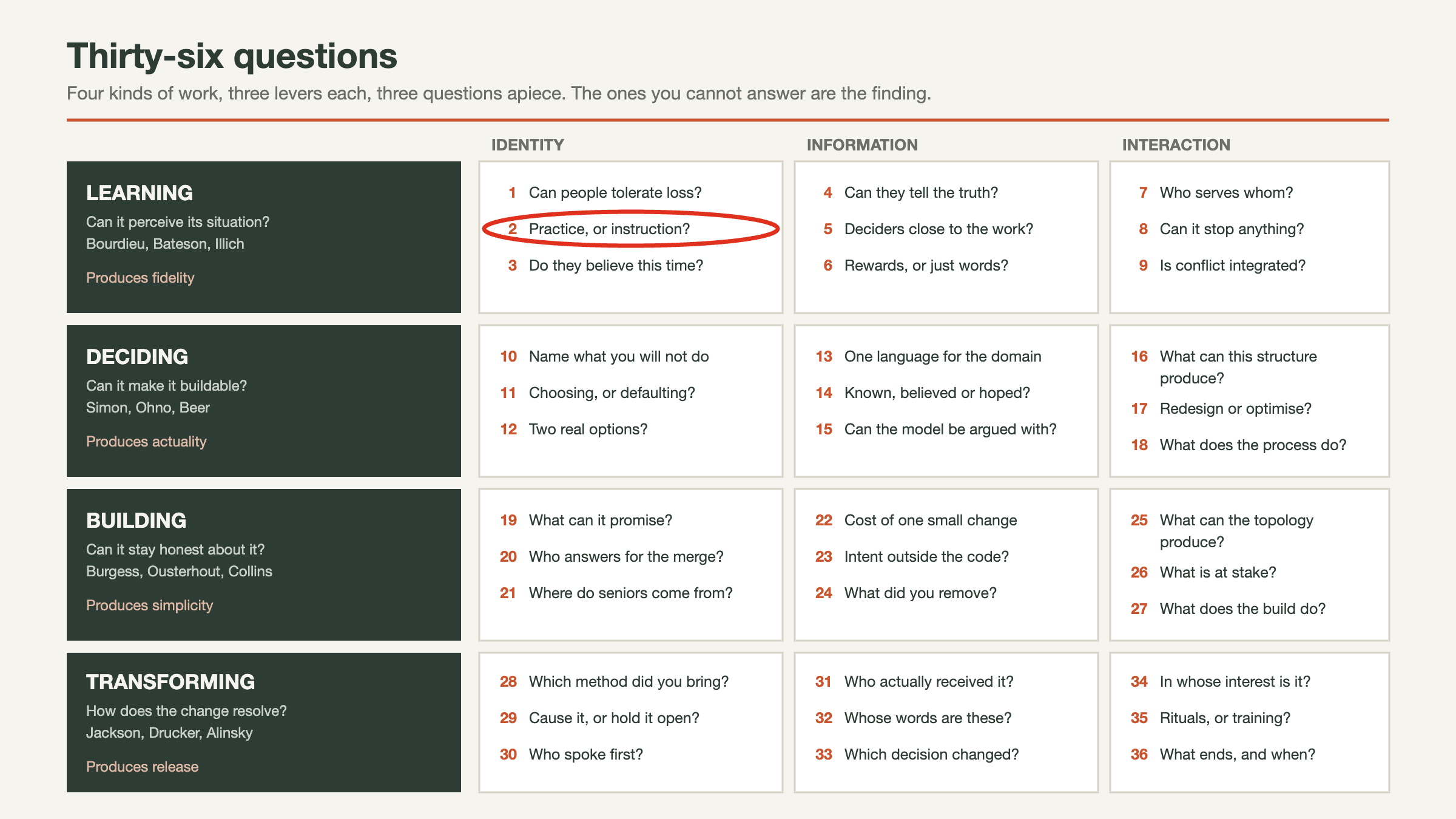
1. Question
Is learning happening through practice, or through instruction?
Answer it by looking backwards rather than by asking anybody. Take the last capability the organisation truly acquired, meaning something it can now do that it could not do three years ago, and trace where it came from. Sometimes the answer is a course, and where it is, say so. More often it was a project that went badly, a person who joined and worked differently, or a customer who refused to accept the old answer.
Then ask the same of the capability you are trying to acquire now, and see whether the mechanism you have funded resembles the one that worked last time. If the capability came from practice and you have funded instruction, you have funded the wrong thing.
2. Purpose
The question separates two things that a completion report cannot tell apart. Instruction gives people a vocabulary, and vocabulary arrives quickly, which is why organisations keep buying instruction. Capability is what somebody reaches for under pressure. Capability arrives slowly, through repetition on real work, with somebody good enough to correct them.
It also exposes a theory of learning that most organisations hold without ever having examined it: that capability is a substance which passes from one head to another by explanation. If that were true, everybody who has read a book on management would be a good manager.
There is a budget fact underneath. A course has a price, a supplier, a date and an attendance list. A senior engineer spending two afternoons a week beside three juniors has no line item, no certificate and no reportable number, so it loses every time the two compete for money. This is not stupidity. It is what happens when the countable thing and the effective thing are different things. Instruction is countable, so instruction gets funded. Practice is not countable, so practice gets postponed. The organisation then reports instruction and calls it capability, and the capability it reports is the capability it does not have.
You can hear the gap in a two-part question. Ask somebody to describe the new way of working, and they will be fluent. Then ask when they last did it, on what piece of work, and who reviewed the result. The distance between the fluency of the first answer and the vagueness of the second is the measurement, and it takes about ninety seconds.
3. Context
Pierre Bourdieu put the mechanism in the body. Dispositions are acquired by participating in a field, not by being told its rules, and the rules a person can state are usually the ones that matter least. A competent practitioner cannot fully articulate what they know, because most of it was never in words to begin with. This is why the training room is the wrong place for the transfer. Nothing is being transferred.
Ivan Illich named the damage the training room does anyway. A programme teaches its subject and it also teaches a hidden lesson about learning itself: that learning requires a programme, that capability is certified by completion, and that this is being done to you rather than by you. Illich distinguished institutions that hand people resources for their own purposes from institutions that prescribe the content, control the sequence, measure the consumption and issue the certificate. The second kind eventually produces the opposite of what it promises, and a change programme measuring training hours has already told you which kind it is.
Richard Sennett supplies the positive account. Craft knowledge is built in the hands over years of doing the work badly and then less badly, in the company of somebody who has done it longer. The apprentice does not receive the craft. They acquire it by making things that are not good enough yet, in front of a person who says so.
Anders Ericsson is the necessary correction, because repetition on its own does not do this. Deliberate practice has conditions: a task pitched slightly beyond current ability, immediate and specific feedback, and repetition with correction. Take away the feedback and you get automaticity instead, which is fast, confident and permanently plateaued. Most of what organisations call experience is automaticity, which is why twenty years in a role sometimes means one year repeated twenty times.
Donald Schön explains where the feedback comes from when no teacher is present. A practitioner works, the situation talks back, and the practitioner adjusts inside the doing rather than afterwards. His word for the setting where this is learned is the practicum: real work, lower stakes, someone alongside. No lecture reproduces it, and no lecture was ever meant to.
Ikujiro Nonaka gives the organisational version. Tacit knowledge moves between people mainly through shared work, and the document captures only what was already explicit. Respond to a capability gap by writing a playbook and you have captured the part that was never the problem.
Chris Argyris closes the loop. People hold an espoused theory, which is what they will tell you they do, and a theory-in-use, which is what governs their behaviour under pressure. Training changes the first with great reliability. It leaves the second untouched, and the person is not lying when the two diverge, because they cannot see the divergence themselves.
4. Action
Convert one course into a practicum this quarter, and only one.
Choose the capability that matters most to the change, then cut its training to a half-day of orientation and spend the rest of the budget on time. Find live work with a real outcome and a real deadline, small enough to finish. Put each learner beside somebody who already has the capability, on that work, for a fixed period with an end date. The pairing is the intervention. Everything else is administration around the pairing.
Set Ericsson’s three conditions explicitly, because they will not happen by themselves. The work has to sit a little beyond what the learner can already do unaided. The feedback has to arrive while the work is still warm. And the loop has to run more than once, which means the same person doing the same kind of task again after being corrected. Name the reviewer, and give them the standing to say that something is not good enough without it becoming a personnel matter.
Then change what you count, because the old measure will quietly drag you back. Stop reporting completions, hours and satisfaction scores. Count instead the number of people who have done the thing on real work with a named reviewer, and the number who have since shown somebody else how to do it without anybody asking them to. The second number is the one that tells you a capability now exists in the organisation rather than in a supplier’s material.
Expect the finance conversation to be awkward. You are proposing to spend expensive senior time on something with no certificate at the end of it, and the alternative has a fixed price and a completion report. Make the case in the language of the reviewer’s diary rather than the training budget, because that is where the cost sits. An organisation that will not pay for its best practitioners to teach has decided to keep buying vocabulary.
The test six months later is simple enough to run in a corridor. Ask somebody to show you, on their screen, a piece of work they did the new way. If they open something, you built capability. If they open the deck, you have bought a course.
This question sits in the Learning group of the series, the articles asking whether an organisation can perceive its own situation accurately enough to respond to it. What an organisation gets out of that work is fidelity, meaning an account of its situation that matches the situation. The route from there into deciding what to do about it is set out in From Learning to Clarity.
Further Reading
Ivan Illich, Deschooling Society (1971), free in full at https://theanarchistlibrary.org/library/ivan-illich-deschooling-society, for the hidden curriculum and the institution that measures its own consumption.
K. Anders Ericsson, Ralf Krampe and Clemens Tesch-Römer, The Role of Deliberate Practice in the Acquisition of Expert Performance, Psychological Review (1993), free at https://gwern.net/doc/psychology/writing/1993-ericsson.pdf, for the conditions that separate practice from repetition.
Donald Schön, The Reflective Practitioner (1983), for knowing-in-action and for the practicum as the place professional capability is actually built.
Richard Sennett, The Craftsman (2008), for skill made in the hands rather than delivered in a room.
I write about the industry and its approach in general. None of the opinions or examples in my articles necessarily relate to present or past employers. I draw on conversations with many practitioners and all views are my own.