
The programme reports green for eleven months. In the twelfth the date moves by six months in a single meeting, and afterwards, in ones and twos, people mention that they had known since about month four. Nobody lied. Every report was accurate against the thing it measured, and the thing it measured was chosen, month after month, by people making a sensible judgement about what could be said out loud.
That is not a reporting failure and no dashboard will repair it. Whether an organisation can change depends on whether accurate information can travel upwards through people who are also managing their own standing, and in most places it cannot. What you get instead is a second conversation, held in the corridor afterwards, where the real assessment is discussed by the people least able to act on it.
1. Question
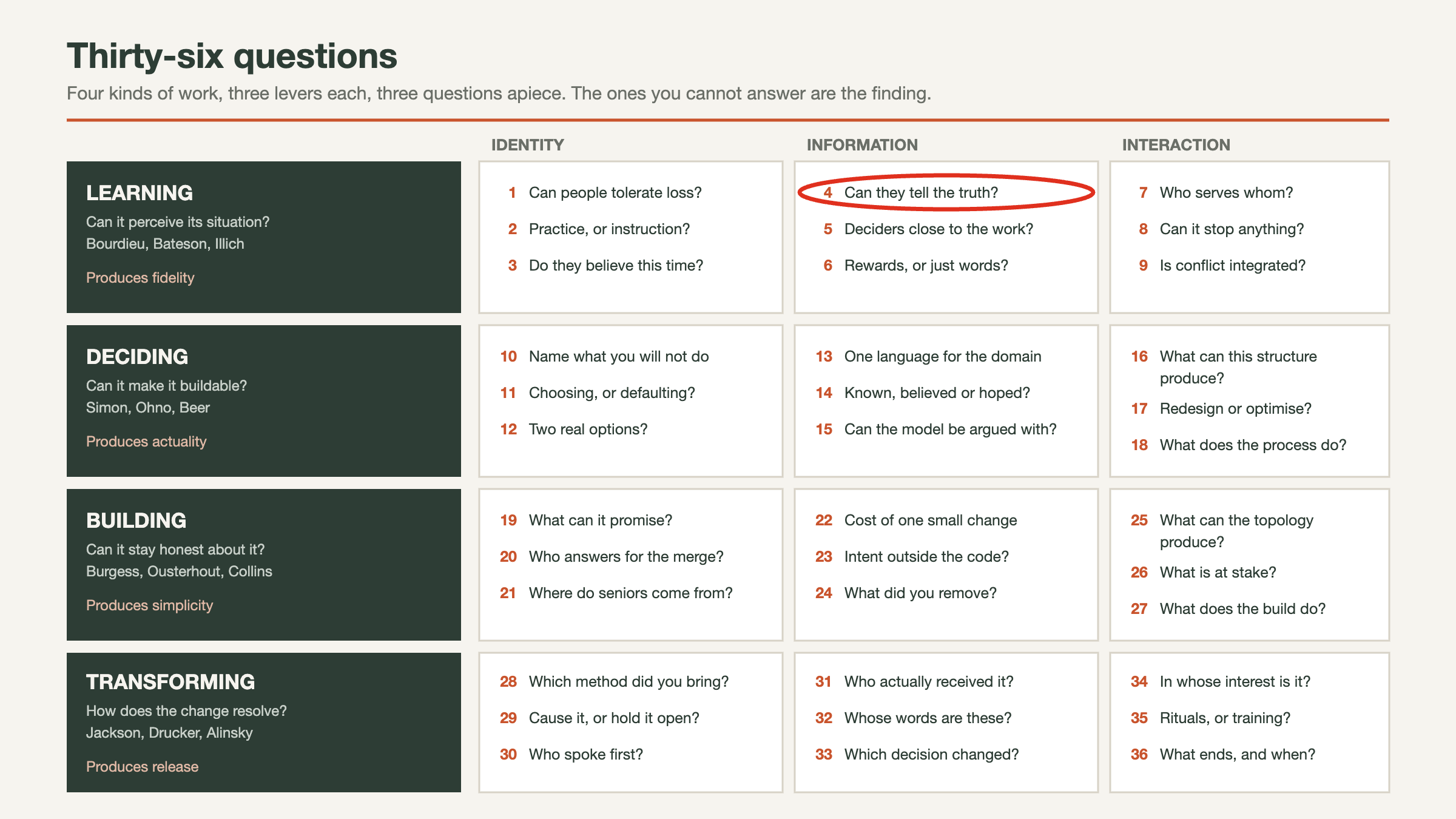
Can people tell the truth here?
Ask it about a specific piece of bad news rather than in general, because the general version produces the general answer. Take the last serious problem the organisation had. Find out who knew first and when, who they told, where the information stopped, and how long it took to reach somebody who could act. Then find out what happened to the person who carried it.
That last part is the whole question, and the rest is commentary. Ask it about bad news, about a named piece of bad news, and about what the messenger paid.
2. Purpose
The question tells you whether your information is real, and every other question in this series rests on the answer. An organisation that cannot see its own situation cannot respond to it, and it will spend the response budget on the situation it believes it is in.
It also separates two failures that get recorded identically, and that need opposite handling. We did not know is a detection problem, and it is solved with instrumentation. We were not told is a truth-telling problem, and instrumentation makes it worse, because more measurement in a place where measurement is punished produces more careful measurement rather than more honest measurement.
The most useful evidence is not what people say when you ask them. Look instead at the last three people who raised something serious and unwelcome. Where are they now? Promoted, quietly moved sideways, or gone? Whatever that pattern shows is your actual policy on truth-telling, and everybody below you has already read it, whatever the values statement says.
The tell is the pause. Ask a direct question in a large meeting and watch how long it takes before anybody answers, and who answers first. A long pause followed by the most senior person present is not deference. Everybody is waiting to hear the permitted range before committing to a position inside it.
3. Context
Ron Westrum built the typology that makes this measurable. He sorted organisations by how information about trouble moves through them, and got three kinds. Pathological organisations punish the messenger and hide the problem. Bureaucratic ones tolerate the messenger and route the information to the correct department, where it stops. Generative ones train the messenger and go looking for the information. His argument is that information flow is not one feature of a culture among many. Information flow predicts how the organisation behaves when trouble arrives, which makes it the feature worth measuring.
Amy Edmondson found the effect by accident. She had to reverse her own hypothesis to explain it. Studying hospital teams, she found that better teams reported more errors, not fewer. What she was measuring was not the error rate but the reporting rate, and the two move in opposite directions. Psychological safety, in her account, is the shared belief that the team is safe for interpersonal risk. Not comfort, not niceness, and not a property of the whole company. It varies sharply between teams reporting to different managers inside the same building, which tells you where the intervention has to happen.
Chris Argyris described the mechanism that keeps it in place. Organisations develop topics that cannot be discussed, and their undiscussability is itself not discussable. He called the surrounding behaviour skilled incompetence, because it is practised, fluent and effective at protecting everybody from an uncomfortable conversation. Nobody experiences themselves as concealing anything. They experience themselves as being professional.
Gregory Bateson supplies the trap underneath. A double bind is a pair of demands that cannot both be met, issued in a setting where the contradiction cannot be named. Bring me problems early, and do not bring me problems, is a double bind. So is move fast and never miss a date. The person receiving both cannot satisfy them and cannot say so, and the reliable response is to go quiet and manage the appearance, which is exactly what you then observe and misread as a lack of ownership.
Erving Goffman explains why the meeting itself works against you. A meeting is a performance with a front stage, and everybody present has a tacit agreement to protect everybody else’s face, including yours. The corridor is the backstage, which is why the assessment there is more accurate. Asking for candour in the room without changing the room asks people to break a social contract they did not write.
Sidney Dekker closes it with the point most organisations get backwards. Asking who is responsible feels like accountability and functions as a stop signal, because once a name has been produced the enquiry ends and everybody else learns what raising things costs. Human error is a judgement made after the fact, not an explanation of anything, and treating it as an explanation guarantees the same event again with better concealment.
4. Action
Trace one message, and let everybody watch you do it.
Take a problem you found out about late. Reconstruct the path: who knew first and on what date, who they told, where it stopped, and what the person who stopped it was protecting when they stopped it. That last question is the one that matters, and the honest answer is almost never malice. Usually it is a reasonable read of what would happen to them, which is information about you.
Say at the outset that nobody will be blamed, and then hold to it under pressure, because the first time somebody is quietly punished for what the trace turns up, you have proved the thesis and closed the channel for years. If you cannot promise that credibly, do not run the exercise. A trace that becomes an investigation is worse than no trace.
Then change one thing about the room. Put a standing item at the top of the weekly meeting for what is worse than the report says, and answer it yourself first, before anybody else speaks. Speaking order sets the permitted range, so whoever goes first decides what the meeting can contain. And separate naming a problem from owning its solution, because attaching work to bad news is the most efficient way to stop bad news, and most organisations do it without noticing.
Stop aggregating for one cycle. A status that rolls up into a colour has had the difference removed from it, and the difference was the information. Ask once a month for the raw thing: the actual list, the actual dates, in the words of the people doing the work.
The test after ninety days is one question, and you should be able to answer it with names. Has anybody told you something you did not want to hear, without being asked, since you started? If you cannot name them, nothing has changed yet and the corridor is still where your organisation keeps its real assessment.
This question sits in the Learning group of the series, the articles asking whether an organisation can perceive its own situation accurately enough to respond to it. What an organisation gets out of that work is fidelity, meaning an account of its situation that matches the situation. The route from there into deciding what to do about it is set out in From Learning to Clarity.
Further Reading
Ron Westrum, A Typology of Organisational Cultures, Quality and Safety in Health Care (2004), free at https://propertools.be/field-manual/Westrum_2004_Typology-of-Organisational-Cultures_QualSafHealthCare_13-SII-ii22.pdf, for the pathological, bureaucratic and generative distinction.
Amy Edmondson, Psychological Safety and Learning Behavior in Work Teams, Administrative Science Quarterly (1999), for the finding that better teams report more errors rather than fewer.
Chris Argyris, Overcoming Organizational Defenses (1990), for skilled incompetence and for topics whose undiscussability is itself undiscussable.
Gregory Bateson, Steps to an Ecology of Mind (1972), for the double bind and for information as a difference that makes a difference.
Sidney Dekker, The Field Guide to Understanding Human Error (2006), for why naming a responsible person ends the enquiry.
I write about the industry and its approach in general. None of the opinions or examples in my articles necessarily relate to present or past employers. I draw on conversations with many practitioners and all views are my own.