
Somebody counts the hours. A team of nine spends roughly a day and a half of every week producing material that exists only so the process can proceed. The fortnightly pack, the risk log nobody reads, the two governance forums whose questions were answered in the pack. None of it touches the product. Every piece of it was introduced by a competent person solving a real problem that existed at the time.
That is how it always happens, and it is why the usual explanations do not fit. Nobody built a bureaucracy on purpose. Each control was proportionate when it was added, nothing was ever removed, and at some point the ratio quietly inverted, so that the structures stopped serving the work and the work began serving the structures. The organisation now spends most of its energy on itself. Nothing announced the moment it happened, which is why nobody can say when it did.
1. Question
Do the structures serve the work, or does the work serve the structures?
Answer it by measuring, not by asking. Take one team for two weeks and split their hours into three: work that changes the product, work that makes the first kind possible, and work that exists only to satisfy a process. Have the team do the splitting, because you will probably get it wrong and they will not. Two weeks is roughly the shortest window that survives a quiet fortnight.
Then ask the second question, which is the one that hurts. For each item in the third bucket, who reads it, and what have they ever done differently because of it?
2. Purpose
The question converts a feeling into a number. Everybody in a large organisation already believes too much time goes on overhead, and belief of that kind is unactionable, because it has no edges and no owner. Two weeks of honest timekeeping from one team turns it into an argument you can take somewhere.
It also finds the difference between a control that works and a control that runs. A working control changes a decision sometimes. A running control produces an artefact, consumes attention and changes nothing. It tends to be invisible precisely because it never fails, since a thing that does nothing cannot fail, and an unbroken record looks like evidence that it works.
There is a second-order cost most organisations never count. Overhead does not only consume hours; it selects people. Where advancement depends on navigating the structures well, the structures start recruiting for themselves. After a few cycles the people who are good at the work and the people who are good at the process are different people, and only one of those groups is in the room where the decisions happen.
The tell is the origin story. Ask why a given forum exists and see how long it takes to reach somebody who knows. Where nobody can name the problem it was built to solve, the structure has probably outlived the problem and is now being maintained for its own sake. That is not a reason to remove it immediately, but it is a reason to test it.
3. Context
Ivan Illich has the sharpest version, drawn from institutions much older than yours. An institution built to deliver a good passes a threshold beyond which it begins producing the opposite: schooling that obstructs learning, medicine that generates illness, transport that consumes more time than it saves. He called it counterproductivity, and the trap is that the institution’s response to falling short is always more of itself. More process, more oversight, more reporting, delivered with complete sincerity by people who cannot see the threshold because they are standing past it. Illich’s institutions were schools and hospitals, and the mechanism transfers without adjustment to a delivery organisation.
Max Weber explains why it is so hard to reverse. Bureaucracy was a liberation: rules instead of favour, offices instead of patronage, competence instead of birth. It works, which is the problem, because a structure that works accumulates, and the accumulation eventually forms what he described as a cage of rules that nobody chose and nobody can leave. The apparatus outlives the purpose and then defends itself, not through malice but because each part of it is somebody’s job.
Stafford Beer supplies the diagnostic. In a viable system, the parts that coordinate and audit exist to serve the parts that do the work, and the ratio between them is a design decision that can be got wrong. When the coordinating functions grow faster than the operational ones, the system spends its capacity on internal communication and loses the capacity to respond to anything outside itself. Beer’s insistence is that this is measurable rather than a matter of taste.
Russell Ackoff explains why the usual remedy fails. Improving a part in isolation frequently degrades the whole, and every process here was an improvement to a part. Make each function more rigorous and you get an organisation that is excellent at everything except the thing it exists to do. His prescription is to design from the purpose backwards, which is uncomfortable, because it means some functions turn out to have no place in the design.
Anthony Giddens removes the last excuse. Structures have no existence apart from the practices that reproduce them. The forum exists because people attend it and prepare for it, and it would stop existing if they stopped. That sounds like good news and is mostly bad news. Nobody is preventing you, and the meeting is still in the diary because everybody is waiting for permission that nobody is authorised to give.
4. Action
Stop one structure for one quarter and watch what happens.
Pick a forum, a report or an approval step that consumes real time and that nobody can trace to a decision it has changed. Not the biggest one. Pick a middling one with a real cost and a weak defence, because you are testing the method as much as the structure, and the method is what you will need again.
Suspend it rather than abolishing it, and put an end date on the suspension. Abolition invites a fight about principle, and suspension invites an experiment. Suspension gets past the objection that something terrible will happen, since anybody worried can point to the date. Then say clearly what you will watch during the quarter and what would count as evidence that the structure was doing something after all. Write that down before the suspension starts, because afterwards everybody remembers having predicted whatever happened.
Say who decides at the end, and decide by default towards removal. Left neutral, the structure comes back, because the people who benefit from it are organised and the people who pay for it are not. The default has to point the other way or nothing is being tested.
While it is suspended, count the hours the team gets back and where those hours go. That number is the argument for the next suspension. There should be a next one, because a single removal is an anecdote and a quarterly rhythm is a policy, and only the second changes anything.
The test after ninety days is whether anybody outside the team noticed. Where nothing broke and nobody asked, you have found the shape of the rest of the work. You now know something about your organisation that no audit would have told you, and you know it cheaply, which matters because you will need to do this many times.
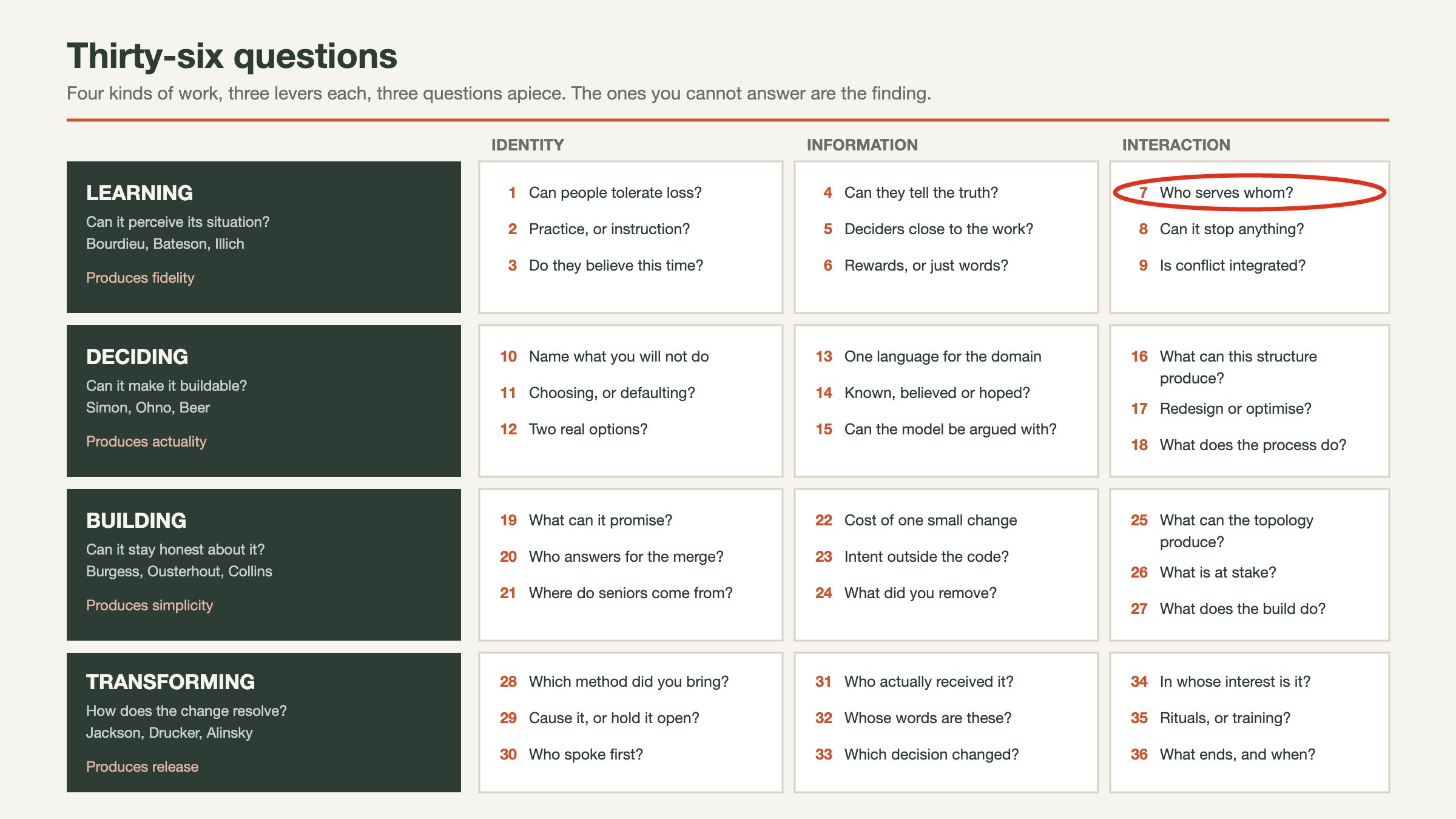
This question sits in the Learning group of the series, the articles asking whether an organisation can perceive its own situation accurately enough to respond to it. What an organisation gets out of that work is fidelity, meaning an account of its situation that matches the situation. The route from there into deciding what to do about it is set out in From Learning to Clarity.
Further Reading
Ivan Illich, Tools for Conviviality (1973), for counterproductivity and the threshold past which an institution starts producing its own opposite.
Max Weber, Economy and Society (1922), for bureaucracy as both liberation and cage.
Stafford Beer, Brain of the Firm (1972), for the ratio between the parts that do the work and the parts that coordinate it.
Russell Ackoff, Redesigning the Future (1974), for why improving the parts degrades the whole.
I write about the industry and its approach in general. None of the opinions or examples in my articles necessarily relate to present or past employers. I draw on conversations with many practitioners and all views are my own.