
Nobody muddles through on purpose. Nobody puts “incremental adjustment from the status quo” in their transformation strategy. And yet that is what most organisations actually do, and Charles Lindblom’s provocation, first published in 1959 and still making people uncomfortable, is that this is not necessarily a failure. It might be the only rational response to the conditions under which real decisions are made.
The series has spent several articles building the architecture of good deciding: Simon’s bounded rationality, Evans’s domain modelling, Beer’s viable systems, Rumelt’s strategic kernel, Kahneman’s decision hygiene. All of these assume, to varying degrees, that the organisation can achieve some form of structured clarity about what it faces and what it should do. Lindblom’s contribution is the honest admission that in most real situations, it cannot. Not because the people are incompetent, but because the problem is too complex, the values too contested, the information too incomplete, and the politics too real for any rational-comprehensive approach to work.
1. The Rational-Comprehensive Ideal and Why It Fails
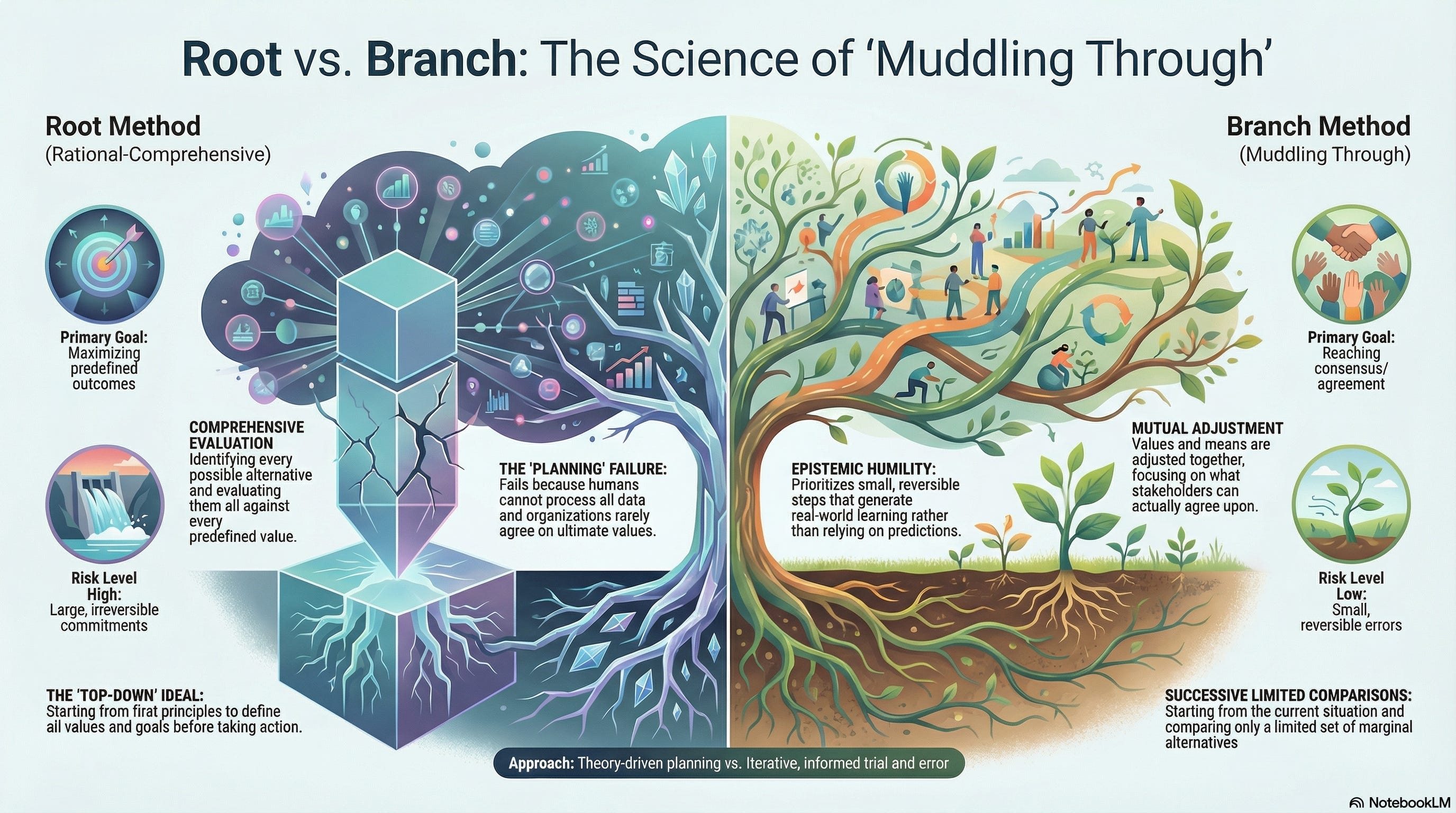
Lindblom distinguished between two modes of decision-making. The rational-comprehensive method, which he called the “root” approach, requires the decision-maker to define all values and goals, identify all possible alternatives, evaluate every alternative against every value, and select the option that maximises the overall outcome. This is what strategy frameworks promise. It is what governance boards assume they are doing. It is what nobody actually does.
The root method fails for reasons Simon had already identified: bounded rationality means the decision-maker cannot process everything. But Lindblom pushed further. The failure is not just cognitive. It is political and epistemic.
In any complex organisation, people disagree about values, not just facts.
The CTO who wants to invest in platform capability and the CFO who wants to cut costs are not making an analytical error. They hold genuinely different values about what the organisation should prioritise. The rational-comprehensive method assumes these value conflicts can be resolved before analysis begins. They cannot. They are resolved, if at all, through the decision process itself.
This is the point most transformation programmes ignore. The AI strategy that claims to have aligned all stakeholders around a common vision has not resolved the value conflicts. It has suppressed them. They will resurface when deployment begins and the trade-offs become real: speed versus quality, automation versus employment, centralised control versus team autonomy. Lindblom would predict this with confidence, because value conflict is not a planning failure. It is the permanent condition of any organisation composed of people who want different things.
2. Muddling Through: The Branch Method
Lindblom’s alternative, which he called the “branch” method or “successive limited comparisons,” accepts these limits and works within them.
Instead of starting from first principles and evaluating all options, the decision-maker starts from the current situation and compares a limited set of alternatives that differ marginally from the status quo.
Values and means are adjusted together, not fixed in advance. The test of a good decision is not whether it maximises some predefined objective but whether the decision-makers can agree on it, which is a political criterion, not an analytical one.
This sounds like giving up. Lindblom argued it is the opposite: it is taking seriously the conditions under which decisions actually happen. The branch method has several properties that the root method lacks. Errors are small and reversible. Each step generates information that informs the next step. The organisation learns from actual consequences rather than from predicted consequences, which in complex environments are unreliable. And the method works even when people disagree about values, because agreement on a specific step does not require agreement on ultimate purposes.
Simon’s satisficing operates at the individual level: the decision-maker accepts “good enough” because they cannot compute “optimal.” Lindblom’s incrementalism operates at the organisational level: the organisation moves in small steps because the collective cannot agree on the destination, and even if it could, it could not predict the consequences of a large move. The two are complementary. Simon explains why the individual decision-maker muddles. Lindblom explains why the organisation muddles.
3. Mutual Adjustment: Coordination Without a Coordinator
Lindblom’s deeper insight, developed more fully in The Intelligence of Democracy (1965), is that coordination in complex systems does not require a coordinator. In pluralist systems, decisions emerge from the mutual adjustment of multiple actors pursuing their own interests. No central rational authority designs the outcome. The outcome emerges from the interaction.
This is Beer’s insight from the opposite direction. Beer designed the architecture that enables viable coordination (the VSM). Lindblom observed that coordination happens anyway, through mutual adjustment, even without the architecture. The two are not contradictory: Beer provides the design principles for when you can shape the system; Lindblom describes what happens when you cannot. Most organisations live in Lindblom’s world while aspiring to Beer’s.
The connection to Evans is sharp. Evans’s knowledge crunching is a mutual adjustment process: developers and domain experts iteratively adjust their models through dialogue until something useful emerges. Nobody starts with a complete specification. The specification emerges from successive limited comparisons between what the model says and what the domain expert recognises. Evans described a method for this. Lindblom observed that it happens naturally, and that designing it is less important than protecting it from the rational-comprehensive impulse to replace iteration with planning.
4. Three Archetypes of AI Transformation Failure
Lindblom’s framework diagnoses three patterns that recur in transformation programmes.
The first is the grand plan that ignores value conflict. The organisation produces a comprehensive AI strategy: use cases prioritised, business cases approved, timelines committed, governance established. The strategy assumes agreement on what, for instance, AI is for. Within months, different parts of the organisation are pulling in different directions because they never actually agreed on the purpose; they agreed on a document. Lindblom would say: start smaller, test actual value in one context, and let the strategy emerge from what you learn. The document is not the strategy. The learning is the strategy.
The second is the irreversible commitment. The organisation selects a platform, signs a multi-year contract, commits to a vendor, restructures teams around a bet that has not been tested. Lindblom’s criterion of reversibility says this is the highest-risk move you can make: a large departure from the status quo that cannot be undone if the assumptions prove wrong. Taleb would call it fragile. Lindblom would call it the root method applied to a problem that demands the branch method. The corrective is not “do not commit” but “commit in ways that preserve your ability to change course.”
The third is the productivity trap. The organisation deploys AI to make existing processes faster. This is the most natural incremental step: it departs minimally from the status quo and generates immediate, measurable results. But it is also Senge’s shifting-the-burden archetype in action: the symptomatic solution (faster output) undermines the fundamental solution (rethinking what the process is for). Lindblom would acknowledge the logic of the incremental step while warning that incrementalism without direction is drift. The branch method works not because steps are small but because each step generates learning that informs the next. If the organisation is not learning from the AI deployment, it is not muddling through. It is just muddling.
5. Lindblom’s Limits
Lindblom must be read with his limitations visible. Incrementalism has a conservative bias: it starts from the status quo, which means it systematically favours those who benefit from current arrangements. For problems that require fundamental change, such as addressing structural inequality, responding to existential risk, or transforming an industry’s operating model, incrementalism may be too slow and too constrained. Ackoff would say Lindblom resolves problems (finding acceptable trade-offs) when he should be dissolving them (redesigning the system).
Lindblom himself acknowledged this. In “Still Muddling, Not Yet Through” (1979), twenty years after the original paper, he distinguished between simple incrementalism (small steps from the status quo) and “strategic analysis” (a broader set of methods including informed trial and error, calculated risks, and deliberate testing). The mature Lindblom is not an advocate for drift. He is an advocate for epistemic humility: start from where you are, test before you commit, preserve reversibility, and do not pretend you can see further than you can.
The deepest tension in the series sits here. These articles have built an architecture for structured clarity: Simon’s premises, Evans’s models, Beer’s systems, Rumelt’s kernel. Lindblom says: all of that is useful, but in the moment of actual decision, under real conditions of uncertainty and disagreement, you will muddle.
The question is not whether you muddle. The question is whether you muddle intelligently: learning from each step, preserving the ability to reverse, and resisting the temptation to mistake the plan for the reality.
Where this falls: Deciding, the second of four phases; Learning, Deciding, Building, Transforming. Incrementalism is a Deciding claim about how much description you can actually get before you have to act, and its answer is: less than the strategy deck implies. What comes out of it is a decision and a specification, both of them provisional. Why Your Organisation Can't Decide is the synthesis, and From Deciding to Building is the bridge to the phase that tests them.
(An Organisational Prompt is something you can do now....)
Organisational Prompt
Find one irreversible commitment in your AI programme and make it reversible.
Look at the decisions your organisation has already made about AI: platform selections, vendor contracts, team structures, governance models. Find the one that would be hardest to reverse if the assumptions behind it prove wrong. Then ask: what would it take to make this reversible? Sometimes the answer is a shorter contract. Sometimes it is an abstraction layer. Sometimes it is a parallel path. The point is not to avoid commitment. It is to stop pretending that you know more than you do, and to build your programme so that being wrong about one thing does not make you wrong about everything.
Further Reading
Charles Lindblom: The Science of Muddling Through - The original paper. Still the most concise statement of why rational-comprehensive planning fails and what decision-makers actually do instead. Widely available in academic repositories.
Charles Lindblom: Still Muddling, Not Yet Through - The twenty-year retrospective. Lindblom refines incrementalism into “strategic analysis” and addresses the objection that muddling through is too conservative.
Charles Lindblom: The Intelligence of Democracy: Decision Making Through Mutual Adjustment - The deeper theoretical framework. How coordination emerges from interaction without a central planner.
Charles Lindblom: Politics and Markets - The broader argument about the relationship between market systems and political authority. Read it for the insight that all coordination is a mixture of hierarchy, markets, and mutual adjustment.
I write about the industry and its approach in general. None of the opinions or examples in my articles necessarily relate to present or past employers. I draw on conversations with many practitioners and all views are my own.