
Two directors disagree about the platform. The disagreement is real, it is technical, and both positions are defensible. What happens next is a series of one-to-one conversations, a paper circulated for comment, a rewritten paper, and eventually a decision taken by somebody senior enough that neither has to lose in front of the other. Everybody is relieved. The decision is a blend that neither believes in and both can live with, and the relief is the only thing in the process that anybody will remember clearly.
Six months later the platform has the weaknesses of both approaches and the strengths of neither. Blends of that kind are the signature of a decision taken to end an argument rather than to answer a question. That was not bad luck, and it was not weak leadership in the usual sense. A disagreement was treated as a social problem to be managed rather than as information about the situation. The information was thrown away in the process of managing it, and nobody noticed, because managing it felt like progress and looked like it too.
1. Question
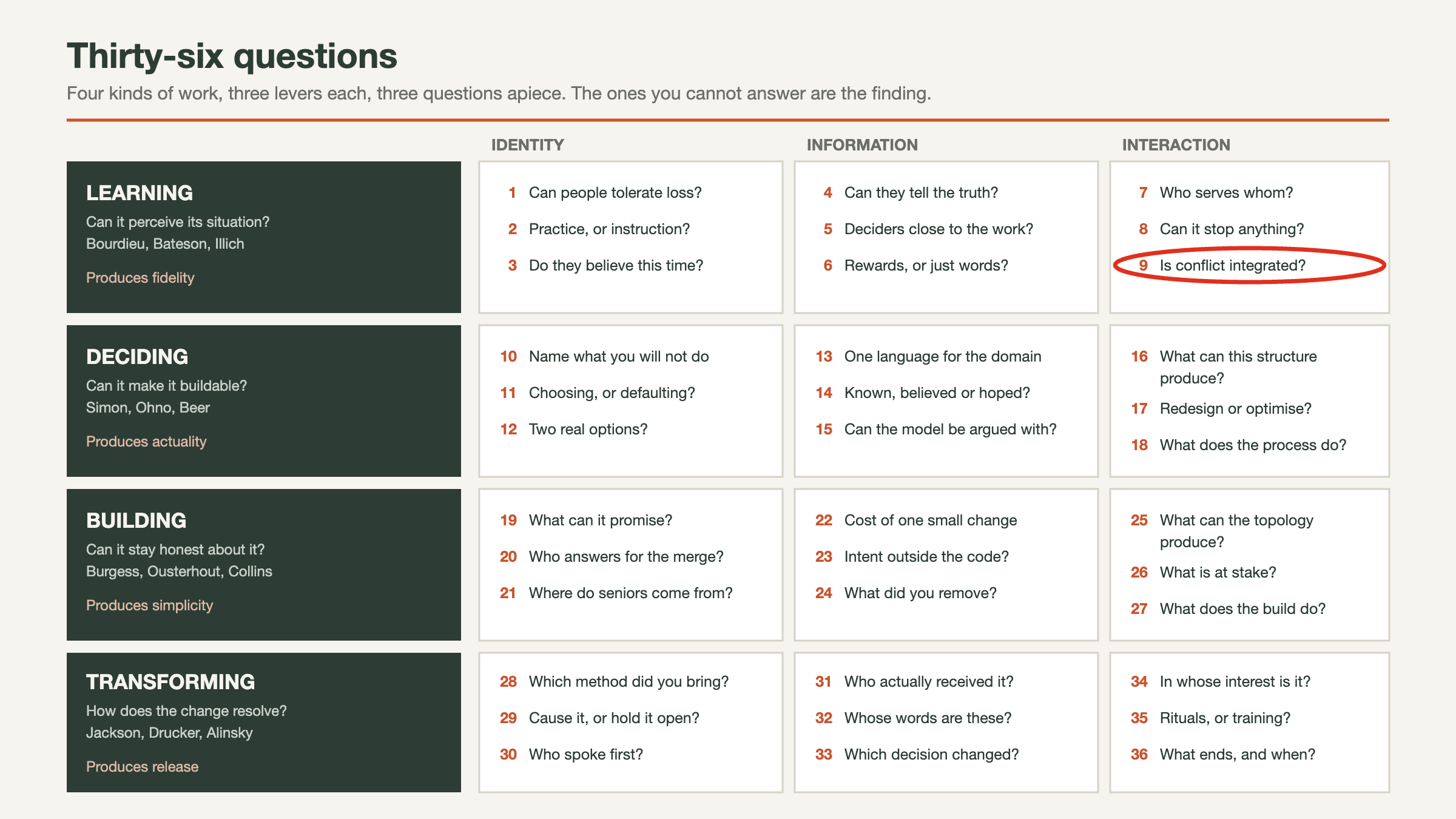
Is conflict integrated, or suppressed?
Take the last serious disagreement between two parts of the organisation and ask what happened to it. Did it get argued through to a position neither side held at the start? Was it settled by splitting the difference, or decided by rank? Or is it still going, quietly, in the way work gets sequenced and people get allocated?
Three of those four are suppression under other names. Only the first is integration, and most organisations cannot remember the last time one happened.
2. Purpose
The question tells you whether disagreement is being used or spent. A disagreement between competent people is usually evidence that the situation contains something neither of them has fully described, which makes it the most valuable raw material you have. Suppress it and you keep the peace and lose the information. Compromise and you get an answer that is worse than either original, since the parts of each position that made it coherent are exactly the parts that get traded away.
It also predicts where your delays come from. Suppressed conflict does not disappear; it moves into the schedule. It reappears as reprioritisation, as resourcing arguments, as an integration that keeps slipping. Not one of those gets recorded as the disagreement it is, so the same fight runs repeatedly in a language that makes it unresolvable.
There is a straightforward diagnostic. Count how many decisions in the last year were taken by someone escalating rather than by the people who disagreed. A high escalation rate usually gets read as a sign that people are aligned to leadership. It is better read as a sign that peers cannot resolve anything with each other, and that every disagreement therefore has to travel upwards before it can end.
The tell is the word alignment. Where it means people arrived at a shared view by arguing, the word is doing useful work and describing something real. Where it means only that the visible disagreement has ended, it describes suppression. The difference between the two uses is never marked, which is what makes the word so serviceable in a status report.
3. Context
Mary Parker Follett drew the distinction that the rest of this rests on, a century ago, and it has not been improved upon. Conflict can be settled three ways. Domination, where one side wins. Compromise, where both give something up and neither is satisfied. And integration, where the underlying desires of both are examined until a position emerges that neither had at the start and both actually want. Her point was that integration requires bringing the difference fully into the open rather than smoothing it. Most organisations reach for compromise instead, because compromise is quicker, looks like maturity, and produces a document by the end of the afternoon.
Ronald Heifetz explains why leaders close it down. Real disagreement generates distress, and the reflex of anybody in authority is to relieve distress, because relieving it is what authority is for in ordinary circumstances. Adaptive work requires the opposite: holding the disequilibrium at a level people can bear without resolving it prematurely. The intervention that feels most like leadership, stepping in and deciding, is often the one that destroys the answer.
Chris Argyris describes the machinery of the smoothing. People are trained to avoid embarrassment for themselves and others, and they execute the avoidance so fluently that they cannot see it. The paper circulated for comment is a defensive routine of real sophistication. It converts a disagreement into a document, removes both people from the room, and produces a text nobody objects to because nobody now holds it.
Amy Edmondson supplies the precondition. Integration requires somebody to say the difficult thing in front of the person it concerns, which is an interpersonal risk, and people take that risk only where they judge it survivable. Safety here is not comfort, and the two get confused constantly. A team with high psychological safety argues more rather than less. The argument rather than the harmony is what produces the result, and a quiet team is usually a frightened one.
Ralph Stacey reframes what the discomfort is. Novelty arises in organisations from the friction between differing positions, not from consensus, so an organisation that removes friction has removed its own source of new answers. The anxiety that difference produces is not a malfunction to be managed away. It is the condition under which anything unfamiliar can appear at all.
4. Action
Put the disagreement back in one room and refuse to resolve it for an hour.
Take a live disagreement currently being handled through papers and one-to-ones. Get both parties in the same room, with the smallest number of witnesses that makes it real, and no more than that. Every additional person raises the cost of changing your mind in public, and changing minds in public is the point of the hour. Say at the start that no decision will be taken in this session, and mean it. That removes the incentive to posture for a verdict, and of everything here it is the change that most alters how people talk. An argument aimed at a judge is a different kind of argument from one aimed at the other person, and everybody in the room can hear which is which within five minutes.
Run it Follett’s way. Each side states not their position but what they need to be true, and why, in specifics. Positions are conclusions. Conclusions cannot be combined. Needs sit underneath the conclusions, and needs sometimes can be, which is the whole reason for insisting on the distinction. The work of the hour is to get both sets of needs written on the same surface where everybody can see them.
Then hold it open. Somebody will propose splitting the difference within twenty minutes, because compromise is the reflex, and your job is to decline it once and say why. Ask instead what would have to be true for both sets of needs to be met. Then let the silence run. That question is hard, and the first useful answer usually arrives well after the point at which somebody would normally rescue the room.
Do not chair it yourself if you outrank both of them, and say who will. Your presence converts an argument into an appeal, and the moment either side starts addressing you rather than the other person, integration has stopped and you are back to domination with extra steps.
The test is whether the outcome surprised you. An integrated result is one neither party brought into the room, so if the answer is one of the two original positions or an average of them, the hour produced a decision but not the information. Where nobody in the room could have predicted the result at the start, the disagreement was used rather than spent. That is the only outcome worth an hour of two directors’ time.
This question sits in the Learning group of the series, the articles asking whether an organisation can perceive its own situation accurately enough to respond to it. What an organisation gets out of that work is fidelity, meaning an account of its situation that matches the situation. The route from there into deciding what to do about it is set out in From Learning to Clarity.
Further Reading
Mary Parker Follett, Constructive Conflict (1925), collected in Dynamic Administration, for domination, compromise and integration.
Ronald Heifetz, Leadership Without Easy Answers (1994), borrowable at https://archive.org/details/leadershipwithou00heif, for holding distress at a level people can bear.
Chris Argyris, Overcoming Organizational Defenses (1990), for the fluency with which embarrassment is avoided.
Ralph Stacey, Complexity and Creativity in Organizations (1996), for novelty arising from difference rather than consensus.
I write about the industry and its approach in general. None of the opinions or examples in my articles necessarily relate to present or past employers. I draw on conversations with many practitioners and all views are my own.