
Collaboration is the second of five values, printed on the wall by the lifts. The bonus is calculated on individual delivery against a target set in January, and the promotion committee asks what each candidate personally owned. Nobody has to work out which of the two to believe. The organisation decided that already, in writing, twice a year, with money, and everybody can read it.
People read the reward system the way they read the weather. That is not cynicism, and it is not a failure to understand the strategy. It is an accurate reading of what the organisation does when its words and its rewards disagree, and they disagree every quarter, and the reward wins every time.
1. Question
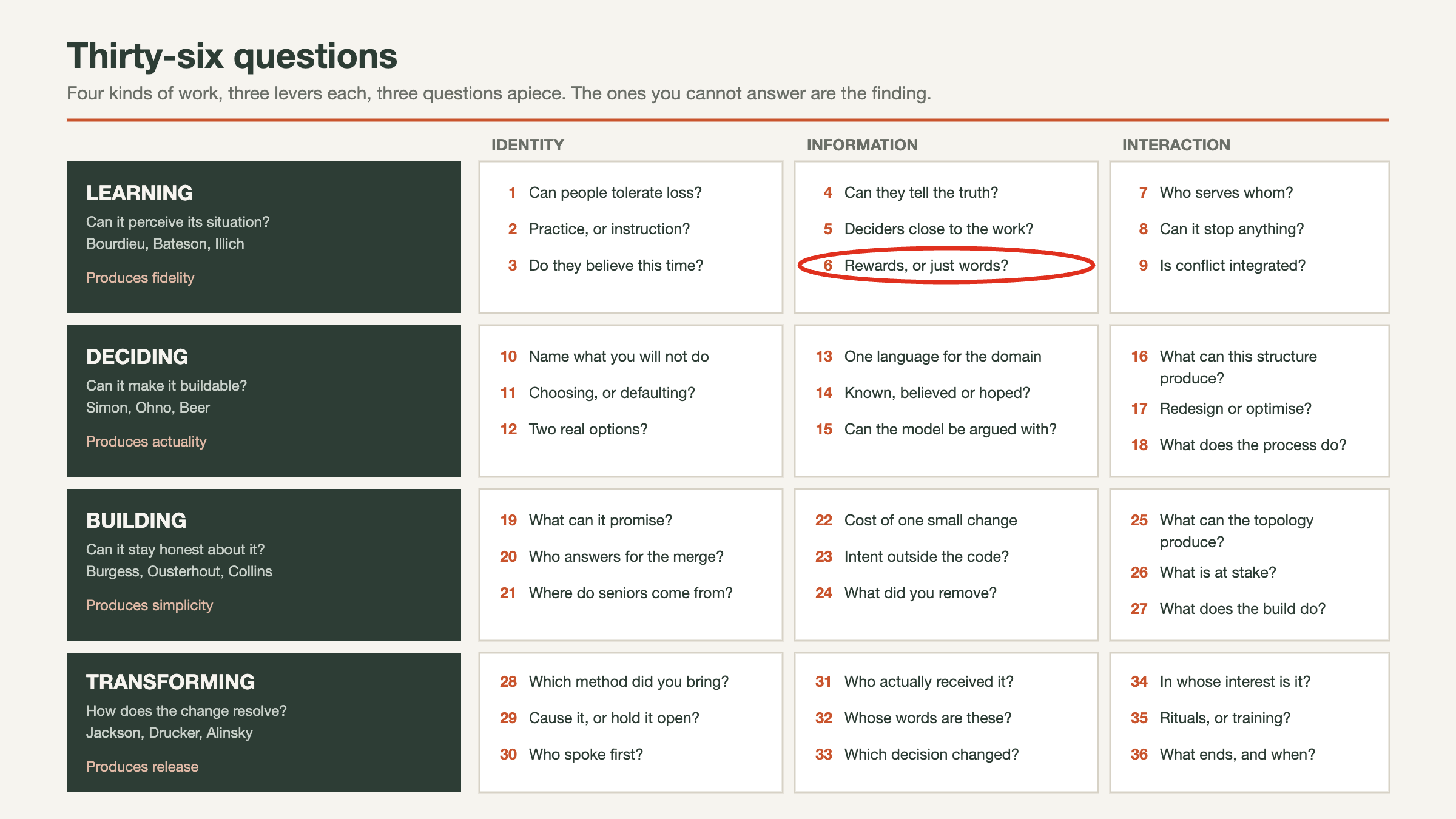
Do the rewards match the words?
Take the single behaviour your change most depends on. Then read three documents in order: the bonus formula, the promotion criteria, and the list of people actually promoted in the last two cycles. If the behaviour is absent from all three, you have asked for it and priced it at zero, and everybody has noticed.
The third document is the one that settles it, because criteria describe intentions and names describe policy. Read the names.
2. Purpose
The question shows you your operative strategy, as distinct from your stated one. The stated strategy is what you would like to be true. The operative strategy is what the organisation pays for, and it is the one people follow, because it is the one with consequences attached.
It also explains behaviour you have probably been filing under culture or attitude. People who will not share, will not stop their own project, will not raise a risk that reflects on them, are usually not obstructive. They are responding correctly to a scheme somebody designed, and the scheme is still running.
There is a practical reason to look here before anywhere else. The reward system is the cheapest lever you own and the least used. A promotion criterion can be changed in a quarter by a small number of people in a meeting. An attitude cannot be changed at all, and a great deal of money is spent trying.
The tell is a sentence. We need to change the culture, said by somebody who controls the reward system and has not changed it, is a statement about where they would prefer the problem to live.
3. Context
Pierre Bourdieu gives the general form. Every field rewards a particular kind of capital, and people orient towards it without deliberating, because orienting towards it is what competence in that field means. Change the reward and you have changed the field, and behaviour follows without anybody being persuaded of anything. Leave the reward alone and no amount of persuasion moves it. This is why the values workshop and the incentive review are not two items on the same agenda. Only one of them is doing anything.
W. Edwards Deming went further and called the annual rating system one of the deadly diseases. His argument was statistical before it was moral. Most variation in results comes from the system rather than from the individual, so ranking individuals mostly ranks the variation, which rewards luck, teaches superstition and sets people against the colleagues they need. The people who game it are behaving rationally. The people who do not are simply losing, and after a cycle or two they either learn the game or stop trying, and both outcomes cost you the person you thought you were rewarding.
Deci and Ryan supply the part that surprises people. Extrinsic reward does not just fail to add motivation for judgement-heavy work; it can displace the motivation already there. Attach a bonus to a proxy for good work and the work becomes a transaction about the proxy, and the interest that was doing the real work quietly leaves. The reward then has to keep rising to hold the position that interest held for free.
Chris Argyris named the gap. An espoused theory is what an organisation says it believes. A theory-in-use is what actually governs behaviour, and people cannot usually see their own. A reward system is unusual in being a theory-in-use that somebody wrote down and circulated, which makes it the easiest one to read and the most embarrassing to read honestly.
Frederick Taylor is where the machinery came from, and the conditions matter. Piece rate assumes the task is known, decomposable, repeatable, and that its output can be attributed to one person. Almost no knowledge work meets those conditions. The conditions went and the machinery stayed, which is why an organisation full of interdependent work still pays out against individual targets and then wonders why nobody helps anybody.
4. Action
Read your own reward system as a stranger would, then change one criterion this cycle.
List the three behaviours the change most needs. For each, write two lines: what a person gains by doing it, and what they lose. Count money, standing, time, and the risk to their next review. Where the second line is longer than the first, you have found the reason the behaviour is missing, and it is not a values problem. It is a pricing problem, and pricing problems have the advantage of being fixable by people who already have the authority.
Then look at the promoted list rather than the criteria. Take the last two cycles, name the people, and say for each of them what they were visibly promoted for. That list is what your organisation teaches, repeated twice a year, with far more authority than anything you say from a stage.
Then make one change, and only one, this cycle. Either add a criterion that names the behaviour and demands evidence of it, or remove a target that punishes it. Removing is usually cheaper, faster and stronger, because most organisations do not lack encouragement for the new behaviour. They have an old measure quietly making it expensive.
Resist adding a metric for the new behaviour. Measuring collaboration converts it into a target, and you will get the measured version of it within two quarters, which is worse than the absence you started with because it looks like success.
Announce the change by naming somebody. Promote a person for the behaviour and say plainly what they did and why it counted. One name does more than a policy document. A name can be checked, and a policy cannot, and everybody in the organisation knows the difference.
The test is a question you can ask three people at random in a corridor. What gets you promoted here? If the answer matches the values on the wall, the words and the rewards have converged. If it matches the bonus formula, you already know what to do next.
This question sits in the Learning group of the series, the articles asking whether an organisation can perceive its own situation accurately enough to respond to it. What an organisation gets out of that work is fidelity, meaning an account of its situation that matches the situation. The route from there into deciding what to do about it is set out in From Learning to Clarity.
Further Reading
Steven Kerr, On the Folly of Rewarding A, While Hoping for B, Academy of Management Journal (1975), for the canonical statement of the gap between what is asked for and what is paid for.
W. Edwards Deming, Out of the Crisis (1982), for the deadly diseases and for why ranking people mostly ranks system variation.
Edward Deci and Richard Ryan, Intrinsic Motivation and Self-Determination in Human Behavior (1985), for reward displacing the motivation already present.
Chris Argyris, Overcoming Organizational Defenses (1990), for espoused theory and theory-in-use.
I write about the industry and its approach in general. None of the opinions or examples in my articles necessarily relate to present or past employers. I draw on conversations with many practitioners and all views are my own.