
Two teams in the same division get the same tools on the same Monday, the same day of training, the same sponsor. Six weeks later one has rebuilt how it works and the other has not started. The explanations arrive in the usual order: leadership, culture, capability, communication. None of them fits. The teams differ in one respect that never reached a slide. In the first, the new way of working makes people better at what they already take themselves to be. In the second, it makes fifteen years of accumulated judgement worth about what a graduate’s is worth.
The second team is not resisting change. It is reading a devaluation correctly, and it will not be talked out of the reading, because the people doing it are not confused about the future. They have understood it faster than you have. Every serious change asks somebody to give something up, and whether they can survive the giving up decides what happens to everything else.
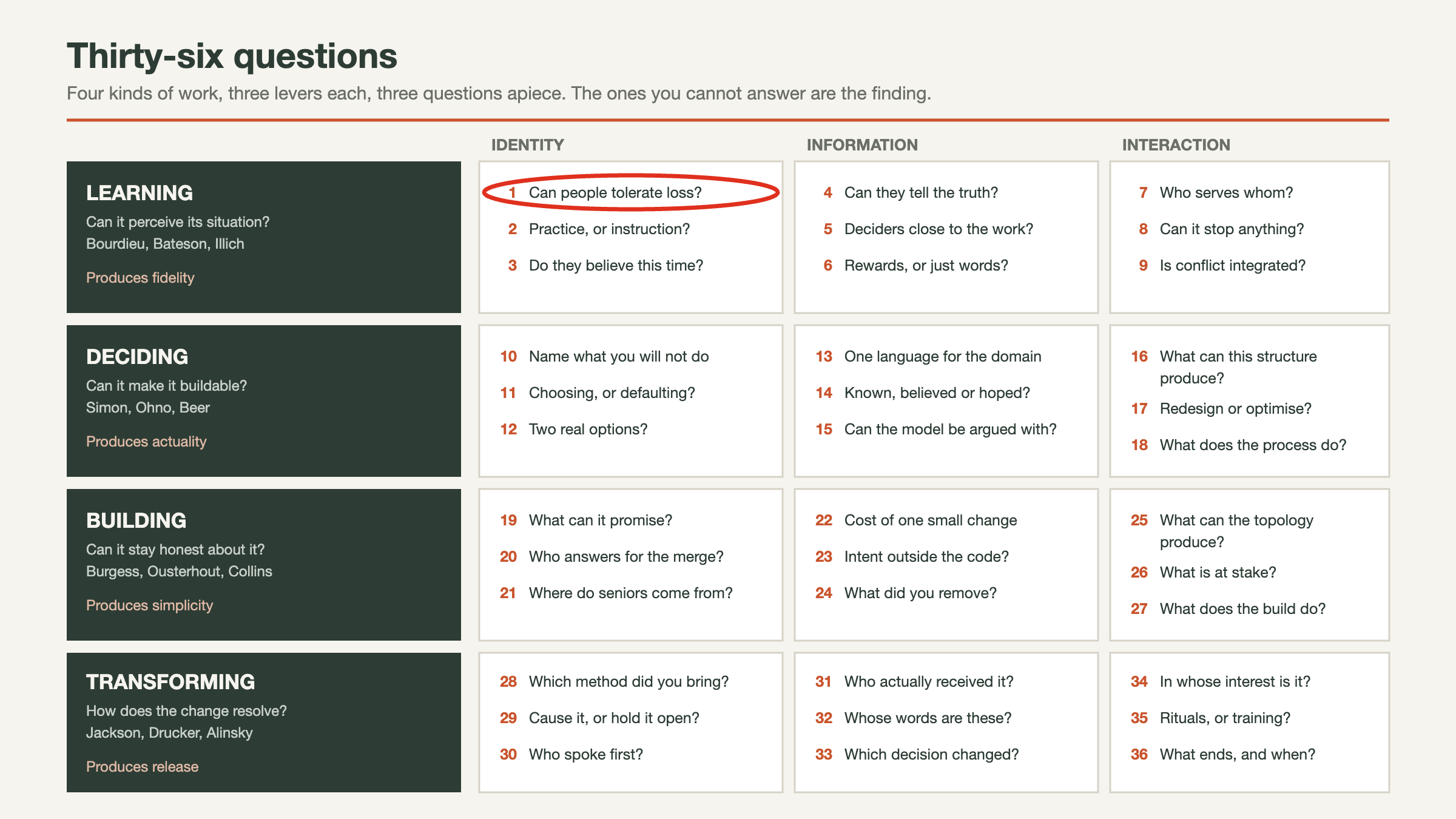
1. Question
Can people tolerate losing what they have?
Ask it of a named group about a specific change, and answer it with names. Not whether the organisation embraces change, which nobody has ever answered honestly and which invites the answer the asker wants. The question is whether these particular people, whose behaviour has to alter for this particular change to work, can survive what the alteration costs them in standing, in expertise, and in the thing they are known for being good at.
The answer is rarely no. Usually it is that nobody has counted.
2. Purpose
The question separates two problems that look identical from a distance and take opposite treatments. A communication problem means people missed the message, and more explanation helps. A loss problem means people have understood it precisely, and more explanation makes it worse, because each repetition confirms that whoever is explaining has not noticed what they are asking for. Organisations spend their first six months treating the second as the first, which is why the remedy so often becomes the aggravation.
It also tells you where the change will stall and what it will be called when it does. An unpriced loss does not stay quiet. It comes back as a risk concern, a sequencing question, a request for one more assessment, a governance step whose origin nobody can reconstruct a year later.
You can hear it before anyone admits to it. The signature is technical precision, deployed at length, against one small feature of the new way of working: the edge cases, the failure modes, the audit trail, the scenario the tool handles badly. Every objection is correct. That is why the argument cannot be won on its own ground. Expertise is being spent to defend expertise, and the most articulate people do it best, because they have the most to lose and the best vocabulary for the defence.
Answering the question removes nothing. Nothing removes the loss. What it buys is the difference between a cost you have counted and a cost that turns up eighteen months later under another name.
3. Context
Pierre Bourdieu named the mechanism. A habitus is the set of durable dispositions a person acquires by succeeding in a particular field over years: what to notice, what counts as good work, what a serious problem looks like, how fast to answer. You do not choose it and you cannot be argued out of it, because it operates below the level at which argument lands. Beside it sits capital, meaning the specific expertise a field currently rewards. When the field revalues, the capital held by the incumbents falls while the dispositions that earned it keep running exactly as before. Bourdieu called that lag hysteresis. From outside it looks like stubbornness; it is a well-adapted person continuing to play well a game whose scoring has changed.
Kahneman and Tversky supply the weighting. A loss is felt at roughly twice the intensity of a gain of the same size, so a change with a clear net benefit on the business case can be a net negative in experience. The gain is diffuse, shared and in the future. The loss is specific, personal and immediate. The spreadsheet and the person are both right, and only one of them has to turn up on Monday.
Ronald Heifetz drew the distinction that decides your options. A technical problem is solved by applying expertise that already exists, and people are grateful when you solve it. An adaptive challenge requires the people who have the problem to change what they value and how they work, and no expertise substitutes for that. His hardest sentence is that people do not resist change, they resist loss. The common failure is not ignoring this. Leaders convert the adaptive challenge into a technical one, because a technical problem can be handed to a programme and an adaptive one cannot.
Robert Kegan explains why sincerity is not enough. A person can want the change and at the same time hold a second commitment incompatible with it, protected by an assumption they have never examined. The architect who wants the teams to move faster is also committed to being the person nothing gets past, because being that person is what keeps him safe. Both commitments are real. The resistance is not sabotage, it is the second commitment doing its job, and it will keep doing it until the assumption underneath is tested rather than argued with.
The loss rarely reaches you in its own words. Chris Argyris described defensive routines run so smoothly that the person running them cannot see them, and Erving Goffman showed the meeting to be a performance in which everyone collaborates to protect everyone’s face. So the loss arrives translated. It arrives as architecture, as compliance, as a concern about quality, as a diary that is somehow full. We in technology are unusually good at this, because our professional register supplies an inexhaustible stock of legitimate-sounding objections and no vocabulary at all for saying that something we were good at has stopped mattering.
Two further findings decide how hard the loss lands. Richard Sennett argues that skill is made in the doing, over years, and held in the hands as much as the head, so what is lost is not information a course can restore. And Carol Dweck found that where an organisation treats ability as innate rather than made, losing a competence is experienced as losing a self. Genius cultures produce the most brittle response to devaluation, because they have taught everybody that what you can do is what you are.
Alasdair MacIntyre gives the whole thing its proper name. He described the moment when a tradition can no longer explain its own failures in its own terms, and called it an epistemological crisis. That is what a serious change does to a working life. What has broken is not the person’s skill set. It is the story in which the skill set made sense, which is why reskilling offered on its own lands as an insult: it answers a question about employment when the question was about meaning.
4. Action
Do the loss inventory yourself, before the next communication goes out.
Take an hour with the three or four people who know the work well enough to be embarrassing. List the groups whose behaviour has to change, by team, and by name where the group is small. For each one, write a single sentence saying what they will be worse at, less needed for, or less admired for once the change lands. Write it in their words rather than yours. If the sentence is one they would recognise and agree with, you have it. If it reads like a benefit with a caveat attached, you have written the deck again.
Then write the second sentence beside it. Which part of their judgement does the new way need more than the old way did? Whatever goes in that column is the honest offer, and it has to be specific enough for somebody to check. Some rows will have no second sentence, and those are the people for whom this change is a loss with nothing on the other side. The decent options there are a different role or a negotiated exit, arranged early and paid for properly. Dressing that row as an opportunity is the fastest way to lose the credibility every other row depends on.
Now change one structure this month, and only one. Pick a structure rather than a message, a workshop or a principle, because a person cannot be talked into a feeling and can be moved by a changed arrangement. Rank the candidates by how loudly they speak. The first promotion after the change tells everybody what is now valuable, more precisely than any communication will. Then comes what the performance review asks for, who sits in the weekly meeting where the real work gets discussed, and what visibly happens to the first person who says the difficult thing.
Alongside it, run one mastery experience, which Albert Bandura identified as the only reliable source of belief that effort will produce a result. A real team, a real problem, the new way, in public. Choose the team because the sceptics respect them, not because success is likely, and let the result stand whichever way it goes.
Ninety days later, ask one question and accept only evidence. Is the person who lost the most now the one explaining the new practice to their peers? Where the answer is yes, the loss has been paid for. Where it is no, the loss is still sitting somewhere in the organisation, unnamed and drawing interest.
A field that revalued its currency once will revalue it again. What an organisation gets from doing this properly is not a completed change but a group of people who have been through one devaluation with their standing intact, and they are the reason the next one costs less. They will not be more willing because they were persuaded. They will be more willing because last time somebody counted the cost out loud, and it turned out to be survivable.
This question sits in the Learning group of the series, the articles asking whether an organisation can perceive its own situation accurately enough to respond to it. What an organisation gets out of that work is fidelity, meaning an account of its situation that matches the situation. The route from there into deciding what to do about it is set out in From Learning to Clarity.
Further Reading
Pierre Bourdieu, Outline of a Theory of Practice (1977), borrowable at https://archive.org/details/outlineoftheoryo0000bour, for habitus, capital and the hysteresis that follows a change in the field.
Daniel Kahneman and Amos Tversky, Prospect Theory, Econometrica (1979), free at https://courses.washington.edu/pbafhall/514/514%20Readings/ProspectTheory.pdf, for loss aversion.
Ronald Heifetz, Leadership Without Easy Answers (1994), borrowable at https://archive.org/details/leadershipwithou00heif, for the technical and adaptive distinction and for holding distress at a survivable level.
Robert Kegan and Lisa Lahey, Immunity to Change (2009), for the competing commitment and the big assumption that protects it.
Richard Sennett, The Craftsman (2008), for skill as something made in the doing and therefore not restorable by instruction.
I write about the industry and its approach in general. None of the opinions or examples in my articles necessarily relate to present or past employers. I draw on conversations with many practitioners and all views are my own.
Justin, this is a powerful way of making the cost of change visible. Your point that people may be reading a devaluation correctly is especially important. What looks like resistance may contain knowledge about both the work and what the change is asking people to give up.
Your essay also raised a further question for me: what happens to an organisation’s future judgement when the work through which that judgement was formed is automated away?
People acquire expertise through repeated encounters with cases, decisions and consequences. When those returns disappear, the organisation may lose both the standing of experienced practitioners and the means of forming their successors.
That seems to sit alongside your question of survivable loss: what must a transformation preserve or create so that judgement can continue to grow?