
The previous article argued that the quality of your organisation’s orientation determines the quality of everything it does. Boyd showed that decision-making is not a sequence of discrete steps but a continuous cycle of observation, orientation, decision, and action, with orientation at the centre. Get your orientation right and you can adapt faster than your environment changes. Get it wrong and speed only accelerates your collision with reality.
But Boyd’s framework carries a hidden assumption: that the environment, however fast-moving, is knowable in principle. Orient accurately enough, cycle fast enough, and you will stay ahead. Nassim Nicholas Taleb spent five volumes and twenty-one years as a derivatives trader demonstrating that this assumption is false. Not occasionally false. Structurally false. The domains in which organisations make their most consequential decisions are dominated not by the events their models can anticipate but by the events their models cannot. The question is not how fast you can orient. It is what you do when the thing that happens is the thing your orientation did not prepare you to see.
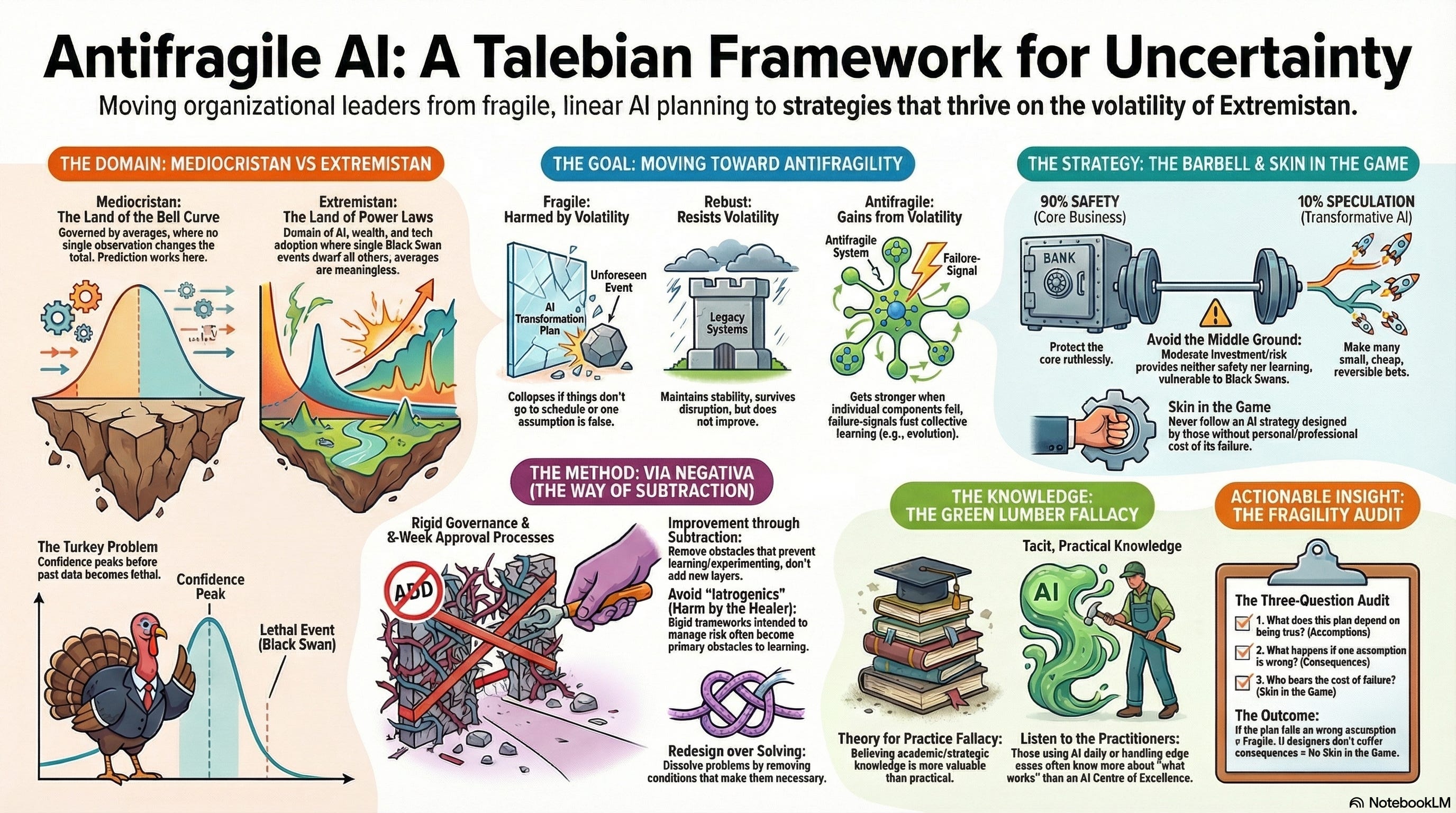
1. The Turkey Problem: Why Your AI Business Case Is a Confidence Trick
Taleb’s most vivid illustration is the turkey. A turkey is fed by a butcher every day for 1,000 days. Each day of feeding increases the turkey’s statistical confidence that butchers love turkeys. The turkey’s confidence is at maximum on day 1,000. Day 1,001 is Christmas.
The point is not that bad things happen. The point is that the turkey’s model was built from the same data that produced the catastrophe. Every observation confirmed the model. The model was perfectly consistent with the evidence. And the model was lethally wrong, not because the data was bad but because the domain was one in which past data does not predict the future in the ways that matter most.
Taleb divides the world into two domains. Mediocristan is governed by bell curves: height, weight, daily calorie intake. No single observation can dramatically change the aggregate. Averages are meaningful. Prediction works. Extremistan is governed by power laws: wealth distribution, book sales, stock market returns, technological adoption. A single observation can dwarf all others combined. Averages are meaningless. The turkey’s problem is that it lives in Extremistan while using Mediocristan tools.
AI transformation lives in Extremistan. Your business case projects linear adoption curves. Your governance framework assumes risks are enumerable. Your roadmap forecasts three-year ROI based on current conditions. Every one of these is a bell-curve tool applied to a power-law domain. The confidence they generate is the turkey’s confidence: highest just before it becomes lethal.
2. The Fragile, the Robust, and the Antifragile
Taleb’s most important contribution is not the Black Swan. It is what comes after: the fragile-robust-antifragile triad. Fragile things are harmed by volatility: the crystal glass, the leveraged company, the transformation plan that depends on everything going according to schedule. Robust things resist volatility: the rock, the legacy system that keeps working through organisational upheaval. Antifragile things gain from volatility: bones that strengthen under stress, immune systems that improve through exposure, ecosystems where individual failures produce collective learning.
The insight is that robustness is not the opposite of fragility. Antifragility is. Most organisations aim for robustness in their AI strategies: survive the disruption, manage the risk, maintain stability. Taleb says this is the wrong ambition. The right ambition is to build an organisation that gets better because it encounters disruption.
This requires a principle that most organisations find viscerally uncomfortable: antifragility of the system requires fragility of its components. Evolution is antifragile because individual organisms die. The restaurant industry is antifragile because individual restaurants fail constantly. Startup ecosystems are antifragile because most startups collapse. The information generated by failure flows to the system level. Organisations that prevent all failure at the component level make the system fragile; they suppress the signal that failure provides. This is why zero-failure cultures do not produce zero failures. They produce catastrophic ones.
Klein showed that expert intuition works in high-validity environments with regular feedback. Taleb adds the uncomfortable corollary: in Extremistan, the feedback that matters most is the feedback you get from failure, and an organisation that has optimised failure out of its process has optimised learning out of its system.
3. Via Negativa: Stop Adding Things
Taleb borrows from apophatic theology a principle that applies directly to every AI governance framework in existence: via negativa. Improvement comes through subtraction, not addition. Knowing what is wrong is more robust knowledge than knowing what is right. You know what will kill a company with more certainty than you know what will make it successful.
The practical consequence: instead of asking “what should we add to our AI strategy?”, ask “what is currently preventing people from learning to use AI, and can we remove it?”
This connects directly to Beer’s POSIWID: the purpose of a system is what it does. Via negativa says look at what the system actually does that is harmful and remove it. The governance process that takes eight weeks to approve an experiment. The procurement policy that restricts teams to a single vendor. The training programme that teaches people about AI without letting them use it. The risk assessment that treats every novel use case as equally dangerous. These are not safeguards. They are iatrogenics: harm caused by the healer. The governance system designed to manage AI risk is, in practice, the primary obstacle to the learning that would reduce AI risk.
Ackoff would recognise this immediately. His distinction between dissolving a problem (redesigning the system so the problem no longer arises) and solving it (finding the answer within the existing system) is the systems-thinking version of via negativa. You do not need a better AI governance process. You need to remove the conditions that make the current one necessary.
4. The Barbell: How to Transform Without Betting the Company
The barbell strategy is Taleb’s answer to the question of how to act in Extremistan. Combine extreme safety with extreme speculation. Protect the core ruthlessly: keep the business running, maintain revenue, preserve capability. Simultaneously make small, cheap, reversible bets on transformative possibilities. Avoid the middle ground, where risks are hidden and returns are mediocre.
The middle ground is where most enterprise AI strategies live. Moderate investment. Moderate ambition. Moderate risk. Enough commitment to generate cost but not enough to generate learning. Enough governance to slow things down but not enough to prevent genuine catastrophe. The barbell says this is the worst position: you get harmed by Black Swans without benefiting from them.
Boyd’s destruction and creation is the barbell applied to orientation. The safe side is the organisation’s operational capability; the speculative side is the deliberate destruction and rebuilding of mental models. You cannot create a new strategic concept without first destroying the old one. The organisation that protects its current orientation while refusing to challenge it is robust at best; the organisation that treats orientation itself as something to be continuously rebuilt through contact with reality is antifragile.
Simon’s satisficing is option-compatible: you do not need the optimal AI strategy; you need a good-enough strategy that preserves your ability to change course when the environment reveals something your model did not predict. The search for the optimal strategy is itself fragile, because it assumes you can know enough to optimise.
5. Skin in the Game: Who Bears the Cost of Being Wrong?
Taleb’s final volume, Skin in the Game, extends antifragility into ethics. The principle is simple: never take advice from someone who does not bear the consequences of being wrong. The most common asymmetry in enterprise AI transformation is that the people who design the strategy (executives, consultants, governance boards) bear none of the implementation risk, while the people who must change their daily work bear all of it. This asymmetry guarantees resistance, because the people with the most at stake have the least influence on the design.
Argyris diagnosed the same pattern from a different angle: the gap between espoused theory and theory-in-use persists because the people who espouse the theory do not live with the consequences of its failure. Model II learning requires the willingness to expose your reasoning to disconfirmation, to bear the personal cost of being wrong in public. That is skin in the game applied to organisational learning.
The test for any AI transformation initiative: will the people who designed it personally experience the disruption they are imposing? Will the executive who mandated the change use the tools they are mandating? Will the consultant who recommended the strategy be present when the consequences arrive? If the answer is no, the strategy is fragile by design, because the people making the decisions have no mechanism for learning from the outcomes.
6. The Green Lumber Fallacy: What Your Experts Actually Know
A trader named Joe Siegel made enormous profits trading green lumber while believing it was lumber painted green. It is actually freshly cut, undried lumber. Meanwhile, people with sophisticated theoretical knowledge of the lumber market went bankrupt.
The green lumber fallacy is the error of mistaking the kind of knowledge that sounds important from the outside for the kind of knowledge that actually drives performance. It is rampant in enterprise AI. Organisations invest heavily in AI literacy programmes, strategic frameworks, and governance architectures while neglecting the tacit, practical knowledge that people develop through daily use. The engineer who has spent three months using AI-assisted coding tools knows things about what works that no amount of strategic planning can replicate. The customer service representative who has figured out how to use an LLM to handle edge cases has domain knowledge that the AI Centre of Excellence does not possess.
Klein’s pattern library is built through practice in high-validity environments. Taleb’s green lumber fallacy says the same thing from the other direction: the knowledge that matters is not the knowledge that sounds impressive; it is the knowledge that has been tested through contact with reality. Your AI strategy should be designed by the people who use AI, not by the people who study it.
7. What Taleb Means for the Series
Every thinker in these articles has been building a picture of what clear, effective decisions look like. Simon showed that decisions are bounded by what the organisation can see. Evans showed that precision of language determines precision of thought. Beer showed that information architecture determines what the organisation can know. Boyd showed that the speed and quality of orientation determines whether the organisation can adapt. Taleb completes the picture by insisting on what none of them quite says: that the domain in which these decisions are made is one where the most consequential events are the ones no model anticipated.
This is not fatalism. It is the opposite. Taleb’s entire project is an argument for action: not planned action based on prediction, but positioned action based on the asymmetry between what you can lose and what you can gain. Protect the downside. Create optionality on the upside. Make many small bets where failure is cheap and learning is rich. Remove what is harmful before adding what might be beneficial. Ensure that the people making decisions bear the consequences of being wrong.
Your AI transformation does not need a better forecast. It needs a structure that gets stronger when the forecast is wrong.
Where this falls: Deciding, the second of the four phases; Learning, Deciding, Building, Transforming. Taleb is a Deciding thinker because his subject is what you are entitled to claim in a description, and the honest answer under uncertainty is a great deal less than a forecast. What comes out of it is a specification that can survive being wrong. From Deciding to Building leads to the articles where being wrong is the point.
(An Organisational Prompt is something you can do now....)
Organisational Prompt
Run a fragility audit on your AI transformation.
Take your current AI strategy document, roadmap, or transformation plan. For every major commitment, ask three questions. First: what does this depend on being true? List every assumption about technology readiness, adoption rates, budgets, timelines, and organisational support. Second: what happens if any one of these assumptions is wrong? If the answer is “the plan fails,” the commitment is fragile. Third: who bears the cost of failure? If the people who designed the strategy do not personally experience the consequences of its failure, you have a skin-in-the-game problem that no governance framework can fix. A strategy that survives contact with these three questions is robust. A strategy that gets better because you asked them is antifragile. Most will not survive the first.
Further Reading
Nassim Nicholas Taleb: The Black Swan: The Impact of the Highly Improbable - The flagship work. Mediocristan versus Extremistan, the narrative fallacy, the ludic fallacy, and the argument that the events that matter most are the events our models cannot predict.
Nassim Nicholas Taleb: Antifragile: Things That Gain from Disorder - The positive agenda. The fragile-robust-antifragile triad, the barbell strategy, via negativa, optionality, and the green lumber fallacy. The most directly applicable Taleb book for anyone running a transformation.
Nassim Nicholas Taleb: Skin in the Game: Hidden Asymmetries in Daily Life - The ethics of decision-making under uncertainty. Why symmetry of risk-bearing is the foundation of sound decisions, and why strategies designed by people who do not bear the consequences are structurally fragile.
Nassim Nicholas Taleb: Fooled by Randomness: The Hidden Role of Chance in Life and in the Markets - The foundational text on survivorship bias and the systematic overestimation of skill relative to luck. Where the Incerto begins.
Nassim Nicholas Taleb: Statistical Consequences of Fat Tails - The technical companion. For readers who want the mathematical foundations behind the arguments. Freely available.
Disclaimer
I write about the industry and its approach in general. None of the opinions or examples in my articles necessarily relate to present or past employers. I draw on conversations with many practitioners and all views are my own.