
Most of the people in a transformation meeting are not developmentally equipped to do what the meeting is asking of them. Nobody says this out loud. True anyway.
Not because they are stupid, and not because they lack training. The meeting asks them to step outside their own assumptions, weigh competing frameworks, and make independent judgements about a future they cannot yet see. For most adults that is not a skill gap but a developmental one. The mind that would do the weighing has not yet formed.
Robert Kegan, a developmental psychologist who spent forty years at the Harvard Graduate School of Education, built his career on one observation: modern work demands a quality of mind that most adults have not developed, and nobody has noticed the mismatch. His work with Lisa Laskow Lahey on immunity to change, and their idea of the deliberately developmental organisation, gives both the diagnosis and the start of a response. If you have watched a talented team agree enthusiastically to a change and then fail completely to enact it, Kegan explains the structure of that failure.
1. Subject and Object: The Mechanism Nobody Sees
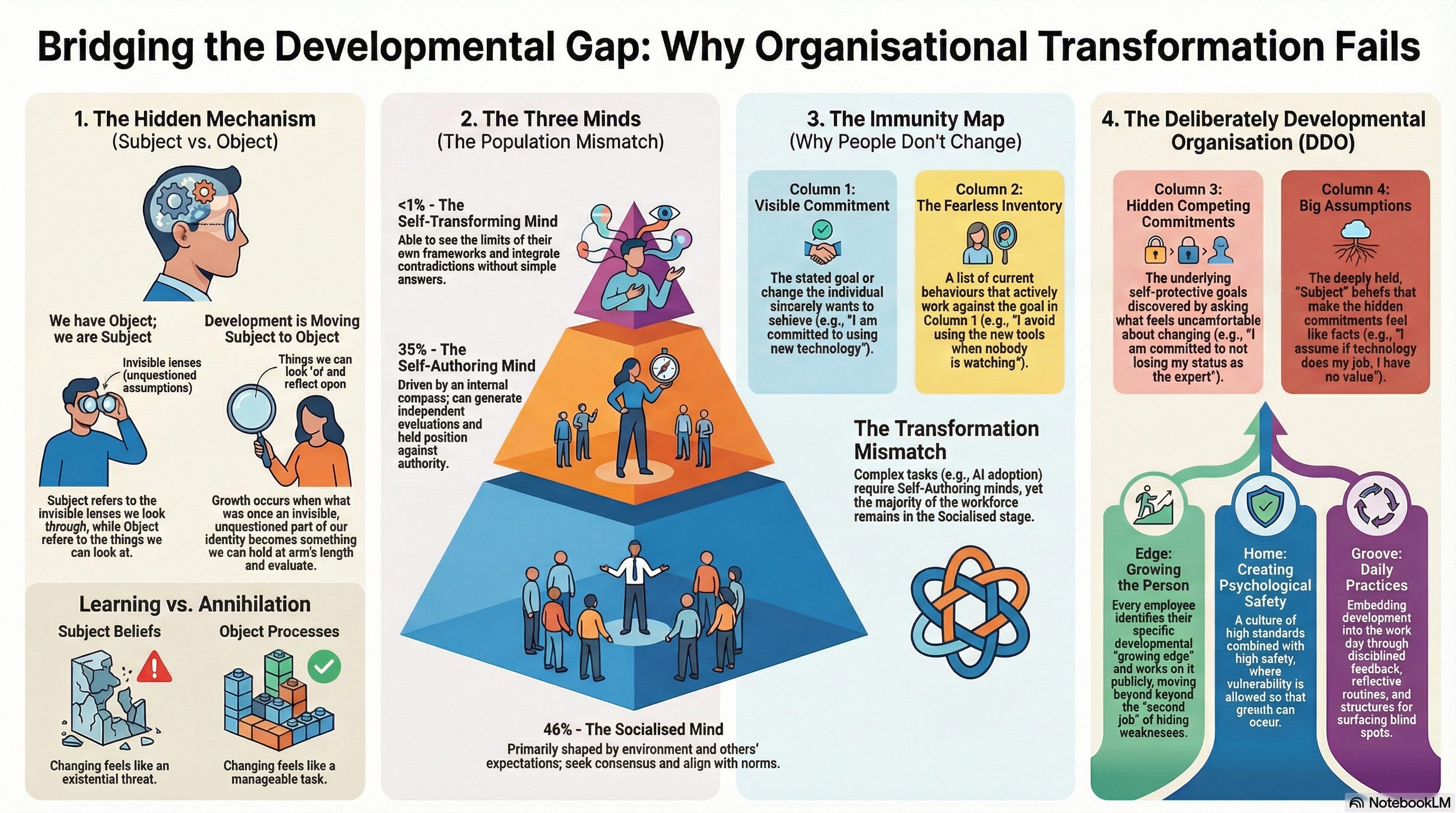
Kegan’s framework rests on one distinction. At any point in your development, some of your meaning-making is Subject to you and some is Object. You are embedded in what is Subject. It cannot be examined, because you are looking through it. What is Object you can hold at arm’s length, reflect on, and make choices about. Kegan’s formulation: “We have Object; we are Subject.” That distinction decides whether someone can do what your transformation programme requires.
Ask someone to change a habit, a technique or a process, and you are asking them to modify something that is probably Object to them. That thing is visible, handleable, revisable. That kind of change is uncomfortable and manageable. Ask someone to change a foundational assumption about how value is created, what expertise means, or how their professional identity works, and you may be asking them to change something that is Subject. That thing is invisible and unquestionable, experienced not as a belief but as the way the world is. That kind of change does not feel like learning. It feels like annihilation.
Argyris saw this happening without naming the mechanism. His smart professionals who resisted learning were defending governing variables they could not see. Kegan explains why they could not see them. Those governing variables were Subject. They were not beliefs the professionals held; they were the lens through which the professionals saw everything else. You cannot examine a lens while you are looking through it.
Development, in Kegan’s framework, is the process by which what was Subject becomes Object. What used to be invisible becomes visible. What used to have you, you now have.
2. The Three Minds and the Mismatch That Breaks Transformation
Kegan describes five orders of mental complexity, and for professional life three matter.
The socialised mind is shaped by the expectations and definitions of its environment. This is not weakness but the most common adult stage, covering roughly 46 per cent of the population. The person at this stage is a capable team player, a faithful follower, someone who aligns with the norms of their professional community. Their meaning-making is co-constructed with valued others: the boss, the team, the professional network. When those authorities agree, the socialised mind is effective and reliable. When they disagree, the person experiences not confusion but something closer to being torn apart, because the conflict is not between two opinions but between two parts of the self.
The self-authoring mind has an internal compass. This person can step back from the social environment, generate independent evaluations, and decide on self-authored criteria. They can hold a position when valued authorities disagree. About 35 per cent of adults operate here. That is the minimum developmental capacity for the work most modern organisations demand: independent judgement, self-directed problem-solving, the ability to specify what needs doing without waiting to be told.
The self-transforming mind, reached by fewer than 1 per cent of adults, can hold even its own ideology as Object, seeing the limits of its own framework and integrating contradictions rather than resolving them. Such a mind tolerates paradox and refuses to reduce complexity to a simple answer, which almost nobody in your organisation is being developed to do.
Kegan’s research suggests that deciding how to adopt AI demands at least self-authoring capacity. Most adults are at the socialised stage or in the transition beyond it. Ask a team to evaluate AI opportunities for their function and you are asking for self-authoring work: independent assessment, prioritisation against self-authored criteria, judgement calls that may contradict what the rest of the organisation thinks. A socialised professional will not refuse this task. They will do something more damaging. They will look to see what their leaders and peers think, align with that, and present the result as independent judgement. The transformation gets consensus without insight. Everyone agrees, and nothing changes.
Weick would call this a sensemaking failure, and Kegan goes underneath it. The problem is not that people fail to make sense. The structure of their meaning-making cannot produce the kind of sense the situation demands.

3. The Immunity Map: Why Willing People Do Not Change
Kegan and Lahey’s most practical contribution is the immunity map, a four-column diagnostic that shows why people who sincerely want to change consistently fail to.
The first column is the commitment, meaning what the person genuinely wants to achieve: “I am committed to using AI tools to improve my practice.” The second is the fearless inventory of what they do instead, which is rewriting AI-generated work from scratch, avoiding the tools when nobody is watching, and finding reasons the output is never quite good enough. The third column is discovered by asking what it would feel like to do the opposite of those behaviours, and it reveals a hidden competing commitment: “I am also committed to not being seen as someone who cannot do the work themselves, and to not losing my status as the expert.” The fourth surfaces the big assumptions that make the hidden commitment feel necessary: “I assume that if AI can do what I do, I am no longer valuable. I assume my worth is defined by my technical skill, not my judgement.”
One foot on the accelerator and one on the brake. The person is not resistant but immune. The hidden commitment serves a genuine self-protective function, resting on assumptions that feel less like beliefs than like facts about the world.

This is where Kegan operationalises what Argyris diagnosed. The big assumptions in the fourth column are the governing variables Argyris argued must change for double-loop learning to happen, and the immunity map makes them visible. Kegan adds the developmental dimension Argyris lacked. Whether someone can examine those assumptions depends on their stage of development. A socialised professional whose big assumption is that their worth is defined by what their peers think of their expertise cannot hold that assumption as Object, because their meaning-making is that social evaluation. The assumption is not something they have. It is something they are.
Heifetz would call this adaptive work. The challenge is not technical, meaning a lack of skills, but adaptive, requiring a change in values, beliefs or self-concept. The immunity map is the diagnostic for the hidden dynamics that appear when people cooperate with change while systematically preventing it.
4. Building What Most Organisations Waste
Kegan’s most ambitious claim concerns organisational design. In most organisations, he argues, people are doing a second job nobody is paying them for: hiding weaknesses, managing impressions, looking competent. That second job is the single biggest waste of organisational resources, and it stays invisible because everyone is doing it.
The deliberately developmental organisation weaves personal development into daily operations through three dimensions. Edge means every person identifies their specific growing edge and works on it publicly, not just the high-potentials. Home means genuine safety for the vulnerability that growth demands, combined with high standards, which is Edmondson’s learning zone where psychological safety meets accountability. Groove means the daily practices that embed development into normal work: disciplined feedback, reflective routines, structures for surfacing blind spots.
For AI transformation, this reframes the whole challenge. The question is not how to train people on AI tools. Training is informational learning, adding new content to an existing mindset. The question is how to develop the capacity to evaluate, integrate and specify AI-augmented work independently. That is transformational learning, changing the form of the mindset itself. The first needs a training programme. The second needs a different kind of organisation.
Your AI transformation is not failing because people lack skills. It is failing because the work demands a mind most of your people have not had the opportunity to develop, and your organisation is designed to ensure they never do. Westrum’s cultural typology maps onto this directly. A pathological culture enforces socialised behaviour, self-protection and conformity, while a generative culture creates the conditions for self-authoring development. You cannot develop complex minds inside a culture designed to suppress complexity.
An Organisational Prompt
Where this sits: Learning, the first of four phases, ahead of Deciding, Building and Transforming. The Learning articles ask whether an organisation can perceive its own situation, and Kegan explains why some of what needs perceiving is not available to the person doing the perceiving. What an organisation gets out of that work is the movement of an assumption from Subject to Object, which is perception in the most literal sense. Kegan returns in Deciding, where the same developmental account is applied to the capacity to commit, and From Learning to Clarity is the bridge.
(An Organisational Prompt is something you can do now, in your organisation, to put the ideas in this article to work.)
Run One Immunity Map on Your Own AI Adoption
Pick a specific AI adoption goal you hold and have not enacted. Write the first column: “I am committed to...” Then the second: what you do instead. Then ask what feels most uncomfortable about imagining the opposite of those behaviours, and write the third: “I am also committed to not...” Finally the fourth: “I assume that if...” Do not try to fix anything. Look at what the map reveals.
Chapter 9 of Kegan and Lahey’s Immunity to Change, which walks through the diagnostic step by step, is freely available as a PDF.
Further Reading
Robert Kegan and Lisa Laskow Lahey
Immunity to Change: How to Overcome It and Unlock the Potential in Yourself and Your Organization - The full immunity map diagnostic and the connection between adult development and organisational change.
An Everyone Culture: Becoming a Deliberately Developmental Organization - The DDO concept with three detailed case studies.
The Real Reason People Won’t Change - The original article introducing competing commitments and the immunity to change framework.
Minds at Work: Diagnosing Your Own Immunity to Change (Chapter 9 PDF). The practical diagnostic exercise, freely available.
Jennifer Garvey Berger
Changing on the Job: Developing Leaders for a Complex World - The most accessible practitioner-oriented account of Kegan’s developmental stages applied to leadership.
Related Background
Harvard Graduate School of Education: The Immunity to Change Approach. Overview of 30 years of adult developmental research.
Key Concepts for Understanding the Work of Robert Kegan - Concise practitioner-oriented summary of the Subject-Object framework.
I write about the industry and its approach in general. None of the opinions or examples in my articles necessarily relate to present or past employers. I draw on conversations with many practitioners and all views are my own.