
Another philosophical interlude…
Ask anyone in your organisation what they are doing. You will get an answer. The developer will say “building the new API.” The product manager will say “delivering the Q3 roadmap.” The transformation lead will say “driving AI adoption.” Now ask each of them why. Not “what is the business case”; they can recite that. Ask them why in a way that connects what they are doing right now, today, at their desk, to what the organisation is trying to achieve. Ask them to trace the chain: I am doing this in order to achieve that, which contributes to this larger thing, which serves that purpose. Most will stall within two links. Not because they are incompetent, but because the organisation has never required the chain to exist. The action happens. The reasons are somewhere else, in a strategy deck nobody re-reads, in an OKR nobody believes, in a vision statement composed by people who have never done the work it describes. The action and the intention have been separated, and nobody noticed because the work kept getting done.
G.E.M. Anscombe, the British philosopher whose 1957 monograph Intention is widely regarded as the most important treatment of human action since Aristotle, explains why this separation matters and what it costs. Michael Bratman, whose planning theory of intention built on Anscombe’s foundations to explain how intentions structure coordination over time and between people, explains why the separation is especially devastating for organisations attempting to act together.
Between Anscombe and Bratman, they provide the sharpest philosophical account of a problem this series has circled from multiple directions: the problem of knowing what you are doing, and why, in a way that makes your action genuinely yours.
Anscombe’s Intention is a dense, technically demanding work that engages with Aristotle, Aquinas, and Wittgenstein, and has generated decades of specialist debate about practical knowledge, non-observational self-knowledge, and the metaphysics of action. Bratman’s planning theory draws on and responds to Davidson, Searle, and Gilbert, and extends into contested territory about collective intentionality and institutional agency. This article focuses on the concepts most directly relevant to anyone leading organisational transformation.
1. Intention Is Not a Mental State: It Is Knowing What You Are Doing
The natural assumption is that an intention is something that happens inside your head before you act. You form a plan, you decide, and then you execute. Intention is the mental event; action is the physical consequence. Anscombe dismantles this picture completely.
Her central claim is that intentional action is action that is known by the agent under a description for which a particular sense of the question “Why?” has application. This requires unpacking.
When you do something, many true descriptions apply simultaneously. You are moving your fingers. You are typing. You are writing a specification. You are contributing to the Q3 delivery milestone. All of these may be true at the same moment. But they are not all intentional in the same way.
An action is intentional under a specific description if and only if the agent can answer “Why are you doing that?” with a reason, not merely a cause.
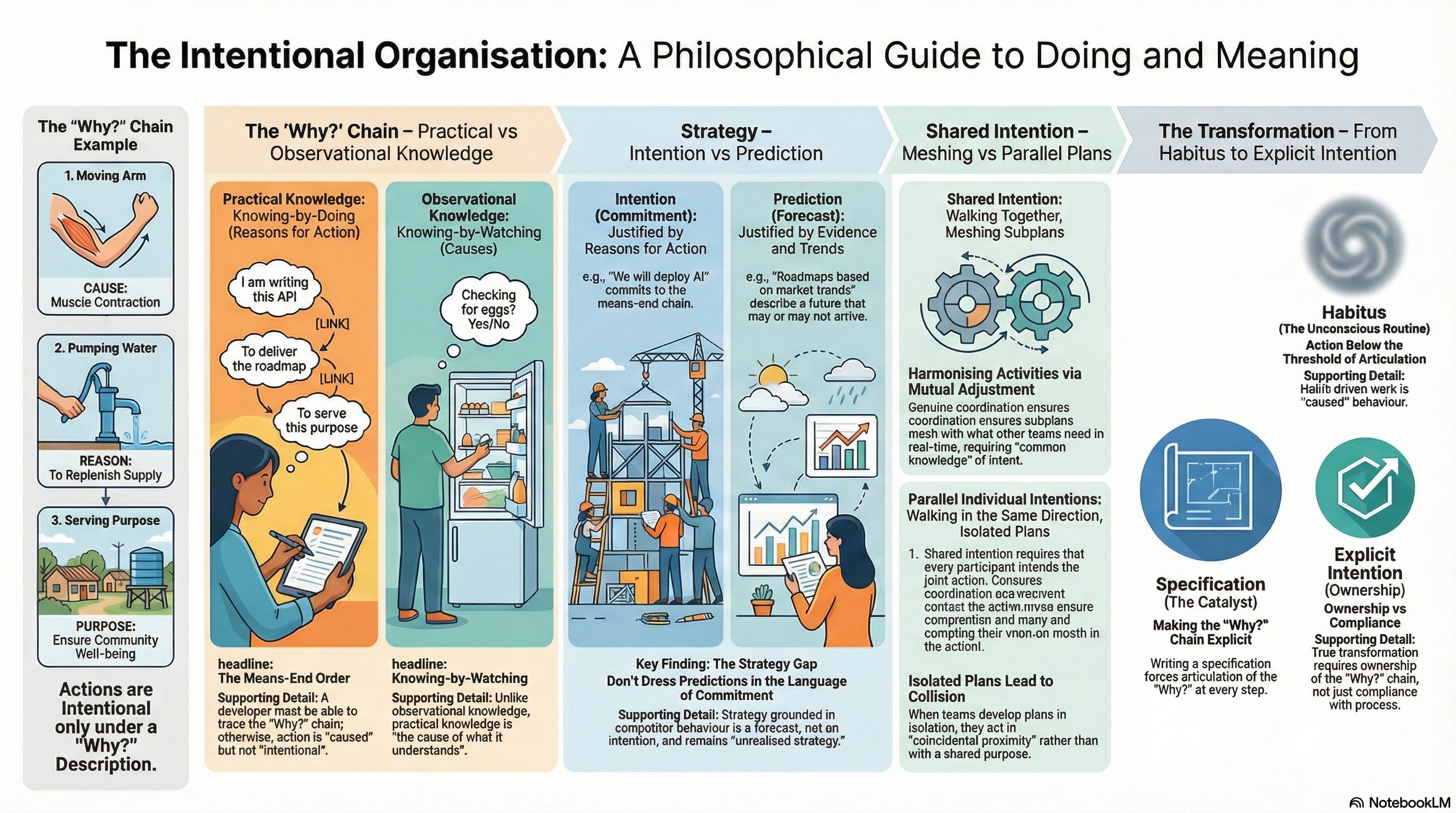
The distinction between reasons and causes is critical. If someone startles you and you knock over a cup, you can explain what happened: “The noise made me jump.” But this is a cause, not a reason. You did not knock over the cup in order to achieve anything. The question “Why did you knock over the cup?” does not have the right kind of answer. By contrast, if you are pumping water in order to replenish the house’s supply, and you know that the water has been poisoned, then you are poisoning the inhabitants intentionally, because you can trace the “Why?” chain: I am moving my arm in order to pump water, in order to replenish the supply, which will poison the inhabitants. Each link answers the question “Why?” by pointing to the next. This is Anscombe’s means-end order, and it is the structure that makes an action intentional.
Drucker’s insistence that the knowledge worker must define the task before they can do it is possibly a management expression of Anscombe’s philosophical point. If the worker cannot answer “Why?” with a reason that connects to a larger purpose, the work is not intentional in Anscombe’s sense. It may be caused —> the habitual routines that Bourdieu describes, the practical consciousness that Giddens identifies, the theories-in-use that Argyris diagnoses. But caused action, however skilled, is not the same as intentional action. And the difference determines whether the organisation is doing what it thinks it is doing.
2. Practical Knowledge: You Know What You Are Doing Without Watching Yourself Do It
Anscombe’s most radical contribution is her account of practical knowledge. When you act intentionally, you know what you are doing. This sounds obvious, but Anscombe means something very specific. Your knowledge of your own intentional action is not based on observation. You do not know that you are writing a specification by watching your hands type, any more than you know the position of your own limbs by looking at them. You know it because you are doing it; the knowledge is, in Anscombe’s phrase, “the cause of what it understands.” This is not efficient causation (in the sense of Aristotle), nor a mental event pushing a physical one. It is formal causation: the knowledge gives the action its form, its intelligibility as a unified course of activity directed at an end.
When practical knowledge fails, the mistake is one of performance, not of judgment. If I say “I am cutting a straight line” and the line comes out crooked, the error is in the cutting, not in my knowledge of what I am doing. Contrast this with observational knowledge: if I say “there are twelve eggs in the fridge” and there are eleven, the error is in my judgment. This asymmetry is the hallmark of practical knowledge. It is knowledge that is answerable to the world in a different way than observation is.
This connects directly to what Csikszentmihalyi describes as the phenomenology of flow. In the flow state, the agent is fully absorbed in the activity, knowing what they are doing without stepping outside the action to observe it. The merging of action and awareness that Csikszentmihalyi identifies as a condition of optimal experience is, in Anscombe’s terms, the experience of practical knowledge operating without interruption.
When a governance process forces the developer to stop, document their reasoning, and wait for approval before continuing, it breaks the practical knowledge by inserting an observational requirement into what should be a continuous intentional activity. The developer is forced to switch from knowing-by-doing to knowing-by-reporting, and the flow is destroyed.

Weick’s sensemaking sits in productive tension with Anscombe here. Weick’s famous formula, “How can I know what I think until I see what I say?”, suggests that understanding is retrospective: you act first, then interpret what you did. Anscombe insists that the agent does know what they are doing, concurrently, as they do it. But the knowledge is of a “whole-in-progress”; it encompasses what you are doing and why, even before the action is complete.
But Weick and Anscombe are not contradicting each other.
Weick describes how meaning emerges retrospectively from action. Anscombe describes how intention is present throughout the action as its formal structure. You can know what you are doing (intention) before you fully understand what it means (sensemaking). This distinction matters enormously for transformation: teams can be acting intentionally, with clear practical knowledge of the specification they are writing, without yet understanding the broader significance of, for instance, specification-driven development for their organisation. The intention is present. The sensemaking comes later.
3. Why the Same Programme Can Be Both Transformation and Preservation
Anscombe’s most practically useful insight for organisations is that the same action can be intentional under one description and unintentional under another. Her example is vivid: a man pumping water is simultaneously moving his arm, operating the pump, replenishing the water supply, and poisoning the inhabitants. These are not four actions but one, described in four ways. The action is intentional under each description that the agent can connect to a reason via the “Why?” chain. If the man does not know the water is poisoned, then “poisoning the inhabitants” is a true description of what he is doing, but it is not intentional.
A transformation programme has many true descriptions. It is consuming budget. It is producing training materials. It is generating governance artefacts. It is creating new roles. It is demonstrating executive commitment. It is changing how software gets built. All of these may be true simultaneously. But under which descriptions is the programme intentional? Under which descriptions can the people involved answer the “Why?” question with reasons that connect to the stated purpose?

Argyris’ distinction between espoused theory and theory-in-use receives a boosted formulation here. Espoused theory is the description the organisation claims for its action: “We are transforming through AI.” Theory-in-use is the description under which the action is actually intentional: “We are protecting existing legacy processes.” The gap between them is not hypocrisy. It is a failure of intention. The people involved are acting for reasons; the reasons simply do not connect to the espoused purpose. And because the actual reasons are, in Argyris’ term, undiscussable, the gap persists. Nobody asks “Under which description is what we are doing intentional?” because asking the question would surface the answer that nobody wants to hear.
4. Intention vs. Prediction: Is Your Strategy a Commitment or a Forecast?
Anscombe draws a sharp distinction between an expression of intention and a prediction. “I am going to take a walk” is typically an expression of intention. “I am going to be sick” is typically a prediction. The sentence “I am going to fail this exam” is ambiguous: it could be a prediction (based on evidence of poor preparation) or an expression of intention (a deliberate plan to fail, perhaps to annoy one’s parents). The difference lies not in the grammar but in the justification. Predictions are justified by evidence that something will happen. Expressions of intention are justified by reasons for making it happen.
This distinction cuts through one of the most persistent confusions in organisational strategy. Most AI roadmaps are presented as expressions of intention: “We will deploy AI-augmented development across all teams by Q4.” But examine the justification. Is it grounded in reasons for action, a connected “Why?” chain from present activity to desired outcome? Or is it grounded in evidence, market trends, competitor behaviour, analyst predictions, the assumption that this is where things are heading whether the organisation acts or not? If the latter, the roadmap is not an expression of intention. It is a prediction dressed in the language of commitment. And predictions, unlike intentions, do not structure action. They describe a future that may or may not arrive. Intentions create the future they describe, because they commit the agent to the means-end chain that produces it.
Mintzberg’s distinction between intended and emergent strategy maps directly onto this. An intended strategy that is actually a prediction will produce what Mintzberg calls unrealised strategy: a plan that was never connected to the reasons-for-action that would have made it executable. Emergent strategy, by contrast, is intention discovered through action. Weick’s retrospective sensemaking is the mechanism by which emergent action becomes recognised as intentional: the organisation acts, observes what it did, and reconstructs a reasons-chain that gives the action the form of intention. This is not dishonesty. It is how practical knowledge works when the domain is too complex for the full means-end chain to be specified in advance.
Stacey would press further. If strategic plans are gestures that call forth unpredictable responses, then the plan is neither pure intention nor pure prediction. It is an intended gesture whose actual meaning will be determined by the interaction it provokes. Anscombe’s framework helps clarify what Stacey is saying: the leader’s gesture is intentional under the description the leader can articulate (”I am initiating AI transformation”). But the organisational response is intentional under descriptions the leader cannot predict. The junior developer who interprets the announcement as permission to stop learning a new language (because AI will write the code) is acting intentionally, for reasons, under a description the strategy team never considered.
5. Shared Intention: What It Actually Takes to Act Together
Michael Bratman extends the philosophy of intention from individual action to collective agency.
His question is deceptively simple: what makes the difference between two people who happen to be walking in the same direction and two people who are walking together? His answer is shared intention: a structure of interconnected individual intentions in which each participant intends that the group does the thing, and each participant’s subplans mesh with those of the others.
Bratman’s conditions for shared intention are demanding. For you and me to share an intention to do something together, three things must hold.
Each of us must individually intend that we do it. Not that I do my part and you do yours; each of us must intend the joint action.
Each of us must intend that the joint action proceeds in accordance with both our intentions and through meshing subplans.
All of this must be common knowledge between us. When these conditions hold, the shared intention serves three functions: it coordinates our activities, it coordinates our planning, and it structures our bargaining when we disagree about how to proceed.
Now consider your organisation’s transformation. Does it meet Bratman’s conditions? Does each team intend that the organisation transforms, or does each team intend only to complete its own deliverables? Are the subplans meshing, or are they developed in isolation by different departments using different assumptions about what “AI transformation” means? Is there genuine common knowledge of each participant’s intentions, or is there a strategy document that everyone has read and nobody has internalised?
Many organisational “alignments” fail the meshing subplans condition. The infrastructure team plans to build a platform. The product team plans to ship features. The governance team plans to manage risk. Each plan is rational on its own terms. But the plans are developed in parallel, with different time horizons, different assumptions about dependencies, and different interpretations of what the transformation requires. They do not mesh. There is no shared intention. There is parallel individual intention, dressed in the language of collective commitment.
Fayol’s coordination function, the continuous effort to harmonise the activities of different departments, is the management practice that Bratman’s philosophy explains. Coordination is not communication. It is the work of ensuring that subplans actually mesh: that what the infrastructure team is building is what the product team needs, on the timeline the governance team can support, for reasons that connect to a shared “Why?” chain. Mintzberg would add that this meshing cannot be fully designed in advance; it emerges through mutual adjustment, which is precisely the coordination mechanism that operates when work is too complex for any other form of standardisation.
Bratman’s later work on institutional agency deepens the challenge.
Institutions can have intentions, he argues, but institutional intention is decoupled from reasons in a way that individual intention is not.
An institution can intend something through its rules and procedures without any individual member holding that intention for reasons of their own. This is Weber’s iron cage given philosophical heft: the bureaucratic system produces intentional action at the institutional level precisely by eliminating the need for individual-level intention. The system runs. The individuals comply. Nobody needs to know why.
6. From Habitus to Intention: The Transformation That Specification Demands
The deepest connection in this article is between Anscombe’s practical knowledge and Bourdieu’s habitus. Both describe action that the agent “knows” in some sense but that operates without the kind of deliberate, articulated reasoning that we typically associate with intention. But Anscombe and Bourdieu locate this knowledge differently, and the difference is the key to understanding what transformation actually demands.
Anscombe’s agent who acts with practical knowledge can answer “Why?” with reasons. The knowledge is non-observational, but it is knowledge: the agent is aware of what they are doing and can articulate the means-end chain that gives their action its intentional character. Bourdieu’s agent who acts from habitus typically cannot. The habitus generates practice “below the threshold of articulation.” The experienced developer who reaches for code rather than specification is not merely acting for a reason they can state; they are acting from a disposition so deeply inscribed that it operates before the question “Why?” can even be posed. In Anscombe’s terms, habitus-driven action is closer to caused behaviour than to intentional action. The developer’s fingers produce code kind of in the way a startled person knocks over a cup: not for a reason, but because of a disposition.
Anscombe provides a warning that most transformation programmes ignore. Practical knowledge is the agent’s own knowledge. It is not instruction-following. It is not compliance with someone else’s intention. The developer who writes a specification because they understand what they are building, why, and how the validation criteria connect to the purpose, is acting with practical knowledge. The developer who fills in a specification template because the process requires it is not. The form is identical. The intention is entirely different. One is acting for reasons they can trace through the “Why?” chain. The other is acting for the reason “the governance framework requires it,” which makes the action intentional under the description “complying with process” rather than “building the right thing.”
This is the exact corruption that Drucker diagnosed in Management by Objectives. MBO was designed to give every individual a “Why?” chain connecting their work to the enterprise purpose, with the individual free to determine the means. It was corrupted into cascaded KPIs, imposed from above, in which the individual’s only genuine intention was compliance. The specification, if it is imposed rather than owned, will suffer the same fate. The form will be completed. The intention will be absent. And Beer will observe, correctly, that the purpose of the system is what it does: produce completed specification templates, not intentional, purposeful engineering. And of course none of us want that.
Heifetz’s distinction between technical and adaptive challenges is the leadership version of this point. A technical challenge can be solved by applying existing knowledge; the leader can define the solution and the team can execute it. An adaptive challenge requires the people with the problem to change their own values, habits, and ways of working. The shift from habitus-driven practice to intentional practice is an adaptive challenge. It cannot be solved on behalf of the practitioners. They must develop their own practical knowledge, their own “Why?” chains, their own means-end reasoning. The leader who imposes the specification has solved a technical problem (the template is filled in) while avoiding the adaptive challenge (nobody has actually changed how they think about their work).
A word on placement. This is an interlude inside Deciding, the second of the series' four phases; Learning, Deciding, Building, Transforming. The Deciding articles ask whether an organisation can say what it is doing precisely enough to design against, and Anscombe's question about intention is that question at its philosophical root. What comes out of it is a description; the next one finds out whether the description survives contact with a build. Why Your Organisation Can't Decide closes the phase.
(An Organisational Prompt is something you can do now...)
Organisational Prompt
Anscombe’s test for intentional action is the question “Why?” applied to specific descriptions of what someone is doing. The test works at every level of the organisation, and it reveals the gap between what people are doing and what the organisation thinks they are doing. Apply the Bratman criteria to test two different teams working on the same outcome.
Further Reading
G.E.M. Anscombe: Intention - The foundational text. Under a hundred pages, and every one of them essential. The discussion of practical knowledge and the “Why?” question remains the starting point for all subsequent philosophy of action.
Michael Bratman: Intention, Plans, and Practical Reason - The planning theory. How intentions structure deliberation over time and filter future options. The book that made “intention” a technical concept in the philosophy of action.
Michael Bratman: Shared Agency: A Planning Theory of Acting Together - The extension to collective action. Shared intention, meshing subplans, and the conditions for genuine joint action. Essential reading for anyone who uses the word “alignment” and wants to know what it would actually require.
Michael Bratman: Shared and Institutional Agency: Toward a Planning Theory of Human Practical Organization - The further extension to institutions. How organisations can have intentions without any individual intending for the right reasons. The philosophical foundation for understanding why bureaucracies act purposefully while nobody inside them feels purposeful.
Disclaimer
I write about the industry and its approach in general. None of the opinions or examples in my articles necessarily relate to present or past employers. I draw on conversations with many practitioners and all views are my own.