
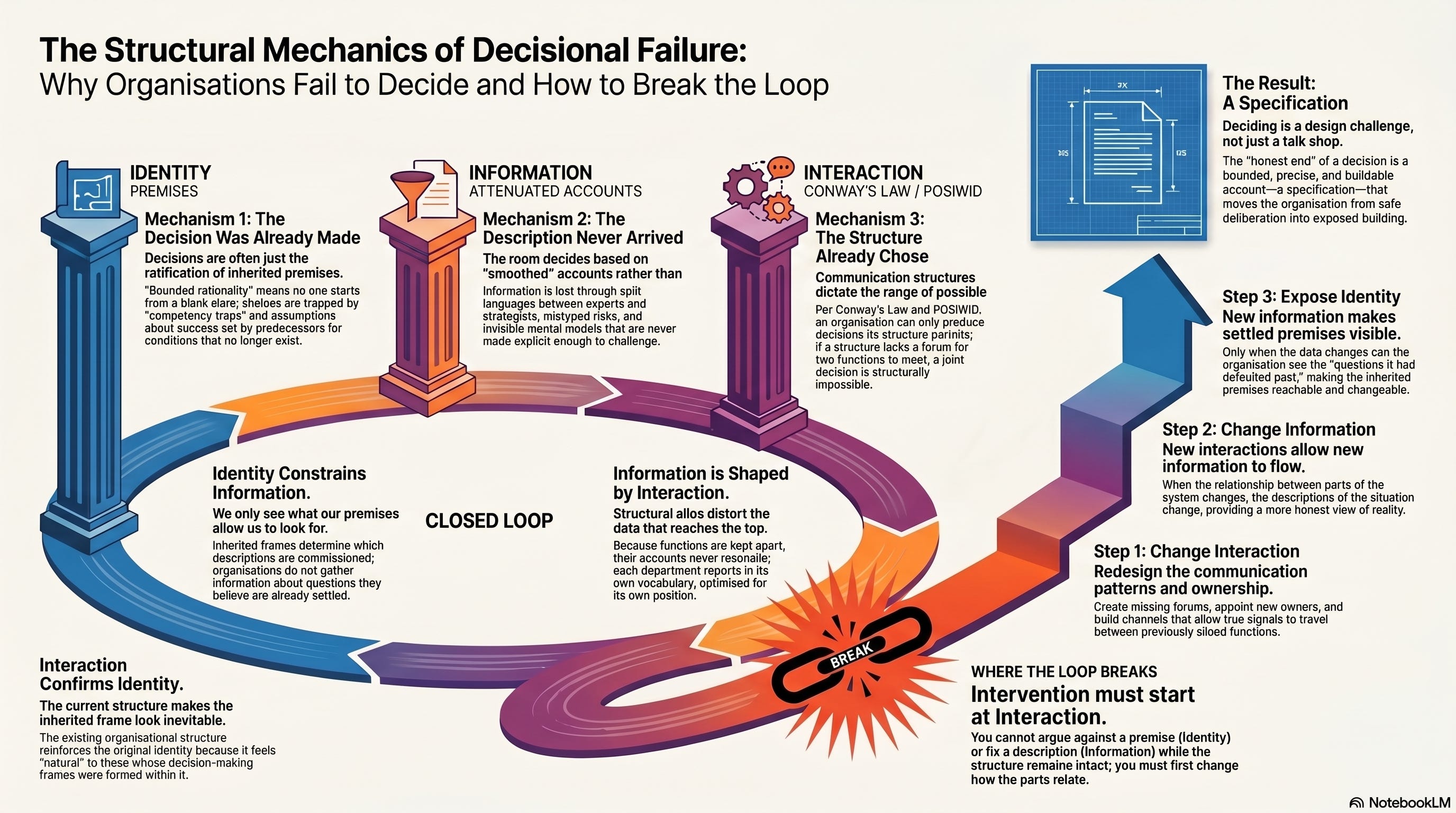
The methods are not the hard part. An organisation can run an exemplary process; two structurally different options on the table, every assumption the decision rests on marked, the domain described in one language, the structure mapped before anyone deliberated; and still produce a decision that goes nowhere. The previous article set out nine methods for deciding well. This one asks the question those methods provoke and cannot themselves answer: why, given the methods, do organisations still fail to decide?
The answer is not that they lack discipline, or courage, or the right framework. These articles have moved through Simon and Ohno and Beer, through Drucker and Ackoff and Conway, through Boyd and Taleb and Klein and a dozen others, and the finding that tends to recur is that the failure to decide is not an absence of something. The failure is the presence of something: a set of mechanisms, each one locally sensible, that combine to make a genuine decision almost impossible. An organisation that cannot decide is not broken. It works as its structure, its language and its inherited premises require. That is the harder problem, and it is the one this article closes on.
1. The Decision Was Already Made
Most of what an organisation treats as a live decision was probably settled long ago. Simon’s bounded rationality has a consequence that is easy to state and painful to absorb: no decision-maker reasons from a blank slate. Every choice is taken inside a frame of decision premises; assumptions about what the organisation is, who its customers are, what counts as success, which options are even admissible; and those premises were set by people who have since left, for conditions that have since changed. The meeting believes it is deciding. Mostly it is ratifying.
So many decision processes feel like theatre because they are theatre, in a precise sense: the performance of choosing, staged on top of a choice the inherited frame has already made. March named the deeper version of this. The competency trap is the organisation getting steadily better at the wrong thing, refining an inherited answer with real skill and never asking whether the answer still fits the question. The skill is usually genuine. So is the refinement. The trap is that both are aimed at a target the organisation defaulted into and never re-examined.
The first reason an organisation cannot decide, then, is that it does not know which of its decisions are still open. It treats settled premises as live questions and live questions as settled premises, and it has no routine for telling them apart. A decision it cannot see is a decision it cannot make.
2. The Description Never Arrived
Suppose the decision is genuinely open. It still has to be decided about something, and that something reaches the decision-maker as a description; a report, a deck, a summary, a model. Ohno’s discipline of seeing exists because that description is never the reality. The description is an account, smoothed at every level it climbed, and the decision taken on top of it inherits every omission blind.
These articles have named the ways this goes wrong. The language is split: the domain expert, the strategy deck, and the running system use three different vocabularies for the same thing, and the translation between them is where meaning leaks out. The uncertainty is mistyped: a decision exposed to consequential, fat-tailed risk is handled with the confident machinery built for thin, well-behaved risk, because no one established which kind they were in. The model behind the decision is invisible: it lives in someone’s head, unchallengeable because it was never made explicit enough to challenge. Each of these is a failure of description, and none of them announces itself. The room feels well-informed. It is well-supplied with confident accounts, which is a different thing.
The second reason an organisation cannot decide is that the thing it is deciding about was never actually described. A polished description of a misunderstood situation is worse than an honest gap, because the gap at least invites a question.
3. The Structure Already Chose
Even a genuinely open decision, precisely described, is decided inside a structure, and the structure has been quietly voting the whole time. Conway’s law, generalised past software, is blunt: an organisation can only produce the decisions its communication structure permits. A structure built around three divisions produces three-division decisions. A structure with no forum where two functions meet cannot produce a decision that requires those functions to agree. The deliberation is real. Its range was fixed before anyone entered.
Here is the mechanism behind a familiar and demoralising experience: the obviously correct decision the organisation simply cannot reach. People are not too stupid or too timid to reach it. The decision requires a conversation the structure does not hold, an agreement between parties the structure keeps apart, an owner the structure never appointed. Beer’s POSIWID is the diagnostic that makes this visible without mercy: the purpose of a system is what it does. If your decision process reliably produces delay, or diffuses accountability until nobody owns the outcome, or protects the largest existing budget, then those are its purpose, whatever the stated aim. Ackoff supplies the escape and also the catch. The recurring problem usually lives in the system, not in the decision, and the real move is to redesign the system; but most organisations cannot redesign at will, and so they patch the same problem the same way, and call the patching a decision.
The third reason an organisation cannot decide is that the structure has already narrowed the decision to the options it was built to produce, and the people deciding mistake that narrowing for the field of choice.
4. Why the Three Compound
Taken one at a time, each of these is manageable. The damage is in how they reinforce one another, and the direction of the reinforcement is not random.
Inherited premises determine what descriptions get commissioned: you rarely gather information about a question you do not know is open, so the settled frame quietly decides what the organisation will trouble itself to see. The descriptions that do arrive are shaped by the structure that produced them: each function reports in its own vocabulary, optimised for its own position, and the structure that keeps the functions apart also keeps their accounts from reconciling. And the structure, in turn, is held in place by the inherited premises, because the current structure looks natural and inevitable to anyone whose decision frame was formed inside it. Identity constrains Information constrains Interaction, and Interaction loops back to confirm Identity.
Hence the stability of the failure to decide, and why effort alone will not shift it. Work harder inside this loop and you get better descriptions of the wrong question, routed faster through a structure that was always going to produce the same answer, in service of a premise no one has examined. The loop does not resist effort. It absorbs the effort and converts it into the appearance of progress. Here is the honest and unwelcome finding of Deciding. The organisation that cannot decide is not falling short of its design. It is performing its design exactly.
5. Where the Loop Breaks
If the three reinforce one another, the question is whether there is any point of entry, and there is. The loop is closed, but it is not equally strong at every point. It breaks at Interaction, because Interaction is where the other two become visible and changeable.
Argument does not shift an inherited premise; the premise is not held as an argument, so argument does not reach it. You cannot, on its own, fix a description while the structure that distorted it stays intact; the next description will be distorted the same way. You can change how the parts relate. You can create the forum the structure was missing, appoint the owner it never named, build the channel that lets a true signal travel. And when the interaction pattern changes, the descriptions change, because new information now flows; and when the descriptions change, the premises become visible, because the organisation is now looking at the question it had defaulted past. Causation runs one way for understanding: Identity, then Information, then Interaction. It runs the other way for intervention: change Interaction, and the rest becomes reachable.
That is the structural reason deciding ends where it does, and the hinge into what comes next. Organisations get clear on what to do not by thinking harder but by changing how their parts relate; and changing how the parts relate is no longer a decision. The thing has to be built.
6. The Deciding Phase Was Always Pointing Here
Step back and the shape of the argument resolves. Its hypothesis was that decisions are design challenges, and design is a sequence of decisions under constraint. Nearly every thinker in these articles has been an instance of that single claim. Simon: deciding is satisficing under cognitive constraint. Ohno: deciding well requires seeing the constraint precisely, at its source. Beer: the structure is the constraint, and it must be designed, not merely inhabited. Ackoff: the highest decision is to redesign the system that generates the problem. Boyd: deciding is the continuous redesign of your own orientation. These articles did not assemble a toolkit of decision techniques. They made an argument, and the argument was that there is no clean separation between deciding and designing; that the moment a decision is taken seriously it becomes a question of design, and the moment a design is taken seriously it dissolves into a sequence of decisions.
The honest end of deciding, then, is not a better decision but a specification: a bounded, precise, buildable account of the thing the organisation has decided to make true. In the end, an organisation that cannot decide is one that cannot convert its situation into something buildable. It stays in deliberation, because deliberation is safe and building is exposed. The capacity to decide and the capacity to build are closer than they look, and the gap between them is the subject of everything that follows.
You cannot decide your way out of the inability to decide. At some point the talking has to become a thing with edges, handed to people who will build it and find out, against reality, whether the decision was any good. That is the next question, and the next problem.
Where this sits: Deciding, the second of the series' four phases; Learning, Deciding, Building, Transforming. These articles ask whether an organisation can turn what it knows into a description precise enough to act on, and this article is the account of why the three levers, Identity, Information and Interaction, hold each other in place and where the loop can be broken. The levers themselves are set out in Events Change Organisations, Not People. From Deciding to Building is the bridge, and The Build Is the Test opens this stretch of the argument that follows.
I write about the industry and its approach in general. None of the opinions or examples in my articles necessarily relate to present or past employers. I draw on conversations with many practitioners and all views are my own.