
Learning article on Drucker asked why organisations cannot make knowledge workers productive. The answer was the specification problem: the knowledge worker must define the task before they can do it, and most organisations have never learned to help them. That was a learning problem. This is the deciding problem that sits beneath it: you cannot define the task if you do not know what the organisation is for. (See the about section for an overview of the phases.)
Drucker had a name for this. He called it the theory of the business.
1. The Theory of the Business
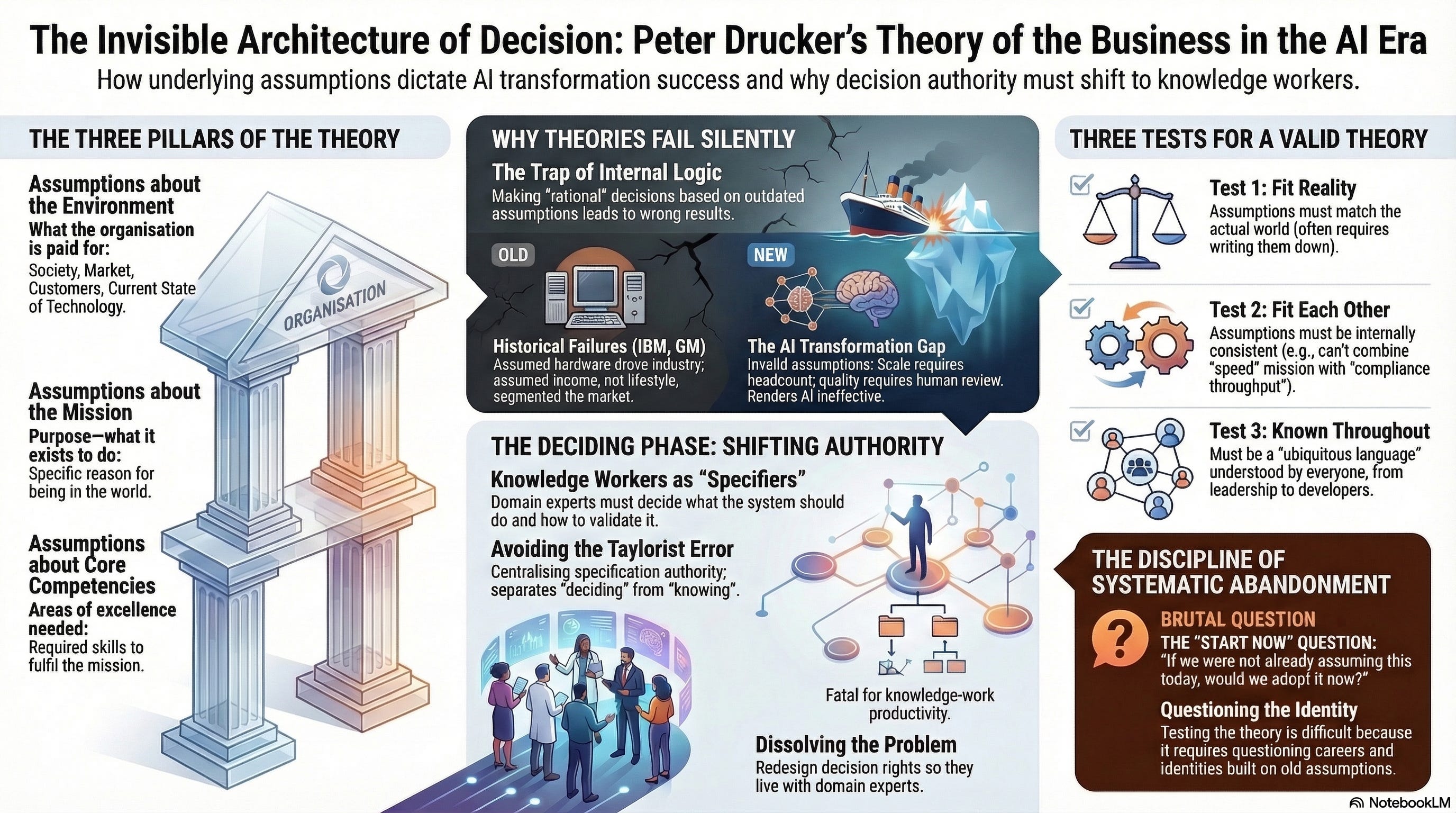
In a 1994 Harvard Business Review article that deserves to be read more often than it is, Drucker argued that every organisation operates on a set of assumptions. Assumptions about its environment: the society, the market, the customer, the technology. Assumptions about its specific mission: what it exists to do. Assumptions about its core competencies: what it must be excellent at to fulfil that mission. Together, these assumptions constitute the organisation’s theory of the business. When the theory is valid, the organisation makes good decisions almost automatically, because the assumptions guide action without requiring every decision to be escalated. When the theory is invalid, no amount of effort, talent, or technology will compensate.
The theory of the business is not the strategy. It is the set of assumptions that makes strategy possible. It is the water the fish cannot see.
And Drucker’s most unsettling claim is that every theory of the business eventually becomes invalid, because the environment changes, and the assumptions do not change with it.
The connection to Deciding architecture is structural. Herbert Simon’s bounded rationality tells you that decision-makers cannot process everything; the theory of the business is what they use instead. It is the set of assumptions that pre-decides most questions before they are asked. Eric Evans’s ubiquitous language tells you that precision of description determines the quality of the specification; the theory of the business is the meta-language that determines what the organisation considers worth describing at all. Beer’s requisite variety tells you the architecture must match the environment’s complexity; an invalid theory of the business is a variety attenuator so lethal that it filters out the very signals that would reveal its own invalidity. We will cover all of these thinkers in other articles.
2. When the Theory Fails Silently
Drucker’s examples are instructive. IBM in the early 1990s had a valid theory of the business (the computer industry is driven by hardware) that became invalid (it is driven by solutions). GM had a valid theory (the American car market is segmented by income) that became invalid (it is segmented by lifestyle). In both cases, the organisation continued to make internally rational decisions that were externally catastrophic, because the decisions were rational within a theory that no longer matched reality. Look at IBM now…(again).
The AI transformation context reproduces this pattern exactly. Most large enterprises operate on a theory of the business that was formed before AI changed what is possible. The assumptions run deep: that competitive advantage comes from proprietary processes, that knowledge resides in individuals, that specification is a planning activity, that quality requires human review, that scale requires headcount. Each of these assumptions was valid. Several are becoming invalid. The organisation that continues to decide on the basis of yesterday’s theory will make decisions that are perfectly logical and completely wrong.
The difficulty is that invalid theories do not announce themselves. They fail silently.
The decisions feel right because they are consistent with the assumptions. The results feel wrong but the cause is invisible, because the cause is not a bad decision but a valid decision made within an obsolete frame. POSIWID applies: if your AI transformation is producing governance artefacts rather than changed practice, that is not a failure of execution. It is the theory of the business doing exactly what it was designed to do, which is to protect the assumptions on which the current organisation was built.
3. Systematic Abandonment as a Decision Discipline
In Learning, systematic abandonment was framed as a refactoring discipline: stop doing what no longer works. In Deciding, it becomes something sharper. It is the discipline of testing the theory of the business by asking which of its assumptions still hold.
Drucker’s question is brutal in its simplicity: “If we were not already doing this, would we start now?” Applied to assumptions rather than processes, it becomes: if we were not already assuming this about our market, our customers, our capabilities, would we adopt this assumption today? If the answer is no, the theory needs revision, and every decision that flows from the invalid assumption needs re-examination.
This is where Drucker connects to Rumelt’s diagnosis. Rumelt argues that the first element of good strategy is an honest account of the challenge. Drucker provides the prior step: before you can diagnose the challenge, you must test whether the theory through which you perceive the challenge is still valid. Most organisations skip this step because testing the theory means questioning the identity. And questioning the identity is the hardest thing any organisation can do, because the people whose careers were built on the old theory have every reason to defend it.
4. The Knowledge Worker Decides
Drucker’s most radical claim for deciding is that knowledge workers must manage themselves. They must decide what the task is, how to do it, and what quality means. This is not delegation. It is a structural requirement of knowledge work. The person who understands the domain is the person who must decide what needs doing, because nobody else has the knowledge to make that decision well.
In an AI-mediated world, this claim becomes urgent. When AI can generate implementations from specifications, the constraint shifts to the person who writes the specification. That person must decide what the system should do, what it should not do, how to validate the output, and when the specification itself needs to change. These are not technical decisions. They are knowledge decisions that require domain understanding, judgment, and the authority to act on that judgment. An organisation that centralises specification authority in a planning function has separated deciding from knowing, which is the Taylorist error Drucker spent his career opposing, reproduced in a new medium.
Ackoff’s distinction between dissolving and solving is relevant here. The organisation that tries to solve the specification problem by creating a central specification team is solving within the existing structure. The organisation that dissolves the problem recognises that specification authority must live with domain knowledge, which means redesigning decision rights so that the people closest to the domain are the people who decide what gets specified.
5. Three Tests for the Theory
Drucker specified three requirements for a valid theory of the business, each of which doubles as a diagnostic for decision quality.
First, the assumptions about environment, mission, and competencies must fit reality. This sounds obvious, but most organisations have never written their assumptions down, let alone tested them. The assumptions are embedded in budget allocations, reporting structures, incentive schemes, and hiring criteria. They are the water. Making them visible is itself an act of deciding, because it forces choices about which assumptions to keep and which to abandon.
Second, the assumptions must fit each other. An organisation that assumes its competitive advantage is speed but measures success by compliance throughput has contradictory assumptions. An organisation that assumes AI will transform its business but funds AI from the cost-reduction budget has contradictory assumptions. The contradictions are not visible to the people inside them, because each assumption was adopted at a different time, by different leaders, for different reasons. The theory of the business has never been read as a single document, because it has never been written as one.
Third, the theory must be known and understood throughout the organisation. This is where Drucker meets Evans most directly. Evans’s ubiquitous language is the theory of the business made operational in a bounded context. When the payments team and the fraud team use the word “customer” to mean different things, the theory of the business has not been translated into the language the teams actually use. The assumptions exist in the strategy deck. They do not exist in the code, the specification, or the daily conversation of the people making decisions.
Placement: Deciding, the second of four phases, after Learning and before Building and Transforming. Deciding is where a description gets made precise enough to design against, and a theory of the business is exactly that description operating at the scale of the whole enterprise. What comes out of it is the specification the next one has to make real. Why Your Organisation Can't Decide closes the phase, and From Deciding to Building is the bridge into Building.
(An Organisational Prompt is something you can do now....)
Write down your theory of the business.
Not the strategy. Not the vision statement. The assumptions. Sit with your leadership team and answer three questions: what do we assume about our environment that justifies our current direction? What do we assume about our mission that determines what we say yes and no to? And what do we assume about our core competencies that determines where we invest? Write the answers on one page. Then test each assumption by asking: when was this last validated by evidence from outside the organisation? If the answer is “never” or “when we wrote the strategy,” you have found the source of your decision problems. The theory of the business is the invisible architecture of every decision your organisation makes. Making it visible is the first act of deciding well.
Further Reading
Peter Drucker: The Theory of the Business (Harvard Business Review, 1994) - The single most important Drucker article for Deciding. Short, devastating, and freely available. Read it for the three requirements and the case studies of theories that expired.
Peter Drucker: Management Challenges for the 21st Century - Where Drucker addresses the challenge of managing yourself, managing knowledge worker productivity, and the change leader. The chapter on the theory of the business extends the HBR article into a full diagnostic framework.
Peter Drucker: The Practice of Management - Where “the purpose of a business is to create a customer” first appears. Still the clearest statement of why purpose must be externally grounded.
I write about the industry and its approach in general. None of the opinions or examples in my articles necessarily relate to present or past employers. I draw on conversations with many practitioners and all views are my own.