
People Do Not Change Organisations. Events Do.
A team wires a coding agent into a spare afternoon and comes back with a working version of the thing the roadmap had scheduled for the third quarter. Eleven weeks of negotiation went into that roadmap. Nothing has been decided and nothing has been announced, and yet the plan cannot be defended in the room any more, and everyone in the room knows it.
That is how organisations change. An event throws received wisdom about what is possible into question. People then find words for what they have just seen, and the new words make new arrangements sayable. The arrangements harden into structures: teams, budgets, decision rights, what counts as a good week. The structures become daily practice, and the practice becomes theirs rather than yours. Then the cycle turns again, from higher ground, because an organisation that has been through it once can recognise events it would previously have explained away.
Change on this account is generative. An event opens a possibility that did not exist the day before. The practice of change is being ready for one, staying faithful to what it showed, and carrying it far enough that nobody needs you for it to continue.
You do not have to be in charge to do that work.
This series is one account of that practice, taken a thinker at a time. The subject is change of every kind: a merger, a regulator, a founder walking out, a market that stops behaving the way it has behaved for twenty years. AI features heavily, because it is the change most of us are living through right now, and because it is the largest discontinuity in how software gets made since the move off assembler in the 1950s. Treat it as the current example rather than the topic.
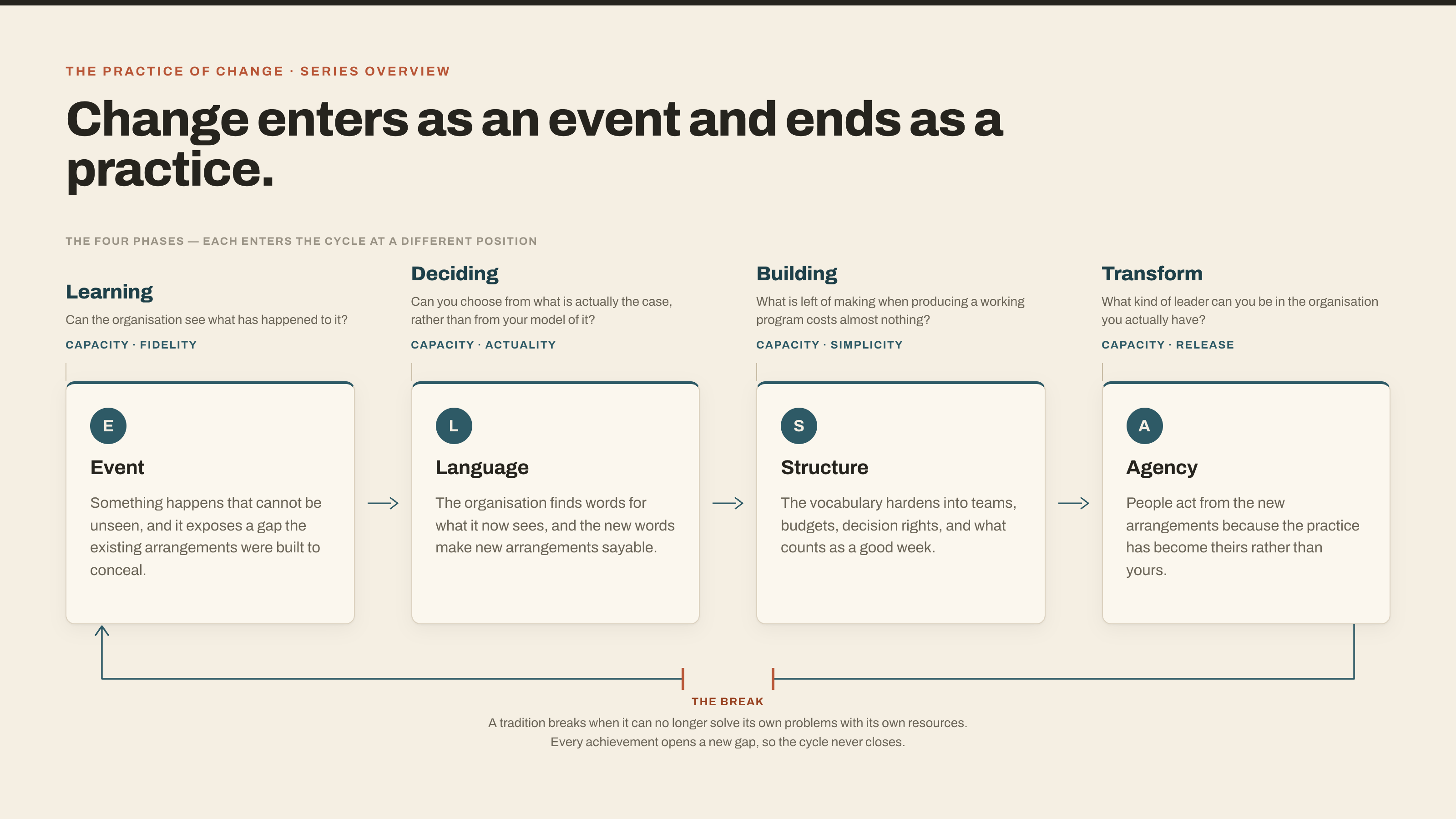
1. Four phases
The practice has four phases: Learning, Deciding, Building, Transform. Each asks a different question, argues for a hypothesis, and aims at one capacity the organisation either acquires or fails to.
Learning asks whether the organisation can see what has happened to it. You cannot run a programme to produce that. Learning is a condition, not a process, and conditions are built rather than launched. The capacity at stake is fidelity: staying true to what the event revealed rather than letting the old situation quietly reabsorb it, which is what usually happens by about month four.
Deciding treats a decision as a design challenge, and design as a sequence of decisions taken under constraint. Can you choose from what is actually the case rather than from your model of it? Actuality is the capacity, and it is acquired at the real place, in front of the real work, or not at all.
What is left of making when the marginal cost of producing a working program falls to almost nothing? Building argues that building is what remains when making becomes free. You build to release, and you release to learn. Simplicity is the capacity: winning small, ownable, testable things out of complexity instead of coping with it.
Transform asks what kind of leader you can be in the organisation you actually have, as opposed to the one on the slide. Leading is taking a position on how change resolves. The capacity is release: letting the change be carried by people who no longer refer to you, which may be the only version that survives your next reorganisation.
Nobody graduates from one phase to the next. They are one rotation, and at any moment you are somewhere in it.
2. ELSA: how change moves
Every phase runs the same four-position cycle. I call it ELSA.
Event. Something happens that cannot be unseen, and it exposes a gap the existing arrangements were built to conceal. A competitor’s launch can do it. So can a demonstration, a resignation, or a letter from a regulator.
Language. The organisation finds words for what it now sees, and most transformations are lost at this point. A vocabulary is contingent, which is the good news: change the words available and you change what can be proposed, funded, argued for and refused.
Structure. The new vocabulary hardens into arrangements. Governance gets rewritten, teams get redrawn, incentives move. Structure decides which version of the world shows up as obvious and which as unthinkable.
Agency. People act from the new arrangements because the practice has become their own, and they can now argue about it in its own terms. By then the change has stopped being a programme and started being how the place works.
Each phase does not start at Event, which corrects the earlier version of this model. Each enters the cycle at a different position and runs on from there: Learning enters at Event, Deciding at Language, Building at Structure, Transform at Agency.
So the four phases together run one complete turn, and the joins between them are translations rather than handovers. Learning ends in a tradition; Deciding needs a design language. The buildable thing that Deciding produces has to be broken into teams and components before anybody can build it. Building hands on the operational language it learned, and Transform has to turn that into a capacity to act. Transform settles an institution, and that institution is the ground the next disruption tests.
The break sits between Agency and Event. It is deliberate. A tradition breaks when it can no longer solve its own problems with its own resources, so every achievement opens a new gap. There is no final settled state, and no version of this in which you finish.
3. Three levers and their foundational thinkers
Three families of question do the diagnostic work at every transition.
Identity asks what people stand to lose, whether the organisation learns by practice or by instruction, and what people actually believe about their own capacity to change.
Information asks whether it is safe to tell the truth here, how close the people deciding are to the work being decided about, and whether the rewards say the same thing as the words.
Interaction asks whether the structures serve the work or obstruct it, whether the organisation can stop doing something that no longer works, and whether it can hold a conflict long enough to get value out of it.
Those nine questions are observable. None needs a survey, a maturity model or a dashboard, and a determined person can answer all nine in a fortnight. In Learning and Deciding the levers run in a diagnostic register: what is the case. In Building and Transform they flip to a constructive one: what to commit to, what to signal, what to sustain.
Each lever in each phase rests on a foundational thinker, and that is a structural role rather than a recommendation. The foundational thinker is whoever gives the others a common foundation, so that arguments which look unrelated turn out to be versions of the same dynamic. It says nothing about whose advice you should follow most closely.
Bourdieu holds Identity in Learning. Habitus explains why an organisation cannot perceive what its own dispositions have taught it to treat as common sense. Bateson holds Information: real learning changes the level at which you are learning, and does not merely add facts inside the old level, an argument he assembled in Steps to an Ecology of Mind in 1972. Illich holds Interaction. Institutions built to enable an activity reliably end up replacing it, which he argued about schools in 1971 and which has aged well against every centre of excellence since.
In Deciding, Simon holds Identity through bounded rationality, which he set out in Administrative Behavior in 1947: a good decision is the best design available within the constraints actually in play, and not the optimum in the abstract. Ohno holds Information through the gemba, the real place, where you go and look before you act. Beer holds Interaction through the principle that the purpose of a system is what it does, and his viable system model, published in 1972, is an attempt to design for that.
In Building, Burgess holds Identity through promise theory, which he first set out in 2005: an autonomous thing can only promise what lies within its own control, and a command is a promise nobody made. Ousterhout holds Information, since complexity is the enemy and the work is deep modules behind simple interfaces, an argument he made in a short book in 2018 that most architecture practices still fail. Collins holds Interaction, since a team runs on emotional energy generated by co-present ritual, which an agent with nothing at stake cannot supply. Brooks runs underneath the phase: essential complexity is the irreducible work of deciding what to build, and the rest, as he argued in 1986, can be stripped away.
Transform is arranged differently, with four thinkers holding the four ELSA positions rather than the three levers. Jackson holds Agency, because the leader’s real skill in a mess is choosing which systems approach to use and then orchestrating it. Girard holds Event. Change arrives as a mimetic crisis, and its default resolution, which he traced in Violence and the Sacred in 1972, is to expel someone and reset unchanged. That is where Heifetz works alongside him. Lakoff holds Language, because people reason in frames, and a new frame installs fast once an event has dissolved the supports under the old one. Lewin holds Structure, with the refreezing he described in 1947 read as provisional settling rather than closure.
4. The spine
Four philosophers hold the four positions in every phase, and they do not move.
Badiou holds Event: an event is external to the whole situation and reveals the void the situation was built to hide. Rorty holds Language: all vocabulary is contingent, so to change what is possible you change the words. Heidegger holds Structure: a structure is a disclosure, a way a world is made to show up. MacIntyre holds Agency: agency is practice inside a living tradition.
Hegel underwrites the method. The cycle is a dialectic of freedom in which each transition preserves what it overcomes. The exception is the break between Agency and Event, which is Badiou’s correction of Hegel: absolute freedom is never reached, and every achievement reveals a new void.
MacIntyre also supplies the ethics, which are not decoration. Holding an organisation through a transformation takes justice, courage, truthfulness and constancy, and I have never seen a procedure substitute for any of them. The identity of the people involved, and the identity of the organisation itself, are things you are obliged to protect while you change them. Fidelity to an event is a moral position before it is a managerial one.
5. How to read the series
Every article introduces a thinker whose work illuminates one part of the practice, and shows how they support, extend or reject the thinkers already covered. Some articles are technical: the shape of a good specification, how domains decompose, what a promise means when the promiser is an agent. Those are not detours. Change now runs partly through the engineering, and a leader who cannot see that will keep mistaking the tooling for the transformation.
Every phase closes with three pieces: the nine methods for that phase, an honest account of why organisations cannot do it, and a bridge into the next. Read in order, they build the full model. Read singly, each stands alone.
Every article ends with an Organisational Prompt: something you can run this week. Deming taught that experience by itself teaches nothing. The prompts exist to get you past work-as-imagined and into contact with the system you actually have. The answers will probably tell you more than the last strategy document you were asked to approve.
Start anywhere. The probes will tell you where you are.
I write about the industry and its approach in general. None of the opinions or examples in my articles necessarily relate to present or past employers. I draw on conversations with many practitioners and all views are my own.
