
Deciding rests on three levers, meaning the three places a change can be pushed on: identity, information and interaction. Who an organisation takes itself to be, what it can therefore see, and how its parts talk to each other. Beer is the foundational thinker for interaction, the structural architecture through which decisions flow. Ohno holds information, the precision and pathology of domain description. The third lever is identity: what is available to the decision-maker before the decision begins. Not what they choose, but what they can see, what they consider, what they take for granted, and what they never think to question. In Learning, Bourdieu held this lever through habitus: the embodied dispositions that generate practice below conscious awareness. In Deciding it passes to Herbert Simon.
Simon’s argument is deceptively simple: human beings cannot be rational in the way that classical economics assumes. They do not have complete information. They cannot evaluate all alternatives. They cannot compute optimal solutions to complex problems. This is not a character flaw. It is a structural feature of human cognition confronting a world more complex than any mind can process. Simon called it bounded rationality, and it is the single most important concept in organisational decision theory, because everything else follows from it: how organisations should be structured, how information should flow, how decisions should be distributed, and why most organisations get all of these wrong.
Simon was an extraordinary polymath. He won the Nobel Prize in Economics in 1978 for his work on decision-making in organisations and the Turing Award in 1975 (with Allen Newell) for contributions to artificial intelligence. He spent most of his career at Carnegie Mellon, where he helped found one of the world’s first computer science departments. His key works span from Administrative Behavior (1947) through Organizations (with James March, 1958), The Sciences of the Artificial (1969), and the landmark essay The Architecture of Complexity (1962). He was simultaneously a political scientist, an economist, a cognitive psychologist, and a computer scientist. He could hold all of these in his head at once, which is precisely the kind of cognitive feat his own theory says most people cannot manage.
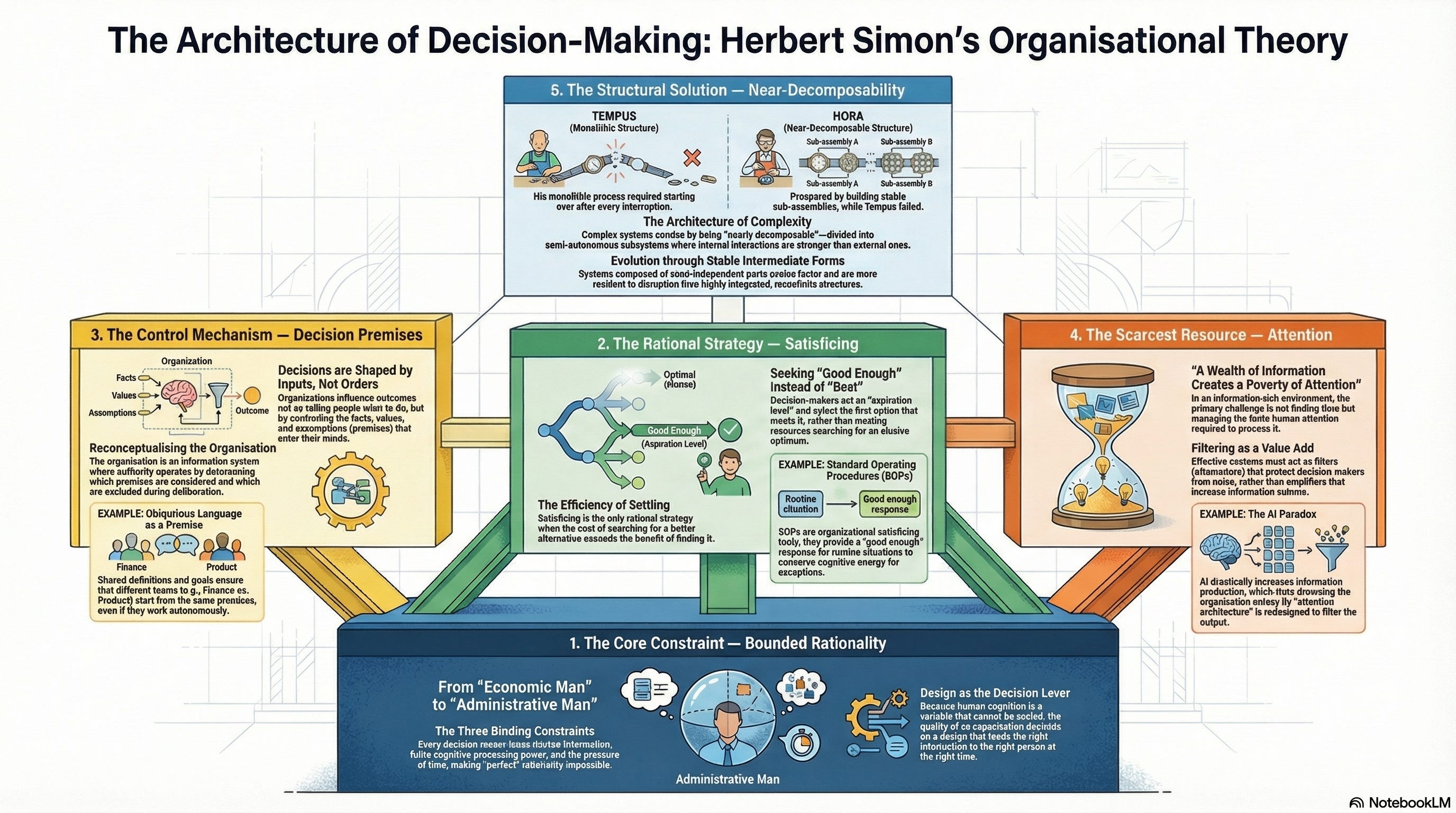
1. Bounded Rationality: The Constraint That Shapes Everything
Classical economics assumes “economic man”: a decision-maker with complete information, unlimited computational capacity, and the ability to select the option that maximises utility. Simon demonstrated that this is a fiction. Real decision-makers face three binding constraints: limited information (they rarely know all the alternatives or their consequences), cognitive limits (the human mind cannot process the information it does have), and time pressure (most decisions must be made before exhaustive analysis is possible).
Simon replaced economic man with administrative man: a decision-maker who operates within these bounds and does the best they can given what they have. This is not irrationality. It is rationality operating under realistic constraints. The interesting question, Simon argued, is not “did you choose optimally?” but “did you decide well given what you could know?”
The implication for deciding is foundational. If bounded rationality is real, and the evidence is overwhelming, then the quality of organisational decisions depends more on the design of decision processes and information flows than on the intelligence of individual decision-makers. You can hire brilliant people and they will still make poor decisions if the architecture feeds them the wrong information, at the wrong time, in the wrong format, under the wrong constraints. The design of the decision environment is the lever. The individual is the variable the design must accommodate.

This is the parallel to Bourdieu that gives Simon the Identity lever. Bourdieu’s habitus constrains what the learner can perceive: the embodied dispositions acquired through socialisation filter what is thinkable before conscious thought begins. Simon’s bounded rationality constrains what the decision-maker can process: the cognitive architecture filters what is decidable before deliberation begins. Both govern through limitation on what is available to the subject. Bourdieu’s limitation is sociological. Simon’s is cognitive. Together they explain why organisations reproduce their existing patterns: the people inside them literally cannot see, think, or decide their way to alternatives that fall outside the bounds their identity imposes.
2. Satisficing: The Rationality That Actually Works
Simon coined the term satisficing (from satisfy and suffice) to describe how people actually choose. Rather than evaluating all alternatives to find the optimum, the decision-maker sets an aspiration level, a threshold of what counts as good enough, and chooses the first option that meets it. If nothing meets it, the aspiration is lowered. If options come easily, the aspiration is raised.
This sounds like settling. It is not. It is the only rational strategy when the cost of searching for the optimum exceeds the benefit of finding it, when the optimum may be unknowable even in principle, or when the scarce resource of attention must be conserved for decisions where it matters most. Satisficing is not the failure to optimise. It is the recognition that optimisation is itself a choice about where to spend cognitive resources, and spending them on search when the first adequate option is available is a waste.
Organisations satisfice systematically, whether they admit it or not. Standard operating procedures are satisficing strategies: they prescribe a response that is good enough for routine situations, conserving attention for exceptions. Departmentalisation is a satisficing strategy: break the problem into pieces small enough for bounded minds to handle. Hierarchy is a satisficing strategy: allocate different types of decisions to different levels so that no single level is overwhelmed.
For AI transformation, satisficing reframes the entire conversation. The organisation that insists on finding the “optimal” AI strategy before acting is not being rigorous. It is violating Simon’s insight: the optimal strategy is unknowable in a domain this complex, and the cost of searching for it (in time, in paralysis, in opportunity foregone) exceeds the benefit. Rumelt’s proximate objectives are the strategic application of satisficing: set a target close enough to be feasible, act, learn, adjust the aspiration, and act again. The organisation that waits for the optimal specification template, the optimal governance framework, the optimal AI platform, will still be waiting when its competitors have satisficed their way through three iterations.
3. Decision Premises: How Organisations Actually Shape Decisions
Simon’s most radical contribution to organisational theory is the concept of decision premises. He reconceptualised organisations not as authority structures that control what people do, but as information systems that shape the premises entering individual decisions.
A decision premise is any input that influences a decision: a fact, a value, a goal, a constraint, an assumption. Authority and influence operate not by controlling decisions directly but by controlling the premises that enter them. When the organisation sets goals, it supplies value premises. When it provides data, it supplies factual premises. When it establishes procedures, it determines which premises are considered and which are excluded. When it defines roles, it determines whose premises count.
This reframing is transformative for Deciding. The question is not “who should make this decision?” but “what premises should enter this decision, and how does the organisation ensure they get there?” A badly designed organisation does not produce bad decisions because its people are stupid. It produces bad decisions because the wrong premises reach the right people, or the right premises reach the wrong people, or the right premises reach the right people too late for them to matter.
The connection to Evans is structural. Evans’s ubiquitous language is a mechanism for aligning decision premises across a team. When the payments team and the fraud team use the word “customer” to mean different things, the premises entering their decisions are different even when the facts are the same. The linguistic divergence is not a communication problem. It is a decision premise problem: the two teams are deciding from different starting points, and their decisions will diverge accordingly. Evans’s knowledge crunching is the process of negotiating shared premises between domain experts and developers. Beer’s System 2 (coordination) is the architectural mechanism that ensures premises are shared across autonomous units without crushing their autonomy.
The connection to Drucker is equally direct. Drucker’s theory of the business is the set of assumptions (premises) about environment, mission, and competencies that pre-decides most questions before they are asked. When the theory expires, the premises are wrong, and every decision that flows from them is wrong. Drucker asks “are our assumptions still valid?” Simon asks the design question: “how do we ensure that valid premises reach the people who need them?”
4. Attention as the Scarce Resource
In 1971, Simon identified what has become one of the defining insights of the information age: “In an information-rich world, the wealth of information means a dearth of something else: a scarcity of whatever it is that information consumes. What information consumes is rather obvious: it consumes the attention of its recipients. Hence a wealth of information creates a poverty of attention.”
This was written before the internet. It was written before email. It now reads as prophecy. The problem in organisations is not information scarcity but attention scarcity. Most information system designers get this backwards: they build systems that produce more information when what is needed is systems that filter information and allocate attention.
For AI, this insight is devastating. AI amplifies information production by orders of magnitude. A single prompt can generate analyses, code, specifications, and reports that would have taken teams weeks. The organisation that deploys AI without redesigning its attention architecture will drown. More AI-generated output is not more value. It is more demand on the one resource that cannot be scaled: human attention.
Beer’s variety management is the structural expression of Simon’s attention insight. Attenuation (filtering incoming variety) is attention management: deciding what not to look at. Amplification (broadening the response repertoire) is attention allocation: ensuring that what does reach the decision-maker is worth their cognitive resources. Beer provides the architecture. Simon explains why the architecture is necessary: because the human mind is the bottleneck, and the bottleneck cannot be widened, only managed.
The 3-4 homeostat that Beer describes, the balance between inside-and-now (System 3) and outside-and-then (System 4), is an attention allocation mechanism in Simon’s terms. The organisation has a finite attention budget. How much goes to optimising current operations and how much goes to sensing the environment is a zero-sum allocation. The committee that meets weekly to review AI adoption metrics is consuming attention that could be spent on sensing how AI is changing the competitive landscape. Both matter. The budget is finite. Simon tells you the budget exists. Beer tells you how to allocate it.
5. The Architecture of Complexity: Why Your Organisation Must Be Decomposable
Simon’s 1962 essay “The Architecture of Complexity” provides the theoretical foundation for everything from microservices to bounded contexts to team topologies. His argument: complex systems that evolve and persist tend to be hierarchically organised, where hierarchy means subsystems containing subsystems, not necessarily authority relationships. He called this near-decomposability: interactions within subsystems are stronger than interactions between them.
The Hora and Tempus parable makes the point vivid. Two watchmakers build watches of a thousand parts. Tempus assembles his sequentially; any interruption means starting over. Hora designs his from stable subassemblies of ten parts each; an interruption loses only the current subassembly. Hora prospers. Tempus goes bankrupt. The lesson: systems composed of stable intermediate forms evolve far more rapidly than systems that must be assembled all at once.
This is the theoretical statement that Beer operationalised as the VSM’s recursive structure and that Evans operationalised as bounded contexts. Simon’s nearly decomposable systems are Beer’s System 1 units (semi-autonomous subsystems with strong internal cohesion and weaker external coupling) and Evans’s bounded contexts (domains with their own model, language, and team). The three foundational thinkers converge, meaning the three thinkers Deciding rests on: Simon provides the theory (complex systems must be decomposable to be manageable), Beer provides the architecture (each subsystem must be a viable system with its own five functions), and Evans provides the domain design (each context must have its own model and ubiquitous language).
For AI transformation, near-decomposability is the architectural argument against the monolithic AI strategy. The organisation that attempts to deploy AI as a single, enterprise-wide programme is Tempus: any disruption (a change in technology, a failed pilot, a leadership transition) means starting over. The organisation that designs AI adoption as a set of semi-autonomous experiments within bounded contexts is Hora: each experiment is a stable intermediate form that can succeed or fail without destroying the others. Conway’s Law, which we will address later in the series, provides the structural mechanism: the system mirrors the communication structure, which means the decision about how to decompose the organisation is simultaneously a decision about the architecture of what it builds.
6. Design as the Core Activity
Simon’s broadest claim is also his most relevant for this series. “Everyone designs who devises courses of action aimed at changing existing situations into preferred ones.” This definition unifies engineering, management, medicine, and education as design disciplines. It is also the philosophical foundation of Deciding hypothesis: decisions are design challenges, and design is a sequence of decisions under constraint.
An artificial (designed) system is an interface between an inner environment (the substance and organisation of the artefact) and an outer environment (the surroundings in which it operates). If the inner environment is appropriate to the outer, the artefact serves its purpose. The design challenge is matching the inner system to the demands of the outer environment, and bounded rationality is the constraint that makes this matching imperfect, iterative, and never complete.
This is where Simon connects to Ackoff and to the deciding hypothesis most directly. Ackoff’s dissolving (redesigning the system so the problem disappears) is Simon’s design made radical: not just matching inner to outer environment but transforming the inner environment so fundamentally that the mismatch ceases to exist. Boyd’s OODA loop is Simon’s design process made temporal: the continuous cycle of observing the outer environment, orienting the inner model, deciding on the match, and acting to improve it. Rumelt’s kernel (diagnosis, guiding policy, coherent action) is Simon’s design process made strategic: diagnose the mismatch between inner and outer environment, establish a guiding policy for closing it, and execute coherent actions.
The AI implication is that AI does not replace the designer. It amplifies the design cycle. The specification writer who uses AI to generate implementations is designing faster, but they are still designing: still matching their understanding of the domain (inner environment) to the demands of the business (outer environment) under the constraints of bounded rationality. The constraint has not changed. The speed has. And speed without design quality, as Simon would insist, produces more artefacts that fail to match their environment, not fewer.
7. Simon’s Limits
Simon must be read with his limitations visible. His framework underplays power and politics: decision premises are not distributed neutrally, and the question “whose premises enter the decision?” is a political question that Simon’s design-oriented framework does not adequately address. Bourdieu explains why: the premises that enter decisions are shaped by the distribution of capital within the field, and those with the most capital shape the premises that favour their position. Giddens adds the structural dimension: the premises are embedded in the rules and resources that are reproduced through daily practice, and changing the premises means changing the structure, which the structure resists.
Simon also underestimates emotion and identity. His framework acknowledges but does not deeply explore how identity concerns shape what people consider decidable. Heifetz names this gap: adaptive challenges are situations where the decision-maker must revise their own identity before they can see the alternatives that bounded rationality has filtered out. The bounds are not only cognitive. They are existential. The leader who cannot imagine their organisation without the function they built cannot see the decision to abandon it, not because the information is missing but because the identity will not permit it.
The deepest limitation is that Simon’s model explains routine and expert decision-making well but is weaker on genuinely creative or transformative decisions. Near-decomposability assumes that the system can be broken into manageable pieces. Some problems resist decomposition. Some situations require the kind of holistic reorientation that Boyd describes and that Stacey’s complex responsive processes theory argues cannot be designed at all. Simon would reply that even in these situations, the design of stable intermediate forms is the best strategy available. The debate is genuine, and the series holds both positions.
8. Why Simon Holds the Identity Lever
Simon is the foundational thinker for identity in Deciding because his work defines what the decision-maker can and cannot do. Bounded rationality is not a flaw to be corrected. It is the condition within which all deciding happens. Satisficing is not settling. It is the only rational strategy when optimisation is impossible. Decision premises are not inputs to decisions. They are the identity of the decision: the set of facts, values, goals, and constraints that determine what the decision-maker considers, what they ignore, and what they never think to question.
The parallel to Bourdieu is exact. Bourdieu says: you cannot learn what your habitus will not let you perceive. Simon says: you cannot decide what your cognitive bounds will not let you process. Both govern through constraint on what is available. The leader who wants to improve decision quality must therefore work on two fronts simultaneously: the sociological (changing the habitus through new practice, new exposure, new fields) and the cognitive (redesigning the decision environment so that the right premises reach the right people at the right time). Beer provides the architecture for the second. Bourdieu provides the theory of the first. Simon tells you why both are necessary.
Simon sits in Deciding, the second of the series' four phases. The Learning articles ask how an organisation comes to know anything; The Deciding articles ask how it turns what it knows into a description precise enough to act on; Building makes that description real; Transforming settles what the result means. Bounded rationality is what Deciding runs into first, because a decision premise nobody has examined is a decision already taken.
(An Organisational Prompt is something you can do now....)
Audit the premises entering one decision.
Pick a decision your organisation makes repeatedly: which AI use cases to prioritise, which teams to fund, which specifications to approve. Do not evaluate the decision. Evaluate the premises. What information enters the decision? What information does not? Who provides the facts? Who provides the values? Who decides what counts as “good enough”? Map the premises on a single page. The pattern will reveal that the decision is largely pre-decided by the premises that enter it, and that the premises are shaped by the organisation’s structure, not by the decision-maker’s judgment. If you want different decisions, redesign the premises. The people are not the problem. The architecture is.
Further Reading
Herbert Simon: Administrative Behavior - The foundational text on organisational decision-making. Bounded rationality, satisficing, and decision premises. Written in 1947 and revised over fifty years, it remains the single most important book on how organisations actually decide.
Herbert Simon: The Sciences of the Artificial - The broader framework on design, complexity, and artificial systems. The definition of design as changing existing situations into preferred ones. Essential reading for anyone who believes Deciding argument that decisions are design challenges.
Herbert Simon: The Architecture of Complexity - The single most important essay on hierarchical systems, near-decomposability, and why complex systems evolve from simple ones. Twenty pages that provide the theoretical foundation for bounded contexts, microservices, and team topologies.
Herbert Simon and James March: Organizations - The collaborative work on how organisations shape behaviour through routines, premises, and structures. March’s contribution on exploration and exploitation extends Simon’s framework into the strategic domain.
Herbert Simon: Designing Organizations for an Information-Rich World - The attention economy essay. “A wealth of information creates a poverty of attention.” Remarkably prescient; freely accessible.
I write about the industry and its approach in general. None of the opinions or examples in my articles necessarily relate to present or past employers. I draw on conversations with many practitioners and all views are my own.