
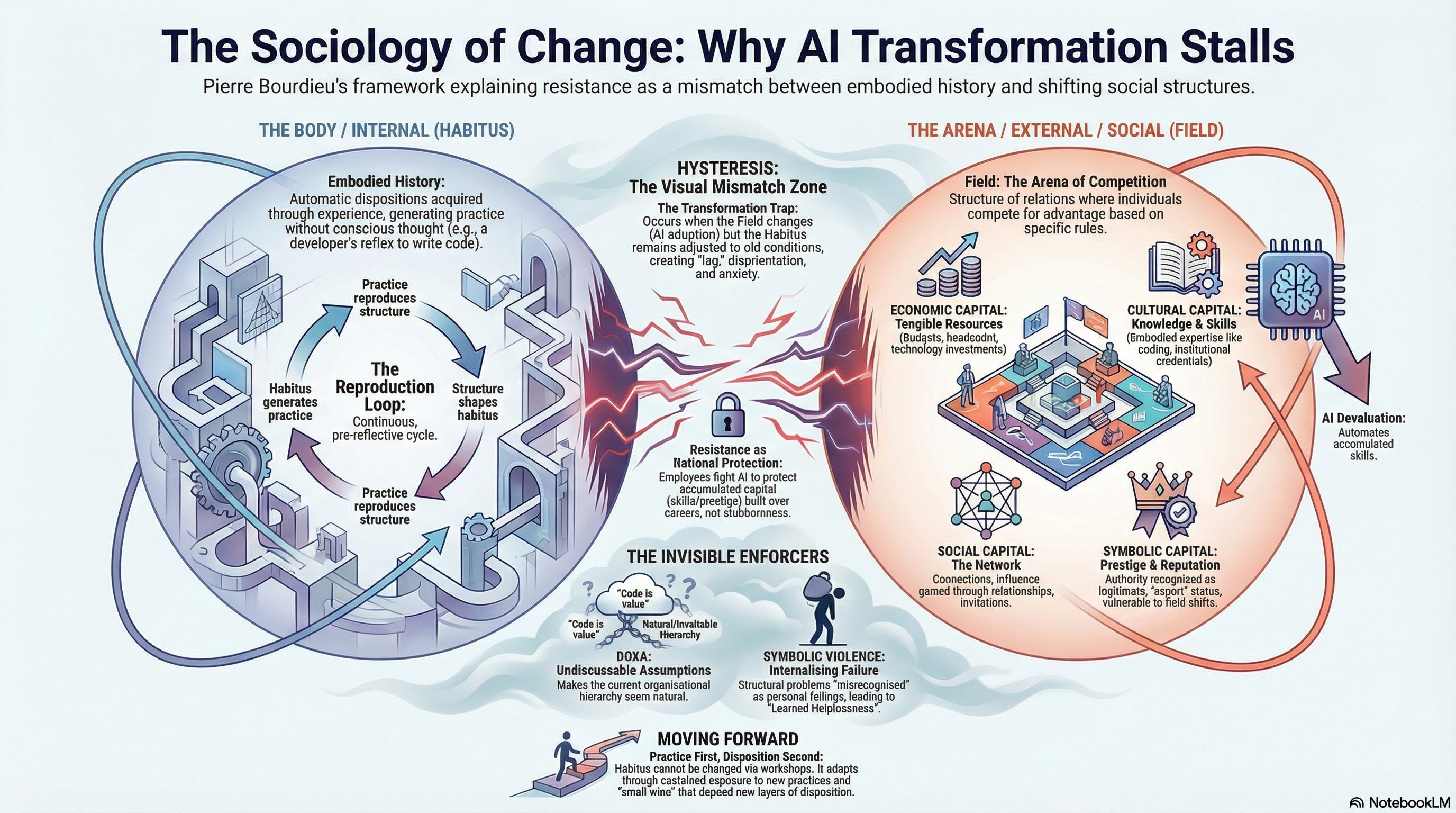
Pierre Bourdieu, the French sociologist whose work on practice, power, and cultural reproduction shaped virtually every social science discipline since the 1970s, explains why the obstacle to transformation is not in people’s reasoning. It is in their bodies. Decades of professional experience have inscribed a set of dispositions, reflexes, judgements, and instincts so deeply into your practitioners that these dispositions operate below conscious awareness. Your developers do not choose to write code when they could write specifications. Their hands reach for the keyboard and produce code because that is what their accumulated professional formation has trained them to do, automatically, without deliberation.
Bourdieu called this embodied structure habitus. And until you understand it, every transformation programme you launch will falter in exactly the same way, for exactly the same reason. The habitus explains why people resist loss, why practice transforms but instruction does not, and why beliefs about capacity are structurally reproduced rather than individually chosen. It is the mechanism beneath every identity barrier this series has diagnosed, and it is where the Learning articles put their questions about identity.
1. Habitus: The Generative Principle
Habitus is the durable, transposable system of dispositions acquired through experience that generates practice without conscious deliberation. This is not “habit” in the everyday sense, a routine you could change if you chose to. Habitus is a generative principle. It does not merely reproduce behaviour; it produces new behaviour that is nonetheless consistent with the dispositions already formed. A developer encountering a new problem does not consciously select an approach. Their habitus generates a response: the tools they reach for, the abstractions they favour, the risks they notice and the ones they overlook, the colleagues they consult and the ones they do not. All of this happens before conscious deliberation begins.

Giddens’ practical consciousness is the structural counterpart. Where Giddens describes the tacit knowledge that reproduces social structure through interaction, Bourdieu describes how that knowledge becomes inscribed in the person. Together they explain both sides: structure shapes habitus, habitus generates practice, practice reproduces structure. The cycle is continuous, pre-reflective, and extraordinarily resistant to intervention.

Argyris’s theories-in-use live in the habitus. The gap between espoused theory (”we are an AI-first organisation”) and theory-in-use (”we write code”) is not a cognitive failure. It is the gap between what people can articulate and what their habitus generates. You cannot reflect your way out of habitus any more than you can reflect your way out of knowing how to ride a bicycle. This is why training programmes fail to produce transformation. A two-day workshop updates what people can say about their practice (discursive consciousness). It does not touch what their bodies do when they sit down to work. Habitus changes only through sustained exposure to new conditions: new practices, new interactions, new consequences, repeated over time until the new dispositions become as automatic as the old ones.

Bateson’s learning levels make the mechanism precise. Learning I corrects an error inside the existing frame; Learning II changes the frame itself. Habitus change is Learning II: it is not a correction within the existing frame but a transformation of the frame itself. Learning I interventions (training, instruction, new tools) operate within the existing habitus. Learning II interventions (sustained new practice that gradually forms new dispositions) transform the habitus. Most organisations provide Learning I and wonder why the habitus does not change.
2. Field and Capital: What People Are Actually Protecting
Habitus does not operate in isolation. It operates within a field: a structured social space in which people compete for specific forms of advantage. Every field has its own logic, hierarchy, and rules about whose opinion carries weight. An enterprise technology organisation is a field. The positions, architect, developer, product manager, are not merely job titles. They are locations in a structured space defined by the forms of capital each commands.
Bourdieu extends capital far beyond the economic. Cultural capital is the knowledge, skills, and dispositions that confer authority: the embodied kind (knowing how to write elegant code, how to read a room in a technical debate), the objectified kind (the tools you use, the contributions you are known for), and the institutionalised kind (your degree, your certifications). Social capital is the network of relationships that provides access and influence. Symbolic capital is any form of capital recognised as legitimate: prestige, reputation, being “the expert.” Symbolic capital is the most powerful because it disguises its own arbitrariness. The architect’s authority appears to derive from knowledge (cultural capital) but is actually sustained by the field’s recognition of that knowledge as the kind that matters (symbolic capital).
AI transformation changes the exchange rate between these forms of capital. The developer whose cultural capital consists of code-writing expertise faces devaluation if AI can generate code from specifications. The domain expert whose knowledge was previously invisible may find their cultural capital suddenly revalued. Resistance to transformation is, in most cases, resistance to capital devaluation. People protect the forms of capital they have spent entire careers accumulating. This is not stubbornness. It is entirely rational behaviour within the logic of the field. And it will not be overcome by better communication, because the threat is real. The question is not how to persuade people that the threat is illusory. It is how to help them convert their existing capital into forms that the new field will value.

This is why Heifetz’s insistence on naming the loss is structurally necessary, not merely emotionally kind. The loss is real: capital that took decades to accumulate is being devalued. Naming it honours what was built. Denying it produces the cynicism that Seligman describes, because people can see what the organisation refuses to say. Dweck’s fixed mindset is a form of what Bourdieu calls doxa: the taken-for-granted assumption that ability is innate, which naturalises existing hierarchies of cultural capital. “Some people are just more technical” is a doxic claim that protects the symbolic capital of those already recognised as technical. Growth mindset, in Bourdieu’s terms, is the disruption of one form of doxa. But individual mindset change without field-level change will fail: if the performance review, the promotion criteria, and the recognition practices still reward the old forms of capital, the field-level doxa will overwhelm the individual-level shift.
3. Symbolic Violence: The Invisible Enforcement
Bourdieu’s most confronting concept is symbolic violence: the process by which the dominant perspective is internalised by everyone in the field, including those it disadvantages, so that the current order is perceived as legitimate by the people it subordinates. The junior developer who “knows” their opinion is less valuable than the architect’s has not been told this explicitly. They have absorbed it through the field’s logic: who speaks in meetings, whose objections halt a project. The field’s hierarchy has been internalised as a personal judgement about one’s own competence.
Consider the transformation programme that tells people they are “empowered” to experiment while the actual field structure, decision rights, resource allocation, performance criteria, remains unchanged. The result is not empowerment. It is symbolic violence: people who fail to transform are now responsible for their own failure, because the organisation has declared the obstacles removed. The structural constraints have been rendered invisible by the language of empowerment. Seligman’s learned helplessness is what happens when symbolic violence succeeds completely: people stop trying because they have internalised the field’s judgement that their inability to change is a personal deficiency rather than a structural condition.

Peters understood this intuitively. His rage against bureaucracy is a refusal to accept symbolic violence. Where Peters provides emotional energy for the refusal, Bourdieu provides the analytical precision to understand exactly what is being refused. The structures of domination are not imposed from outside. They are inscribed in the habitus of the people who suffer them. You are asking people to rebel against dispositions they carry in their own bodies.
4. Hysteresis: The Lag That Kills Transformation
Perhaps Bourdieu’s most practically useful concept is hysteresis: the mismatch that occurs when a field changes rapidly while the habitus of its participants remains adjusted to the old conditions. The old dispositions generate practices suited to a field that no longer exists.
Hysteresis produces disorientation, anxiety, a feeling of being out of place in a world that used to make sense. It is the developer who cannot explain why specification writing feels wrong, even though they understand the rationale intellectually. It is the architect who feels diminished by a process that values intent articulation over system design. The body continues producing the old practices because the habitus has not adapted. This is the Bourdieusian mechanism for what Giddens describes as the loss of ontological security. When the field shifts but the habitus has not caught up, people experience existential anxiety. The drive to restore security is the drive to resolve hysteresis, and the fastest resolution is reversion: go back to what the habitus already knows.

Weick’s Mann Gulch firefighters experienced hysteresis in its most extreme form. Their habitus (trained firefighter with tools) no longer matched the field (wildfire requiring flight). Dropping the tools meant abandoning not a possession but a self. Bourdieu explains why most could not do it: the tools were embodied cultural capital, the physical expression of professional identity.
If the new field conditions are sustained, reliably and consistently, habitus will eventually adapt. New dispositions will form. The specification writer will develop the same automatic fluency the code writer once had. But if the organisation allows reversion, if old processes reassert themselves, if leadership loses nerve, the habitus snaps back with the relief of returning home. And the next transformation attempt starts from a worse position, because the habitus now includes the disposition to treat transformation as temporary.
5. From Diagnosis to Practice
Bourdieu is better at explaining why things stay the same than how they change. But the framework is not as deterministic as it appears. Hysteresis itself is the opening. When the field changes faster than the habitus can adapt, the mismatch produces reflexivity: a moment where dispositions that normally operate below consciousness become visible. The developer who notices that their habitus is pulling them toward code rather than specification is experiencing reflexivity. That noticing is rare, uncomfortable, and fleeting, but it is the crack in the reproduction cycle.
His small wins are the mechanism for exploiting this crack. Each successful specification deposits a thin layer of new disposition over the old. No single win is sufficient. But accumulated wins, sustained over time, gradually build a new habitus. The sequence is always practice first, disposition second: you do the new thing, repeatedly, until doing it becomes what your hands produce automatically. You cannot think your way into a new habitus. You must act your way there. Bandura’s mastery experience is the same process in psychological terms: self-efficacy changes through doing the thing and succeeding, which is habitus adaptation through changed practice.
The series runs four phases, Learning, Deciding, Building and Transforming, and Bourdieu is the foundational thinker for identity in the first of them, meaning the one the other articles draw on for identity. He earns it by explaining the deepest mechanism by which identity resists change and the only mechanism by which it genuinely transforms. Identity is the first of three levers this series keeps returning to: who an organisation takes itself to be, what it can therefore see, and how its parts talk. They constrain each other in that order and are changed in reverse, because interaction is the only one you can reach directly. When the series moves on to Deciding, the identity question passes to Simon: where Bourdieu constrains through habitus, the sociological limit on what is available to the person, Simon constrains through bounded rationality, the cognitive limit on what is available to the decision-maker. Both govern through constraint on what is available. Both explain why people act within a narrower range than their situation permits. The leader who wants to improve both learning and decision quality must work on two fronts: the sociological (changing the habitus through new practice, new exposure, new fields) and the cognitive (redesigning the decision environment so the right information reaches the right people). Bourdieu tells you why the first is necessary. Simon tells you why the second is. This article sits in Learning, the first of four phases. The Learning articles ask how an organisation comes to know anything at all. Deciding turns what it knows into a description precise enough to act on, Building makes that description real, and Transforming settles what the result means. Each phase ends by handing over something the next one cannot use directly. That gap is why there are four.
(An Organisational Prompt is something you can do now....)
Organisational Prompt
Identify the three roles most affected by your AI adoption initiative. For each, ask: what cultural capital currently sustains their professional standing? What can they do that others cannot? What gives them prestige? Now ask: which of these forms of capital does the transformation threaten, and which does it potentially enhance?
The critical question: have you designed any mechanism to help people convert their existing capital into forms the new field will value? The developer’s ability to decompose complex logic is cultural capital that transfers directly to specification writing. The architect’s ability to see structural patterns transfers directly to domain modelling. These are not new skills to be learned from scratch. They are existing capital to be converted. If you have not made the conversion path visible, you are asking people to accept devaluation and call it progress. The resistance you encounter is not change fatigue. It is rational behaviour in a field where the rules are shifting and nobody has explained what the new currency is.
Further Reading
Pierre Bourdieu, The Logic of Practice (1990). The most developed theoretical account of habitus, field, and capital. Dense but essential.
Pierre Bourdieu, Distinction: A Social Critique of the Judgement of Taste (1979/1984). How cultural capital reproduces social hierarchy. Read it for the mechanism by which “competence” is naturalised as individual quality rather than structural advantage.
Pierre Bourdieu and Loïc Wacquant, An Invitation to Reflexive Sociology (1992). The most accessible introduction to the conceptual triad. Start here.
Anthony Giddens, The Constitution of Society (1984). The structural counterpart. Giddens’ practical consciousness and Bourdieu’s habitus are two perspectives on the same phenomenon.
I write about the industry and its approach in general. None of the opinions or examples in my articles necessarily relate to present or past employers. I draw on conversations with many practitioners and all views are my own.