
A technology leadership team gathers to review their AI adoption strategy. The conversation is rigorous. Data is cited. Risks are weighed. Three hours later, the team selects the platform play. Everyone agrees it was a good discussion.
Nobody notices that the platform play was the only option that was ever going to survive. The framing assumed AI adoption is an infrastructure problem. The CFO evaluated options against a payback model that treats capability investment as cost. The head of engineering assessed feasibility against the existing team structure, designed around a technology AI is about to make irrelevant. Every participant brought rigorous analysis. Every analysis operated within assumptions that were never examined, because they were never visible. The decision was made before the meeting started. The meeting was the performance of deciding, not the act.

Senge appeared in this series’ Learning phase as the systems thinker who made organisational learning accessible to practitioners. That article explored how the invisible internal representations of neural networks parallel the invisible assumptions that shape organisational behaviour. Deciding requires the argument to become structural. The question is no longer whether mental models exist. It is how they function as decision architecture, how they interact with the cognitive and institutional mechanisms the series has now explored, and what a leader can do about them.
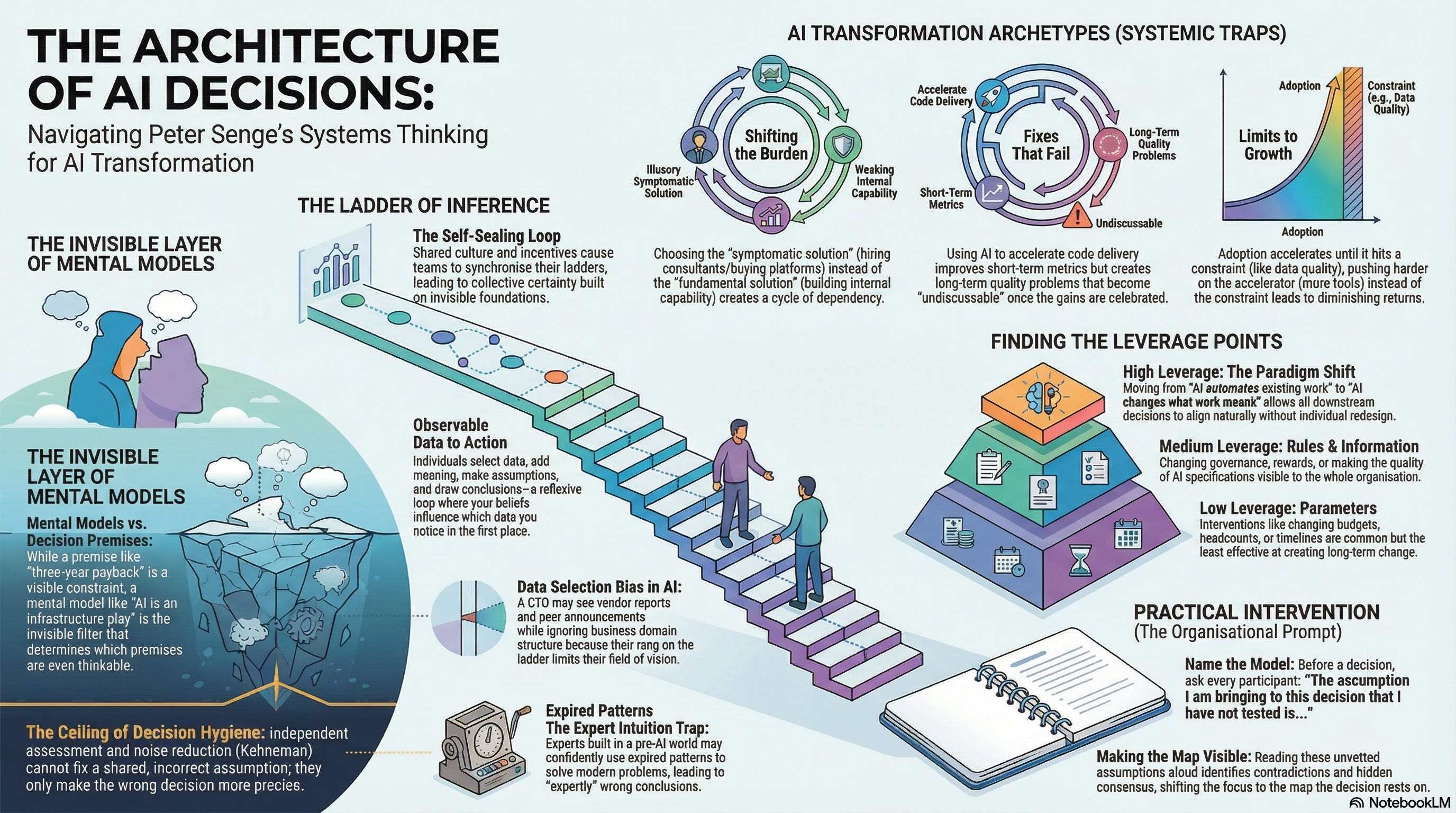
1. Mental Models as Decision Premises
Simon’s previous article in this series argued that organisations shape decisions not by controlling what people choose, but by controlling the premises that enter their choices: the facts, values, goals, and constraints that frame the decision before deliberation begins. Senge’s mental models are the invisible layer beneath even Simon’s premises. They determine which premises are admitted, which are excluded, and which are so deeply assumed that they never register as premises at all.
Consider the difference. A decision premise is something that enters a decision and can, in principle, be identified: “we assume a three-year payback period,” “we require SOC 2 compliance,” “we prioritise customer-facing use cases.” These are visible constraints. They may be wrong, but they are at least articulable.
A mental model is the structure that determines which premises are thinkable. The leadership team that evaluates AI through the lens of “infrastructure investment” has a mental model about what AI is. The premise “three-year payback” is visible. The model “AI is an infrastructure play like cloud migration” is not. It is the water the fish swims in. Every premise that enters the decision has already been filtered through it, and the filtering is invisible.

This is why Kahneman’s decision hygiene, however valuable, has a ceiling. Kahneman showed that structuring decisions reduces noise: independent assessment, aggregation of judgment, explicit criteria. But decision hygiene operates on the premises it can see. It cannot structure what it cannot identify. If the entire leadership team shares a mental model, if everyone deciding assumes AI is an infrastructure problem, then independent assessment will produce independently similar answers, and aggregation will confirm the shared assumption with statistical authority. The noise is reduced. The bias is preserved. The decision is precise and wrong.
Klein’s expert intuition has the same vulnerability. Klein showed that experts in high-validity environments have trustworthy pattern recognition. But the pattern library is itself a mental model. The senior architect whose patterns were built in a pre-AI world will recognise the current situation as something it is not. Their intuition will fire with full confidence, selecting a response calibrated to conditions that no longer obtain. Klein’s conditions for valid intuition require that the environment be regular enough for patterns to hold. Mental models persist precisely because they were once valid. The danger is not the novice who has no patterns. It is the expert whose patterns have expired but whose confidence has not.
2. The Ladder of Inference: How Decisions Climb Away from Reality
Senge’s most practical tool for understanding mental models is the ladder of inference, adapted from Chris Argyris. The ladder describes the cognitive escalation from observable data to action: select data from what is observed, add meaning, make assumptions, draw conclusions, adopt beliefs, take action. The ladder is reflexive: the beliefs at the top influence which data is selected at the bottom, creating a self-reinforcing loop. You see what your beliefs prepare you to see.

In the AI strategy meeting, the ladder operated simultaneously in every participant. The CTO selected data: vendor demonstrations, analyst reports, peer company announcements. She did not select what a domain-driven designer would have prioritised: the structure of the organisation’s business domains, the coherence of its data architecture, the specification capability of its teams. That data was not excluded deliberately. It was not visible from the rung of the ladder she was standing on. Her mental model determined what counted as relevant data, and the data she selected confirmed the model that selected it.
Argyris described this as the self-sealing quality of defensive reasoning. Senge adds the systemic dimension. In organisations, ladders synchronise. Shared culture, shared training, shared incentive structures produce shared data selection, shared meaning-making, shared conclusions. The result is collective certainty built on collectively invisible foundations. Bourdieu would recognise this immediately: the habitus of the leadership class generates perception before conscious thought begins. The ladder of inference is the cognitive mechanism; habitus is the sociological one. Together they explain why the entire leadership team can walk out confident they made a good decision when they never examined a single assumption that mattered.
3. System Archetypes as Decision Traps
Senge’s system archetypes are recurring patterns of systemic behaviour that produce predictable failures. They are not metaphors. They are structural descriptions of how reinforcing and balancing feedback loops interact to produce outcomes that surprise the people inside the system but are entirely predictable to anyone who can see the structure.
Three archetypes are operating in almost every AI transformation.
Shifting the burden. The organisation faces a problem: its teams lack the domain understanding and specification capability to direct AI effectively. The symptomatic solution is to buy a platform, hire consultants, or adopt a vendor’s framework. The fundamental solution is to build specification capability within the teams that understand the business domains. The symptomatic solution is faster, cheaper, and more legible to leadership. It also works, briefly. But each time the symptom is addressed without building the underlying capability, the capability atrophies further. The consultants leave. The platform operates on the consultants’ specifications, which the internal teams cannot maintain or evolve. Dependency deepens. The next time the problem surfaces, the gap is wider and the symptomatic solution is more expensive. This is Beer’s POSIWID in dynamic form: the purpose of the system is what it does, and what this system does is produce dependency, regardless of what it intends.
Fixes that fail. AI-generated code accelerates delivery in the short term. Teams produce more features faster. The metrics improve. Six months later, quality problems emerge: the generated code does not account for edge cases that domain experts would have caught, because the specifications that prompted the generation were too thin. The fix was not wrong. It was incomplete, and the incompleteness only became visible after the short-term gains had been reported and celebrated. The correction now requires admitting that the celebrated gains were partly illusory, which triggers exactly the defensive routines Argyris diagnosed. The fix that failed becomes the fix that cannot be discussed.
Limits to growth. AI adoption accelerates productivity until it hits a constraint: specification quality, data quality, organisational capacity to review and integrate AI output, or the human capacity to understand what they actually want. Each constraint is a balancing loop that the reinforcing loop of adoption ignores. The organisation responds to the slowdown by pushing harder on adoption (more AI, more tools, more automation) rather than investing in the constraint. Senge’s insight is that the leverage is always in the constraint, never in the accelerator. Evans would say the same thing differently: the leverage is in the domain model, not the code generation. Simon would say the leverage is in the decision architecture, not the decision speed.
4. Shared Vision or Shared Compliance
Senge drew a sharp distinction between vision that is genuinely shared and vision that is merely imposed. Compliance produces people who do what is expected. Commitment produces people who want the vision and will create whatever structures are needed. The difference is categorical, not marginal.
Most AI transformation programmes operate on compliance. The strategy is cascaded. Teams are assigned targets. The language of commitment is everywhere: “aligned,” “bought in,” “on board.” But the test is what happens when the plan meets reality and the plan is wrong. Committed people adjust the plan and keep pursuing the vision. Compliant people wait for new instructions, because the plan was never theirs.
This completes a thread running through Deciding. Drucker argued that purpose must be tested against reality, not declared. Beer’s viable system requires each autonomous unit to have purposeful identity, not delegated tasks. Simon showed that compliance ensures only approved premises circulate. Senge adds: without genuine commitment, the organisation will execute the plan as specified and miss the point entirely. Evans’s knowledge crunching requires people to challenge each other’s understanding. Compliance produces polite agreement. Commitment produces the argument that reveals what the domain actually is.
5. Leverage Points: Where to Intervene
Senge borrowed from his mentor Jay Forrester the insight that in complex systems, the point of greatest leverage is almost always counterintuitive. Where common sense says “push harder,” systems thinking says “look elsewhere.” Donella Meadows extended this into a hierarchy: the least effective interventions change parameters (budgets, headcount, timelines); the most effective change the paradigm from which the system arises.
For AI transformation, the hierarchy is instructive. Most interventions target parameters: more budget for AI tools, more headcount for data science, shorter timelines for pilots. Slightly more effective: changing the rules (governance, rewards). More effective still: changing information flows (making specification quality visible, connecting AI output quality to domain understanding). Most effective: changing the mental models from which the system operates. If the leadership team’s mental model shifts from “AI automates existing work” to “AI changes what work means,” every downstream decision changes without any of them needing to be individually redesigned.
This is the structural version of the argument the series has been making since the first article. Argyris says: surface the theory-in-use. Bourdieu says: make the habitus visible. Bateson says: learn about the frame, not just within it. Senge says: find the leverage point where a small change in the model produces a large change in the system. They are all describing the same intervention at different levels of analysis.
6. The Limits of Senge
Senge must be read with two serious criticisms visible.
Stacey’s objection is the most fundamental. Stacey argues that Senge assumes a position outside the system that does not exist. The leader who “surfaces and tests mental models” is themselves embedded in mental models, shaped by the same power dynamics, defensive routines, and habitual perception as everyone else. The discipline Senge prescribes requires capacities that the conditions he diagnoses make nearly impossible to develop. Senge’s learning organisation is a design that cannot be designed, because the designer is caught in the same processes the design is meant to correct. This is a genuine and important disagreement, and it cannot be resolved by choosing one side. The practical path is to hold both: Senge is right that mental models can be surfaced and that doing so has leverage. Stacey is right that the surfacing is always partial, always political, and never innocent.
Giddens adds a structural objection. Mental models do not exist in isolation. They are embedded in structures of signification (shared meaning), domination (power), and legitimation (norms). Changing mental models without changing the power structures and norms that sustain them produces articulate people who behave exactly as before. The CTO who recognises that “AI is not an infrastructure play” but whose budget, reporting lines, and promotion criteria all assume it is will find the recognition evaporating under institutional pressure. Senge’s discipline of mental models underestimates how much institutional reinforcement those models receive.
For Deciding, both critiques point to the same conclusion. Mental models cannot be addressed through workshops, offsites, or facilitated dialogue alone. They must be addressed through structural change: different information flows (Beer’s System 3*), different decision premises (Simon), different domain boundaries (Evans), and different reward structures (Drucker’s theory of the business). The invisible map will not become visible because someone asks people to look at it. It will become visible when the organisation builds the architectural capacity to generate a different view.
Where this sits: Deciding, the second of the series' four phases; Learning, Deciding, Building, Transforming. Senge appeared first in Learning, where seeing the pattern was the achievement. Here the same mental models are put to a harder question, because a map you cannot see is a map you cannot specify against. What comes out of it is a description precise enough to design from, and From Deciding to Building is where that description meets a build.
(An Organisational Prompt is something you can do now....)
Organisational Prompt
At your next leadership decision meeting, before the discussion begins, ask each participant to write one sentence completing this prompt: “The assumption I am bringing to this decision that I have not tested is...” Collect them. Read them aloud. Do not debate them. Just make them visible.
Further Reading
Peter Senge: The Fifth Discipline: The Art and Practice of the Learning Organization - The foundational text. Mental models, systems thinking, shared vision, and the system archetypes. Still the best single book on why organisations reproduce the patterns they claim to want to change.
Peter Senge et al.: The Fifth Discipline Fieldbook - The practitioner companion. Contains the ladder of inference exercise, the left-hand column exercise, and detailed facilitation guides for surfacing mental models in teams. More useful than the main text for anyone who wants to do something on Monday morning.
Peter Senge et al.: The Dance of Change - Why learning initiatives stall. The ten challenges of sustaining change, organised around the growth processes and limiting processes that the system archetypes describe. Honest about how often the disciplines fail in practice.
Donella Meadows: Thinking in Systems: A Primer - The clearest introduction to systems thinking available. Meadows’s hierarchy of leverage points, from parameters to paradigms, extends Senge’s analysis and provides the framework for identifying where intervention will have the greatest effect.
Daniel Kahneman, Olivier Sibony, and Cass R. Sunstein: Noise: A Flaw in Human Judgment - Decision hygiene structures what is visible. Senge reveals what is not. Read together, they describe the full architecture of decision failure: the scatter that structure can reduce, and the shared bias that structure alone cannot reach.
I write about the industry and its approach in general. None of the opinions or examples in my articles necessarily relate to present or past employers. I draw on conversations with many practitioners and all views are my own.