
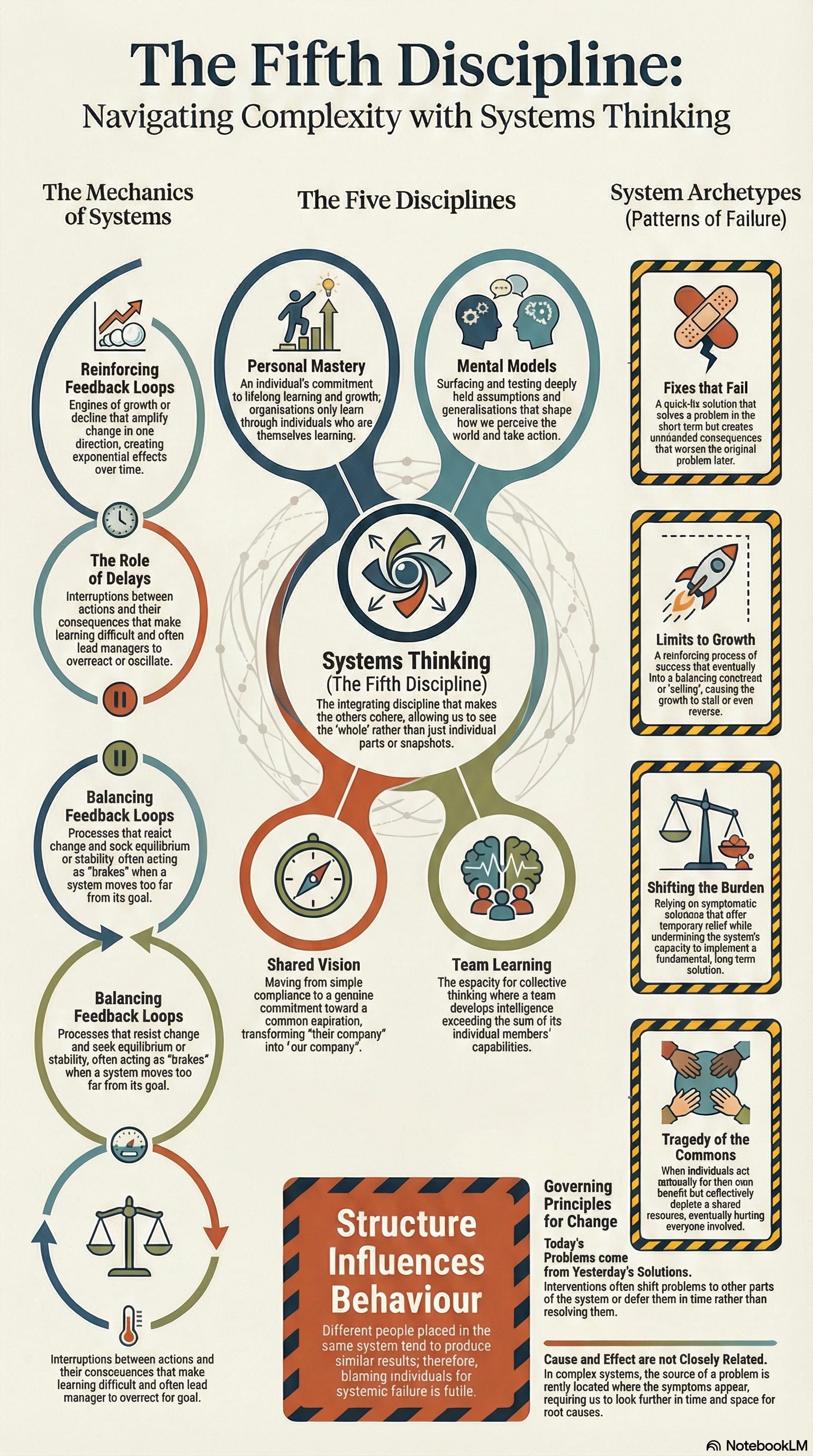
A practitioner described a pattern that will be familiar to anyone who has led a transformation. The programme had been running for eighteen months. The initial enthusiasm had faded. Teams were hitting their milestones but the organisation felt no different. The leadership team responded by intensifying: more governance, more reporting, more pressure on lagging workstreams. Within three months, the workstreams that had been performing well began to stall. The programme had entered what Senge would call a “fixes that fail” archetype: the intervention designed to accelerate the change was producing the resistance that slowed it down, and the response to the resistance was more of the intervention that caused it.
Peter Senge’s The Fifth Discipline, published in 1990, argued that organisations are not machines to be fixed but living systems to be grown. The distinction matters because it determines what kind of thinking is brought to bear. Mechanical thinking is linear: identify the broken part, replace it, expect the machine to run better. Systems thinking is circular: every intervention changes the system, the changed system produces new behaviour, and the new behaviour changes the conditions for the next intervention. Senge identified five disciplines required for a “learning organisation”: systems thinking, mental models, personal mastery, shared vision, and team learning. The five have been widely adopted, widely misapplied, and, in one crucial respect identified by Stacey, fundamentally limited. All of which makes Senge essential reading for any leader attempting transformation in a complex environment.
1. Systems Thinking: How the Parts Relate
Systems thinking is the discipline that Senge calls the cornerstone: the ability to see the whole rather than the parts, and to understand that the behaviour of the whole emerges from the relationships between the parts, not from the parts themselves. Most transformation failures occur because leaders intervene in one part of the system without understanding the feedback loops that connect it to every other part. Cut costs in engineering and you destroy the slack that innovation requires. Incentivise speed in delivery and you erode the quality that customers depend on. Optimise each silo separately and you sub-optimise the whole.

Deming made the same argument through his concept of appreciation for a system: a network of interdependent components working together to accomplish an aim. The leader’s job is to manage the interactions, not to rank the components. Senge extends Deming by mapping the specific patterns through which systems defeat well-intentioned interventions. His systems archetypes, including “shifting the burden,” “fixes that fail,” “limits to growth,” and “eroding goals,” are recurring structures that explain why organisations repeatedly produce outcomes that nobody intended and nobody wants. The archetypes are not exotic. They are the everyday experience of any leader who has watched a transformation programme generate the opposite of what it was designed to achieve.

Giddens provides the structural mechanism. His theory of structuration explains how structure is reproduced through daily practice: people act within structures, and their actions reproduce the structures that constrain them. Senge’s reinforcing loops are structuration made visible. The system archetype “shifting the burden” is a precise description of Giddens’ structural reproduction: a symptomatic fix (hiring consultants, creating a task force) relieves pressure temporarily but weakens the organisation’s internal capacity to address the fundamental problem, ensuring that the symptom recurs and the fix is applied again, each cycle deepening the dependency.
2. Mental Models: The Invisible Architecture
Senge argues that organisations are trapped by mental models: deeply held internal images of how the world works that limit thinking and action to familiar patterns. If a leadership team believes that competition drives performance, they will design a transformation that pits teams against each other, destroying the collaboration the transformation requires. If a technology leadership team believes that governance ensures quality, they will layer governance onto every new initiative, producing exactly the bureaucratic drag that prevents the initiative from delivering.

Mental models are not just cognitive. Bourdieu would call them habitus: embodied dispositions that generate practice below the level of conscious awareness. The leadership team does not consciously choose to believe that competition drives performance. Their accumulated experience in organisations that rewarded competition has formed dispositions that make competitive structures feel natural and collaborative ones feel risky. Argyris describes the same phenomenon at the interpersonal level: the gap between espoused theory (”we value collaboration”) and theory-in-use (”I will structure the meeting to ensure my position prevails”) is produced by mental models that operate below the threshold of awareness. Kahneman provides the cognitive mechanism: mental models are System 1 artefacts, fast, automatic, coherent, and invisible to the person they govern. WYSIATI ensures that the model feels complete even when it has excluded the information that would challenge it.
Surfacing mental models is therefore not a communication exercise. It is an identity exercise. The mental model is part of how the person understands themselves as a professional. Questioning it feels like questioning their competence, which is why Argyris’s defensive routines activate whenever mental models are examined. The leader who asks “what assumptions are we making?” in a meeting is performing an important but insufficient act. The assumptions that matter most are the ones nobody involved can see, because they are looking through them rather than at them.
3. The Laws That Govern Drift
Senge outlined several “laws” of systems behaviour that explain why aggressive change programmes stall. Two are particularly relevant for transformation leaders.
“Faster is slower.” When leaders push a system beyond its natural rate of change, the system pushes back. The transformation programme that demands immediate adoption produces compliance without understanding, ritual without principle. Dekker would recognise the result: drift into failure, where small, locally rational adaptations accumulate until the system has migrated far from its intended design without anyone noticing. The teams adopt the new ceremonies without the new thinking. The reporting shows progress. The reality is cargo-cult transformation: the form without the substance.
“Today’s problems come from yesterday’s solutions.” The legacy system you are fighting today was the strategic solution of five years ago. The governance framework that now obstructs every initiative was created to solve a real problem: uncontrolled change, quality failures, compliance risks. The solution worked. Then it persisted past its usefulness, accumulated institutional support (roles, budgets, identities), and became the obstacle it was designed to prevent. This is Giddens’ structural reproduction operating at institutional scale, and it connects directly to one of the observable probes in this series: can the organisation stop doing what no longer works? Most cannot, because the activities that should be stopped have accumulated constituencies whose identity and status depend on their continuation.
4. Shared Vision and the Compliance Trap
Senge distinguishes sharply between commitment (”I want to do this”) and compliance (”I have to do this”). Most transformation programmes settle for compliance and call it success. The strategy is endorsed. The milestones are met. The status reports are green. And nothing has actually changed, because the people doing the work are performing the transformation rather than inhabiting it.
Shared vision, for Senge, is not a statement on a slide. It is a genuine common aspiration that people have helped to create and feel personally invested in. Heifetz would frame this as the difference between technical problems (where the authority can provide the answer) and adaptive challenges (where the people with the problem must change their own values, habits, and priorities). A shared vision provides what Heifetz calls the “holding environment”: the psychological space within which people can tolerate the discomfort of adaptive work. Without it, the discomfort produces retreat, and retreat produces the polite compliance that Seligman would recognise as learned helplessness wearing a professional mask.
Stacey adds a crucial corrective. Shared vision cannot be designed and installed by leadership. It emerges from the interaction of people engaged in genuine conversation about what matters. The leader who crafts a vision statement and cascades it through the organisation has produced a gesture, not a shared vision. The gesture may call forth genuine engagement, or it may call forth compliance. The outcome depends on whether the organisation’s interaction patterns permit honest response, which returns us to Argyris: if the defensive routines are intact, the response to the vision will be agreement without commitment, enthusiasm without action.
5. Team Learning: Where Interaction Becomes Learning
Senge insists that organisations learn only through individuals who learn, but individual learning does not guarantee organisational learning. The discipline of team learning, specifically through dialogue, is the bridge. Dialogue, for Senge, is not discussion or debate. It is the capacity to suspend assumptions and think together: to examine the mental models operating beneath the conversation rather than advocating for pre-formed positions.

Weick’s sensemaking research explains why this matters. Sensemaking is a social process; it happens between people, not inside them. The individual who learns a new skill in isolation will be overwhelmed by an organisation that does not value that skill. Bateson provides the epistemological frame: team learning, when it works, is a Learning II practice. The team is not just solving problems (Learning I). It is examining the assumptions that determine which problems it sees and which solutions it considers (Learning II). Most meetings never reach this level because the defensive routines Argyris describes prevent assumptions from being surfaced, and the cognitive biases Kahneman describes prevent participants from noticing that their assumptions have not been examined.

Westrum’s typology of organisational culture determines whether team learning is even possible. In a pathological culture, dialogue is dangerous: saying “my mental model might be wrong” is an invitation to be attacked. In a bureaucratic culture, dialogue is procedural: assumptions are examined in designated workshops and then forgotten. In a generative culture, dialogue is continuous: assumptions are tested against reality in the daily practice of the work.
6. The Limits of the Designer
Senge redefines the leader not as the charismatic hero but as the designer, steward, and teacher. The leader’s job is not to solve the problem but to design the learning processes that allow the organisation to solve its own problems. In an era where no single leader can know the answer and change occurs faster than any hierarchy can process, this redefinition feels prescient.
But Stacey’s critique must be stated honestly, because it identifies a fundamental limitation. Senge assumes that a leader can stand outside the system and design its learning processes. Stacey argues that this is impossible. The leader is inside the system. Their “design” is a gesture made from within the pattern of interactions, not a blueprint imposed from above. The learning organisation cannot be designed into existence any more than a conversation can be scripted in advance. What emerges depends on the responses the gesture calls forth, and those responses cannot be predicted.
This does not make Senge useless. It makes him diagnostic rather than prescriptive. Systems thinking is a superb tool for seeing the patterns that are governing behaviour: the archetypes, the feedback loops, the structural reproduction. But seeing the pattern does not give you the power to redesign it from outside. It gives you the knowledge to participate more skillfully from within. Stacey’s skilled participation, Heifetz’s adaptive leadership, Argyris’s Model II: these are the practices that translate Senge’s diagnostic clarity into the messy, uncertain, improvisational work of actual transformation.
A note on where this sits. The series runs Learning, Deciding, Building and Transforming, and Senge belongs firmly in the first, because seeing the pattern is a perceptual achievement and not yet a decision. Learning leaves an organisation with the capacity to see; it does not produce a specification, which is why the next group of articles begins by writing one. From Learning to Clarity is the bridge between them, and the diagnosis made here is what Deciding assumes you already hold.
(An Organisational Prompt is something you can do now....)
Organisational Prompt
Identify one systems archetype that is operating in your transformation programme right now. The most common is “shifting the burden”: a problem that keeps recurring because the organisation applies a symptomatic fix (a workaround, a task force, an escalation) rather than addressing the fundamental cause. Map it. Name the symptomatic fix, the fundamental solution that is being avoided, and the side effect that weakens the organisation’s capacity to apply the fundamental solution.
Then ask: what would it take to stop the symptomatic fix? The answer will almost certainly involve confronting something that the organisation currently finds undiscussable: a structural dependency, a protected role, an assumption about what the organisation is for. The archetype is not the problem. The undiscussable that sustains it is.
Further Reading
Peter Senge, The Fifth Discipline: The Art and Practice of the Learning Organization (revised edition, 2006). The original statement of the five disciplines. The chapters on systems archetypes and mental models remain the most practically useful.
Peter Senge et al., The Fifth Discipline Fieldbook (1994). The practical companion. Exercises, methods, and case studies for applying the disciplines in real organisations. More useful than the original for leaders who want to act, not just understand.
Donella Meadows, Thinking in Systems: A Primer (2008). The clearest short introduction to systems thinking. Meadows’s list of leverage points is the best available guide to where intervention in a system is most likely to produce change.
Peter Senge, The Dance of Change (1999). The underrated sequel. Where The Fifth Discipline describes what a learning organisation looks like, The Dance of Change describes why building one is so difficult. The treatment of the “challenges of sustaining” is directly relevant to any transformation leader.
I write about the industry and its approach in general. None of the opinions or examples in my articles necessarily relate to present or past employers. I draw on conversations with many practitioners and all views are my own.