
Learning article on Argyris diagnosed why smart people are often the worst at learning. Defensive routines, the gap between espoused theory and theory-in-use, skilled incompetence: the mechanisms by which successful professionals protect themselves from the discomfort of examining their own reasoning. That was a learning problem. This is the deciding problem that lives inside it: you cannot specify what you cannot articulate, and you cannot articulate what the organisation has made undiscussable.

Every specification problem is, at its root, an articulation problem. The domain expert who cannot explain why the system should behave this way rather than that way is not stupid. They know. They have been doing the work for years. But the knowledge lives in what Argyris called the theory-in-use: the actual rules governing behaviour, which operate below conscious articulation and are often directly contradicted by the espoused theory, the rules people claim to follow. The specification demands that tacit knowledge become explicit. The defensive routines ensure it cannot.
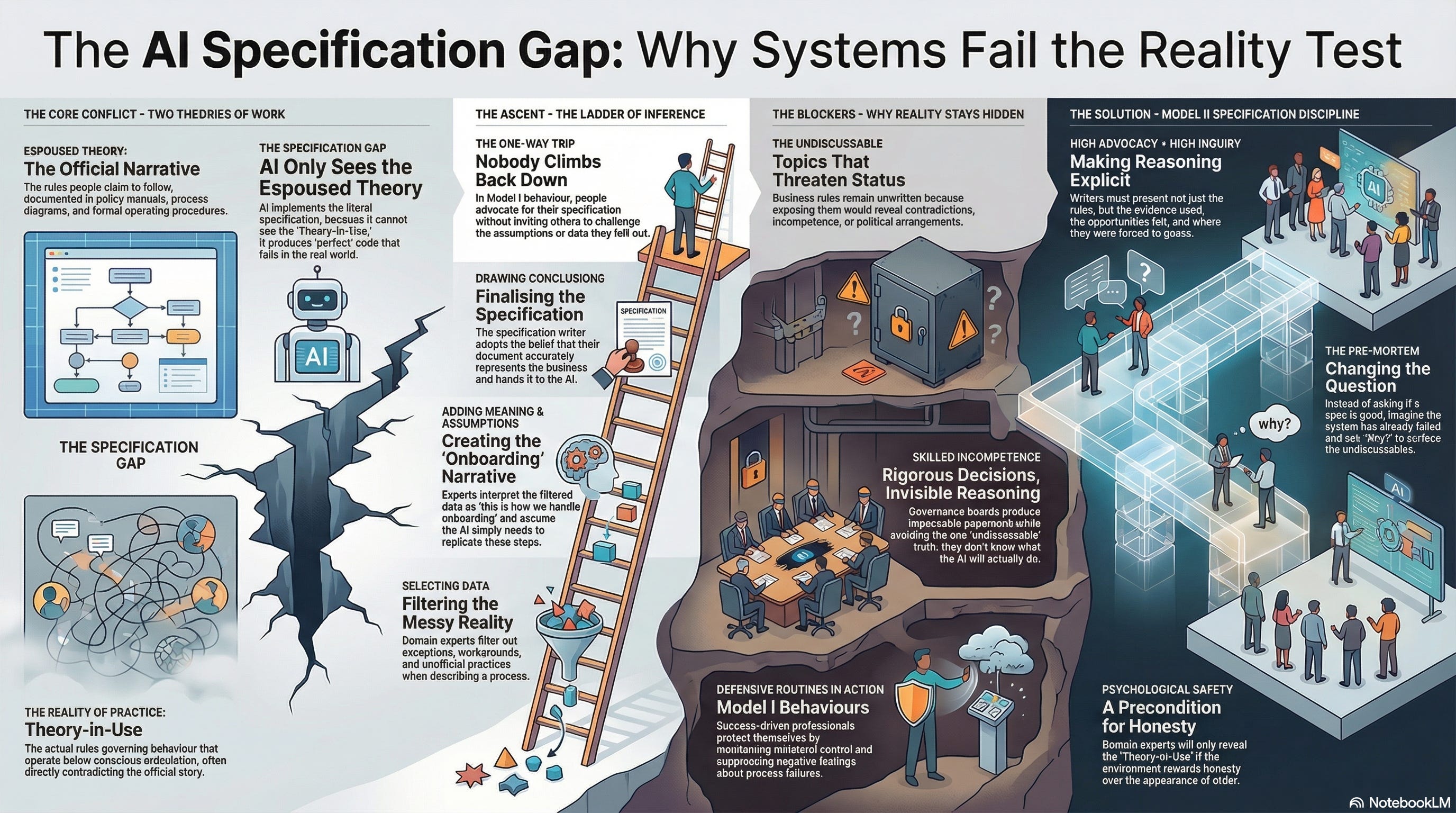
1. The Undiscussable: Why Specifications Miss What Matters Most
Argyris’s most devastating observation is that organisations develop elaborate mechanisms for not discussing the things that matter most. A topic becomes undiscussable when raising it would threaten someone’s competence, status, or control. The undiscussability itself then becomes undiscussable: everyone knows the topic cannot be raised, but nobody can say so. The silence is perfectly maintained by people who are not conscious of maintaining it.
In specification work, the undiscussables are the business rules that nobody has ever written down because writing them down would expose contradictions, incompetence, or political arrangements that benefit from ambiguity. The pricing logic that varies by client relationship but is officially uniform. The approval workflow that is formally three steps but informally seven, with the extra four existing to protect specific people’s authority. The risk threshold that the policy document says is one thing but the actual practice says is another, because the policy was written for the regulator and the practice was designed for the commercial reality.
These are precisely the rules the AI needs to know. They are precisely the rules nobody can say.
Evans’s knowledge crunching assumes that developers and domain experts will sit together and, through iterative dialogue, surface the domain model. Argyris explains why this process reliably fails in practice: the domain expert cannot articulate the theory-in-use because it has never been conscious, and the organisation cannot surface it because doing so would make the undiscussable discussable. The developer asks “how does the pricing work?” The domain expert gives the espoused theory. The specification is written against the espoused theory. The AI generates code that implements the espoused theory. The system goes into production and produces wrong answers, because the actual pricing follows the theory-in-use, which nobody articulated because it was never safe to do so.
2. Skilled Incompetence in the Deciding Phase
In Learning, skilled incompetence described the ability of successful professionals to avoid examining their own reasoning. In Deciding, it has a sharper manifestation: the ability of organisations to produce decisions that look rigorous while avoiding the reasoning that would make them genuinely informed.
The AI governance board is the canonical example. The board meets. Papers are circulated. Risks are assessed. Matrices are completed. A decision is recorded. At no point does anyone say: “We do not actually understand what this AI system will do in production, because the specification it was built from does not describe how the business actually works.” That sentence is undiscussable, because it would imply that the specification process the board oversees is not working, which would threaten the authority of the people who designed it, which would make them defensive, which would trigger the very Model I behaviours (unilateral control, suppress negative feelings, maximise winning) that Argyris documented.
The board’s skilled incompetence is not that it makes bad decisions. It is that it makes decisions that are disconnected from the information that matters, while appearing to be thoroughly informed. The paperwork is impeccable. The reasoning is invisible. Kahneman would call this noise masked by process. Beer would call it an accountability sink. Argyris names the mechanism: defensive routines have colonised the decision architecture, ensuring that the information the architecture was designed to process never enters it.
3. The Ladder of Inference: How Specifications Drift from Reality
Argyris and his colleagues developed the ladder of inference to show how people move from observable data to action through a series of increasingly abstract steps, each of which introduces assumptions that are never tested. You observe data. You select data (filtering what you notice). You add meaning (interpreting what you noticed). You make assumptions (based on the meaning you added). You draw conclusions. You adopt beliefs. You take action. Each rung of the ladder takes you further from the observable reality and closer to a self-reinforcing interpretation that feels like fact.
Specification writing climbs the ladder of inference at every step. The domain expert observes a business process. They select the parts they consider important (filtering out the exceptions, the workarounds, the unofficial practices). They add meaning (”this is how we handle onboarding”). They make assumptions (”the AI needs to replicate this process”). They draw conclusions (”the specification should describe these steps”). They adopt beliefs (”this specification accurately represents our business”). They hand the specification to the AI.
The problem is not at any individual rung. The problem is that nobody climbs back down. Nobody tests whether the selected data was the right data. Nobody checks whether the meaning added was accurate. Nobody challenges whether the assumptions hold. Argyris showed that in Model I behaviour, people advocate their position without inviting inquiry. The specification writer who presents their specification as “how the business works” is advocating without inquiry. The reviewer who approves it without asking “what did you leave out and why?” is colluding in the ascent.
Simon’s decision premises reframe this structurally. The ladder of inference describes how premises become progressively more detached from the observable world. By the time the premise reaches the decision (or the specification), it has been filtered through so many layers of interpretation that it may bear little resemblance to the reality it claims to describe. Simon asks how the right premises reach the right people. Argyris asks why the premises that do arrive have been systematically distorted by the defensive needs of the people who produced them.
4. Model II as a Specification Discipline
Argyris’s Model II is usually presented as a personal skill: make your reasoning explicit, invite genuine challenge, combine high advocacy with high inquiry. In Deciding, it becomes a specification discipline.
A Model II specification process looks like this. The specification writer presents the specification and simultaneously presents the reasoning behind it: “I specified the pricing logic this way because I believe the discount structure works like this. Here is the evidence I used. Here is what I am uncertain about. Here are the parts where I had to guess because nobody could give me a clear answer.” They then invite challenge: “Where am I wrong? What have I missed? What do you know that contradicts what I have written?”
This is what Evans’s knowledge crunching requires but does not describe the conditions for. Evans assumes the dialogue will happen. Argyris explains why it will not happen unless the conditions are explicitly created. The domain expert who says “actually, the discount structure does not work that way; it depends on the relationship manager’s judgment, which is never documented” is making an undiscussable discussable. They will only do this if the environment rewards honesty rather than punishing it, which is Edmondson’s psychological safety operating as a precondition for Model II behaviour.
Klein’s pre-mortem is Model II made structural. Instead of asking people to change their defensive routines (which Argyris acknowledged is extraordinarily difficult), the pre-mortem creates a context in which the undiscussable becomes expected. “Imagine this specification has been implemented and the system is producing wrong answers. Why?” The answers will contain the undiscussables: the business rules nobody wrote down, the exceptions nobody mentioned, the political arrangements that the specification politely omitted. The pre-mortem works not because it changes people but because it changes the question.
5. Why the Gap Between Espoused Theory and Theory-in-Use Is the Specification Gap
The deepest connection between Argyris and deciding is this: the gap between espoused theory and theory-in-use is precisely the gap between the specification and reality.
Every organisation has an espoused theory of how it works: the process documentation, the policy manuals, the architecture diagrams, the operating procedures. And every organisation has a theory-in-use: the actual practices, workarounds, informal agreements, and undocumented decisions that govern what people really do. The two rarely match. The gap between them is not a documentation failure. It is a structural feature of organisations that have optimised for the appearance of order while accommodating the messiness of reality.
AI does not accommodate the gap. AI takes the espoused theory (the specification, the documentation, the formal rules) and implements it literally. The theory-in-use, the part that makes the business actually work, is invisible to the AI because nobody has articulated it. The result is a system that perfectly implements what the organisation says it does and completely fails to do what the organisation actually does.
POSIWID applies at the specification level: the purpose of the specification is what it produces. If the specification produces a system that does not match reality, then the specification’s actual purpose was to document the espoused theory, not to describe the business. And this is almost always its actual purpose, because documenting the espoused theory is safe (it matches the official narrative) while documenting the theory-in-use is dangerous (it exposes the gap).
Drucker’s theory of the business sits one level above this. The theory of the business is the set of assumptions that generates both the espoused theory and the theory-in-use. When the theory of the business is valid, the gap between the two is small and manageable. When the theory is invalid, the gap widens because the espoused theory continues to express the official assumptions while the theory-in-use adapts to a reality the assumptions no longer describe. The specification inherits whichever version it is given. Without Argyris’s diagnostic, nobody can tell which version that is.
6. Argyris’s Limits
Argyris must be read with his limitations visible. His framework was developed in Western, individualistic contexts, and its applicability in collective cultures is contested. The distinction between Model I and Model II can be overly normative: Model II is presented as universally superior, but in some organisational contexts, the defensive routines serve genuine protective functions that Model II behaviour would strip away without providing an alternative.

Stacey poses the deepest challenge. Argyris assumes there exists a position from which reasoning can be examined and improved: you can step outside your defensive routines and observe them. Stacey argues this position does not exist, because the observer is embedded in the same responsive processes as the observed, and the act of examination is itself shaped by the dynamics it claims to examine. The debate is genuine. This series holds both: Argyris provides the diagnostic that Stacey says is impossible but practitioners find indispensable.
The practical limitation is that Model II behaviour is extraordinarily difficult to learn. Argyris himself found that even after years of training, most professionals could articulate Model II principles (which became their new espoused theory) while continuing to operate in Model I (the unchanged theory-in-use). The programmes reproduced the very gap they were designed to close. This is not a reason to abandon Argyris. It is a reason to complement him with structural interventions, like Klein’s pre-mortem and Kahneman’s decision hygiene, that reduce the dependence on individual behavioural change and instead redesign the decision environment.
Where this sits: Deciding, the second of the four phases; Learning, Deciding, Building, Transforming. This is Argyris's second appearance; the first, in Learning, asked whether an organisation can perceive its own reasoning at all. Here the same mechanism is put to a decision, because an undiscussable assumption becomes a specification nobody will admit to having written. What comes out of it is a description precise enough to build from, and From Deciding to Building is where the question changes.
(An Organisational Prompt is something you can do now....)
Find one undiscussable in one specification.
Take a specification your organisation has recently produced, one that is considered complete and approved. Sit with the domain expert who provided the business rules, in private, without the project manager or the governance people present. Ask: “Is there anything about how this actually works that is not in this document?” Then be quiet. Wait. The silence will be uncomfortable. What follows will be the most valuable information in the entire project, because it will be the information that the specification process was designed, structurally, not to capture. You do not need to fix the process today. You need to see the gap. Once you have seen it in one specification, you will see it in all of them.
Further Reading
Chris Argyris: Teaching Smart People How to Learn - The single most important Argyris article. Why the most successful professionals are the worst at learning, and why leadership development programmes reproduce the gap they are designed to close. Freely accessible.
Chris Argyris: Overcoming Organizational Defenses - The fullest treatment of defensive routines, the ladder of inference, and Model I/Model II applied to organisations. The book to read if you want to understand why your specification process captures the espoused theory and misses the theory-in-use.
Chris Argyris and Donald Schön: Organizational Learning II: Theory, Method, and Practice - The collaborative framework that extends single-loop and double-loop learning to the organisational level. Deutero-learning, the capacity to learn how to learn, is the concept this series keeps returning to.
Chris Argyris: Knowledge for Action - The practitioner-oriented treatment. Case studies of organisations attempting Model II and the specific ways they fail. Read it for the honest assessment of how hard this is.
I write about the industry and its approach in general. None of the opinions or examples in my articles necessarily relate to present or past employers. I draw on conversations with many practitioners and all views are my own.
The undiscussable is not a secret waiting to be confessed. It is a fold in the organisation that has done real work: holding things together across years of contradiction, protecting continuity where full articulation would have ruptured it. The question is not how to expose the fold but what new capacity would allow it to be gradually integrated rather than suddenly torn open.
A system that implements the espoused theory and produces wrong answers has not failed. It has made the gap visible with a fidelity no human process achieves, because it carries no defensive routine of its own, no stake in the silence. The wrongness of its outputs is the organisation’s self-portrait.
The interpretive possibility is this: read the divergence between specification and output as a signal, a place where the organisation’s actual shape has never been described. Not automation. Mapping. The patient, unjudging illumination of how the organisation actually moves.
Organisational learning is not the correction of error. It is the widening of what the system can hold.