
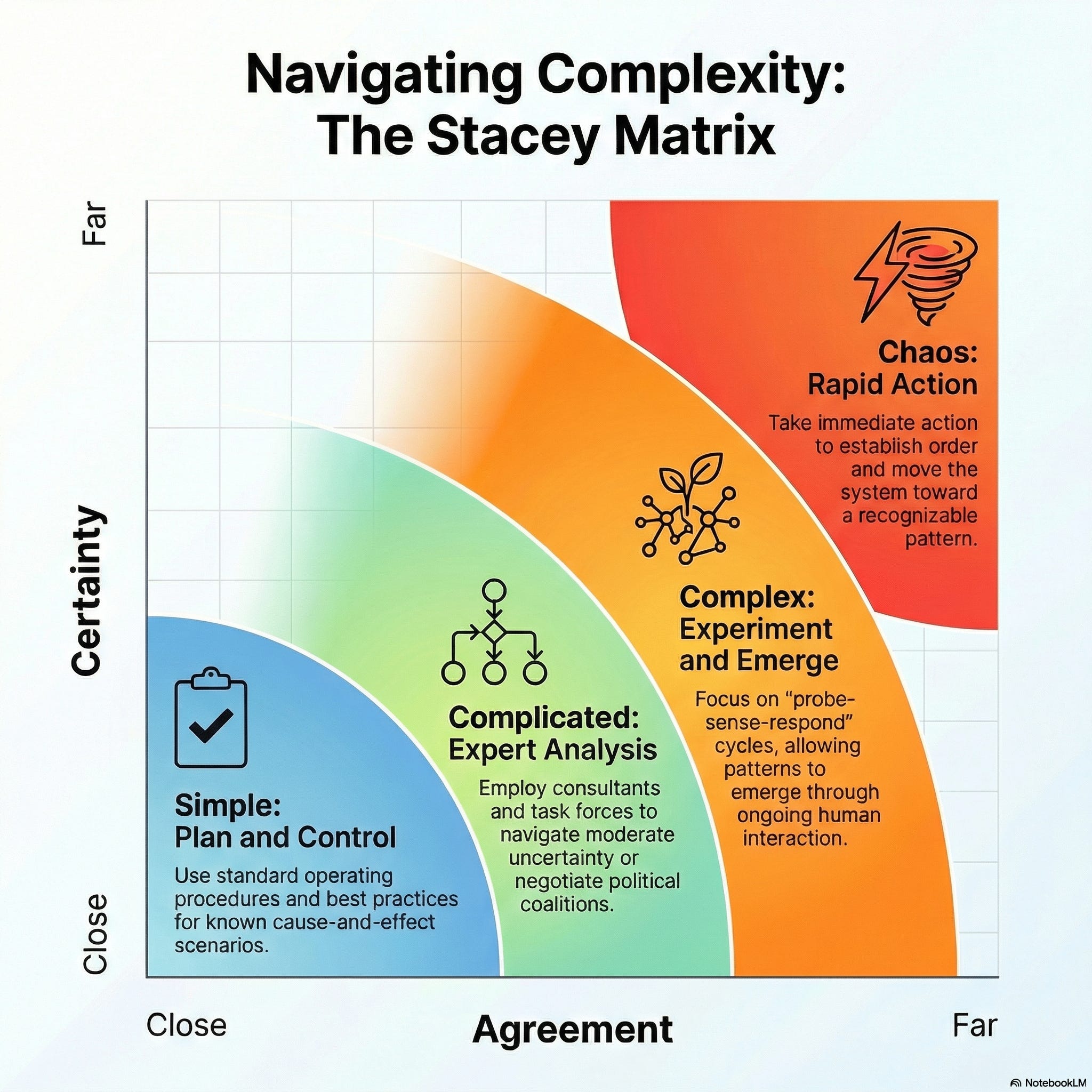
You have a transformation strategy. You also have a governance framework, a roadmap with milestones, a change management plan with stakeholder analysis, and a communications programme designed to “bring people on the journey.” You believe, in some fundamental way, that you are driving the bus.
For three decades Ralph Stacey argued that this belief is a fantasy. Not a simplification, or an approximation. A fantasy. What you experience as “the organisation” is not a thing that can be steered. The organisation is an ongoing pattern of interaction between people. You do not stand outside this pattern directing it. You are inside it, as caught up in its dynamics as everyone else. Your AI transformation strategy is not a blueprint being implemented. The strategy is a gesture being responded to, and the responses decide what happens, not the plan. Stacey’s mature theory of Complex Responsive Processes, developed across his books from the 1990s onward, draws on George Herbert Mead, on Norbert Elias, and on the pragmatism of the 1900s in ways that resist easy summary. What follows is the part that bears directly on leading change now.
1. There Is No System to Design
The foundational assumption shared by most management thinkers, including Senge, is that a leader can, in some meaningful sense, observe the organisation and act upon it. Senge’s learning organisation asks you to see the system and redesign it. Deming asks you to understand how the parts interact. Either way, somebody stands outside the pattern and judges it.
Stacey argues that this is impossible in principle. There is no position outside the web of interaction from which to observe it, because you are the interaction. The senior technology leader publishing an AI strategy is not programming a machine. She is making a gesture from within a web of relationships, and that gesture will be received, interpreted, distorted, resisted, and adapted by thousands of people whose responses she cannot predict. The belief that she is driving transformation is not strategic confidence. The belief is a defence against the anxiety of not being in control.

Here Stacey parts company most sharply with Senge. Senge proposes that leaders can learn to see systemic patterns and redesign them; that the learning organisation is something you can build through disciplines applied from a position of diagnostic clarity. His response is that the designer is inside the system being designed. The act of “seeing the pattern” is itself shaped by power dynamics, ideological assumptions, and identity anxieties that the designer cannot fully access. You cannot design a culture. You can only participate in the conversations that are the culture. Stacey states most sharply what runs through the whole series. The organisation is not a machine to be fixed, a system to be redesigned, or a culture to be installed. It is an ongoing pattern of interaction. The pattern changes when the interactions change, and not before.
2. Plans Are Gestures, Not Blueprints
In a Complex Responsive Process, a strategic plan is not a set of instructions. A plan is a gesture that calls forth responses from every part of the organisation. Those responses are shaped by local politics, personal anxiety, identity threats, and power dynamics that the planners never see.

Mintzberg provides the empirical support. His research demonstrated that most realised strategy is emergent: it arises not from deliberate planning but from the accumulation of decisions and actions that form a pattern over time. What the organisation actually does is always a combination of what it intended and what emerged from its responses to events, opportunities, and surprises. Where Mintzberg frames this as an empirical finding about strategy formation, Stacey argues it is an ontological truth about human interaction. Emergence is not something in strategy that can be managed. Emergence is what organised human activity is.
Your 47-page AI transformation roadmap is not a strategy. The roadmap is an intended strategy, a gesture, and it will provoke responses from every part of the organisation. Some of those responses will be supportive. Many will be defensive. Some will be creative adaptations that no one anticipated. The teams quietly using AI to solve real problems outside the sanctioned process are probably not being non-compliant. They are the emergent strategy trying to tell you where the value is. Weick would add that these teams are engaged in the sensemaking that the plan cannot do for them: they are acting, observing what happens, and constructing meaning retrospectively from their experience. The formal plan, by contrast, attempts to construct meaning prospectively, which is precisely what complexity makes impossible.
3. Anxiety Is the Centre, Not the Periphery
Where Argyris identifies defensive routines as blocks to organisational learning, Stacey places anxiety at the very centre of why transformations stall. His argument goes deeper: people do not merely defend against having their reasoning challenged. Significant change threatens identity. The question people are actually asking is not “Do I agree with the strategy?” but “Do I still belong here?” and “Am I still competent?”

When you tell a senior architect that their role is evolving from designing systems to writing specifications for AI agents, you are not only asking them to learn a new skill. You disrupt the routines that provide their sense of professional identity, their daily experience of competence, and their understanding of what it means to do their job well. Giddens would call this a threat to ontological security: the basic sense of continuity and order that people need to function. Bourdieu would call it capital devaluation: the accumulated expertise that provided professional standing and daily meaning is losing its value as the field shifts beneath it. The anxiety this produces is not irrational. The anxiety is the entirely predictable response to having your identity disrupted, and it will usually express itself as resistance however compelling the business case is.

Stacey argues that you cannot remove this anxiety. Reassurance, change champions and upbeat communications are dishonest attempts to try. What you can do is contain it. Leadership in Stacey’s framework is not about solving the problem of anxiety but about holding the space for it to be expressed without destroying the group. That is not the same as psychological safety treated as a designed condition. For Stacey, the capacity to tolerate anxiety is a quality of the ongoing interaction between people. It must be continuously accomplished, not installed. Heifetz names the same task from a different angle: the leader must regulate the distress, keeping it high enough to motivate change but not so high that it overwhelms the capacity to function. The holding environment is not a room or a policy. The holding environment is the quality of attention the leader brings to the interaction.
4. Learning Happens in the Shadows
If the formal plan is just a gesture, where does organisational learning actually happen? Stacey locates it in the shadow conversations at the margins. The hallway discussion. The venting session. The unofficial group where people say what they think rather than what the official narrative requires.
This directly challenges the assumption that learning can be designed and governed. Set up a formal community of practice or an innovation lab and you are trying to capture the generative quality of informal conversation inside a formal structure. Stacey warns that formalising it kills the spontaneity that made it generative. The community that formed organically around a shared problem, the developers who started experimenting with AI pair programming, the business analysts who began testing specification-driven approaches, was generative precisely because it was outside the formal power structure. Put it on an org chart, give it a budget and a reporting line, and you have converted a living conversation into a bureaucratic programme.
Bateson’s framework illuminates what is lost in the formalisation. The shadow conversation runs at Learning II. It questions the governing assumptions and examines the frames the organisation interprets its situation through. The formal structure cannot generate that insight, because the formal structure is built on the assumptions being questioned. Formalising the conversation forces it back to Learning I: it can now only operate within the frame that the formal structure provides. The budget, the reporting line, and the governance all constrain what can be said, and what cannot be said includes the things that made the conversation valuable in the first place. Argyris’s undiscussables are precisely the topics that thrive in the shadows and die in the light of formal accountability.
The practical implication is counterintuitive but obvious to anyone who has spent time in a large organisation. If you want to know how your AI transformation is really going, stop reading the dashboards and start listening to the conversations people have when they think nobody senior is listening.
5. From Driver to Skilled Participant
If you cannot design the system, predict the outcome, or control the culture, what is left for the leader to do? Stacey redefines leadership as skilled participation. The leader is not an architect standing above the organisation but a participant whose gestures carry more weight because of the power they hold, but who is no less caught up in the pattern than anyone else.
Skilled participation means three things. First, noticing patterns: paying attention to who is included and excluded from conversations, which topics are discussable and which are not, where anxiety is being expressed and where it is being suppressed. Kahneman applies here. System 1 makes leaders see what they expect and miss the signals contradicting their assumptions. Stacey asks leaders to attend to precisely the signals their cognitive biases are filtering out.
Second, disrupt repetitive patterns. Make gestures that force the organisation off its script. When every meeting follows the same structure, produces the same outputs, and avoids the same topics, the pattern has become self-reinforcing. The skilled participant introduces a question, a challenge, or a different voice that breaks the repetition and creates the possibility of something new emerging.
Third, legitimise dissent. Let the anxiety and conflict surface in public rather than driving it underground. Here Stacey aligns with Argyris: the undiscussables must become discussable. Stacey frames it as a political act that redistributes power, not as a skill deficit you can train away. Making the undiscussable discussable requires someone with sufficient power to make it safe for others to speak, and sufficient courage to tolerate what they say. Follett, writing in the 1920s, saw exactly this: her insistence on integration over domination, on conflict as a resource rather than a problem, describes the disposition that skilled participation requires. An organisation that uses conflict productively, holding competing perspectives in tension long enough for a solution neither party imagined to emerge, has the interaction quality Stacey describes. Where conflict has to be resolved through hierarchy, compromise or suppression, that quality is absent.
6. The Courage to Not Know
Stacey takes away many of the tools that leaders reach for. The desire for a tool, he argues, is itself a symptom of anxiety and a defence against not knowing what will happen. The strategic roadmap, the maturity model, the governance framework with its RAG statuses and milestone reviews: these are, in Stacey’s analysis, sophisticated ways of pretending we know what we are doing.

Seligman describes learned helplessness as the condition that arises when people repeatedly experience a lack of control and stop trying. Stacey would argue that the opposite condition is equally dangerous: the illusion that we are completely in control. Most transformation leadership operates in this second mode. The confident executive who owns the vision and drives the change is managing their own anxiety, and the managing stops them noticing what is emerging. Dekker adds a complement. Look at a complex system failure afterwards and we build neat causal narratives that make the outcome seem inevitable. The people inside the situation at the time had no such clarity. They were making locally rational decisions under uncertainty.
Stacey invites you into the complexity honestly. You are influential and you are not in control. You can participate skilfully and still not decide the outcome. The quality of your conversations decides more than the quality of your plan. That is the hardest thing this series asks of leaders, because it requires surrendering the identity of the person who knows, and becoming the person who participates honestly in the not-knowing from which the future is constructed.
This article sits in Learning, the first of the series' four phases, ahead of Deciding, Building and Transforming. The Learning articles ask whether an organisation can perceive what is actually happening inside it, and Stacey's answer is that what is happening is conversation, most of it outside the plan. Learning does not give you control. It gives you the capacity to participate honestly in what you do not control. In Deciding the question becomes what can be described and designed from there, and From Learning to Clarity marks the turn.
(An Organisational Prompt is something you can do now....)
Organisational Prompt
Take a recent major announcement or strategic initiative: an AI strategy, a reorganisation, a new governance framework. Instead of asking “How is execution going?”, ask three questions. What conversations did this gesture actually trigger in the hallways, the private messages, the places where people say what they really think? How did those conversations differ from what was said in the formal meetings? And what does that gap tell you about the anxieties and power dynamics you are not addressing?
The point is not to close the gap through better communications. The gap is the information. It tells you what the formal channels cannot: where the real anxiety lives, which power dynamics are shaping responses, and what is actually emerging from your “strategy.” His argument is that transformation leadership begins not with a better plan but with a more honest reading of what is actually happening in the conversations that constitute your organisation.
Further Reading
Ralph Stacey, Complexity and Organizational Reality (2nd edition, 2010). The most accessible entry point to Complex Responsive Processes theory. Stacey directly challenges the foundations of systems thinking and strategic planning.
Ralph Stacey and Chris Mowles, Strategic Management and Organisational Dynamics (7th edition, 2016). The comprehensive textbook treatment. Spans systems thinking, complexity science, and the full development of his process thinking. Dense but rewarding.
Ralph Stacey, The Tools and Techniques of Leadership and Management (2012). A direct challenge to the evidence base for standard management tools. If you want to understand why Stacey argues that the desire for a framework is itself the problem, start here.
Ralph Stacey, Complexity and Group Processes (2003). The application of complex responsive processes to how groups actually function. The treatment of anxiety and power in group interaction is directly relevant to any leader facilitating change.
I write about the industry and its approach in general. None of the opinions or examples in my articles necessarily relate to present or past employers. I draw on conversations with many practitioners and all views are my own.